html
throughline-grey

ContractSafe vs. Agiloft Comparison

An Agiloft comparison is a buying decision between two full-lifecycle contract management platforms with different operating strengths. Agiloft emphasizes no-code configuration for complex enterprise workflows. ContractSafe emphasizes organization-wide adoption across legal, finance, procurement, and business owners. The better fit depends on the contract work your team has to support and, just as importantly, who has to use the system every day.

Quick answer: Choose Agiloft when deep no-code configuration and complex enterprise workflows are requirements your team is prepared to own. Choose ContractSafe when you need full-lifecycle contract management with published flat pricing, unlimited users, included implementation support, and an approach designed for broad adoption.

For example, think about a kitchen renovation. One contractor lets you specify every cabinet, drawer, and work surface. That freedom helps when a skilled owner knows exactly how the room must function. The other offers a practical layout that everyone in the house can understand. Choose too much customization and the admin spends Friday debugging a route; choose too little and approvals return to inboxes.

Use this comparison to test the operating model behind the feature list. Bring real agreements, real users, and one genuinely awkward approval path to each product conversation. The best demo is the one that shows how your team will find a contract, route a decision, control access, act on a renewal, and get help after launch.

Key Takeaways

  • Agiloft describes itself as a full-lifecycle CLM for enterprise complexity, with configurable workflows, approvals, data models, and automations.
  • ContractSafe covers e-signature, intake, approvals, storage, renewal alerts, and reporting in one full-lifecycle system.
  • Agiloft asks buyers to request pricing. ContractSafe publishes flat pricing and includes unlimited users on every plan.
  • ContractSafe includes implementation, migration support, and customer success support.
  • Configuration depth and broad adoption solve different problems, so decide which problem is actually yours before you start counting features.

Choose your next step:

  • Start with the buying criteria if you’re evaluating options in 2026 and your requirements are still taking shape.
  • Jump to the comparison table if your team already knows what it must test.
  • Use the fit sections if the decision is really about operating model and ownership.

ContractSafe vs. Agiloft: Who This Comparison Is For

This ContractSafe versus Agiloft comparison is for buyers choosing between configurable enterprise depth and a full-lifecycle system designed for broad everyday use. The decision usually belongs to legal operations, a general counsel, finance, procurement, or another operator who must make the software work beyond the buying team.

Maybe you’re replacing shared folders. Maybe you’re replacing an older contract tool that never quite took. Maybe the process works for legal and falls apart when a business owner needs an answer on Tuesday. In every case, the buying question is bigger than storage. Name the future admin, every occasional reader, the quote boundaries, and the person who maintains approvals after launch.

Agiloft deserves a serious look when your workflow has real structural complexity. That can include branching approvals across business units, a custom data model, or connected processes that contracts must trigger. No-code configuration matters when someone understands the desired rules and owns the system after launch. That makes workflow ownership central to an Agiloft comparison.

ContractSafe fits when sales, finance, procurement, and legal need answers from the same contract process. Unlimited users remove the need to ration logins, while included implementation and migration support give the rollout a defined starting point. The full lifecycle remains in one system, but everyday use doesn’t depend on turning occasional users into administrators.

Proof to ask for:

  1. Ask a non-legal user to find an agreement they didn’t upload and explain which version governs.
  2. Use an upcoming renewal to see who receives the alert and what the next action looks like.
  3. Price every person who needs access, including occasional business owners and reviewers.
  4. Separate software fees from implementation, migration, training, and ongoing support.
  5. Demonstrate the access model with a sensitive agreement and the real groups that should see it.

Those tests create a fair comparison because neither vendor gets to choose the easiest scenario. They also expose the difference between a configurable platform and an adopted operating system. A feature only helps when the right person can use it at the moment the contract creates work.
The Buying Criteria That Matter Most

The buying criteria that matter most are workflow complexity, user adoption, administration, pricing clarity, implementation scope, support, access, integrations, and AI review. Rank those criteria before the demos start. An impressive feature has a way of quietly replacing the problem your team set out to solve, and nobody notices until the contract is signed.

Workflow complexity. Map the approval branches, exceptions, contract types, and data your team genuinely needs. Agiloft’s no-code model is relevant when those rules differ across regions or business units. Standard routes are often easier to maintain when the process is consistent.

Who logs in. Name the occasional users, not just legal and the system owner. Finance may need payment terms, procurement may need a renewal date, and a sales leader may need the governing agreement. Test whether each person can get the answer without sending legal an email that starts with “quick question.”

Who administers the system. No-code still requires decisions, testing, and ownership. Ask who changes a route, checks the result, and documents why the configuration changed. If that responsibility is nobody’s actual job, configuration depth can turn into unattended homework.

Access design. ContractSafe organizes access through tags and folders. Demonstrate your real team structure in both products and confirm that sensitive agreements reach only the intended groups. If your requirement is more granular, make the vendors show the exact behavior instead of assuming the models are interchangeable.

Connections and AI. Define the owned connections you must verify rather than assuming the products connect to the same systems. For AI, bring a difficult clause and a scanned document. Compare the answer, the supporting language, the review step, and what happens when the extraction is uncertain.

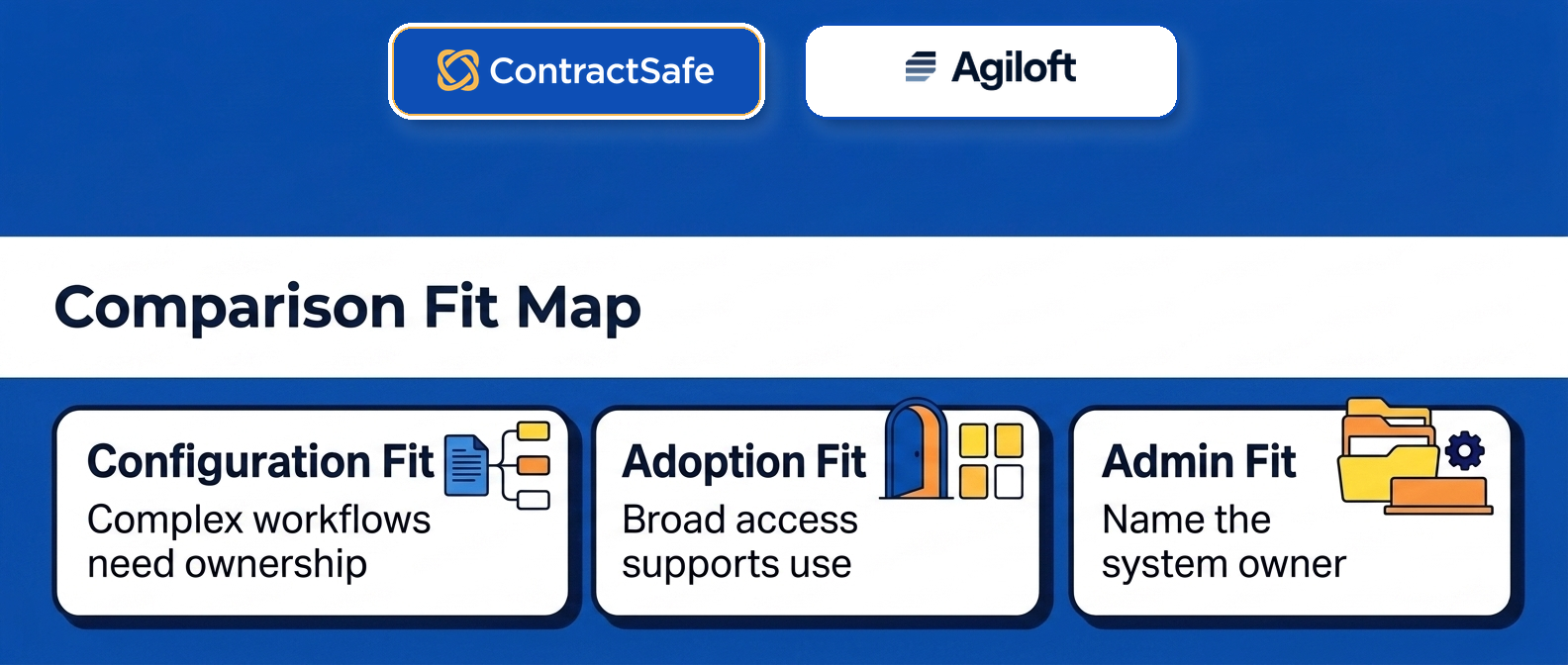
ContractSafe and Agiloft comparison fit map

Side-By-Side Comparison Table

Decision criteria ContractSafe Agiloft
Features Full-lifecycle CLM with e-signature, intake, approvals, storage, renewal alerts, and reporting Full-lifecycle CLM with configurable workflows, approvals, data models, and automations
Time to value Included implementation and migration support; test the plan with your source files and owners Ask for a scoped implementation plan tied to your configuration, data, integrations, and owners
Configuration burden Designed around broad adoption and standard contract work without making occasional users system builders No-code configuration supports deeper workflow and data-model requirements that still need an owner
Pricing visibility Published flat pricing with unlimited users on every plan Official pricing information asks buyers to request pricing and doesn’t show public plan amounts
Ease of use Built for use across legal, finance, procurement, and business owners Test each intended role against the configured experience your team plans to maintain
Customer support Customer success support is included Confirm what support, training, and ongoing services are included in the quote
Admin model Favors a simpler operating model and broad participation Favors teams prepared to own deeper no-code configuration and governance
AI assistance Assists review, search, and extraction with people checking the results Ask Agiloft to demonstrate current AI behavior, source grounding, and review controls on the same documents

Read the table as a test plan, not a scorecard with a universal winner, because there isn’t one. A company with unusual routes and a dedicated platform owner may value configurability most. A smaller legal team serving many business users may put adoption, pricing clarity, and included help at the top.

The distinction is especially important for unpublished details. Agiloft’s public pricing material asks buyers to get pricing, so contract terms, services, licensing, and current product behavior belong in the quote and demo. “Not public” isn’t a negative claim. It’s a reminder to get the answer in writing.

Pricing, Implementation, And Support Differences

In an Agiloft comparison, pricing, implementation, and support differ most in how much buyers can establish before a sales conversation. ContractSafe publishes flat pricing, includes unlimited users, and includes implementation, migration, and customer success support. Agiloft’s public pricing material directs buyers to request pricing, so buyers need a scoped quote to make the same comparison.

Start with the contract management price comparison and build one cost model for both vendors. Include software, user access, implementation, data migration, integrations, training, administration, and ongoing services. Use the same contract volume, user groups, source files, and workflow scope for each estimate.

The ContractSafe pricing page makes the licensing contrast easier to see. Unlimited users mean adding an occasional reader doesn’t create a per-seat charge. Buyers should still confirm the right plan for their contract needs, but they can model broad access without deciding which departments deserve a login.

Agiloft’s official pricing page doesn’t show public plan amounts. An independent pricing analysis says quote variables can include team size, workflow complexity, integrations, and product needs. Treat that as context for the scoping conversation, not as a substitute for Agiloft’s current written quote.

Implementation deserves the same discipline. Ask who prepares the data, who resolves duplicates, who configures routes, who trains each user group, and what support continues after launch. ContractSafe’s included implementation and migration support answer part of that scope. The demo should still show the work both teams must do.

Where Agiloft Is A Better Fit

Agiloft is a better fit when configurable enterprise workflow depth is a must-have and the buyer has people who can own it. Its no-code positioning is useful for teams that need to shape approvals, data models, and automations around requirements that standard configuration cannot absorb.

Lean toward Agiloft when:

  • Approval paths branch across business units, regions, contract types, or risk conditions.
  • The contract record needs a custom data model tied to the organization’s broader operations.
  • A named administrator or team owns configuration, testing, documentation, and changes.
  • Connected business processes require contracts to trigger or receive more complex automation.
  • Contract professionals are the primary users and deeper specialization pays for the upkeep.

The important qualifier hiding in that list is ownership. No-code removes the need to write traditional software code, but it doesn’t remove design choices or maintenance. Ask the future administrator to join the demo, explain the desired route, and change a rule while everyone watches. That exercise shows whether flexibility feels like useful control or work the team isn’t staffed to keep doing.

Agiloft should be judged on that strength, not punished for being a deeper platform. If complex configuration is the problem you are funding, a simpler system may leave important requirements unresolved. The buying team’s job is to prove that the complexity is real and that someone will own it.

Where ContractSafe Is A Better Fit

ContractSafe is a better fit when the team needs full-lifecycle contract management that legal and business users will actually use. Published flat pricing, unlimited users, included implementation help, and an organization-wide design matter when adoption is harder than configuration.

The clearest signal is the shape of the team. A general counsel, a small legal group, finance, procurement, and business owners all have contract questions, but none may be available to become a dedicated platform builder. In that setting, the operating model must make everyday work clear without giving up intake, approvals, e-signature, alerts, or reporting.

The ContractSafe contract repository supports storage, search, and OCR for scanned agreements. Those capabilities matter when the first problem is finding the executed contract and its amendments. Search isn’t the platform’s whole identity; it’s the foundation that lets later lifecycle work start from the right record.

ContractSafe AI contract management assists review, search, and extraction while people check the results. That review step belongs in the demo. Ask the system to answer a difficult question, point to the source language, and show how a person confirms or corrects the result.

ContractSafe’s included implementation, migration, and customer success support also fit teams that want a defined partner during rollout. Ask what the team needs from you, who owns each preparation task, and how business users enter the process. Broad adoption still requires decisions, but the software and licensing model shouldn’t make participation the exception.

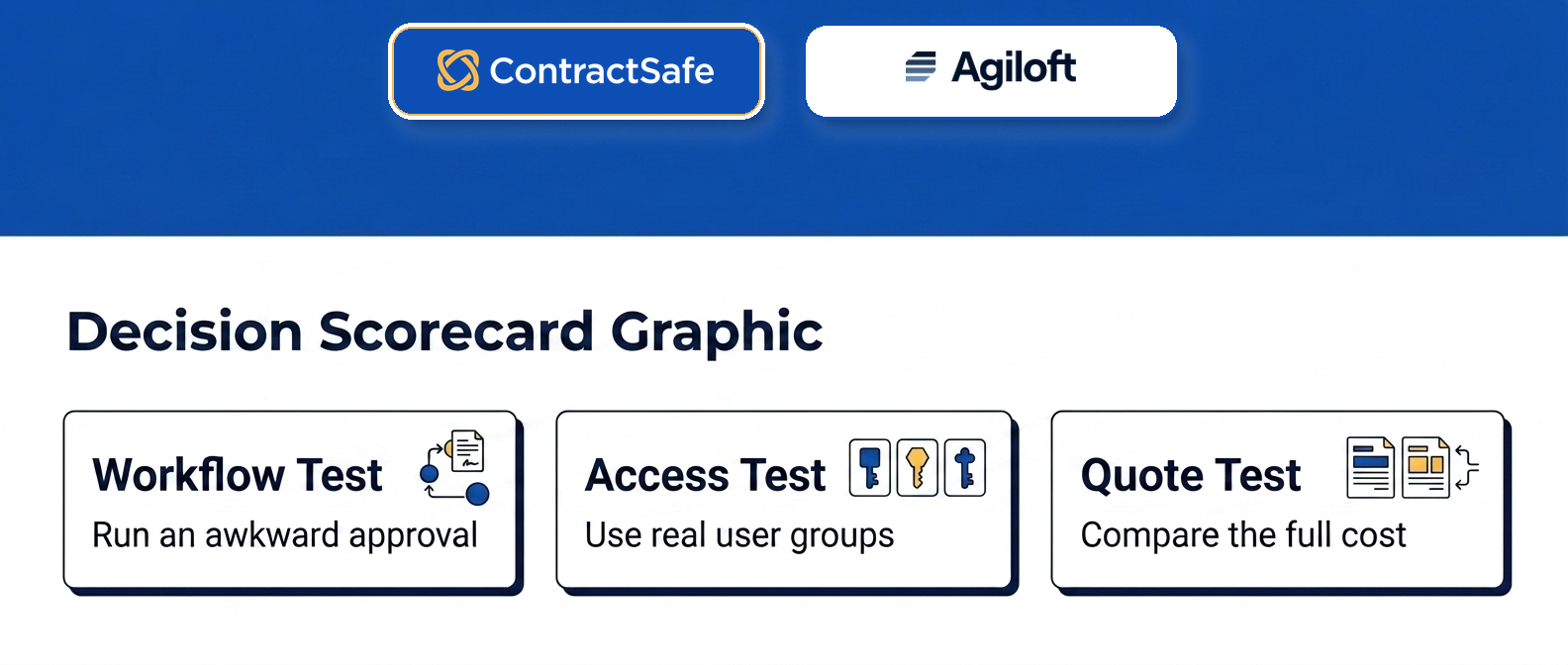
ContractSafe and Agiloft decision scorecard

How ContractSafe Helps You Make the Final Call

ContractSafe helps with this decision by giving buyers a full-lifecycle option built for organization-wide adoption. The system covers e-signature, intake, approvals, storage, renewal alerts, and reporting, while published flat pricing and unlimited users make broad participation easier to plan.

That fit should be tested rather than taken on faith, including ours. For instance, bring one scanned agreement, one awkward approval, one sensitive contract group, one renewal question, and users from outside legal. Ask them to find the record, follow the route, review the result, and explain the next action.

ContractSafe includes implementation, migration, and customer success support, so the evaluation should cover the rollout as well as the product screen. Confirm what your team prepares, what ContractSafe handles, and how each user group learns the new route.

If that operating model matches your needs, book a ContractSafe demo and run the proof tests with your own contracts. If deeper configuration remains the requirement, use the same tests with Agiloft and make the administrator’s work part of the decision.

Frequently Asked Questions

What is the biggest difference between ContractSafe and Agiloft?

The biggest difference is operating emphasis. Agiloft emphasizes no-code configuration for complex enterprise workflows and data models. ContractSafe emphasizes a full lifecycle that legal, finance, procurement, and business owners can adopt broadly, supported by published flat pricing, unlimited users, and included implementation help.

Which teams are a better fit for Agiloft?

Agiloft is a better fit for teams with complex approval logic, custom data requirements, connected processes, and a named person or group prepared to administer the platform. Buyers should confirm that the need for deeper configuration is real and that ownership continues after launch.

Which teams are a better fit for ContractSafe?

ContractSafe is a better fit for teams that need e-signature, intake, approvals, storage, renewal alerts, and reporting in one system that occasional business users can navigate. It also fits buyers who value published pricing, unlimited users, and included implementation, migration, and customer success support.

How should buyers compare pricing and implementation effort?

Buyers should give both vendors the same contract volume, user groups, source files, workflow scope, and integration needs. Compare software, access, implementation, migration, training, administration, and ongoing services in one model. Then require each vendor to state what the buyer must prepare and what the vendor will handle.

What should buyers confirm before choosing between these vendors?

Buyers should confirm workflow requirements, user groups, access needs, administration ownership, integrations, AI review, implementation scope, migration work, support, and total pricing. The final test should use real contracts and the people who will rely on the system, not a polished vendor dataset.

icon_line_dots person_testimonial

“I couldn't believe we were already up and running in just 30 mins

icon_yellow_quotes
  • sirius-xm-logo
  • Dollar-Shave-Club-logo
  • TED-logo
  • United-Express-logo
  • The-University-of-Arizona-logo
  • j2Global-logo
  • payscale-logo
  • Living-Spaces-logo
  • Jam-City-logo
  • McClatchy-logo
  • SFMOMA-logo
  • Sacred-Heart-logo
  • california-pizza-kitchen-logo
icon-line-dots

Contract relief is waiting.

Gain control of your contracts today. Take the first steps in just a few minutes.

Request a Demo