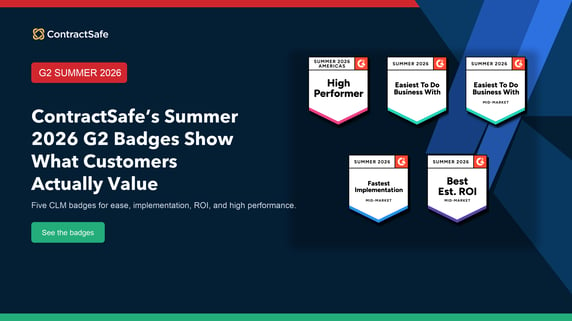
ContractSafe G2 badges are a practical way to read customer feedback about ease of use, setup speed, estimated return, and performance across the Americas.
Picture a legal operations lead who owns a growing set of active agreements, misses a renewal because the reminder sat in a spreadsheet, and now needs software that files contracts, sets alerts, and answers questions fast. These badges speak to that exact job, from getting a contract system running to finding what you signed without digging through email threads.
You will use this article to turn each badge into buying work: tests to run during a demo, questions to ask about setup and support, and the owners, renewals, and alerts to name before you sign. Read on to convert public recognition into a checklist your team can act on.
Key Takeaways
ContractSafe earned five Summer 2026 G2 badges in the Contract Lifecycle Management category.
The badges recognize ease of doing business, fast implementation, estimated ROI, and high performance.
The recognition matters because it reflects customer review signals from teams using ContractSafe in real contract work.
For buyers, the badges are useful proof points to pair with demos, security review, and day-to-day product fit.
Choose Your Next Step
Different readers arrive with different jobs, so pick the path that matches yours. Each option points to a feature or a demo you can test against your own contracts, renewals, and access needs this week.
- Ready to see it live: book a ContractSafe demo and bring real contracts to search.
- Worried about finding signed documents: open the contract repository and test a keyword search.
- Focused on missed dates: review contract alerts and map a renewal to an owner.
- Weighing automation: compare AI contract features against a report you build by hand today.
The Summer 2026 Badge Stack
ContractSafe earned five G2 Summer 2026 badges in the Contract Lifecycle Management (CLM) category.
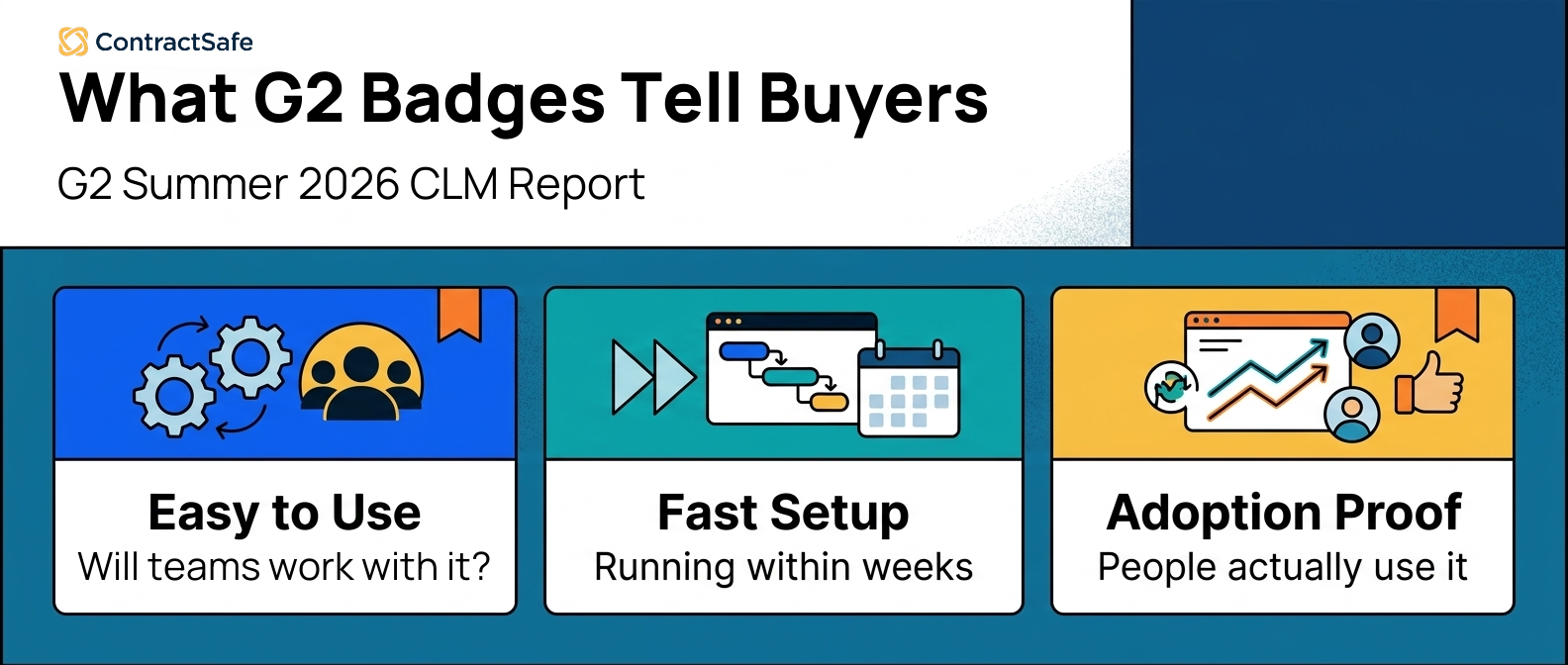
The confirmed badges are:
-
High Performer, Americas
-
Easiest To Do Business With
-
Easiest To Do Business With, Mid-Market
-
Fastest Implementation, Mid-Market
-
Best Estimated ROI, Mid-Market
That’s a pretty useful spread.
It’s not just one flavor of recognition repeated five times with a different ribbon color.
The badges point to the parts of contract management that buyers care about after the sales call is over. Will this be easy to work with? Can our team get it running without losing a quarter? Will people actually use it?
Those are not decorative questions.
Those are the questions that decide whether a contract platform becomes the place people go for answers, or just another tab everyone politely ignores.
Why G2 Recognition Matters
G2 recognition gives software buyers another way to see what real users say once a product becomes part of their workday.
That matters because software pages can promise anything.
A homepage can say a product is powerful, intuitive, flexible, intelligent, user-friendly, future-ready, and maybe even “transformational” if someone let the thesaurus drive.
But a customer review is different.
It comes after the demo.
After implementation.
After the first renewal deadline.
After someone in finance asks for a report by Friday.
After a legal team realizes that “just store it in SharePoint” was less of a system and more of a group wish.
G2 ties badges to products recognized in its market reports. Its research materials also describe how reports use review data, satisfaction, market presence, and report criteria.
G2 recognition isn’t magic. It’s not the whole buying process. For broader software buying context, independent groups like the FTC and NIST have also published guidance that reminds buyers to look for trustworthy evidence and clear risk controls.
But it’s useful proof because it reflects what users say after the software becomes part of their actual day.
And contract management software has to survive the actual day.
What Customers Keep Rewarding
Customers reward contract management software when it helps them find agreements, track deadlines, control access, and get answers without adding a new layer of work.
The funny thing about contract management is that nobody wakes up thinking, “You know what I need today? A more complicated contract platform.”
People need the opposite.
They need the contract.
They need the deadline.
They need the renewal notice.
They need to know whether the agreement has auto-renewal language, who signed it, whether the amendment is attached, and why the file name says “final” three separate times.
That’s the everyday work ContractSafe is designed to make easier.
So when customers recognize ContractSafe on G2, it comes back to a few practical things.
Easy To Do Business With
Easy To Do Business With recognition points to the experience of working with a vendor, not just clicking around inside a product.
Contract software shouldn’t require a treasure map.
If someone needs to find a contract, they should be able to search for it.
If someone needs a renewal reminder, they should be able to set one.
If someone needs access, an admin should be able to control that without calling a committee meeting and ordering sandwiches.
Being easy to do business with matters because adoption matters.
The best contract system in the world doesn’t help much if everyone avoids it.
Fast Implementation
Fast Implementation recognition matters because contract problems rarely wait politely while a team works through a long rollout.
Implementation is where a lot of software dreams go to become calendar invites.
ContractSafe takes a simpler approach.
Teams can upload contracts, organize their repository, set alerts, search documents, and start getting control without turning the project into a six-month expedition.
That speed matters because contract problems keep moving.
Renewals keep renewing.
Deadlines keep approaching.
Vendors keep asking questions.
The system should help quickly.
Best Estimated ROI
Turn this badge into your own math. Total the hours your team loses searching for signed agreements and the cost of a renewal that slips because no alert fired.
Then ask the vendor to show exactly how the product removes that work, from faster search in a contract repository to automatic contract alerts and reports you can run yourself. Compare that to the manual report you produce today and let the gap guide the decision.
High Performer
High Performer recognition is the badge version of a customer saying, “Yes, this is working for us.”
Some teams need a huge enterprise CLM project.
Many teams don’t.
They need a secure place for contracts, strong search, clear permissions, alerts, reports, AI help, and a system people will actually use.
That’s the ContractSafe lane.
Not overbuilt.
Not underpowered.
Just the contract management work that matters, without making everyone learn a new language first.
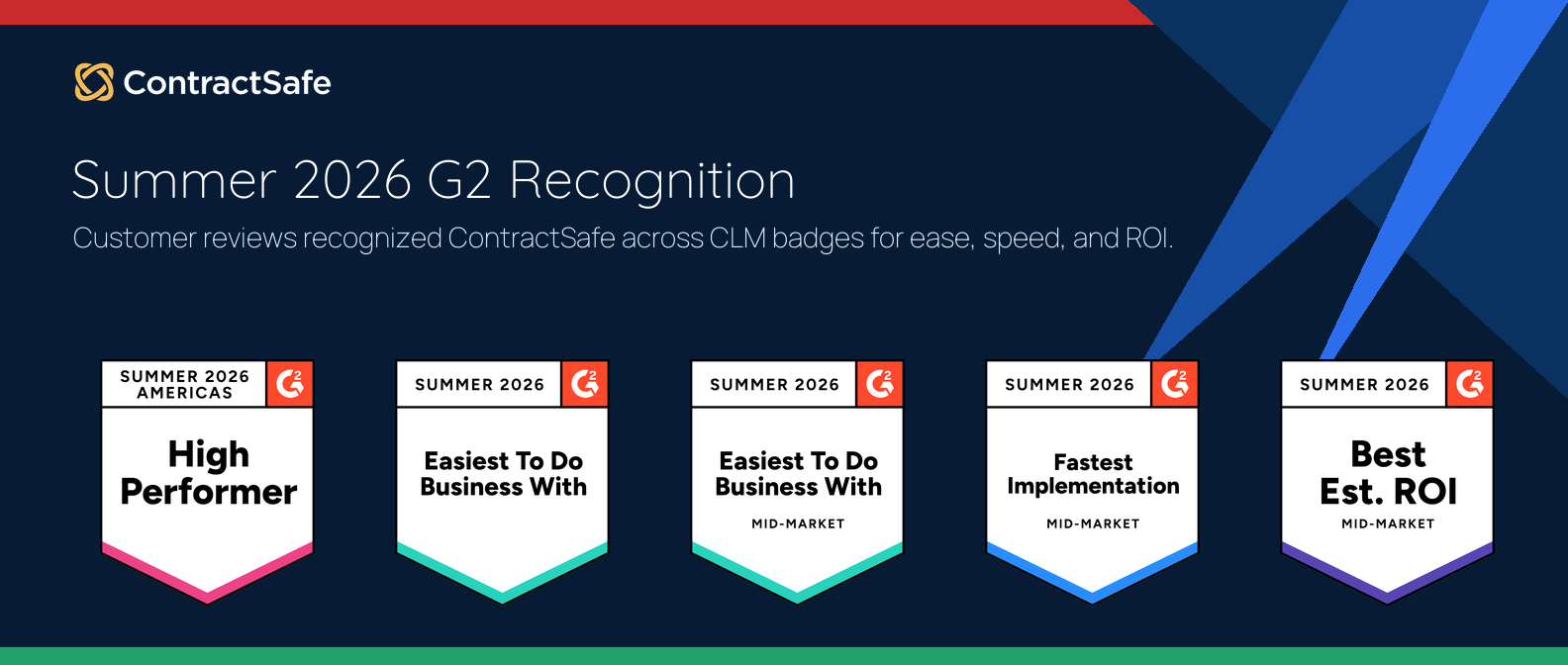
How Badge Comparison Fits Into Your CLM Buying Process
Compare each badge claim against your own contract records and renewal history before you commit. Ask the vendor to show how their platform tracks obligations, then test whether the results match what your renewals actually demand. Check every promise against evidence you can verify yourself.
Match ease of use to a real demo test
An ease of use badge reflects how customers rate day-to-day work, so put it to the test. During a demo, ask a non-legal teammate to file a contract and find a clause without help. For example, an ease badge means little if your accounts payable lead can't locate a signed renewal date in under a minute.
Turn setup speed into implementation questions
A fast implementation badge points to smooth onboarding, but your contracts and your team decide the real timeline. Ask how existing agreements move into the repository, who does the loading work, and how long a first search takes. Name the person who owns your back catalog before you commit to a start date.
Test estimated return against your own renewals
An estimated return signal reflects value other customers report, yet your savings come from renewals you stop missing. Set alerts for the agreements that would cost the most if they lapsed, and list those dates now. Ask how the system flags a renewal early enough for you to act rather than react.
Check performance against support you can reach
A performance badge across the Americas suggests customers stay satisfied after the sale, so probe what that support looks like. Ask who answers when a question about finding answers in your contracts or a failed search comes up, how fast, and through which channel. Confirm that help covers your whole team, not just the buyer who signed.
How to Use G2 Badges in a CLM Buying Process
Add G2 badges to your Buyer checklist and tie each to concrete work: book a demo, assign an owner for the CLM rollout, and map badge signals to your renewal date. Request an implementation timeline, permission settings, an alert or report walkthrough, and support proof before you sign.
1. Start With the Contract Work You Need Fixed
Before you read a single badge, write down the contract work that hurts today: a renewal that slipped past its date, a slow hunt for a signed PDF, or an approval that stalls between teams. Name the owner for each problem so the demo has a scorekeeper who cares about the outcome.
Bring that list to every vendor call. When recognition says a product is easy or fast, ask the seller to prove it against your renewal, your report, and your access rules, not a polished sample file the vendor prepared in advance. Send the same list to each vendor so you compare answers on identical contract work.
2. Turn Easiest To Do Business With Into a Demo Test
The Easiest To Do Business With and Easiest To Do Business With, Mid-Market badges point to buying and renewing without friction. Test that claim directly. Ask for written terms, a trial loaded with your data, and a named contact who answers onboarding questions during the evaluation.
In the session, load a real agreement into a contract repository yourself and search for a clause. If you can't file, tag, and find a document without the seller driving the mouse, the ease reviewers described will not survive contact with your team.
3. Test Fastest Implementation Before You Sign
The Fastest Implementation, Mid-Market badge is about time to live use, so make the vendor commit to a plan. Ask who loads your existing contracts, how metadata gets tagged, and the exact date your team can start searching records and setting alerts on renewals.
Then measure the plan against your calendar. Set a go-live date, assign an internal owner for migration, and confirm what support you receive while records move. A fast rollout you can't staff on your side isn't a fast rollout for you. Ask for the migration owner by name, not a job title.
4. Pressure-Test the Payoff With Your Own Report
Book a demo, then run the same searches you handle every week. Pull up signed agreements, check who the owner is on each, and watch how fast the repository surfaces the exact clause. That hands-on implementation walkthrough shows what the payoff looks like inside your own workflow, not a slideshow.
During the demo, set a renewal alert and load a batch of signed agreements into the repository. Watch the report update, then weigh the payoff against the hours your team spends today on search and renewal tracking.
5. Confirm High Performer With Support Proof
The High Performer, Americas badge signals steady satisfaction, so turn the rating into evidence you can hold. Ask for support response windows in writing, sample help articles, and a named contact you can reach the week after the contract is signed, not only during the sales cycle.
Then ask current users, through references or reviews, what happened when a renewal date changed or an import broke. A high rating earns its weight when it predicts how the vendor treats you on a hard day, not when the software behaves in a scripted demo.
6. Assign Owners, Renewals, and Alerts Before Rollout
Badges can't run your program, and people do. Before you sign, name who owns each contract type, who approves changes, and who acts the moment an alert fires. Write those owners into the rollout plan so nothing important depends on memory or a single busy inbox.
Rank your riskiest renewals and set an alert for each with a clear owner and enough lead time to act. If the demo can't show a reminder reaching the right person early, keep testing the alert until it does or move to the next vendor.
7. Weigh the Mid-Market Badges Against Your Own Segment
The mid-market badges name a segment, so check whether your contract volume and team size resemble the reviewers behind them. Count the agreements you manage, the teams that touch them, and the renewals you track each quarter, then ask the vendor for references that match that shape.
References from a company your size tell you more than a top-line rating. Ask those users how long implementation took, how they set permissions, and whether alerts caught renewals before they lapsed. Turn the badge into a question you put to a team that looks like yours, not an outlier.
Build a Buyer Scorecard That Turns Badges Into Contract Control
A scorecard keeps the choice honest. Convert each badge into a test with an owner, a pass mark, and a due date, then grade every vendor the same way so public recognition never stands in for proof on your own contracts. Keep the same tests and pass marks for every product you review.
Run a Structured Demo With Real Agreements
Don't accept a slideshow. Send the vendor a set of your own agreements ahead of time and ask them to load, tag, and search those documents live, so you watch the product handle your clauses and your naming, not a clean file built to impress.
During the session, grade these tasks as pass or fail:
- File a signed agreement and find it later by keyword search.
- Tag a renewal date and confirm the alert reaches its owner.
- Restrict a folder so only approved users can open it.
- Export a report of expiring contracts without vendor help.
Score Implementation and Support With Written Evidence
Ask for the rollout plan and support terms in writing, then grade both. Implementation should name who migrates your contracts, how tagging happens, and the go-live date. Support should list response windows and a named contact who stays reachable after you sign the agreement.
Turn the answers into a short grade you can compare across vendors:
- Implementation owner and go-live date are written down.
- Existing contracts get loaded and tagged, not left to you.
- Support response windows sit in the contract, not a brochure.
- References confirm help arrived when a renewal or import broke.
Set Permissions and Access Before Anyone Logs In
Contract data is sensitive, so decide access before rollout. Map which teams see which agreements, who can edit metadata, and who can export records. Ask the vendor to configure those rules during the demo and confirm they hold the moment a test user with limited rights signs in.
Write the access model into your rollout plan and name an owner who reviews it each quarter. If permissions are hard to set during a controlled demo, they will be far harder once your whole contract library and every team depend on them.
Verify AI Features Against Your Own Contracts
If a badge nudges you toward automation, test it on your documents, not a demo file. Ask the vendor to extract dates and parties from a messy scanned agreement you supply, then check every field by hand so you know where the product is accurate and where a person still reviews.
Read how the vendor handles accuracy before you rely on it. Compare AI contract features against the review your team does today, and study AI Contract Data Accuracy so your owners know what to double-check after import.
Plan the Renewal Workflow You Will Run After Go-Live
A demo ends, but renewals don't, so design the recurring workflow now. Decide who receives each alert, how far ahead it fires, and what the owner does next: renew, renegotiate, or let the agreement lapse on purpose with a record of the choice.
Ask the vendor to build that workflow with your dates during the trial. Confirm the reminder lands in the owner inbox with enough lead time, and set the contract alerts that protect your highest-value agreements before rollout, not after the first missed date.
Check Pre-Signature Review Fit If You Redline at Scale
If your team reviews and redlines many incoming contracts, test that work too, since a repository badge doesn't prove pre-signature strength. Bring a draft with risky clauses and watch how the product helps your reviewers flag, compare, and route it for approval. Time how long a full redline round takes inside the tool.
Read Why Pre-Signature Contract Review Breaks at Scale before you assume one tool covers every stage. Name the owner for pre-signature review, the owner for the signed repository, and the handoff between them so no contract falls through the gap.
Decide With a Rubric, Not a Badge
Add your scores and let the totals choose. A product can earn strong reviews and still miss the renewal alert your team needs most, so weight the tests that map to your worst contract risks well above the ones that only look impressive.
Before you sign, require a written summary of what passed, what failed, the owner for each open item, and the go-live date. When you're ready to test this against your own agreements, book a ContractSafe demo and bring the contracts that matter most.
Quick Gut Check: What the Badges Mean for Buyers
Use this quick gut check if you’re comparing contract management options and trying to decide whether G2 recognition should matter to your team.
| Buyer question | Badge signal | Why it matters |
|---|---|---|
| Will our team be able to work with this vendor? | Easiest To Do Business With | The buying and support experience matters after the contract is signed. |
| Will implementation drag on forever? | Fastest Implementation, Mid-Market | A faster rollout helps teams get control before more deadlines pile up. |
| Will the product be worth it? | Best Estimated ROI, Mid-Market | Contract software should give time, control, and confidence back to the business. |
| Are users actually getting value? | High Performer, Americas | Recognition from users is a useful signal, especially when paired with demos and references. |
Badges shouldn’t replace your buying process.
They should help you ask better questions.
The Real Trophy Is a Contract System People Use
The best award for contract management software is a system people keep using after launch.
Imagine two storage rooms.
In the first one, every contract is technically “somewhere.”
There are folders. There are subfolders. There are PDFs. There are scans. There is one spreadsheet that everyone says is mostly current, which is the most dangerous kind of current.
In the second room, every contract has a place.
You can search the text.
You can see the deadline.
You can control access.
You can run a report.
You can ask AI for help understanding a document, then check the source language yourself.
That second room is what ContractSafe is trying to build.
The G2 badges are nice.
But the better win is when a customer no longer has to be the office contract detective.
Thank You to Our Customers
Every G2 badge starts with a customer taking the time to share feedback.
That’s not a small thing.
People are busy. Legal teams are busy. Operations teams are busy. Procurement teams are busy.
So when customers pause long enough to explain what ContractSafe helps them do, we pay attention.
Your feedback helps other teams make better buying decisions.
It also helps us keep building the product in the right direction.
So thank you.
For the reviews.
For the suggestions.
For the honest notes.
For trusting ContractSafe with the agreements that keep your organization moving.
What’s Next
ContractSafe is using the Summer 2026 G2 recognition as a reminder to keep building for real contract work.
We’re proud of the recognition, but we’re not treating it like a finish line.
Contract management keeps changing.
Teams want better search, cleaner reporting, easier review, smarter AI, and stronger ways to keep people in control.
That’s where ContractSafe is focused.
The goal isn’t to collect badges for the badge shelf.
The goal is to make contract management feel less like digging through a filing cabinet during a power outage.
Less hunting.
Less guessing.
Less “Who has the latest version?”
More control.
More clarity.
More time back for the work that actually needs your brain.
Related Reading
Keep going from here if you want more context on ContractSafe, contract operations, and product proof:
How ContractSafe Helps You Turn G2 Proof Into Contract Control
ContractSafe helps teams turn customer-proof signals into practical contract work: storing agreements, searching text, tracking dates, managing access, and reporting on what matters.
That’s where the badge story comes back to the product.
ContractSafe gives teams a secure contract repository, flexible contract alerts, practical AI contract features, and the everyday tools teams need to stop hunting through folders.
If you’re ready to see what customers are talking about, book a ContractSafe demo.
You can also search for ContractSafe on G2 if you want to read reviews from real users.






.svg)







.svg)