Ironclad pricing is a quote-only, fully custom model with no public list price, so each contract is sized to your contracting volume and budget. Buyer-reported annual deals run from $30,000 to $250,000+, with a median near $40,000 a year, per Vendr data. Compare an Ironclad alternative.
Think of buying Ironclad like buying a corporate jet. The sticker is only the start, and the real budget is in the crew, the hangar, and the years of maintenance. For a legal team that mostly needs to find contracts, track deadlines, and pull reports, that is a lot of plane for a short trip.
This guide breaks down what Ironclad currently costs a legal team, the first-year expenses that don’t appear in the headline quote, the deployment scope where it makes sense, and how ContractSafe compares on price model and time to value.
For context, CLOC’s 2026 legal-operations research shows why teams need to separate required scope from capacity pressure, while WorldCC’s value-gap research explains why implementation and governance belong in the buying case. Neither report supplies Ironclad list prices; the vendor remains quote-only.
Key Takeaways
- It’s quote-only with a floor: Ironclad publishes no pricing, and reported annual contracts typically run from $30,000 to $250,000+, so you can’t budget without a sales process.
- The subscription is only one part of the decision: buyer-transaction evidence reports a median near $40,000 a year, but implementation, integrations, support, and add-ons still need separate written confirmation in the quote.
- First-year scope extends beyond the subscription: require the vendor to itemize implementation, migration, integrations, support, and AI modules instead of assuming a universal implementation range or multiplier.
- Most legal teams don’t need that scope: ContractSafe starts at $450 a month with unlimited users and gets teams live in under an hour, for roughly $5,400 to $9,780 a year.
Choose Your Next Step
Use this guide to shape your Ironclad evaluation around where your team sits today, and start from the contract management number you’ll actually have to defend to finance.
- Want the number fast? Jump to what Ironclad actually costs and the first-year costs legal teams miss.
- Sizing the decision? Read how Ironclad packages a custom quote and when Ironclad is and isn’t worth it.
- Already over budget? Run the Decision Check on whether your team needs Ironclad’s scope at all.
- If you only remember one thing: Ironclad is priced for large enterprise legal, and a transparent, unlimited-user tool like ContractSafe covers the full contract lifecycle with simpler adoption for a fraction of the cost. Our contract management price comparison shows where it lands against the field.
What Ironclad Actually Costs
Ironclad doesn’t publish pricing, and buyer-reported data puts annual contracts typically in the $30,000 to $250,000+ range. That same Vendr data, drawn from 350+ transactions, shows a median near $40,000 a year before implementation, integrations, and add-ons. See what ContractSafe includes.
Because the platform fee is only part of the bill, the headline quote understates what you’ll spend. The table below puts Ironclad’s model next to ContractSafe’s published pricing.
| Dimension | Ironclad | ContractSafe |
|---|---|---|
| Pricing model | Quote-only, custom, $30K-$250K+/yr reported Source context | Flat, published, by contract volume |
| Starting price | Median ~$40,000/yr, buyer-reported, no public price | $450/mo |
| Users | Custom packaging; confirm how users, volume, and scope affect the quote | Unlimited on every plan |
| Implementation | Buyer-reported implementation range: $10,000 to $100,000+; confirm work, owner, acceptance tests, and calendar | Included launch support; confirm the migration plan for your records |
| First-year reality | Subscription plus the launch work and modules confirmed in writing | $5,400 to $9,780 a year |
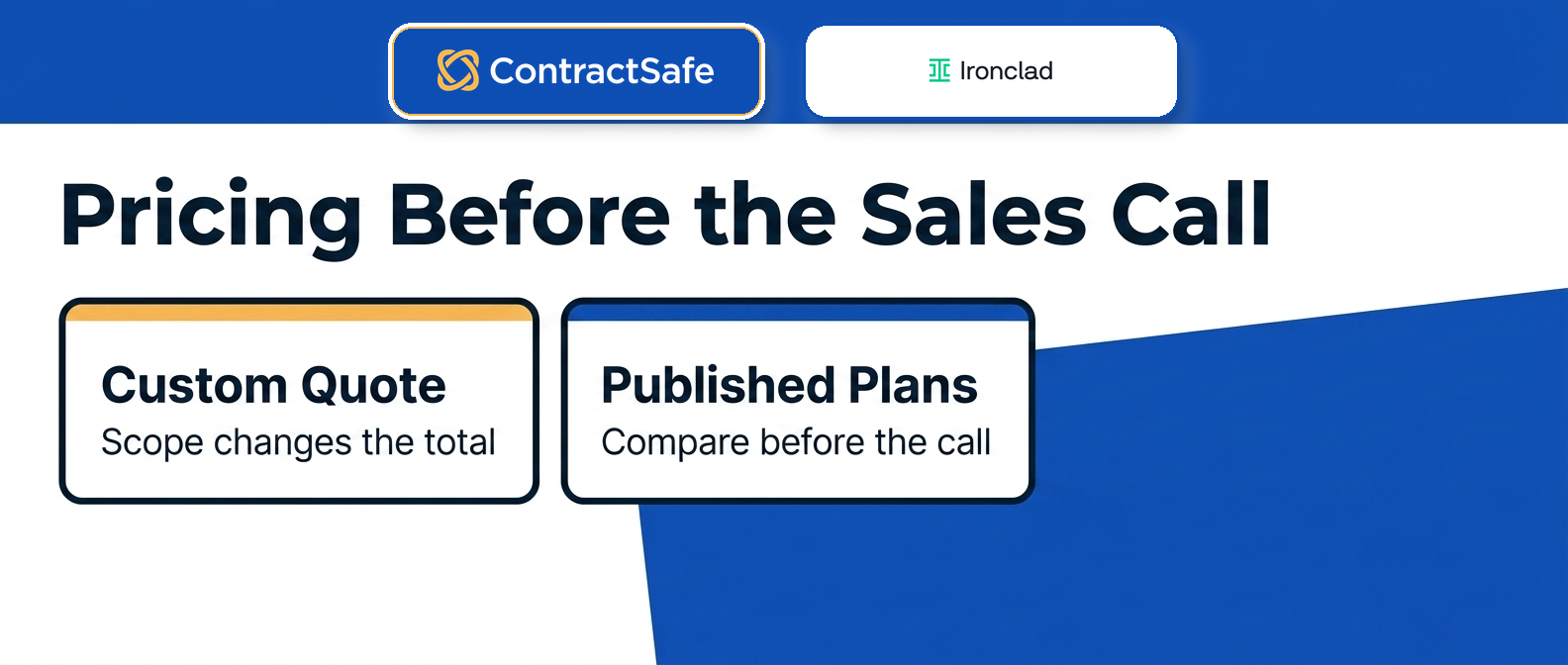
Two numbers tell the story. Ironclad’s median price runs $40,000 a year, and that’s before implementation. ContractSafe starts at $450 a month with every price published. Getting this number right means a budget you can defend and a renewal with no surprises. See how contract management costs add up.
Here’s what belongs in the first-year budget: the subscription, implementation, migration, integrations, support, and any authoring or AI modules sold separately. Require a written scope, owner, acceptance test, and fee for each item so finance can compare the same package across vendors.
How to scope a custom Ironclad quote
Your quote can vary with contract volume, workflow complexity, deployment scope, integrations, and support. Use those inputs to define the work instead of assuming a price from a team-size band.
- Focused deployment: name the first contract types, workflows, integrations, reports, and administrators that must work.
- Multi-team deployment: identify each team’s access, intake, approval, reporting, and support needs before the quote is finalized.
- Enterprise deployment: document governance, security, integrations, migration, service levels, and change-management work as separate scope items.
One more detail finance should know: buyer-reported data shows buyers save about 21 percent on average by negotiating, which tells you the first quote is a starting position, not a price. ContractSafe removes that whole exercise by publishing the number on its pricing page. See what ContractSafe includes.
That reported $30,000+ floor deserves special attention if you run a small legal team. Per Vendr’s buyer-reported data, a five-person team can end up paying enterprise-style pricing before it has enterprise-scale workflow needs. Ironclad is also typically sold on annual or multi-year terms, which locks in that minimum and any escalators for the length of the contract. See how contract management costs add up.
A multi-year commitment deserves a line-by-line comparison with a published alternative. ContractSafe’s published plans start at $5,400 a year and include unlimited users, while Ironclad requires a custom quote for the deployment you define.
Before approving that commitment, ask procurement to normalize every finalist into the same cost schedule. The schedule should separate the subscription, implementation work, migration, integrations, premium support, optional modules, and renewal escalator. It should also name the contract volume and workflow assumptions behind the quote. That turns an attractive headline price into a number finance can reproduce and prevents a necessary capability from appearing as an unplanned change order after signature.
Legal should run the same exercise against its actual phase-one packet. Identify the agreements, metadata fields, approval paths, reports, and user roles the team needs at launch. Then ask the vendor to mark each item as included, separately priced, partner-delivered, or deferred. This evidence-based scope is more useful than a generic tier label because it connects the commercial proposal to the work the implementation team must deliver.
How Ironclad Packages a Custom Quote
Ironclad doesn’t publish a standard three-tier price card. Ask the sales team to map every requested capability to the subscription, implementation statement of work, support terms, and renewal order form.
- Entry scope: confirm included workflows, users, support, and implementation in the written quote.
- Expanded scope: confirm which workflow, AI, integration, and support modules are included.
- Enterprise scope: confirm governance, security, service levels, migration, and change-management costs.
The quote varies with scope, volume, and deployment. Ask the vendor to state whether and how user access affects the number. ContractSafe takes a different approach with unlimited users on every plan.
What Drives an Ironclad Quote Up
Ironclad prices every contract management deal individually, so knowing the levers the sales team pulls is the only way to predict the number. Four factors move an Ironclad quote more than anything else, and each one is a place the bill grows after the demo.
- User access: ask whether user count, role, or department changes the quote, and require that rule in writing.
- Contract volume: ask how stored records and annual workflow volume affect packaging and renewal.
- Workflow complexity: more approval paths and integrations mean more configuration, and configuration is billable.
- AI and analytics: the modules buyers most want are the ones most often quoted separately, which is how a base number becomes a much larger one.
None of these levers exist with a flat, published price. ContractSafe scales by contract volume alone, includes unlimited users, and ships AI extraction and reporting in the plan, so the quote you see is the number you pay.
The First-Year Costs Legal Teams Miss
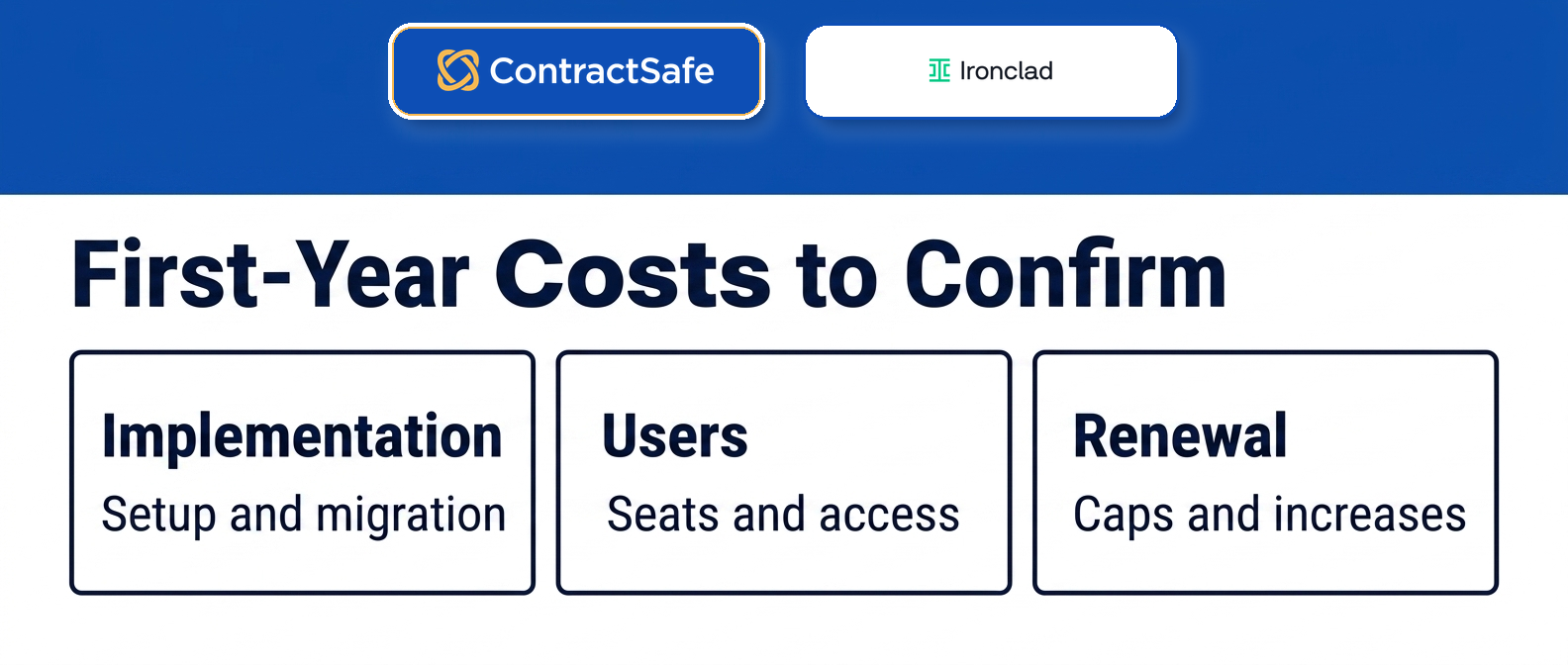
The Ironclad subscription is only one part of a realistic first-year total. Budget the separately confirmed implementation, migration, integrations, support, AI modules, and renewal terms alongside it.
1. Implementation and onboarding
Implementation is separately quoted. Require a statement of work that names the migration packet, workflows, integrations, training, owner, acceptance tests, calendar, and change-order rules.
- Watch for: training and integration setup billed separately on top of the implementation fee.
- By contrast, ContractSafe customers are typically operational in under an hour, with no implementation project and a dedicated success manager included.
2. AI add-ons
AI capabilities may appear as separate modules in a custom quote. Ask the vendor to identify the exact review, extraction, usage, and support scope included in the subscription and implementation order form.
- Watch for: AI capabilities shown in the demo but omitted from the written subscription and implementation scope.
- ContractSafe includes AI data extraction in its published plans rather than as an upsell.
3. Workflow buildout
Ironclad is a workflow platform, and that flexibility is a recurring cost. Every additional task, approval path, or department can require reconfiguration, and that work often carries a charge. For example, onboarding procurement onto its own approval flow can become a paid services engagement.
- Watch for: a quote scoped to one team’s workflow that grows each time another department joins.
- ContractSafe supports signature, approvals, searchable contract records, alerts, reporting, and renewals in a system designed for adoption, so teams can expand without rebuilding an enterprise workflow.
4. Premium support
Support scope can vary by quote. Confirm the named success contact, response targets, onboarding hours, and any separately priced service level in writing.
- Watch for: the support tier you actually want sitting above the one in the base quote.
- ContractSafe gives every account a dedicated success manager at no extra cost.
- Watch for: response-time guarantees and onboarding hours metered into the higher support tier rather than the base plan.
For a legal team, premium support isn’t optional in practice, because an enterprise workflow platform needs help when an approval flow breaks. That turns a nice-to-have line item into a standing annual cost.
5. Annual escalators
Check the order form for renewal increases, module changes, usage limits, and notice requirements. Model the renewal from those written terms instead of assuming the first-year subscription remains fixed.
- Watch for: an automatic annual increase buried in the order form.
- ContractSafe publishes its pricing, so the renewal is a number you can plan around rather than negotiate again.
6. Integrations and data migration
Connecting Ironclad to your CRM, eSignature, and storage tools is a separate setup cost, commonly a separately quoted amount, and migrating existing contracts in can add more on top. For example, a Salesforce integration alone is often a paid professional-services line rather than a toggle you switch on.
- Watch for: each integration scoped and priced individually rather than bundled into the plan.
- ContractSafe includes native integrations and migration support, so getting your contracts in doesn’t become its own project.
Decision Check Before You Commit to Ironclad
Before you kick off an Ironclad sales process, run your contract management evaluation through this five-question checklist. If a legal team answers "no" to two or more, you’re probably paying for enterprise scope you won’t use.
- Do you have a full-time admin who can own configuration and ongoing workflow changes?
- Can you absorb a three-to-six-month implementation before you get any value?
- Do you draft most contracts in-house with multi-step internal approvals, rather than just storing third-party paper?
- Is a six-figure first-year budget realistic for contract management alone?
- Do you need authoring and negotiation workflows, not just search, alerts, and reporting?
Now count your yeses, because the pattern matters more than any single answer.
- Four or five yeses: Ironclad is probably the right enterprise buy. You’ve got the admin to run it, the budget to feed it, and the in-house drafting volume that makes authoring and negotiation workflows earn their keep. The plane matches the trip, so the sticker and the maintenance are money well spent.
- Two or three yeses: you’re in the gray zone. Some of Ironclad’s power gets used and some sits idle, so price out only the pieces you’ll actually touch, then ask whether a lighter tool covers those same jobs for a fraction of the annual contract. If the answer is yes, the extra scope is just risk you’re paying to carry.
- Zero or one yes: Ironclad is almost certainly too much product. If your team mostly needs to find contracts, track deadlines, and pull reports, you’d be signing up for enterprise pricing and a multi-month implementation to power capabilities that never leave the hangar.
The honest version of this decision isn’t "Ironclad or nothing." It’s "how much of Ironclad will this team actually run." A ten-person legal team storing a few hundred agreements and chasing renewal dates gets the same core outcomes from ContractSafe for a published rate that starts at $5,400 a year, live in under an hour, with no consultant required. Ask the five questions, count the yeses, and buy the tool your answers point to, not the one with the biggest logo. See how contract management costs add up.
Why Ironclad Is Worth It for Some Teams, and When It Isn’t
Ironclad is worth its price in a narrow case: a large enterprise legal team with a full-time admin, heavy in-house drafting, complex multi-step approvals, and a budget that treats six figures as routine. For that team, the workflow depth can justify the cost.
For everyone else, it’s an expensive answer to a simpler question. Most legal teams need to find a contract fast, never miss a renewal, and pull a report, and they need finance and procurement to self-serve without a per-seat penalty. Paying Ironclad’s median, plus implementation, plus add-ons, to get basic storage and alerts means buying a platform you’ll barely use. Our breakdown of a repository versus a full CLM covers where that line falls.
The honest test is what you actually need after signature. If your team mostly receives third-party paper and needs it stored, searched, and tracked with reminders and reports, a full-lifecycle CLM built for easy adoption does that job well without a heavy workflow platform. If your team drafts high volumes of its own agreements with branching internal approvals, Ironclad’s deeper workflow engine may earn its keep. Most in-house legal teams sit in that first group, which is exactly the job a simple, adoptable CLM like ContractSafe is built for.
Common Ironclad Pricing Mistakes Legal Teams Make
Most budget overruns on Ironclad contract management software come from a few predictable errors during the buying process, and avoiding them is worth more than any negotiated discount. These are the ones that catch legal teams most often.
- Budgeting the subscription, not the first year: require implementation, migration, integrations, support, and AI modules to appear as separate written line items.
- Scoping to one team: document procurement, finance, and operations access before the vendor prices the deployment.
- Leaving AI undefined: specify the AI capabilities, usage limits, review controls, and support included at launch and renewal.
- Ignoring the renewal: automatic annual escalators mean the year-three price can sit well above the year-one number you approved.
The simplest way to avoid all four is to compare Ironclad against a transparent, flat-rate option before you start a sales cycle. A published price like ContractSafe’s gives you a fixed point of reference that an Ironclad quote, by design, will not.
How to Budget for Ironclad If You Still Buy It
If your team genuinely needs Ironclad’s authoring and workflow depth, you can still control the cost by budgeting for the whole contract management first year rather than the headline quote. A practical approach looks like this.
Getting this right matters because the benefit is real money. The gap between Ironclad’s headline quote and its true first-year cost can run into six figures, and that difference comes straight out of the legal team’s budget for headcount, outside counsel, and other tools. A disciplined budgeting process turns an open-ended enterprise quote into a number finance can actually defend.
- Build a line-item first-year model from the written subscription, implementation, migration, integration, support, and module scope.
- Define AI and analytics in writing, including the capabilities, usage limits, review controls, launch work, and renewal treatment.
- Cap the annual escalator in the order form, because an uncapped increase compounds for the life of the contract.
- Lock implementation scope to a fixed fee, so workflow changes during onboarding don’t become open-ended billable hours.
For many legal teams, this exercise reveals that full-lifecycle contract control does not require a long enterprise implementation. That realization is usually the start of a shorter, clearer evaluation.
How Ironclad’s Price Compares to Transparent Alternatives
The clearest way to judge an Ironclad quote is to set it next to contract management tools that publish their prices. Against transparent, flat-rate options, Ironclad’s median looks less like the going rate and more like a premium for opacity and enterprise scope.
- ContractSafe: roughly $5,400 to $9,780 a year with unlimited users and a fast setup. For a legal team that needs search, alerts, and reporting, it does the core job for a fraction of Ironclad’s median. See what ContractSafe includes.
- ContractWorks: a reported Standard plan around $700 a month with unlimited users, though the vendor site no longer publishes dollar pricing and higher tiers are quoted.
- Concord: published tiers from about $499 a month, with per-user charges that climb as the team grows, but again a price you can compare up front.
The pattern is consistent. The transparent tools cluster in the low five figures a year, while Ironclad’s median sits near $40,000 before implementation. For most legal teams, the question isn’t whether Ironclad is capable, it’s whether its workflow depth justifies paying several times more than a published-price repository. Our full contract management price comparison lays the numbers out side by side.
Related Reading
Keep going if you’re building a budget or a shortlist.
- The best contract management software for 2026: where Ironclad lands against the field on price and fit.
- Contract repository versus CLM: when you need workflows and when you just need storage.
How ContractSafe Helps Legal Teams Skip Ironclad’s Bill
ContractSafe supports intake, signature, approvals, searchable records, reporting, alerts, and renewals. Plans are billed annually, with unlimited users included.
ContractSafe was built for the legal team that needs Ironclad’s outcome without Ironclad’s invoice. Every plan and price is published, every plan includes unlimited users, and most teams are live in under an hour rather than three to six months. The annual cost runs roughly $5,400 to $9,780, against an Ironclad median near $40,000 before implementation.
That price buys secure storage, OCR search, AI data extraction, automated renewal alerts, role-based permissions, reporting, and migration support, with a dedicated success manager included rather than billed as a support tier. Research from World Commerce & Contracting ties weak post-signature contract management to real value leakage, which is the problem full-lifecycle contract management is built to catch, regardless of how much you spend on the platform.
For a legal team weighing an Ironclad quote, the difference is stark in practice. An Ironclad deployment can spend its first quarter in implementation while the contracts you needed last week are still scattered across drives and inboxes.
A ContractSafe account is searchable the same afternoon you load it, so the renewal you were worried about is tracked before an Ironclad project finishes its kickoff. The fastest way to see the difference is to put your own contracts side by side with an Ironclad quote. Bring an auto-renewing vendor agreement and a stack of scanned contracts to a free demo and get a published price the same day.








.svg)







.svg)