
Payer contract management is the ongoing work of tracking, organizing, and acting on the agreements between a healthcare provider and the insurers who pay that provider for patient care. The scope runs from fee schedules and amendment history to notice windows and renewal deadlines. Get those details wrong and the damage shows up later as denied or underpaid claims.
Picture your team sitting down to renew a big insurer’s contract, and nobody can find last year’s fee schedule, the amendment that changed it, or the deadline that quietly slipped by. Good payer contract management is what keeps that scramble from ever starting.
The cost of doing it poorly is measurable. Kodiak Solutions found hospitals lost $48.4 billion in net revenue in 2025 to final denials and uncollected patient balances, up 25% from the year before. That combined figure covers final denials and uncollected patient balances; it does not establish that contract terms caused most of the loss.
Renewal answer: judge payer contract management by whether a team can assemble the executed agreement, current fee schedule, amendments, notice deadline, owner, and next decision before a renewal conversation starts.
Legal, revenue cycle, finance, and operations should be able to work from the same current record without treating an old email attachment as the source of truth.
ContractSafe supports that work across the full contract lifecycle, from signature and organized records through alerts, reporting, and renewal action.
Key Takeaways
-
Managing payer contracts means treating insurer agreements as living documents with rates, deadlines, and amendments you actively watch rather than files you rediscover mid-crisis.
-
A 2019 Medicare Advantage claims sample found plans denied 17% of initial claims and 57% of denials were overturned on appeal (Health Affairs).
-
The most expensive version of a payer contract is the one living in an email thread. Every amendment and attachment should be attached to the executed contract, or your team ends up arguing from the wrong document.
-
ContractSafe is full-lifecycle contract management software for lean healthcare teams, supporting signature, searchable payer records, automatic renewal alerts, reporting, and the work that carries each agreement through renewal.
-
Before your next renewal, you want to know three things cold: when it expires, what the current rates actually say, and who’s allowed to change them.
Choose your next step:
-
If you just need a quick definition, read the snapshot first.
-
If you already manage these contracts and want the business case, jump to why this matters for legal teams.
-
If you’re shopping for software, use the buyer checklist before you start comparing vendors.
Payer Contract Management Buyer Snapshot
A payer contract buyer snapshot compares the work the system has to support: clean records, trustworthy answers, clear ownership, and next actions the team can genuinely take.
| Reader question | Short answer | What to do next |
|---|---|---|
| What is it? | Payer contract management creates a searchable, governed contract record | Confirm the system stores documents plus metadata, owners, dates, and permissions |
| Who needs it? | Legal, finance, procurement, and operations teams that act on signed agreements | Map which contract records, folders, and tagged groups each role may access |
| What matters most? | Findability, metadata, alerts, reports, permissions, and audit history | Use those capabilities as the core buying checklist when you build a shortlist of payer contract tools |
| Where does AI fit? | AI helps when it extracts and validates contract data inside the governed record | Require source traceability and human review |
| What’s the first step? | Inventory contracts and define the minimum metadata model | Start with active and high-risk agreements before historical cleanup |
Decision Check
-
Can the team find a signed agreement by party, date, owner, and clause?
-
Can the system show what needs action this month?
-
Can non-legal folks answer basic contract questions without opening a whole new access problem?
Evidence Checklist
| Planning claim | Evidence to request |
|---|---|
| Contracts are searchable | Find a scanned agreement by party, clause, date, and business owner |
| Metadata is usable | Show required fields, review status, reporting, and cleanup ownership |
| The rollout is realistic | Show launch-critical work separately from historical cleanup |
What Is Payer Contract Management?
Payer contract management covers five recurring jobs: negotiating terms, storing the signed agreement where anyone can find it, tracking fee schedules and effective dates, watching the renewal window, and keeping every amendment and attachment tied to the master agreement. The version your team argues from should always be the version that is actually in force.
Think of your payer contracts as the wiring behind the walls of your organization. You don’t see it or think about it and money flows through it every day, right up until a circuit trips and a whole wing of your revenue goes dark.
Payer contract work is the practice of keeping that wiring diagram current.
Underneath every payer agreement sits a payment model, and the three that come up most often are:
-
Fee-for-service agreements, where each rendered service maps to a negotiated rate.
-
Capitation, common in managed care contracts, where the payer pays a fixed amount per patient per month regardless of services used, shifting utilization risk to the healthcare provider.
-
Value-based arrangements, where reimbursement bends around patient outcomes rather than service volume. Some are indication-specific, meaning the payment terms apply only to a defined condition or treatment.
Payer contracts rarely stay in one lane. A single agreement can pay capitation for primary care, fee-for-service with per diem or case rates for inpatient stays, and layer quality bonuses on top. Add single case agreements, the one-off arrangement for out-of-network patients without a master fee schedule, and the tracking picture gets complicated fast.
Each model carries different risks, so each needs different things watched. A capitated, primary-care deal needs utilization reviewed monthly; a straight fee schedule mostly needs its rates and expiration dates tracked and kept current.
And payer agreements are only one kind of healthcare contracts; the full picture includes staffing, vendor, and Business Associate Agreements too, but payer agreements are where the revenue lives.
Renewal Check
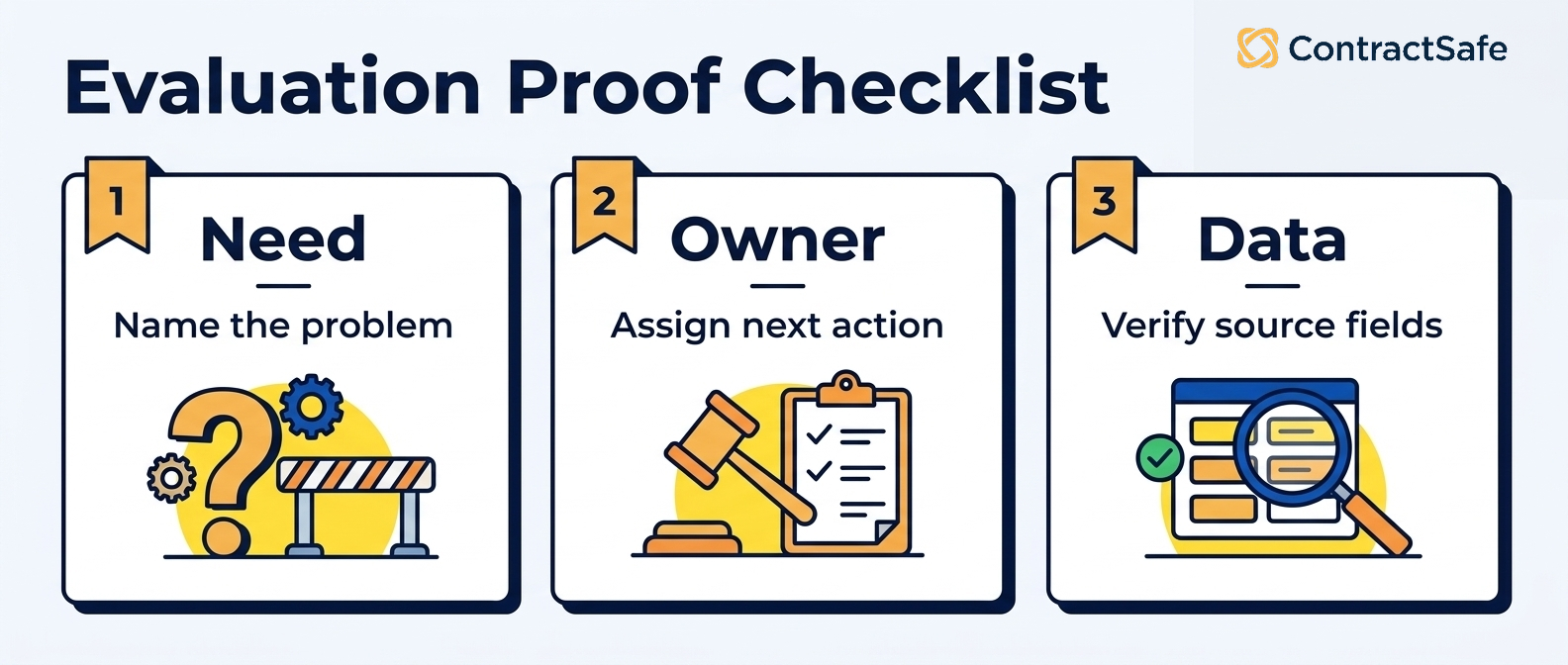
Before you decide whether this is a problem worth solving this quarter, run down this short list. And answer honestly, nobody’s grading you.
-
Can you name every payer contract that renews in the next ninety days without opening a spreadsheet?
-
Do you know, right now, which agreements auto-renew versus require active re-signature?
-
Can you find the current fee schedule for your three largest payers in under five minutes?
-
Is there one place where the executed version, its amendments and attachments live together?
-
Does someone specific own each renewal, or does ownership evaporate the moment the ink dries?
If you checked fewer than four boxes, the wiring’s running hot. That isn’t a crisis yet, but it’s the smell of one. Fix the panel before the trip.
Why Payer Contract Management Matters for Legal Teams
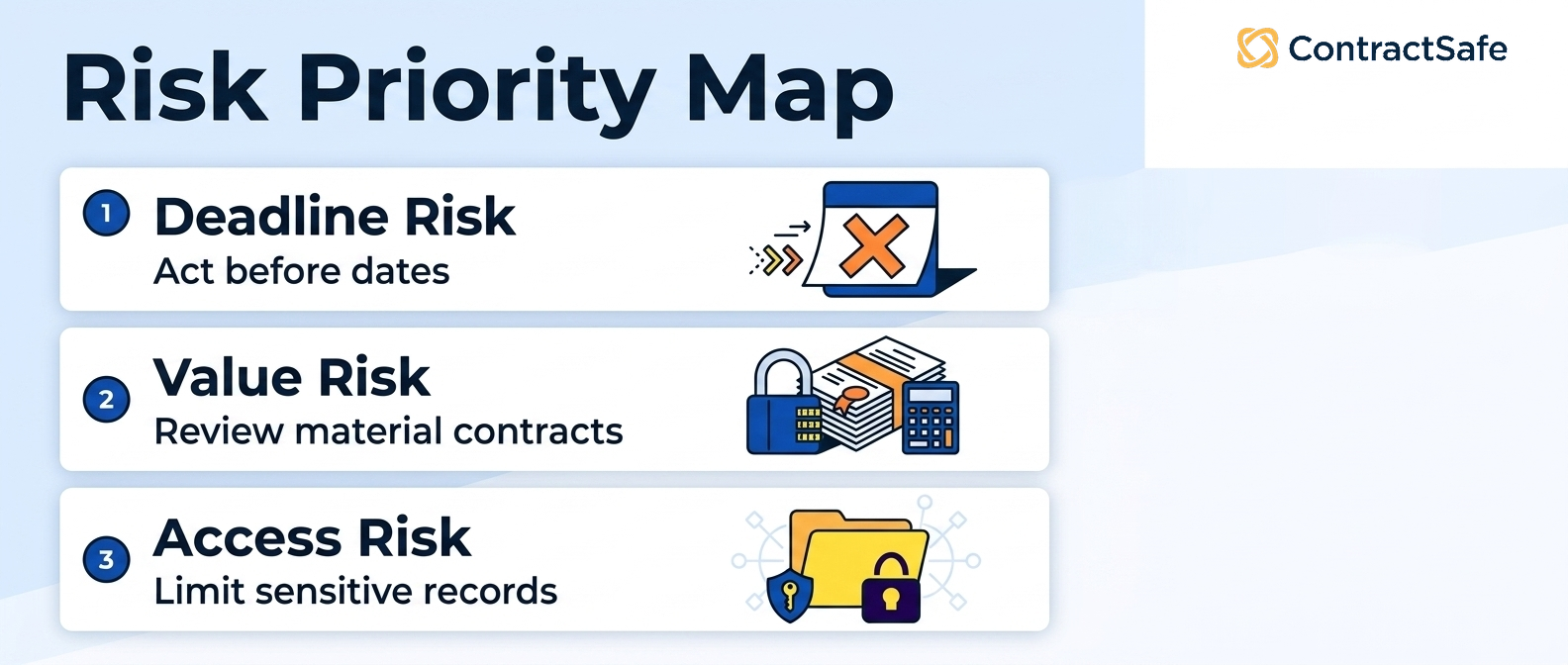
Payer contract management matters to legal teams because missed renewal windows, amendment drift, and version confusion convert directly into locked-in rates, compliance exposure, and disputes argued from the wrong document.
The wins come from putting dates and operative terms in front of legal before deadlines.
Legal teams tend to inherit payer contracts at the two worst possible moments: right before signature, when there’s no time left to negotiate, and right after something breaks, when there’s nothing left to negotiate.
The middle, where all the actual negotiating power lives, gets skipped.
In WorldCC’s research, most respondents report a consistent disconnect between legal protection and financial opportunity during template development and negotiation.
Most practitioners are telling you the protective wiring and the power wiring are run by people who don’t talk to each other. Legal guards against risk. Finance chases margin.
The payer contract is where those currents should meet, and most of the time they arc past each other.
For a legal or compliance function, that disconnect shows up as concrete exposure:
-
Missed renewal windows that lock you into outdated rates for another full term.
-
Amendment drift, where the operative terms live in an email chain instead of the executed record, which is exactly the sort of thing a healthcare compliance audit loves to find.
-
Regulatory tripwires, since payer terms touch billing accuracy, anti-kickback boundaries, and network adequacy rules that shift year to year.
-
No single source of truth, so two departments end up arguing from two different versions of the same contract.
There’s a quieter reason this matters. WorldCC notes that a new global Contract Management Standard gives cross-functional teams one framework for contracts, renewal dates, and obligations.
Translated: the excuse that legal and finance simply speak different dialects is expiring. The vocabulary exists now. Purpose-built healthcare contract software is how you put that shared language into daily practice.
My blunt opinion: the teams that get burned are almost never the ones with bad lawyers.
They’re the teams treating a payer agreement like a static file when it behaves more like a subscription that renegotiates itself the second you look away. Good contract management software doesn’t replace judgment.
It makes sure judgment gets applied before the renewal date, not after.
Common Use Cases and Workflows
Four workflows pay for themselves fastest: intake and centralization, renewal tracking, rate and amendment reconciliation, and reporting with access controls. Each one turns a recurring scramble into a scheduled task with a named owner.
Think about this work the way you’d think about tending an orchard rather than harvesting a field. A field you clear once and you’re done.
An orchard is a standing relationship with dozens of trees, each on its own schedule.
That’s what a hospital’s payer relationships actually look like. The workflows worth building let you walk the rows on purpose.
1. Intake and Centralization
Intake sounds dull and is quietly the whole game. Here is what lands in one searchable place so you can track every agreement from day one:
-
Every executed agreement and its amendments
-
Every fee schedule attachment, tied to the contract it modifies
When your Blue Cross agreement, your Medicare Advantage terms, and your regional managed care contract all live in the same repository, you can answer “what rate did we agree to for this CPT code” without three emails and a prayer.
For example, an intake pass usually surfaces agreements nobody remembered signing: orphaned amendments, superseded fee schedules filed under the wrong payer, and drafts still marked active.
First action: choose the three payers that drive the most revenue, then store their agreements, amendments, and fee schedules in one place before touching anything historical.
2. Renewal and Evergreen Tracking
Renewal tracking is where most teams lose money without ever seeing the invoice for it. Payer contracts love an auto-renewal clause with a notice window buried in section fourteen.
Miss the window and you’re locked into last year’s rates through next year’s inflation.
A renewal calendar closes that gap by making the deadline everyone’s problem before it becomes anyone’s crisis. Track two things for every agreement:
-
The auto-renewal clause and its notice window
-
The date the current rates expire
First action: list every renewal date inside the next six months and assign each one a named owner this week.
3. Rate and Amendment Reconciliation
A payer sends an amended fee schedule, someone files it, and now you’ve got two versions of the truth living in different folders.
The workflow that saves you is version control paired with a plain record of what changed and when.
For instance, when a payer sends an amended fee schedule mid-term, the workflow attaches it to the master agreement, flags the changed codes, and records who approved the change.
If you’ve ever tried to reconstruct why a claim paid at the wrong rate, you already know this is less about lawyering and more about archaeology.
First action: pull the newest amendment for your largest payer and check that the rate table in your system matches the executed document. The audit risk lives in the gap between those two versions.
4. Reporting and Access
Reporting is the part where your CFO and compliance officer each want a different number and neither wants to wait a week.
A dashboard that pulls straight from the underlying agreements turns storage into a searchable contract repository you can query.
Understanding your full contract lifecycle management stages helps here; reporting is only trustworthy when intake, amendment, and renewal feed the same source.
First action: define the one report your CFO asks for most and make it runnable without exporting to a spreadsheet.
Payer Contract Management Best Practices
Four practices carry most of the weight: standardize vocabulary before buying software, protect notice windows with ninety-day alerts, manage each contract by setting and complexity, and keep the audit trail clean.
Where hospital margins are razor thin, the leakage WorldCC measured across contracts and missed renewals is a service line, not a rounding error. So these four practices aren’t hygiene.
They’re the difference between an orchard that feeds you and one that just costs you water.
1. Standardize Before You Optimize
WorldCC has now published a global Contract Management Standard, which means you no longer have to invent a framework from scratch while your cross-functional teams argue about definitions.
Define a shared vocabulary for effective dates, renewal windows, rate tables, and termination rights, and put it in writing before you touch any software.
When everyone means the same thing by “renewal date,” half your reconciliation risk quietly evaporates.
2. Treat the Notice Window as Sacred
The single most expensive habit in payer contracts is discovering the deadline after it passes. Set alerts at intervals that give you room to negotiate, not just to react.
The common failure mode isn’t forgetting the date entirely, it’s remembering it after the useful planning window has nearly closed, which is too late to build a negotiating position and just early enough to panic. Set the lead time from the agreement’s actual notice window and the evidence the negotiation requires; for example, 90 days can be an internal planning window only after the contract-specific deadline is verified.
For example, a ninety-day alert leaves time to pull utilization data, brief the negotiator, and draft a counterproposal before the auto-renewal locks.
Your future self will thank you.
3. Respect the Context of Each Contract
Don’t force every payer agreement through one template. Build the renewal packet from the current contract, fee schedule, active amendments, performance evidence, notice window, and the operational teams that will own the next decision.
Then adjust the review plan to the agreement in front of you. A narrow specialty arrangement and a broad network agreement can require different evidence and reviewers, but each conclusion should trace back to the current contract record rather than an old market study.
Tag them by setting and complexity, and let the workflow bend to the contract, not the other way around.
4. Keep Your Audit Trail Boring
A clean version history and a permission structure that shows who touched what is the least glamorous thing in this whole discipline and the first thing you’ll reach for during a healthcare compliance audit.
Boring, in this context, is a compliment. Boring means nobody’s reconstructing anything from memory.
Spreadsheets vs Contract Management Software for Payer Agreements
A spreadsheet can track renewal dates, but a spreadsheet cannot defend a deadline when nobody is watching. Dedicated contract management software ties every renewal date to alerts, owners, and the underlying record.
| Capability | Spreadsheet tracking | Dedicated software |
|---|---|---|
| Renewal alerts | Manual, breaks when the owner leaves | Automatic, tied to the contract record |
| Amendment history | Separate files, easy to fork | Version-controlled in one record |
| Permissions | All-or-nothing file access | Folder- and role-based |
| Scanned fee schedules | Unsearchable images | OCR makes them searchable |
| Audit trail | Reconstructed from memory | Recorded as it happens |
The honest comparison is not about features. The question is whether the tracking survives staff turnover, an audit, and a renewal season landing all at once. For a lean team, that resilience is the actual product.
Implementation Plan for Legal and Procurement Teams
A safe rollout runs in five phases: inventory, failure-mode definition, structured migration, alert and access wiring, and a thirty-day review. Each phase gets one owner and a concrete exit test before the next begins.
Rolling this out is less like flipping a switch and more like transplanting that orchard into better soil. Here’s a sequence that keeps the roots alive.
Phase one, take inventory. Before you migrate anything, list every active payer agreement and where it currently lives. Half the rollout’s value is discovering contracts nobody remembered signing. Name a single owner for this pass so it doesn’t stall.
Phase two, define the failure modes you’re preventing. This is the step teams skip and later regret.
The risks worth naming out loud: renewals slipping past their notice windows, duplicate or conflicting rate schedules, orphaned contracts with no internal owner, and a migration that copies your existing mess into a nicer-looking home. Write these down.
Phase three, migrate with structure. Move contracts in batches, tag them by payer and setting as you go, and use extraction to pull effective dates, renewal deadlines, and party names into fields you can actually report on.
Migration is where good contract management software earns its keep, because manual re-keying is exactly where errors and burnout breed.
Phase four, wire up alerts and access. Set the renewal reminders, assign permissions, and confirm the right people get notified before, not after. Then pressure-test it with a live deadline you know is coming.
Phase five, review and adjust. Thirty days in, check what’s actually being used. Seeing the workflow in motion, ideally through a ContractSafe demo before you commit, tells you more than any spec sheet.
Build the Renewal Review Packet Before You Negotiate
Walking into a payer renewal without a review packet is how teams end up agreeing to terms they never actually read. Before anyone picks up the phone, pull the current agreement and every amendment into one place, then confirm what the contract really says today versus what people remember it saying. Rates drift, definitions get revised, and a single amendment can quietly change how a claim gets paid. The goal is a clean, current picture so your team argues from facts rather than assumptions.
The packet also forces a decision the team has been avoiding: what do we want out of this renewal, and what are we willing to walk away from. Assign one owner who is accountable for the file, the timeline, and the answers. That person tracks the notice window so you are not boxed in by an auto renewal, and they surface the risk questions early enough that legal and finance can weigh in before the payer sets the agenda.
- Confirm the current terms, effective dates, and how the fee schedules and reimbursement rates read after every amendment.
- Rebuild the amendment history in order so you can see what changed, when, and why it mattered.
- Calendar the notice window and any auto renewal trigger, then name the single owner accountable for hitting it.
- List the open risk questions and the outcomes your team will accept, reject, or push for before talks begin.
The teams that treat implementation as an ongoing practice rather than a one-time event keep the value their migration promised.
Related Reading
-
A deeper look at healthcare contract software and how flexibility changes what a lean team can manage.
-
A breakdown of the managed care contract, which sits right beside payer agreements in most repositories.
-
If you’re comparing tools across industries, the construction contract management software guide shows how the same core needs show up in a very different field.
How ContractSafe Helps With Payer Contract Management
ContractSafe is full-lifecycle payer contract management software, supporting intake, approvals, e-signature, governed records, reporting, alerts, and renewal decisions. Test the workflow with a live payer packet in a ContractSafe demo.
ContractSafe is contract management software for lean healthcare legal, finance, and operations teams that need payer agreements organized without a dedicated admin babysitting the whole thing.
The recurring nightmare is the deadline you didn’t see coming, and that’s precisely what ContractSafe was built to remove.
ContractSafe handles renewals, milestones, and notice windows with proactive alerts and reminders, so the system supports the contract-specific negotiating runway you verify.
Underneath the alerts sits the part that makes them trustworthy. ContractSafe centralizes signed agreements in one searchable repository, and OCR technology makes scanned documents searchable, fee schedules included.
AI extraction pulls effective dates, renewal deadlines, party names, and key clauses into fields your team can review and report on, which turns migration from a re-keying marathon into a structured pass.
When your CFO asks what a payer relationship is actually costing, custom dashboards and reports answer without a spreadsheet excavation, and version control plus audit trails mean your next compliance review reads a labeled timeline instead of a mystery.
Because ContractSafe includes unlimited users on every plan, your legal, finance, and operations teams can all work from the same source without per-seat math.
Implementation and migration support come included, so the rollout above doesn’t stall waiting on a separate services engagement.
You can see published ContractSafe pricing without sitting through a quote process first.








.svg)







.svg)