
Logistics contract management software is software for managing carrier, broker, customer, warehouse, insurance, and service agreements.
Think of it like a dispatch board for contract obligations. Each route has rates, exceptions, and documents attached. In practice, the software means four jobs: storage, clause search, date alerts, and document chains per carrier.
When a fee is disputed, the answer is not in the truck. It is in the agreement.
Key Takeaways
- Carrier rate agreements are renegotiated every 12 to 18 months. When the market flips, you need to see across every carrier simultaneously.
- Freight billing errors can cost shippers a hefty 3-7% of their total freight spend each year. The contract is the only document that proves an overcharge.
- Cargo theft and security? Those used to be a concern for some, but now they're a massive headache. Inbound Logistics found that these issues jumped from being a top challenge for 12% to 48% of shippers in just two years.
- ContractSafe offers unlimited users, OCR for scanned compliance documents, and AI extraction across the full portfolio.
Choose Your Next Step
Logistics contract problems get solved faster when you start from the agreement type that's burning you this quarter. Jump to the part of this guide that matches it.
- Market flipped on you? Start with what happens when the freight market turns.
- Auditing invoices? Go to the billing problem and pull the rate agreements first.
- Vetting carriers? Read the carrier fraud problem and check the compliance documents.
- Building the system? Work through the nine agreement types and the thirty-day rollout.
- Whichever path you take, assign an owner to every carrier agreement you touch and set alerts on its insurance and renewal dates as you go.
- Need the foundation first? Our contract repository requirements guide covers what the underlying system must do.
When the Freight Market Flips, Every Carrier Contract Needs Review
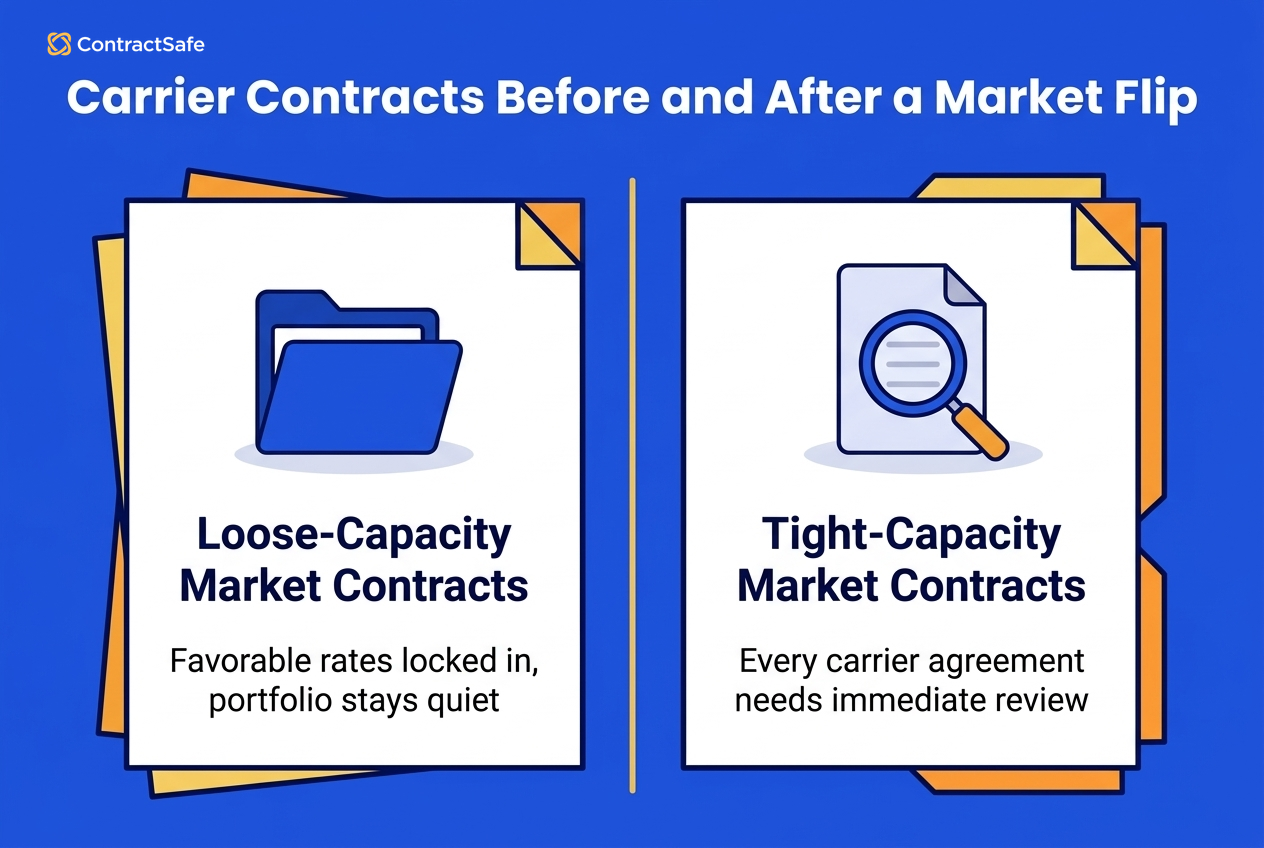
A freight market flip turns a quiet contract portfolio into an urgent review queue, because every rate, commitment, and accessorial schedule was priced for the old market.
The freight market is cyclical, and the cycle is fast. Carrier contracts are typically reviewed every 12 to 18 months. But the market doesn’t wait for the review cycle.
Through the loose-capacity stretch, carriers dropped rates to compete for volume. A shipper with 80 carrier agreements ran an RFP, locked in favorable terms, and filed the contracts. Some in the TMS. Some in email.
The insurance certificates went wherever the ops manager put them.
Then the market flipped. Capacity tightened. Carrier exits accelerated. Some shippers saw accessorial charges double year over year in 2025.
| Before the Flip | After the Flip |
|---|---|
| Rates locked at favorable terms | Rates below what carriers will accept |
| Carriers competing for volume | Carriers pushing back on commitments |
| Contract portfolio is quiet | Every agreement needs immediate review |
| Filing location doesn’t matter | Filing location is the difference between renegotiating in a day and scrambling for a week |
A logistics manager who can search across every carrier agreement simultaneously, pull up rate terms by lane, and see which contracts expire soonest can renegotiate strategically.
The one who can’t is calling carriers one at a time, working from memory.
The Nine Agreement Types in a Logistics Portfolio
A logistics contract portfolio runs on nine agreement types, and a market shift stresses every one of them at once.
The rate agreements are the obvious problem, but carrier rates are only one layer. Broker terms, customer SLAs, equipment leases, insurance, compliance packets, facility agreements, surcharge schedules, and claims records all carry their own dates and owners.
Here's each type in working detail: what it governs, what breaks, and what to track. Check your own portfolio against the list and require a system home for every type you find.
Work the list in order of claim exposure: insurance and compliance documents first, then rates and accessorials, then the slower-moving leases and facility agreements.
Before you start, confirm who owns each agreement type today, because half the gaps below are really ownership gaps wearing a filing problem's clothes.
1. Carrier Rate Agreements
Carrier rate agreements set the base rates, lane commitments, volume terms, and the accessorial schedule each carrier can bill against.
For example, when the market tightens, the agreement is what says whether a carrier can walk away from committed capacity or reprice mid-term.
Track the expiration and renegotiation windows by carrier and lane, and check the accessorial schedule against the invoices monthly.
When the market flips, run the portfolio review from the contract records: expirations soonest first, below-market commitments flagged, and renegotiation owners assigned per carrier.
- Watch for: rate agreements that live only in the TMS, separated from their amendments.
- Watch for: evergreen language that quietly extends below-market commitments.
2. Broker Agreements
Broker agreements set commission terms, liability allocation, and payment flows between shippers and freight brokers.
Commission terms that seemed reasonable when freight was cheap eat into already-thinning margins when the market turns. Liability allocation matters more when claims increase during tight capacity.
Check who carries cargo liability in each broker relationship before a claim forces the question.
For example, a broker failure with freight in transit turns every ambiguous liability clause into a same-day legal question. Read those clauses before the market makes you.
- Watch for: double-brokering prohibitions with no verification process behind them.
- Watch for: payment terms that leave you liable when a broker fails to pay the carrier.
3. Customer SLAs
Customer SLAs set the delivery commitments, performance penalties, and review windows your own customers hold you to.
Performance penalties that were easy to avoid with abundant capacity start triggering when trucks aren’t available. The shipper needs the SLA terms on screen immediately, not after a 20-minute search through a contract folder.
For example, a penalty clause with a cure window only helps if someone sees the breach inside the window. Set the alert on the review date, not the renewal.
Check each SLA against current carrier capacity quarterly, and renegotiate the commitments you can no longer keep before the penalties decide for you.
- Watch for: SLA penalties that compound monthly while nobody monitors the threshold.
- Watch for: commitments your rate agreements can no longer support after a market flip.
4. Equipment Leases
Equipment leases carry the hidden obligations: balloon payments, end-of-term mileage caps, and renewal windows that pass unnoticed.
For example, a balloon payment due in Q4 and a mileage cap that's already been exceeded are both findable today, and both expensive as surprises.
Extract the term dates, caps, and end-of-lease duties into fields, and check usage against the caps quarterly.
Check the lease dates against the equipment plan quarterly: returns, buyouts, and renewals each need a decision before their window, not after.
- Watch for: maintenance obligations that shift cost to you at end of term.
- Watch for: auto-renewing leases on equipment you planned to return.
5. Insurance Certificates and Policies
Insurance documents prove coverage exists for the freight, the carrier, and the facility, and each certificate expires on its own schedule regardless of the contract terms around it.
Coverage gaps between renewal and new policy are invisible until a cargo claim hits. A carrier’s insurance certificate that expired last month means the shipper is carrying risk they don’t know about.
Require certificates on the contract record with expiration alerts, and confirm the replacement certificate arrives before the old one lapses.
For example, a cargo claim against a carrier whose certificate lapsed last month is a loss you carry. The alert costs nothing; the gap costs the cargo.
- Watch for: certificates collected at onboarding and never re-requested.
- Watch for: coverage amounts that no longer match the cargo values you're tendering.
6. Carrier Compliance Documents
Compliance documents are the onboarding packet that keeps you shipping with authorized carriers: FMCSA authority, DOT certification, safety records, W-9s, and the signed carrier agreement.
If any of those lapse or were fraudulent from the start, the shipper is exposed. When a carrier’s authority expires, the alert needs to fire before the next load is tendered, not after.
Check the packet completeness per carrier monthly, and re-verify the high-volume carriers first.
Treat packet verification as a recurring obligation, not an onboarding event: authority and insurance get re-checked on a schedule tied to volume.
- Watch for: onboarding packets that were complete once and never refreshed.
- Watch for: documents that pass filename checks but were never opened and read.
7. Warehouse and Facility Agreements
Warehouse agreements govern storage rates, liability for stored goods, access hours, and termination terms for the spaces your freight moves through.
For example, a third-party warehouse agreement with a three-month exit clause is the constraint on every network redesign, and that clause is rarely in the room when the redesign is planned.
Track the exit windows and rate review dates alongside the carrier portfolio; networks change faster than facility contracts allow.
Before any network change, pull the facility agreements first and map the exit windows. The redesign timeline is whatever the contracts say it is.
- Watch for: liability caps below the value of goods you actually store.
- Watch for: holdover clauses that reprice storage steeply after expiration.
8. Accessorial and Surcharge Schedules
Accessorial schedules define what carriers can bill beyond base rates: detention, fuel surcharges, reclassification, liftgate fees, and the indexes behind them.
For example, if the agreement caps the fuel surcharge at a published index and the invoice bills a flat percentage, that's recoverable money, but only if you can find the schedule and point to the clause.
Keep schedules attached to their parent rate agreements, and audit the top accessorial categories against contracts every quarter.
For example, detention billed beyond the contracted free time is the most common recoverable error; the schedule plus the timestamps is the whole dispute.
- Watch for: schedules amended by email that never reached the contract record.
- Watch for: surcharge indexes that no longer exist, leaving the billing basis undefined.
9. Claims and Liability Records
Claims records connect cargo loss events to the agreements that allocate the liability: the carrier contract, the broker terms, and the insurance policies.
A claim is a race to assemble documents. The team that can pull the carrier agreement, certificate, and tender record in minutes recovers; the team that can't absorbs the loss.
Run a claims drill once a quarter: pick a delivered load and time how long the full document chain takes to produce.
Attach every claim's documents to the carrier's contract record as it happens. The next negotiation with that carrier should start from the full history.
- Watch for: claims handled entirely in email, leaving no trail on the contract record.
- Watch for: liability language that conflicts between the broker and carrier agreements.
Quick gut check before you build anything. Pick one active carrier and try to produce its rate agreement, current insurance certificate, and authority verification in five minutes. That elapsed time is the problem, measured.
The Carrier Fraud Problem
Carrier fraud is now a contract-document problem: vetting partners means verifying the onboarding packet, not just the load board profile.
Inbound Logistics’ 2025 Trucking Perspectives survey found that cargo theft and security concerns jumped from 12% to 48% of shippers’ top challenges in just two years. Carrier fraud, double-brokering, and identity theft are reshaping how logistics companies vet their partners.
The onboarding package for a new carrier is a set of contractual compliance documents: proof of FMCSA authority, insurance certificates, safety records, W-9s, and the signed carrier agreement itself.
If any of those documents lapse or were fraudulent from the start, the shipper is exposed. Tracking those documents across dozens or hundreds of carriers is a contract management problem.
Verify the packet at onboarding, set expirations on every document, and check the chain again before high-value loads.
The Billing Problem in Logistics
Freight billing errors are recoverable money, and the rate agreement is the proof.
Zero Down Supply Chain Solutions estimates that freight billing errors cost mid-market shippers 3 to 7% of total freight spend annually. Base rates, fuel surcharges, accessorial fees, detention charges, reclassification fees. The invoices are complex and the errors are buried.
The only way to dispute an overcharge is to produce the contract. That's the rate agreement that specifies what the carrier can and cannot bill.
A searchable repository that lets you pull up a carrier’s rate terms in seconds turns freight auditing from a quarterly project into something you can do on every invoice.
Start with your top five carriers by spend: compare last month's invoices against the rate agreements and accessorial schedules, and log every billing mismatch you find.
The TMS Manages the Freight. The CLM Manages the Agreements.
A TMS manages the freight. A CLM manages the agreements. The difference decides which questions your team can answer when something goes wrong.
A Transportation Management System handles load planning, routing, and carrier selection. It manages active shipments. It’s needed.
But the TMS doesn’t track when a carrier’s insurance certificate expires. It doesn’t store the broker agreement’s liability clause. It doesn’t alert you when a customer SLA’s performance review window opens.
It doesn’t hold the equipment lease with the balloon payment due in November.
The CLM manages the agreements behind the shipments. Compared side by side: the TMS answers "where is the load?"; the CLM answers "what did we agree to, and what happens now?"
Check your stack against the nine agreement types above. The ones with no system home are the ones a market flip finds first.
Questions to Ask a Vendor Before You Buy
The right vendor questions for logistics contract software expose whether the system handles freight's document variety, not just clean PDFs. Start from the shortlist in our comparison of contract management platforms and ask each of them.
- Can OCR read a faxed insurance certificate and a scanned rate confirmation? Bring both to the demo.
- Can one carrier's record hold the agreement, certificates, compliance documents, and claims history together?
- Can alerts escalate when the insurance contact ignores the first expiration notice?
- Can a dispatcher look up rate terms without a license-seat negotiation?
- Can reports show expirations by month across carriers, brokers, and leases in one view?
- What does week one look like with four hundred mixed documents, and who does the work?
Score the answers against the nine agreement types above. A system that handles only the rate agreements solves a ninth of the problem.
A Thirty-Day Logistics Rollout
A logistics contract rollout fits in thirty days when it starts from the carriers that move the most freight.
- Week one: upload every carrier, broker, customer, lease, insurance, and facility agreement you can find. Let OCR and AI extraction make the first pass.
- Week two: verify the extracted rates, dates, and liability terms on your top carriers by spend, and assign an owner to each agreement.
- Week three: set alerts on insurance expirations, compliance documents, lease windows, and SLA review dates, with escalation.
- Week four: run the claims drill and the invoice audit on one carrier, and time both. Those two numbers are your before-and-after proof.
If a vendor's rollout plan can't fit that shape, ask what the extra time buys. The freight market won't wait for a services project.
Keep the drill numbers from week four on the contract record itself. The next market flip is a when, not an if, and the team that measured its document-retrieval time once can prove the system still works each quarter.
And schedule the first full portfolio review for ninety days out: extraction verified on every carrier, owners confirmed after any turnover, and the watch-fors from the nine agreement types checked against reality.
Mistakes That Cost Shippers Real Money
The expensive logistics contract mistakes repeat across shippers, and each one is checkable this week.
- Paying invoices without the accessorial schedule open. The errors are buried in detention and reclassification lines, and the schedule is the only proof.
- Treating the insurance certificate as an onboarding document instead of an expiring one. The gap appears exactly when a claim does.
- Letting rate agreements auto-renew through a market flip. Yesterday's favorable lock is today's above-market commitment.
- Filing the equipment lease and forgetting the balloon payment. Q4 budgets discover these the hard way.
- Keeping the carrier agreement in the TMS and the amendments in email. The current terms are whichever document someone finds first.
Check your portfolio for all five before renewal season. Each takes an hour to verify and a quarter to discover unverified.
Related Reading
- Auto-renewal clauses, for the renewal traps in carrier and lease agreements.
- Contract management metrics, for the numbers that prove the portfolio is actually being tracked.
- Contract repository requirements, for the buying checklist underneath this rollout.
How ContractSafe Helps With Logistics Contract Management
ContractSafe gives logistics teams portfolio-wide search, automated date alerts across hundreds of agreements, AI extraction that handles the variety from rate contracts to facility leases, and unlimited users so dispatchers, account managers, and the CFO all have access.
The nine agreement types above become one searchable portfolio: rate terms by lane, insurance expirations with escalating alerts, compliance packets per carrier, and the accessorial schedules attached to their parent agreements.
Connect the work to your main contract storage, the key details about each contract, and how you manage your obligations, with renewal and effective date hygiene on every record.
For a deeper dive into the discipline, WorldCC's contract resources and the National Contract Management Association's journal cover contract management beyond the software.
The fastest proof is your own carrier file. Bring one carrier's rate agreement, insurance certificate, and compliance packet to a free demo and run the five-minute drill live.









.svg)







.svg)