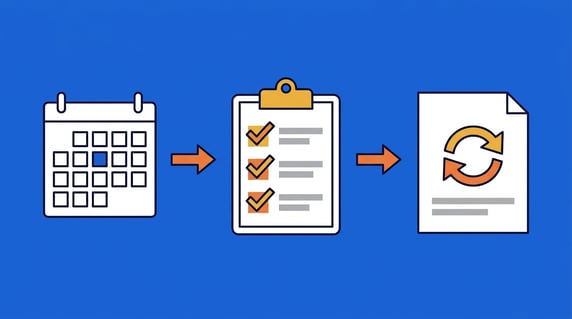
Quick answer: A contract renewal process is the set of steps for finding, reviewing and deciding on agreements before their notice deadline. Doing it well comes down to sorting each agreement into a tier by value and risk, counting back from that deadline, and sending it through a named owner and approval chain. Every renewal should end in one of three calls (renew, renegotiate or exit), and that call has to clear a compliance check before anyone signs.
Here's the failure that process is built to prevent. Your marketing analytics subscription renews for another twelve months unless someone gives written notice at least sixty days before the end date. Somebody did set a reminder, thirty days before the end date, so it fired a full month after the notice window closed. By the time anyone opens the contract, the only thing left to negotiate is who explains the invoice to Finance.
The contract wasn't the problem. The reminder counted from the end date instead of the notice deadline, which Step 3 fixes by counting back from the deadline itself. Nobody had put the renewal in a tier or named an owner for it, so nobody was watching when the window closed, and Steps 2 and 4 fix that. If one of those gaps is already costing you money, start here.
Choose your next step:
If you're ready to stop tracking notice dates by hand, start with contract renewal tracking software.
If you're not sure whether you're looking at a renewal, which starts a new term often with new pricing, or an extension of the same agreement on the same terms, read our explainer on contract renewals first.
Key Takeaways
- Keep every contract in one searchable place, with each notice deadline stored as its own date.
- Tier every renewal by value and risk, then count alerts back from the notice deadline: 120 or more days for Tier 1, 90 for Tier 2 and 60 for Tier 3.
- Give every renewal a named owner and an approval chain that grows with its tier, up to Legal → Finance → Exec.
- End each renewal with a renew, renegotiate or exit call based on SLA results, usage, spend and market pricing, and hold any rollover until security, privacy and insurance checks pass.
- Record every outcome so next year's tiers and lead times improve.
Why Contract Renewals Slip Through the Cracks
Contract renewals slip for four predictable reasons, and good contract renewal management fixes them in order. Plenty of teams still manage renewals in spreadsheets, inboxes or shared drives nobody really owns.
- Contracts sit in inboxes, shared drives and old email threads, so nobody can see what's coming up. Step 1 fixes this.
- Every renewal gets the same attention, so a $300 tool competes with a regulated cloud vendor for the same review time. Step 2 fixes this.
- Auto-renewals roll over quietly because the alerts count from the end date instead of the notice deadline. Step 3 fixes this.
- There's no time or data left to negotiate, so the vendor's quote becomes the price. Steps 4 to 6 fix this.
Organizations lose an average of 11% of contract value after signature, according to World Commerce & Contracting's 2026 procurement value gap study, and a renewal is one of the few moments you can win some of that back, as long as it surfaces in time.
1. Centralize Every Contract and Make It Searchable
Store every contract in one searchable repository, with its notice deadline saved as its own date, so you can see what's coming up without opening each PDF.
The volume is why this can't wait. Zylo's 2026 SaaS statistics put the average organization at 211 SaaS renewals a year. That's close to one every business day, before you count leases, services agreements or supplier contracts.
Save the renewal details as their own fields instead of leaving them buried in the text:
- The end date and the notice deadline, kept as two separate dates (the notice deadline is the one that costs you money)
- The renewal term and whether the contract auto-renews
- The owner, the annual value and the tier you'll assign in Step 2
Once everything's in one place, you can search for words like “auto-renew” or “price escalation” across every contract, scans included, instead of opening PDFs one by one. If your agreements are still spread across drives, our guide to a centralized contract repository covers the move.
2. Tier Your Renewals Before You Touch Them
Put each renewal in a tier based on value and risk before any review starts, because not every renewal needs a negotiation. The tier sets how early work begins, how deep the review goes and who signs off. That way your team spends its time on the contracts that can actually hurt you.
Three tiers cover most portfolios. Tier 1 is for high-value, regulated or operationally critical contracts, meaning anything tied to revenue, customer data or keeping the lights on. Tier 2 is for mid-value agreements where pricing and performance are worth a real look. Tier 3 is for low-value SaaS and commodity services, where the usual question is whether you still use the thing.
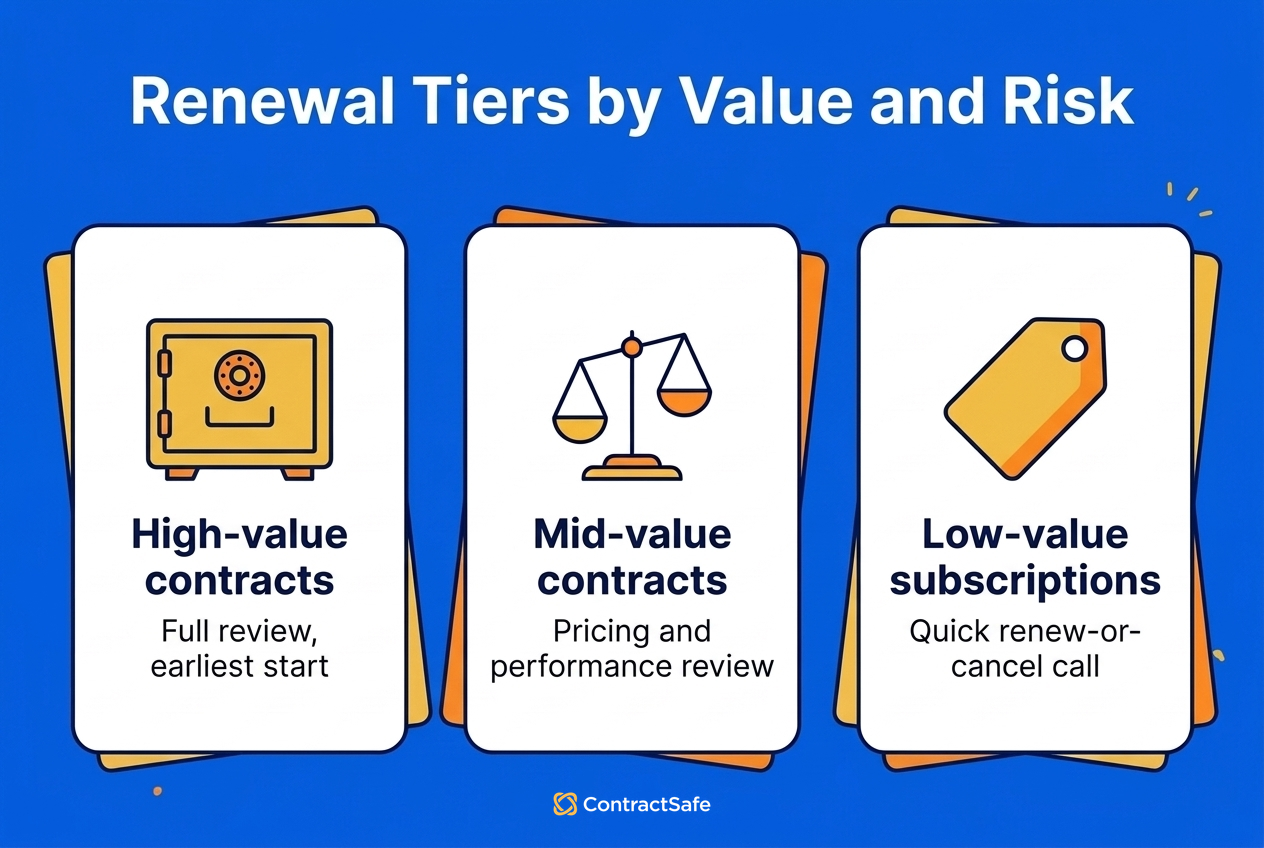
Every tier gets a compliance check before the decision, and the tier only sets how deep it goes. Tier 1 gets a full review and approval from Legal → Finance → Exec. Tier 2 gets a pricing and performance review approved by Legal → Finance. Tier 3 gets a quick renew, renegotiate or exit call from the contract's owner, after a light compliance check.
Set your own value thresholds and write them down. A $50,000 contract might be Tier 1 at a 40-person company and Tier 2 at a large bank. With written thresholds, a contract's tier doesn't depend on who happens to be looking at it.
| Tier | What qualifies | First alert (days before the notice deadline) | Review depth | Who approves |
|---|---|---|---|---|
| Tier 1 | High-value, regulated or operationally critical contracts | 120 or more | Full review of pricing, performance, terms and compliance | Legal → Finance → Exec |
| Tier 2 | Mid-value contracts | 90 | Pricing and performance review plus a standard compliance check | Legal → Finance |
| Tier 3 | Low-value SaaS and commodity services | 60 | Usage check plus a light compliance check | The contract's owner |
3. Set Alerts That Count Back From the Notice Deadline
Set automated alerts that count back from the notice deadline rather than the contract's end date. Reminders someone sets by hand get missed, and under a 60-day notice clause, an alert set 30 days before the end date fires after the window has already closed.
Tier 1 contracts get their first alert 120 days before the notice deadline, followed by alerts at 90, 60 and 30 days. Tier 2 starts at 90 days, and Tier 3 gets alerts at 60 and 30 days. If a renewal shows up 90 days early, you've still got time to negotiate, but once it's auto-renewed, all you can do is pay the invoice. Send each alert to the owner and the next approver, rather than one shared inbox, so one person's vacation can't sink a renewal.
In ContractSafe, you set reminders on the notice-to-renew date itself, using the notice deadline field you created in Step 1, and you can add as many date fields as you need on every plan. Each reminder can go to anyone, including colleagues and outside counsel who don't have a login, with the contract attached. The notice date rolls forward with each renewal, so next year's alerts are already waiting once this year's call is made.
Don't count on the vendor's reminder. In New York, General Obligations Law 5-903 makes an auto-renewal clause in a service, maintenance or repair contract unenforceable against the customer unless the vendor gives written notice “at least fifteen days and not more than thirty days” before the time for serving cancellation notice.
Wisconsin's business contract renewal statute is narrower than it sounds. It covers business-equipment leases and business-service contracts whose initial term runs longer than a year and that renew for another term longer than a year. For those, the vendor has to give notice “at least 15 days but not more than 60 days before the deadline for the customer to decline renewal or extension,” and a customer who didn't get it can recover twice their damages.
Colorado now reaches business contracts too. Colorado SB25-145 changed the definition of “consumer” in the state's automatic-renewal law from an individual buying for household purposes to any person, so since February 2026 the law has covered business auto-renewals as well. Vendors have to send a reminder 25 to 40 days before each automatic renewal and offer one-step online cancellation for contracts you agreed to online.
There's no federal backstop either. In March 2026 the FTC restarted its Negative Option Rule with an advance notice of proposed rulemaking, and no federal click-to-cancel rule is in force.
That leaves a handful of states, New York, Wisconsin and Colorado among them, that make the vendor warn you at all. Each one lets the vendor wait until late in the window: 15 days before your notice deadline in New York or Wisconsin, or 25 days before the renewal in Colorado. That's far less than the 90 or 120 days a Tier 2 or Tier 1 renewal needs, which is why your own alerts are the protection that counts.
Decision Check
Before your next renewal comes in, check your current setup against these three questions. If any answer is no, fix that first.
- Can one search pull up every contract with a notice deadline in the next 120 days?
- Does each of those contracts have a tier, a named owner and a notice deadline stored separately from its end date?
- Would the first alert give that contract the full runway its tier calls for before the notice deadline?
4. Standardize the Workflow and Name Every Owner
Give each renewal a named reviewer, approver and signer, and route it through a fixed chain (Legal → Finance → Exec for Tier 1) that starts automatically when the renewal window opens. Unclear ownership sits behind plenty of contract management challenges, and renewal delays often happen because no one knows who needs to approve what, or when.
Renewals involve more than Legal, and each function brings its own question. Finance wants cost control. Procurement wants vendor performance. Operations wants delivery continuity, and Legal wants terms that still protect you. When everyone works from the same report and alerts, those questions come up in a set order instead of in a group chat three days before the deadline.
That report is worth running on a schedule. Once a month, pull every renewal with a notice deadline inside the next 120 days, grouped by department, owner and tier, and send it to each department head, so Operations sees its own renewals before Finance starts asking about them. In ContractSafe, you can store the department as a custom field and set that renewal report to email itself automatically to anyone who needs it.
The chain grows with the tier. Tier 1 runs the full Legal → Finance → Exec sequence, Tier 2 stops at Finance, and Tier 3 stays with the owner. On the Finalize and Maximize plans, ContractSafe emails a pending approver every three days until they act, and if someone rejects a renewal, their reasons and comments stay with the contract. Keep the version history and comments with the contract too, so next year's owner can see why this renewal went the way it did.
5. Decide to Renew, Renegotiate or Exit
Every renewal should end in an explicit call. Renew as-is if the vendor hit its SLAs, the price is still competitive and nothing has changed on compliance. Renegotiate if pricing has drifted, usage has changed or terms such as termination clauses have gone stale. Exit if performance has slipped or there's a better option.
Treat every renewal like a new deal and make the call with numbers, starting with the renewal's total contract value. Pull SLA performance, historical spend and actual usage against paid seats, then check the price against the market, and write down the negotiation history so next year's owner starts with the context.
Usage is often where the easy money sits. Zylo's 2026 SaaS Management Index, drawn from more than 40 million licenses and $75 billion in spend, reports that organizations leave an average of 36% of their SaaS licenses unused when measured against industry utilization standards. Zylo's 2026 SaaS statistics also show that 79% of IT leaders saw price increases at renewal in the past 12 months.
Timing also changes the price you're offered. Vertice's SaaS inflation index recorded 16.4% in June 2026, its highest monthly rate on record, and Vertice notes that for annual contracts “the increase they're offered at renewal depends heavily on timing.” That's why Tier 1 starts at 120 days: you need room to benchmark before the vendor's quote becomes the default.
Exit is getting cheaper for some contracts. Under the EU Data Act, cloud providers can't charge customers for switching or data egress from 12 January 2027, so switching fees stop being a reason to roll over.
6. Gate Every Rollover on Compliance
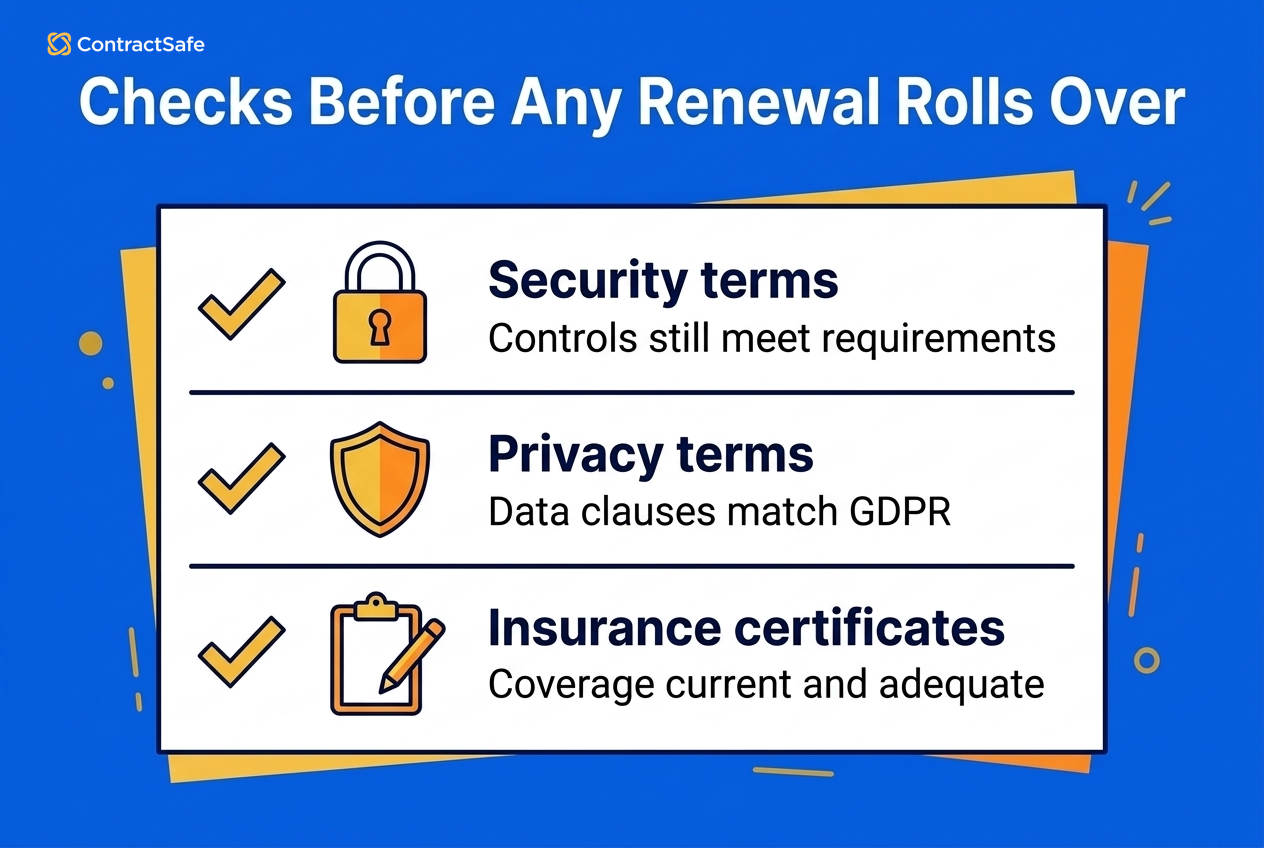
No contract should renew until the vendor still meets your current security, privacy and insurance requirements. A vendor that passed at signing may not pass now, so treat compliance as a gate every renewal has to clear, and let the tier decide how deep the check goes.
World Commerce & Contracting's Contract Management Standard treats managing obligations after signature as part of the job, and a renewal is the natural moment to check them. Before anything rolls over, make sure you've got:
- A current security attestation, such as an up-to-date SOC 2 report
- Data processing terms that still meet GDPR for any personal data the vendor handles
- DORA contractual terms, if you're a financial entity buying ICT services in the EU
- Current insurance certificates at the limits your contract requires
DORA oversight of technology providers has become concrete. On 18 November 2025, the European Supervisory Authorities published their DORA critical provider designations, putting 19 named providers under direct EU oversight. The list goes beyond hyperscale cloud (AWS, Google Cloud, Microsoft, Oracle and SAP) to IT services and telecom firms such as IBM, Accenture, Kyndryl and Deutsche Telekom, so the gate applies to your non-cloud renewals too. Expect some designated providers to push back at renewal on contract demands they think direct oversight already covers.
Financial entities also have to keep a register of information on all their ICT contractual arrangements, which is hard to do when renewal records live in email. Pull a report of every renewal tied to a critical vendor so those get checked first. Run the renewal copy through AI contract review to flag clauses that changed since the last term, then have Legal confirm each flag.
If a check fails, hold the renewal until the vendor fixes the problem or you decide to exit. For Tier 1, add a “renewal risk review” to the monthly report from Step 4, so nothing inside the 120-day window gets missed between cycles.
7. Close the Loop After Every Renewal
After each renewal, record what happened and use it to reset next year's tiers and lead times. Note the outcome (renewed, renegotiated or exited), any savings or term changes, and how much runway you actually had before the notice deadline.
Then adjust. If a renewal felt rushed, move its first alert earlier next year. If a Tier 2 contract took three rounds of negotiation, it may belong in Tier 1. If nobody used a Tier 3 tool all year, the next call is probably exit. The notes from this round become the starting point for the next one, which is really what makes renewal a stage of contract management rather than a one-off chore.
Add up what each renewal saved or avoided, because a quarterly summary of savings and avoided rollovers gives Finance a real return on contract management and tells you which tiers need longer lead times.
What This Looks Like in Practice
Run on one contract, the process takes a $40,000 subscription from its first 120-day alert to a signed, cheaper amendment well before the notice deadline.
A project management subscription costs $40,000 a year for 100 seats. It auto-renews for 12 months unless you give notice 60 days before the end date. For a 200-person company, that makes it Tier 1, so the first alert goes to the owner, an operations manager, 120 days before the notice deadline.
The owner pulls usage data and finds that 30 of the 100 paid seats haven't been used in six months. At $400 a seat, cutting down to actual use saves about $12,000 a year before anyone talks about price. Legal confirms the vendor's SOC 2 report is current and asks for an updated insurance certificate, which arrives two weeks later.
The vendor's renewal quote includes a price increase. With the seat data in hand, the owner renegotiates: 70 seats at the old per-seat rate, with the notice period shortened from 60 to 30 days. Finance approves, the Exec signs, and the amendment is done well before the notice deadline. The owner logs the outcome, the $12,000 saving and the 90 days of runway left before the notice deadline, and keeps the contract at 120 days for next year.
Related Reading
- Renewal strategy for in-house counsel: how automated alerts drive down renewal costs and risks.
- How to audit your contracts: finding the hidden risks before they renew.
- Contract tracking tips: the do's and don'ts that keep dates and owners current.
How ContractSafe Helps with Contract Renewal Management
ContractSafe's contract management software keeps your renewals, their dates and their owners in one place. It automates the parts people forget: reminders on notice-to-renew dates that roll forward with each renewal, and a renewal report by owner or department that emails itself to whoever needs it. You set the tier, owner and department as custom fields, and search covers every word in every contract, including scans, so you can pull up every “renewal” clause in seconds.
Date fields, reminders, reports and search come with every plan. The Finalize and Maximize plans add approval workflows that set who reviews a renewal and when, and the Maximize plan adds approval sequences with automated stage changes based on approval and e-signature activity.
ContractSafe pricing starts at $450/month (Organize plan, billed annually; $540 month-to-month), with unlimited users on every plan. Everyone who touches renewals in Legal, Finance, Procurement and Operations can jump in without extra cost. Our security practices include SOC 2 audit certification and 256-bit AES encryption, and ContractSafe implementation includes onboarding, data migration and a dedicated customer success manager with no implementation fee.
Carrie McClain, Procurement Specialist at Vitality Living, put it this way: “ContractSafe helps us stay ahead of renewals and saves me at least a few hours every week. Instead of rebuilding information from SharePoint, I can pull the contract report I need and keep the process moving.”








.svg)







.svg)