Here's the short answer: a contract repository pays off in four ways. You stop auto-renewing into contracts you meant to cancel. You answer "what does our termination clause say" in seconds instead of spending an afternoon opening PDFs. You walk into a renegotiation knowing what you already pay that vendor across every agreement. And when an auditor asks for twelve contracts, you send them the same day. Everything below is how those four actually happen.
Every important agreement, contract, memorandum, or amendment is stored in a contract repository. And it's not always given the respect it deserves. It's an often-overlooked asset that can make or break your business. A contract repository should be easy to navigate, secure, and powerful enough to find a document, even if you only remember a tiny excerpt or the counterparty's name. For the step-by-step on setting up, automating, and implementing a contract repository, read our complete contract repository guide.
Here's a quick way to tell whether your current setup earns the name. Ask for the termination terms in one vendor agreement and see how long it takes. Seconds means you already have a working repository. Hours of opening PDFs means you have a folder. The assessment below turns that gut check into a score across storage, findability, key dates, workflow, and risk, so you'll know which of the nine features later in this guide would change your answer.
Key Takeaways
- A contract repository simplifies contract management, offering easy access, bank-level security, and efficient oversight of all contractual documents. This digital approach acts as a reliable document repository system.
- Key features to look for include AI-driven data extraction, advanced search capabilities, automated data reminders, seamless tech integration, version control and audit trails, and user-friendly interfaces.
- Embracing a modern contract repository solution not only boosts efficiency and reduces risks but ensures consistent, transparent, and proactive management of business contracts.
What "User-Friendly" Actually Means in a Repository
Ease of use isn't a feeling, it's four numbers you can measure in a free trial:
Time to first answer. Upload 20 contracts. Can you pull the termination clause from one of them within an hour? If it takes a day, the system isn't friendly, it's just digital.
Clicks to a real question. "Which contracts renew in Q1?" should be one filter, not an export to Excel.
The non-lawyer test. Hand it to someone in sales or finance with no training. If they can find their own contract in five minutes, adoption will stick. If they need a walkthrough, it won't.
Setup before value. Some platforms need workflow configuration before they do anything. Others index your contracts on upload. Ask which one you're buying.
What Is a Contract Repository?
A contract repository, at its core, is a centralized digital system where organizations store, organize, track, and manage their contracts. A contract repository or document repository ensure that all documents are organized, easily accessible, and protected. It can also be referred to as a file repository or a repository for documents. The terms "contract repository" and "document repository" are often used interchangeably—they both mean the same thing. However, because contracts are typically the only types of documents stored, the name contract repository is used more often.
Rather than simply storing documents, a digital contract repository can use features like artificial intelligence (AI), optical character recognition (OCR), and cloud technology which drastically reduces contract cycle time, a key benefit.
And it’s all thanks to the metadata or the “data about data” stored within each contract.
What's Stored in a Contract Repository?
A contract repository is a centralized hub for storing all things contract-related, ensuring secure and organized storage of a wide range of contract documents and data. It’s a place where the entirety of a contract's lifecycle is preserved and accessible, essentially functioning as a comprehensive contract database for your legal documents.
Here's a snapshot of what a contract repository typically contains:
- Contracts and amendments: All amendments, revisions, and historical versions are stored in a contract repository, offering a complete narrative of each contract’s evolution.
- Signatures: Digital signatures, often integrated with e-signature tools, can also be stored in a repository, providing proof of agreement and execution.
- Notes: Detailed annotations or comments left by team members or stakeholders, adding context and clarity to the contract documents.
- Payment information: A contract repository can store essential financial details, including payment schedules, terms, and conditions, ensuring easy tracking and management.
In addition to these core elements, a contract repository is enriched with detailed metadata, which is instrumental in managing and navigating through the contracts effectively.
The different types of contract metadata include:
- Type of contract
- Counterparties and other stakeholders
- Key dates (effective, termination, deadline to nonrenew)
- Renewal Term
- Contract status
- Payment information
- Governing Law
- Related documents
- Responsibility and ownership
- Signature status
- Contract value
This contract metadata is what lets businesses locate, review, and put contracts into action, optimizing processes and ensuring timely decisions without sifting through each document's entirety.
Why Is a Digital Contract Repository Important?
We get it; those old, dusty metal filing cabinets have a sort of vintage charm. But you need more than charm when it comes to contract management.
Traditional, manually driven contract management processes are inefficient, costly, and lack transparency, especially when compared to a sophisticated document repository system.
Benefits of a Digital Contract Repository
Managing contracts is a crucial aspect of any business, small or large, and how you store them matters. Moving to a document repository and using proper contract repository software changes what happens on the days contracts actually cost you something. Here's what a digital contract repository prevents:
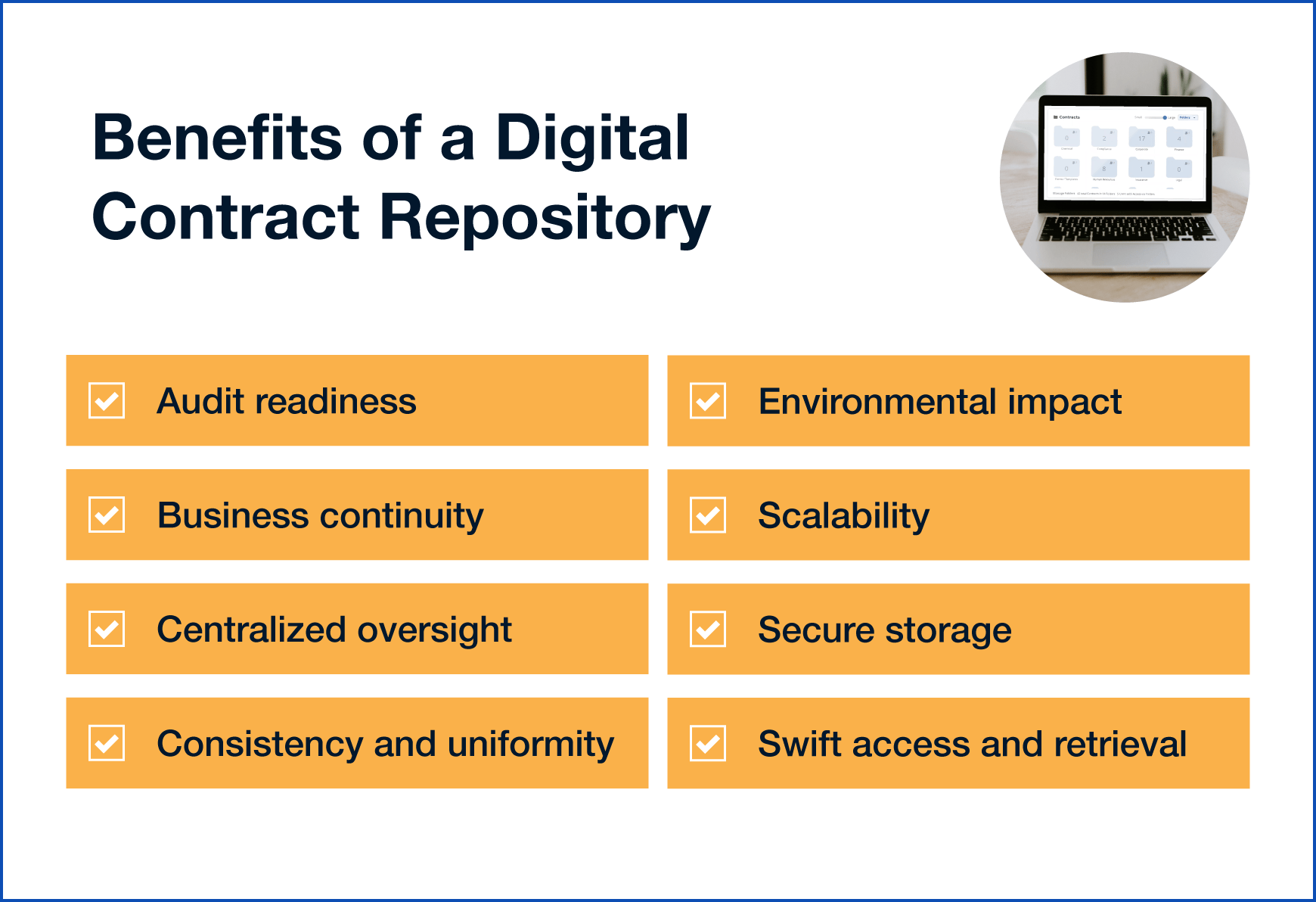
- Renewals you control: An auto-renewal you meant to cancel doesn't cost you a fee — it costs you another full term. One missed 60-day notice window on a $40K annual contract is $40K you didn't budget. A repository sends the alert 90 days out, to a person, by name.
- Answers in seconds: Search inside scanned PDFs and you find the indemnity language across 300 agreements in one query. Without that, the same request is a day of someone's week.
- A stronger position at the table: When every agreement with one vendor sits in one place with its dollar value extracted, you renegotiate knowing your total spend. Scattered files mean you negotiate blind against a counterparty who isn't.
- Audits that don't derail a quarter: Indexed contracts plus an access log means the auditor's list gets answered from a search bar, not a scavenger hunt across three shared drives.
- One true version: Amendments, revisions, and the original live together, so nobody signs off using terms that changed eighteen months ago — and you never hold two contradictory copies of the same contract in two places.
- Secure storage: Contract data sits behind access controls and encryption instead of in an email thread anyone can forward.
- Business continuity: Backup and disaster recovery are built in, so a dead laptop or a departed employee's drive doesn't take your signed agreements with it.
- Transparency: With all contracts and related metadata stored centrally, tracking the lifecycle of any agreement, from signature to renewal or termination, is something anyone on the team can do without asking legal.
Each of these is a specific bad day you don't have. Together they're the difference between a contract process that runs and one that reacts.
Can your file cabinet do that?
Decision check: what to prove before you shortlist
Every repository demos well on a clean test file. Run this checklist on your own worst document instead — the scanned, hand-signed amendment nobody can find.
- Upload that scan and search for a phrase buried in the middle of it.
- Ask for the renewal date to be extracted without you typing it in.
- Give a Finance colleague access to one folder and confirm they can't see the rest.
- Check what the audit log shows after they open it.
- Ask what happens to your files if you leave.
A repository that handles all five is one you can put the whole company on.
What to Look for in a Contract Repository: 9 Must-Have Features
A digital contract repository should do more than store files. It should help you find what you need fast, prevent costly missed deadlines and give your team visibility into what's actually in your agreements. Here are nine essential features to look for:
1. Advanced Search With OCR Technology
A contract repository is only as useful as your ability to find things in it. You need to locate specific contracts, clauses, or terms in seconds, not spend hours digging through folders.
Look for optical character recognition (OCR), which lets the system read and recognize text inside scanned PDFs and images. This means every contract becomes fully searchable, even documents that started as paper or fax.
See how easy it is to find exactly what you’re looking for when you need it with ContractSafe:
The repository should also be dynamic enough to allow you to filter and search contracts linked to specific vendors, regions, or counterparties. And let's not forget the older agreements; your legacy contract portfolio holds invaluable information and should be easily accessible within the system.
What to ask vendors: Can your system search inside scanned documents? How quickly are results returned across hundreds of contracts?
2. AI-Driven Data Extraction and Automation
The best repositories use artificial intelligence to automatically extract key information from contracts: party names, effective dates, renewal terms, dollar amounts, jurisdiction and more. They organize it without manual data entry. Human oversight ensures the system remains in check, but the efficiency gains are unparalleled.
This matters because it eliminates tedious data entry, reduces human error, and helps surface patterns across your entire portfolio. The best systems combine AI efficiency with human oversight, so you stay in control while working smarter.
What to ask vendors: What data fields does your AI extract automatically? How accurate is the extraction, and can I review and correct it?
3. Automated Renewal Reminders and Alerts
Missed renewal deadlines are one of the most expensive contract management mistakes a company can make. They trigger unwanted auto-renewals, lock you into unfavorable terms, or cause critical agreements to lapse without warning. A strong contract repository sends automatic alerts well before key dates so you have time to act.
Look for customizable reminders that let you set different lead times. A simple vendor agreement might need 30 days' notice, while a major supplier contract might need 90 or 120 days to renegotiate properly.
What to ask vendors: Can I customize reminder timing for different contract types? Who receives alerts, and through what channels (email, in-app)?
4. Seamless Integration With Your Existing Tools
Your business likely relies on a suite of tools, from CRM platforms like Salesforce or HubSpot to electronic signature solutions like DocuSign. Your contract repository shouldn't live in isolation. It needs to connect with the tools your team already uses.
Strong integrations mean contracts flow naturally through your existing workflows instead of creating extra steps or duplicate data entry.
What to ask vendors: What integrations do you offer? Do you offer an API. How difficult is it to set up integration with our current tech stack.

5. Role-Based Permissions and Access Controls
Not everyone needs access to every contract. A good contract repository lets you control exactly who sees what, whether by individual user or group.
This protects sensitive information (like employee compensation agreements, or pending acquisitions) while giving each team member a clear view of their responsibilities. Look for granular permission that let you create view-only access for stakeholders who need visibility but not editing rights.
What to ask vendors: How granular are your permission settings? Can I restrict access to specific folders, contracts?
6. Secure Cloud-Based Storage
It’s common in modern business for stakeholders to span multiple cities or even countries. That means a cloud-based repository isn't a luxury; it's necessary to ensure contracts are accessible from anywhere in the world.
The repository should also be fortified with the best security, safeguarding sensitive contract data in the vast expanse of the cloud.
Security is something ContractSafe takes seriously.
Look for enterprise-grade protections including SOC2, ISO 27001 certifications, PCI DSS-certified data centers, 256-bit AES encryption, automatic offsite backups. These aren't nice-to-haves, they're must-haves for protecting sensitive business agreements.
What to ask vendors: What security certifications do you hold? Where is data stored, and how is it backed up?
7. Version Control and Audit Trails
Contracts go through multiple drafts before they're signed, and sometimes they're amended afterward. You need to know exactly what changed, when, and who made the change.
Strong version control keeps every iteration accessible and clearly labeled. A complete audit trail shows who viewed, edited, or downloaded each document. This is critical for compliance requirements, legal disputes, or simply figuring out which version is the final one.
What to ask vendors: Does your system automatically save versions, or do users have to do it manually. Can I see a complete history of who accessed each contract?
8. Reporting and Analytics Dashboards
A contract repository shouldn't just store documents. It should give you visibility into your entire portfolio. Look for reporting that helps you answer questions like: How many contracts are expiring this quarter? What's our total committed spend with a particular vendor? Which contracts have been sitting unsigned for more than a week?
Good dashboards turn your repository from a filing cabinet into a strategic tool. You'll spot issues before they become problems and identify opportunities you might otherwise miss.
Many teams also rely on exporting repository data and saving datasets in a universal spreadsheet format for audits, reporting, and cross-team analysis.
What to ask vendors: What reports come standard? Can I create custom dashboards based on the fields that matter to my business?
9. User-Friendly Interface and Onboarding
The transition to a new system can be overwhelming, but it doesn’t have to be. Prioritize repositories with intuitive interfaces that feel almost second nature to use.
How the Main Platforms Compare on Ease of Use
| Platform | Easiest for | Setup before it's useful | Where ease breaks down |
|---|---|---|---|
| ContractSafe | Teams with no legal ops function | Upload, OCR runs, search works in the first week | Not built for complex multi-branch approval workflows |
| Juro | Mid-market legal teams | Rated easier to set up than Ironclad by reviewers | Reviewers cite thin reporting and document-management limits |
| Ironclad | Enterprises configuring heavy workflows | Weeks, and setup needs technical help | Reviewers repeatedly cite search difficulty and a steep learning curve |
| PandaDoc / Contractbook | Small businesses | Fast, but they're document-generation tools first | Wrong shape if your real problem is 4,000 signed PDFs |
The learning curve should be minimal, with the vendor providing comprehensive onboarding and training support.
A good vendor will make importing your existing contracts painless, whether you're migrating from spreadsheets, shared drives, or another system.
What to ask vendors: How long does implementation typically take? What does onboarding and training look like for my team.
Want to ensure your transition to a new system is seamless? Check out our step-by-step implementation guide and checklist to find a system that works for you.
How to Pick in One Week
Shortlist two. Upload the same 25 messy contracts to each — include scanned ones, because that's where systems break.
- Day one: search for a clause you know is buried in a PDF.
- Day two: ask each system which contracts auto-renew in the next 90 days.
- Day three: hand it to a colleague outside legal with zero instructions.
Whichever one survives day three is the user-friendly one. That's a cheaper answer than any feature comparison chart.
Frequently Asked Questions
What Are the Benefits of a Contract Repository?
Four that matter: you stop auto-renewing into contracts you meant to cancel, you find a clause across hundreds of agreements in one search instead of an afternoon of PDFs, you renegotiate knowing your total spend with a vendor, and you answer an audit request the same day. Everything else — consistent naming, tidy folders — follows from those.
What Is the Most User-Friendly Contract Repository?
It depends on who's using it. Teams with no legal ops function want a system that's searchable the day they upload; mid-market legal teams building approval workflows and enterprises needing heavy configuration are buying a different kind of ease. Test it rather than trust it: time to first answer, clicks to a real question, whether a non-lawyer can find their own contract unaided, and how much setup happens before the system does anything.
Related Reading
- Why you need an electronic Contract Management System
- Contract Repositories vs. CLM: How Legal Teams Grow
- What Is OCR in Contract Management?
How ContractSafe Helps
You know what contract management features to look for. Now see how ContractSafe delivers on all of them.
Find any contract in seconds. ContractSafe's OCR reads every word in every document, including scanned PDFs. Keyword search, natural language smart search and filters, lets you instantly find any contract, clause or term.
Let AI do the busywork. Our AI automatically extracts nearly 30 fields such as party names, effective dates, termination dates, contract value, so you can skip the manual data entry.
Never miss another renewal. Set custom reminders for any date that matters: 30, 60, 90 days out, or whatever your contracts require. ContractSafe also sends alerts when approval and signatures are needed.
Control who sees what. Role-based permissions let you give each team member exactly what they need. Executives see the big picture. Department heads see their contracts. Sensitive agreements stay protected.
Trust your data is secure. ContractSafe is ISO 27001 and SOC 2 certified with 256-bit AES encryption and we have servers in the US, Canada, the EU, and Australia. We back up your data offsite and use intrusion, malware, and virus detection to keep it safe.
Get up and running fast. Most customers import their contracts and run their first real search in the first week, not the first quarter. There's no workflow configuration to complete before the system does anything useful — upload a contract and it's searchable once OCR finishes. Your customer success manager handles the bulk import and trains your team, so you're not paying implementation consultants to get to value.
Whether it’s ease of use, robust features, or unmatched customer support, ContractSafe goes beyond the basics to deliver an all-encompassing contract management solution.
With ContractSafe, you're not just investing in a tool but partnering with an ecosystem designed to elevate your contract management experience.
Want to see it in action? Take ContractSafe for a spin. Start your free trial today.







.svg)







.svg)