Quick answer: Contract AI is software that uses large language models to read your contracts, pull out parties, dates and key terms, and flag risky language. A person confirms each result before anyone relies on it. ContractSafe's AI works this way: it reads each contract on upload, pulls out the key dates, and you confirm or edit each one.
Say you're a general counsel with 800 contracts and no one to share the work with. You upload a vendor MSA, and within seconds the tool hands back the renewal date and the auto-renew notice window. You check both against the clause they came from, and the tedious part of logging that contract is done.
Choose your next step:
For teams comparing tools: Our guide to the best AI contract review software sets out what to look for before you shortlist anyone.
For teams ready to try it on real agreements: Schedule a demo today and bring a few of your own contracts.
Key Takeaways
- Contract AI's job is the first pass: it reads, extracts and flags so a person doesn't start from a blank page.
- It only saves time when a reviewer confirms each output against the source clause before it becomes the record.
- Judge a tool by how easily you can check its work on your own contracts, not by how good the demo looks.
- Keep unconfirmed AI suggestions out of reports and reminders until someone accepts them.
What Is AI-Based Contract Management?
AI-based contract management is the use of AI inside your contract process to handle the repetitive reading, sorting and renewal-date tracking people used to do by hand, while the contract owner still makes the decisions.
In practice, that usually covers:
- Drafting and redlining contracts
- Setting up new contract records from uploaded documents
- Organizing and tagging documents
- Extracting key terms, clauses and dates
- Flagging discrepancies and risky language
- Sending reminders ahead of key dates and deadlines
- Reporting to leadership
Today's contract management tools mostly run on large language models, the same kind of model behind general chat assistants. Many pair the model with retrieval over your own documents, so it answers from the contract in front of it rather than from memory. That's how a tool recognizes clauses such as indemnification, termination and payment terms, along with names and dates.
Once it finds those terms, it can flag potential issues, suggest redlines or send reminders to the right people using the dates it picked up.
Smart contracts are a separate concept from AI-based contract management. Our earlier smart contracts explainer covers those blockchain-based, self-executing agreements.
How Contract AI Works in Practice
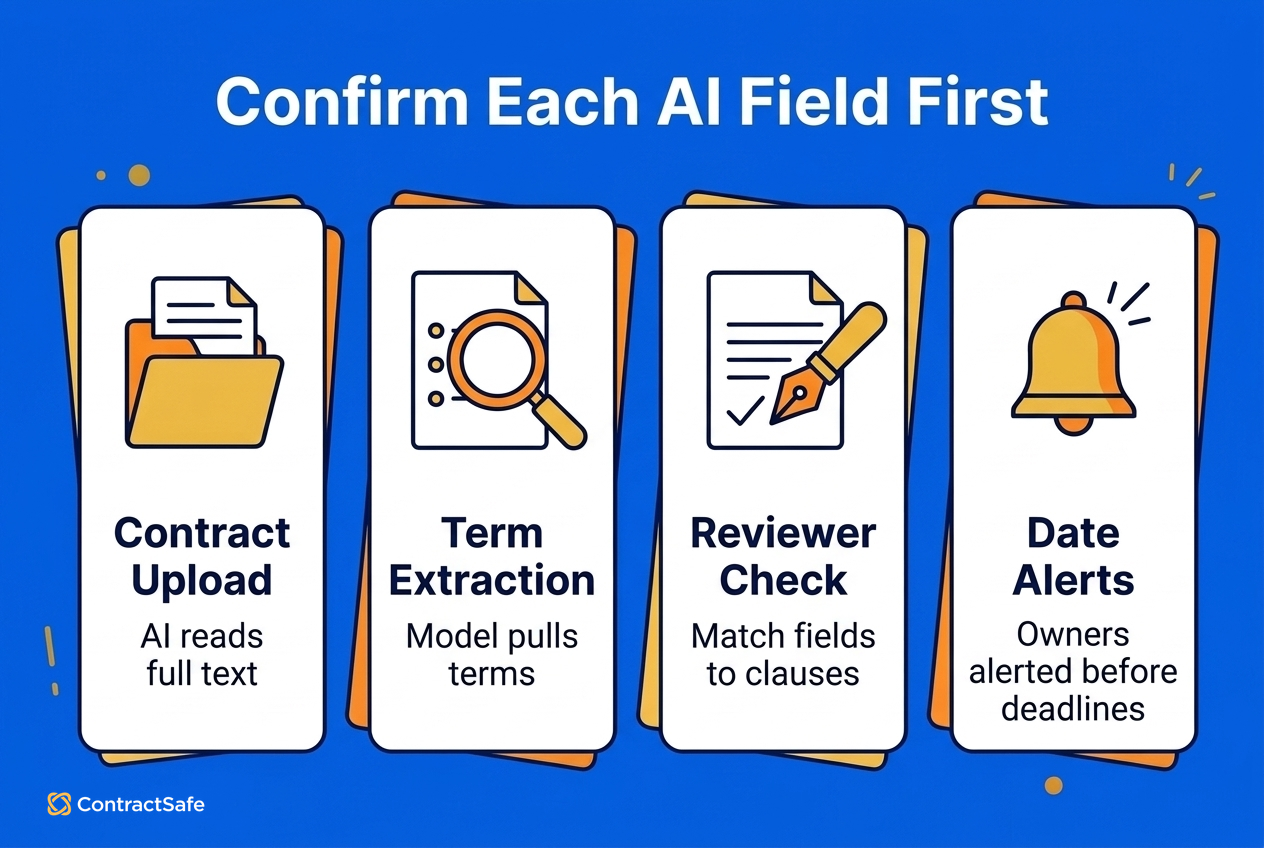
You upload a contract, the tool reads its text (using OCR for scans), a large language model pulls out parties, dates and key terms and flags unusual clauses, and a reviewer confirms each field against the source. Only then do alerts and reports run on it.
Take the general counsel with 800 contracts and that vendor MSA. Here's what happens between upload and a reminder landing in someone's inbox:
- Upload: You add the MSA on its own or with a batch of other agreements.
- Read: The tool turns the file into text, running OCR if it's a scan, so the words can be searched and analyzed.
- Extract: The model pulls out the parties, effective date, renewal date, notice window and payment terms, and flags clauses that differ from your usual positions.
- Confirm: You check each suggested field against the clause it came from and accept, correct or skip it.
- Act: Confirmed dates drive renewal reminders, and confirmed terms feed search and reports.
Step four is the one that matters. Our rule is that no AI output becomes the record until a reviewer has seen its source and signed off. In ContractSafe, pending AI suggestions stay out of exported, emailed and scheduled reports until someone accepts them. A lawyer or the contract owner makes every call, and our AI legal contract review guide shows how legal teams check AI suggestions before they're saved.
How AI Is Changing Contract Management
AI is taking over eight recurring jobs in contract management, from pulling data out of new uploads to flagging risk across a growing stack of agreements. It does the first pass faster than a person can, and your team keeps the challenges that still need judgment.
1. Data Extraction
AI can pull data out of PDFs, image files and word processor files as soon as they're uploaded. Typical fields include:
- Expiration and renewal dates
- Names of parties and signers
- Key clauses
- Terms and conditions
That fills in new contract records without anyone retyping them. The extracted data then drives the rest of the work: notices when deadlines approach and flags on ambiguous language for legal review.
2. Intelligent Workflow Automation
AI helps run the reviews, approvals and renewals around each agreement by:
- Sending emails when signatures are needed
- Following up with anyone who missed the first email
- Comparing contract versions and showing what changed
- Keeping everyone on the current version
3. Extract Insights From Contract Data
Once your contract data is extracted, you can build reports for leadership, keep audit trails that make compliance work easier, and look back at how past deals were struck. Across historical contracts, AI can surface patterns in pricing, discounts and business terms, so you go into the next negotiation better prepared.
4. Clause and Metadata Analysis
AI contract tools can find and pull out clauses and organize metadata. That helps you:
- Spot missing or ambiguous clauses
- Find the terms your compliance obligations depend on
5. Bulk Document Organization
Upload a group of documents and the tool tags them and groups attachments, so everything for one deal or agreement sits together. Specific contracts and data get easier to find, and less gets missed.
6. Smart Contract Review
This means AI reviewing ordinary contracts, not the blockchain smart contracts above. A 2024 study by Martin et al. at the Onit AI Centre of Excellence, part of a CLM vendor, measured leading LLMs against ground truth set by senior lawyers. It found the models "complete reviews in mere seconds, eclipsing the hours required by their human counterparts."
AI can review contracts automatically and flag issues based on the terms of the agreement, which helps you check that contracts are complete and compliant. It can also suggest how to negotiate based on guidelines you set, so cost-saving points that used to slip by get raised.
7. Contract Risk Analysis
AI-powered contract management tools can analyze contracts to identify potential risks, such as noncompliance, breach or the procurement risks buried in vendor agreements. They spot mistakes, highlight unfavorable terms, suggest fixes for missing or ambiguous clauses, notify the right teams when terms change, and compare clauses against your standard contracts.
8. Contract Volume Mitigation
As a business grows, its contract count tends to grow with headcount, and so does the work of tracking each one, which is why more teams are adopting contract management software. AI carries the load by:
- Automating routine tasks
- Flagging areas of concern
- Organizing bulk uploads
- Keeping related documents in one place
Contract managers then spend their time on the contracts that need a person.
The Benefits of AI Contract Management
The main gains are hours back on data entry and chasing people, fewer missed renewal dates, and contract terms you can actually search. Those gains only hold up when someone checks what the AI pulled out.
Less repetitive work: AI handles data extraction, routine workflows, filing and bulk uploads.
Clearer accountability before signature: Redlining and version control keep everyone on the same document and show who owes the next step.
Better-prepared negotiations: Insights from past contracts point to terms worth pushing on.
Lower risk: Flagged language helps you catch terms that create compliance or contractual exposure.
Fewer missed dates: Confirmed renewal and notice dates turn into reminders, instead of sitting in shared drives and spreadsheets nobody checks.
Faster search: Search runs on the extracted text, and OCR makes scanned contracts readable, so you can find a clause without opening files one by one.
The Limitations of AI Contract Management
AI misreads context, gets things wrong with confidence, and is only as good as the documents and checks behind it, so you can't let its output become the record unreviewed. Contracts are written by people, for people, and they need a person's oversight.
It can be confidently wrong: Air Canada was held liable after its chatbot invented a refund policy. New York City's official chatbot told businesses to break the law, and Google said some of its own AI Overviews were odd, inaccurate or unhelpful after launch. In contract extraction, the same failure is a wrong date or a missed clause that nobody checks.
It won't replace a contract manager: Some companies expect AI to replace whole teams. It cuts the time spent on some tasks, but it can't do a contract manager's job.
It depends on what you give it: AI works from prompts, inputs and pre-set data. Wrong data or a missing document can produce a wrong output, and that can mean missed risks or missed revenue.
It needs data controls: Privileged or confidential contracts fed into a tool without the right access controls can reach the wrong people.
It misses context: A model can miss how one clause changes another, or what a term means in your industry.
It needs current information: AI has to work from the latest data. You don't want it basing a call on regulatory information that's out of date.
Is AI Contract Management Right for Your Business?
Yes, if one person owns hundreds to a few thousand contracts and loses hours keying in dates and chasing approvals. No, if you want AI to make legal calls for you, because it can't.
The fit is strongest when your company has roughly 50 to 1,000 people and contracts sit with one owner who isn't a full legal department, such as a general counsel, finance lead or contracts manager. AI extraction inside lean contract management software lets everyone else request, approve, sign and track contracts without that owner doing it all by hand.
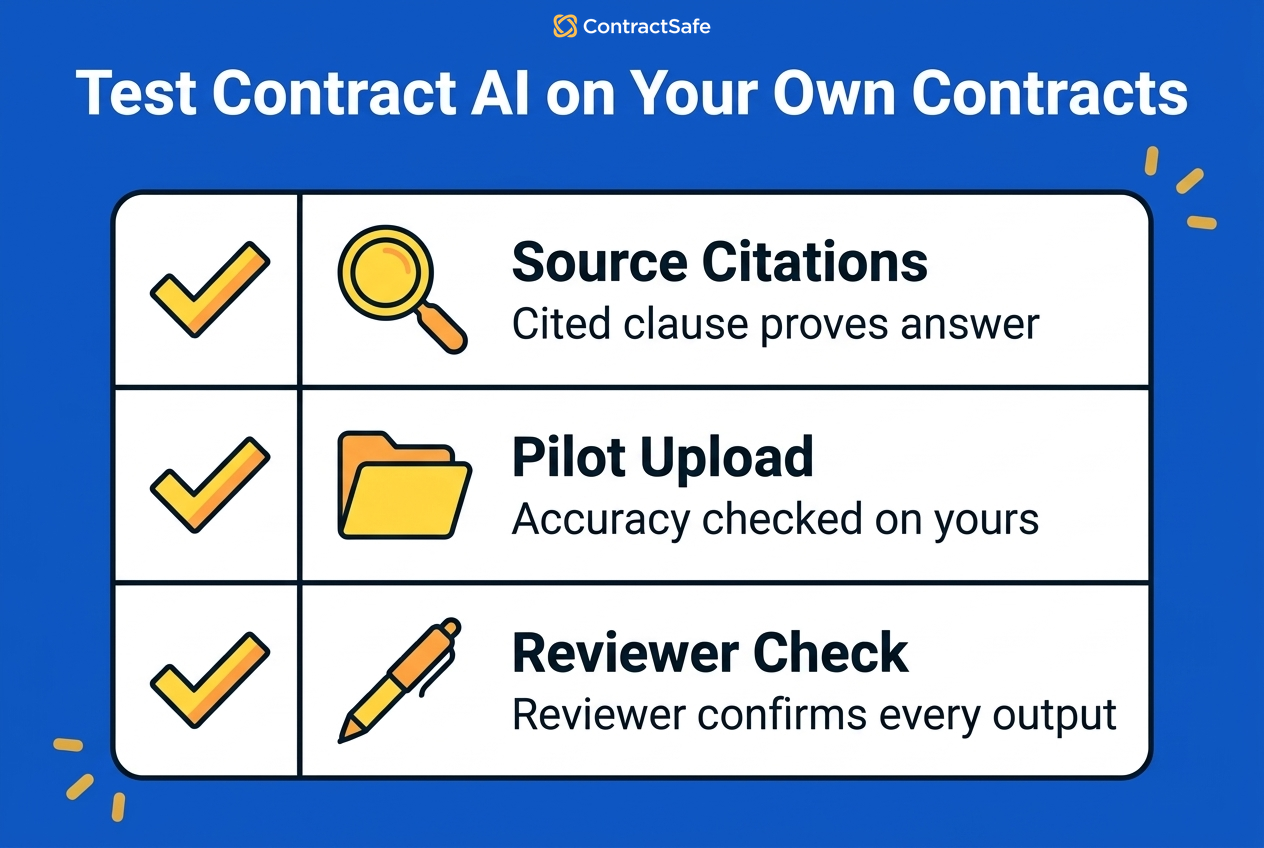
Before you commit, check these on a few of your own contracts:
- Does each extracted field show the clause it came from?
- Can you accept or correct a suggestion in one step?
- Do unconfirmed values stay out of reports and reminders?
- Does it read your scanned contracts accurately?
- Can one owner keep up with the review queue alongside the rest of the job?
Related Reading
How ContractSafe Helps With Contract AI
ContractSafe's AI reads each contract on upload and pulls out key dates such as renewals, terminations, notice periods and expirations. It can extract up to 29 fields, and all 29 are available on every plan. A person accepts, corrects or skips each suggested value before it's added. Confirmed dates drive automated reminders, and anyone can receive one, including people who aren't ContractSafe users.
ContractSafe is full-lifecycle CLM, not only a repository: it supports contract creation, review, approval, signature, storage, date management and reporting, with the complete feature set on the Maximize plan. Getting started takes a meeting, not a project: of new customers who have an onboarding meeting, 70% have just one in their first 90 days. ContractSafe pricing starts at $450/month (Organize plan, billed annually; $540 month-to-month), with unlimited users on every plan.