The essential elements of a contract are the six components that make it legally binding. Without these six essential elements, a contract is just like any other document — but when it includes all six, it becomes enforceable, with all the force of law.
Why do you need to know what makes a contract legally binding? Well, if you’ve already made it through law school, you can probably skip this one, but for everyone else, knowing exactly what to check for can save you from signing (or sending) a contract that won’t hold up in court.
If you want to understand how to make a contract legally enforceable, then look no further! This post will take a look at the six essential elements of a contract and why they matter.
Key Takeaways
-
Contracts are an essential part of doing business.
-
The six elements of a valid contract are:
-
Contract management software can help ensure contracts are legally compliant.
-
Note: Some legal sources also call out two closely related concepts — “intention to create legal relations” (often captured by awareness/mutual assent) and “certainty/definiteness of terms” (often bundled into offer/acceptance). If either is missing, courts may find no enforceable contract.
What Is a Contract, and Why Are They Important?
Did you know that the first-ever contract was created over 4,000 years ago? It was a clay tablet from Mesopotamia that detailed the transfer of goods from one party to another. And while modern contracts may not need to be written in stone, they remain an essential part of how we do business today.
But what exactly is a contract? Before we dive into the essential elements, let’s learn a little about what makes a contract a special kind of document:
-
Contracts are legally binding agreements between two or more people that formalize a new or renewing relationship or transaction.
-
They’re used in all kinds of business dealings, from buying property, trading services or goods, employment arrangements, and more.
-
Contracts are essential for making sure all parties know their rights and responsibilities before they enter into any kind of agreement. In other words, having a contract helps protect everyone involved in the transaction.
-
In commercial contexts, courts generally presume parties intend to create legal relations; social/domestic arrangements typically do not create this presumption.
There are many types of contracts — but all types should include the following six essential elements: offer, acceptance, awareness, consideration, capacity, and legality.
Now let’s dive into the six elements and learn exactly what each one is.
Element 1. Offer

To create a valid contract, one party needs to make an offer and the other needs to accept. In other words, you can't have a contract without making an offer. An offer is what kicks off the whole spiel.
The offer can be broken down into two parts: expression and intention:
-
The expression is the statement of the offer. It can be verbal, written, or implied through conduct — but the most legally enforceable offer is a written one.
-
The intention needs to show agreement to the terms of the offer. In written contracts, this usually means language like, “By signing, I’m agreeing to XYZ.”
The offer needs to be specific, with enough details about the exchange of value so everyone knows how the offer benefits each party. The value can be money or something else like an action, service, or outcome.
It also has to have a clear acceptance period, and must be communicated to the other party — or else it won't count.
After an offer has been made, the receiving party can reject the offer, accept the offer, or reply with a counteroffer.
To make a contract enforceable, an offer should include the essential terms a reasonable person would need to understand the deal — who the parties are, what’s being provided, price/value, and timing. An offer generally can be revoked any time before acceptance, and a counteroffer usually terminates the original offer.
Element 2. Acceptance

Once an offer has been made, the other party will have to accept it in order for the contract to be valid. After all, what’s the point of making an offer if nobody accepts it?
Most courts consider a contract to be accepted once it’s signed. Anything else, like the negotiation of terms, may be considered a counteroffer and would restart the process.
Still, it’s important to know that inaction doesn’t mean the offer has been accepted — both parties have to take explicit action to create an enforceable contract. Think of it like a dance, where one person leads, and the other follows until both are in sync.
Acceptance comes in two basic types: express and implied.
-
Express acceptance is when the offer is accepted in the same way it was given. For example, if you send an email with all the details of your offer and the other party replies by email with “I accept,” then that would be express acceptance.
-
Implied acceptance is when action is taken that indicates an acceptance of the offer. If, for example, you have a verbal agreement with a lawn mowing company to show up every month and mow the lawn even though there is no contract, this would be considered implied acceptance. The key here is that you need to act on what was offered.
For example, if one party starts to perform their duties under a contract before explicitly accepting it in writing, that can also be considered acceptance. This could be painting a house while waiting for the contract to be signed, or starting work on a design project before it is officially accepted.
Acceptance should be unequivocal and “mirror” the offer’s terms. If acceptance changes material terms, it’s treated as a counteroffer rather than acceptance. Silence generally isn’t acceptance unless prior dealings or the contract itself make that clear.
Element 3. Awareness

For a contract to be valid, all parties need to be aware of the offer and the acceptance. Sometimes called a “meeting of the minds,” awareness means that all parties understand what they’re getting into.
If one party is unaware of the terms and conditions, then they can argue that there was no true agreement.
This may sound obvious, but clarity makes all the difference between a contract that’ll hold up in court, or one that won’t.
Courts don’t usually assess whether consideration is “adequate” (e.g., a dollar can do), but it must be real and not merely past consideration. A promise to do something you’re already legally required to do typically isn’t valid consideration.
Courts also look for an intention to create legal relations — a shared intent that the agreement will be legally binding. In business deals this is usually presumed; in family or social arrangements it often is not.
That’s why legal contracts usually contain a section that explains all the details in plain language, so everyone knows exactly what they’re signing up for.
In short, if there is no “meeting of the minds,” the contract may not be valid. After all, you can't dance if you don't know the steps.
Element 4. Consideration

Consideration is the value that each party agrees to exchange to make a contract valid. It’s the whole reason everyone shows up.
For example, think about an employer-employee relationship. No one is lining up to work for free, right? And no employer is going to pay someone for nothing. The exchange of value here is the paycheck an employee receives for doing the job outlined in their job description.
But depending on the type of contract, the consideration can be money, goods, services, or any other form of legal tender that both parties agree upon. This element is essential because it sets out what each party gets if they fulfill their end of the bargain.
Element 5. Capacity

Capacity is each party’s ability to understand and agree to their end of the contract. Both parties have to be capable of understanding the obligations they’re entering into, and have a legal right to do so.
For instance, minors can’t enter into contracts because they don’t have the capacity to understand the implications of their decision. Similarly, people who are incapacitated due to mental illness or intoxication won’t be held legally responsible for any agreements made during that state.
Here are a few examples where a person may lack capacity:
-
They are under the age of 18
-
They are mentally unsound
-
They are under the influence of drugs or alcohol
-
They are under duress
-
They do not speak the language
Capacity also includes authority — for example, the person signing on behalf of a company must have the authority to sign for that company.
Element 6. Legality

Legality is the final essential element of a contract. If a contract contains language that violates any laws or regulations, then that contract isn’t legally binding for either party.
What kind of contract is illegal? Any agreement that:
-
Violates public policy: Agreements must be in line with federal, state, and local laws.
-
Is made under misleading circumstances: This includes agreements made under duress (force) or based on fraud or deception.
-
Involve illegal activities: Agreements cannot require either party to do something that is against the law.
-
Involve a person who lacks the capacity to sign a contract: Agreements cannot involve a minor, or person who is mentally unsound.
Legality is a truly essential element, because without it, a court can declare a contract void and unenforceable. If it contains any illegal language, it doesn’t matter who signed — it’s simply not a valid agreement.
A Quick Note on Force Majeure
Force majeure is when a contract becomes impossible to fulfill due to circumstances beyond the control of the parties involved.
Force majeure events are typically the result of something really bad happening. For example, when the world went into lockdown in 2020, many contracts were impossible to fulfill as a result of shuttered factories, travel restrictions, or supply chain disruptions. Other force majeure events might include natural disasters, war, civil unrest, or acts of terrorism.
Even if a contract is legally valid, a court can still sometimes rule that it’s unenforceable due to the special case of force majeure.
A Quick Note on the Statute of Frauds Requirement
The law says that certain types of agreements have to be in writing to be enforceable. This is known as the statute of frauds requirement, and it usually applies to the following kinds of agreements:
-
Real estate sales
-
Guarantees/surety agreements
-
Contracts that can’t be performed within one year
-
Many sales of goods under the U.S. Uniform Commercial Code (UCC) above a set dollar threshold
Before agreeing to anything that may fall under the statute of frauds requirement, it’s important to check your jurisdiction’s rules.
The Six Elements in Action: A Quick Example
It's easier to see how the six elements fit together with a real-world example. Say a mid-sized company is signing up with a software vendor for a SaaS subscription:
- Offer: The vendor proposes a one-year subscription to its platform for 50 users at $30,000 annually, including standard support.
- Acceptance: The company's procurement lead signs the order form, agreeing to the pricing and terms as written.
- Awareness: Both sides reviewed the scope, user counts, service levels, and renewal terms, so everyone understands what's being exchanged. A true meeting of the minds is reached.
- Consideration: The company pays $30,000; the vendor provides access to the software and support. Each side is exchanging something of value.
- Capacity: Both parties are legitimate businesses, and the person signing for the company has teh authority to commit it to the agreement.
- Legality: Licensing business software is perfectly lawful, so nothing about the deal runs afoul of the law.
All six boxes are checked, which means this is an enforceable contract. Knock out any one of them (say the order form is never countersigned, or the person who signed had no authority to bind the company), and you may not have a binding agreement at all.
How Is a Contract Enforced?
When a dispute arises about a contract, one party or the other can try to enforce it by seeking a legal remedy. The most common remedy is (surprise!) a settlement for cold hard cash.
But depending on the specific breach of contract and any other applicable laws, one party may take the other to court to force them to deliver the goods or services they agreed to provide — this is known as specific performance. A party may also seek compensatory and/or punitive damages and attorney’s fees. Other common remedies include rescission (unwinding the contract), and enforcing reasonable liquidated damages clauses if the parties agreed to them up front.
Enforcement can be a lengthy process. In fact, in the United States, it takes an average of 444 days to enforce a contract. And if you consider the fact that litigation costs alone for an average contract dispute are $91,000, you can see why so many people choose to settle outside of court.
What’s more, a large business has thousands of contracts to keep up with at any given time — so the most cost-effective remedy is to avoid disputes in the first place. That’s where contract management software is designed to help, by making sure your contract language is consistent and legally enforceable, and that you never miss an important contract deadline.
Explore Contract Management Solutions
Contract management software can help operationalize the six elements above by:
- Standardizing offers and essential terms with vetted templates and clause libraries (certainty).
- Routing approvals and eSignatures to capture clear, time-stamped acceptance and authority (acceptance, capacity).
- Centralizing versions and comments to document mutual assent and intent (awareness).
- Tracking consideration, milestones, and obligations with alerts (consideration).
- Flagging risky or non-compliant language and maintaining audit trails (legality). ContractSafe delivers these capabilities with:
- Providing a searchable, secure repository and role-based access.
- Sending automated reminders for renewals, expirations, and obligations.
- Maintaining version control and activity logs for who did what, when.
Offering built-in eSignature integrations and approval workflows. See how ContractSafe simplifies compliance from drafting to renewals.
Take the Legwork Out of Contract Management
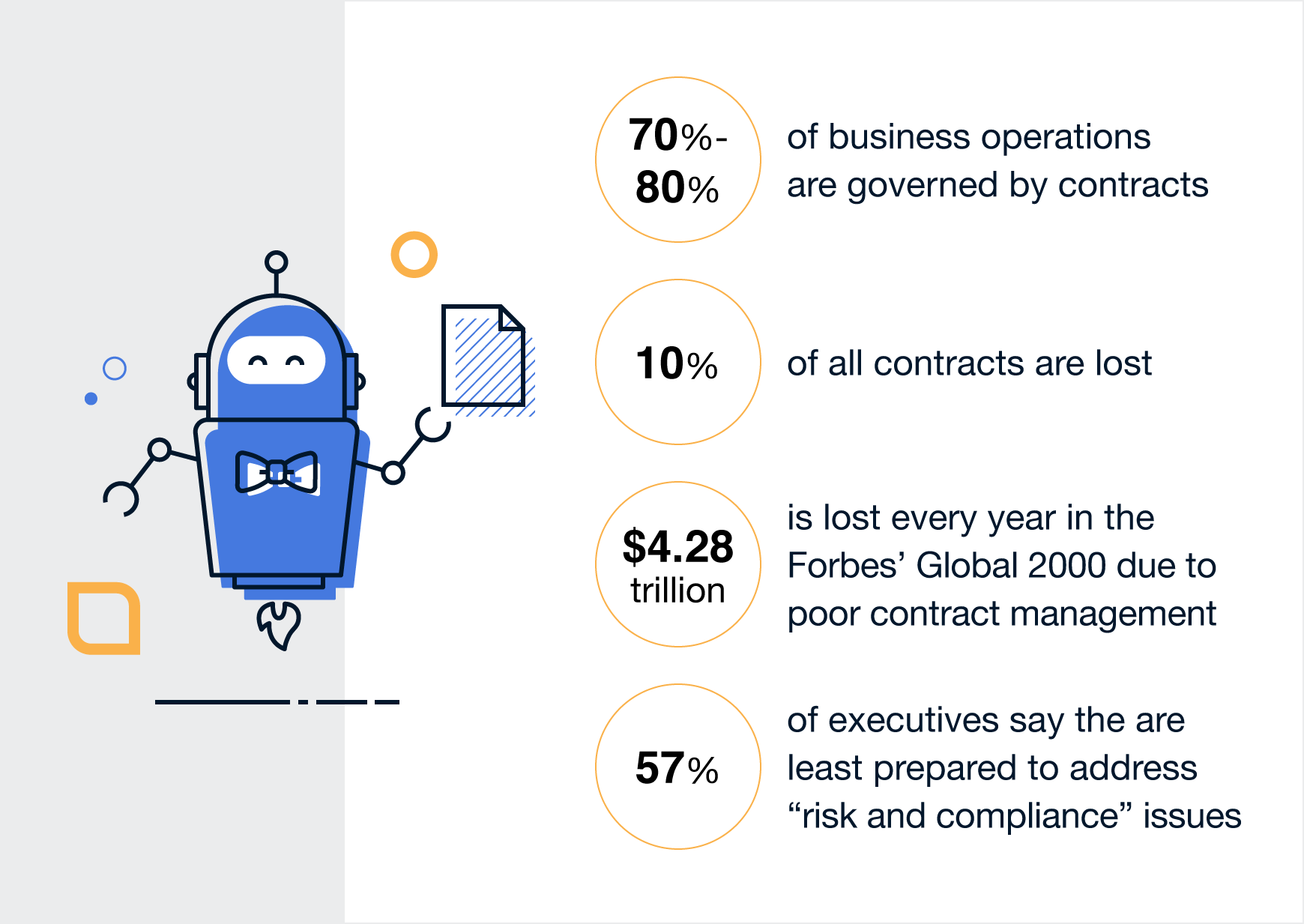
Compliance with a contract's terms is especially important when you consider that so much of any given business's revenue, spend and supplier relationships runs on contracts.
That’s why 64% of senior legal, compliance and risk executives told a 2025 AlixPartners survey that their organization is insufficiently prepared to adapt to national regulatory changes, and 71% said the same about international ones.
And just like your wallet and keys every other morning, about 10% of those contracts are lost, according to a report by the Journal of Contract Management.
The true cost of poor contract management is staggering, sitting at an estimated 9% of total company revenue.
Across the Forbes Global 2000 list, as much as $4,284,000,000,000 in revenue is lost yearly due to poor contract management. That's 4 trillion (trillion, with a T).
But that doesn't have to be you.
Contract management software can help streamline the contract management process, and help ensure contract compliance.
By automating the process, you can be sure that your contracts are stored securely and in accordance with regulations and laws. Plus, you can easily access all your contracts, track their progress throughout the contract management lifecycle, and receive notifications for important dates and obligations.
Contract Management Stats
Not sold yet?
Here are some of the ways contract management software can help your business today:
Execution
Contract management software can help you make sure everything has been approved, all parties have signed, and all conditions are outlined.
Date Reminders
Reminders can inform you when important dates are coming up, so you can stay on top of your obligation deadlines and renewal dates.
Audits
A digital repository helps guarantee compliance and mitigate risks by providing an auditable record that shows exactly who has done what when it comes to all your contracts — so no lapses go unnoticed.
Version Tracking
Contract management software also keeps track of different versions. That'll help you make sure everyone is reading the right document.
Security
Data security is a big concern when it comes to contract management. With the right software, you can rest assured knowing your information is safe and secure.

Ensure Your Contracts Are Compliant Today
Contracts are an essential part of any business, but they can be daunting to manage. Contract management software helps you stay on top of all your documents and ensures contract compliance throughout the entire contract management lifecycle.
When you’ve got thousands of contracts to manage, ContractSafe can take the hard work off your plate. Get things done efficiently and easily, from searching and finding contracts in just a few clicks to ensuring compliance with regular contract audits. You can sleep at night knowing nothing is slipping through the cracks.
Schedule a demo to see how contract management software can transform your business today.







.svg)







.svg)