
Contract risks rarely show up with a big flashing warning sign. Things look fine, the agreement is signed, and everyone moves on.
Then six months later, a missed renewal, a vague clause, or a compliance gap quietly turns into a problem nobody saw coming.
It's a lot like checking the weather. You don't control the storm. But you can grab an umbrella before you walk outside.
That's what contract risk management is really about, spotting potential issues early and putting simple safeguards in place so surprises don't derail your business.
The uncomfortable part is that most contract risk doesn't show up in the clauses. It shows up in the process around them: the renewal nobody was tracking, the vague scope nobody owned, the agreement that lived in someone's inbox. Which means you can size up your own exposure before you read the ten practices. The assessment below scores your team on storage, findability, key dates, workflow, and risk controls, and the lowest score is the umbrella to grab first.
Choose your next step:
Key Takeaways
-
Contract risk management means identifying financial, regulatory, performance, and security risks before they cause problems.
-
Missed renewals, unclear obligations, and compliance gaps are some of the most common (and most expensive) contract risks.
-
Standard templates, clear ownership, and proactive alerts help reduce risk without adding complexity.
-
Regular audits and training keep risk controls from quietly breaking down over time.
-
Contract management software gives teams visibility, accountability, and automation that manual processes simply can't match.
What Is Contract Risk Management, and Why Is It Important?
Contract risk management is the process of identifying, assessing, and reducing risks tied to contracts throughout their lifecycle. This includes reviewing terms, tracking obligations, monitoring compliance, and addressing potential issues before they escalate.
In practice, it's less about reacting to problems and more about building a safety net. When you know what could go wrong, you can create guardrails that protect revenue, relationships, and reputation.
And the earlier you start, the easier it is to manage.
What Are the Most Common Contract Risks?
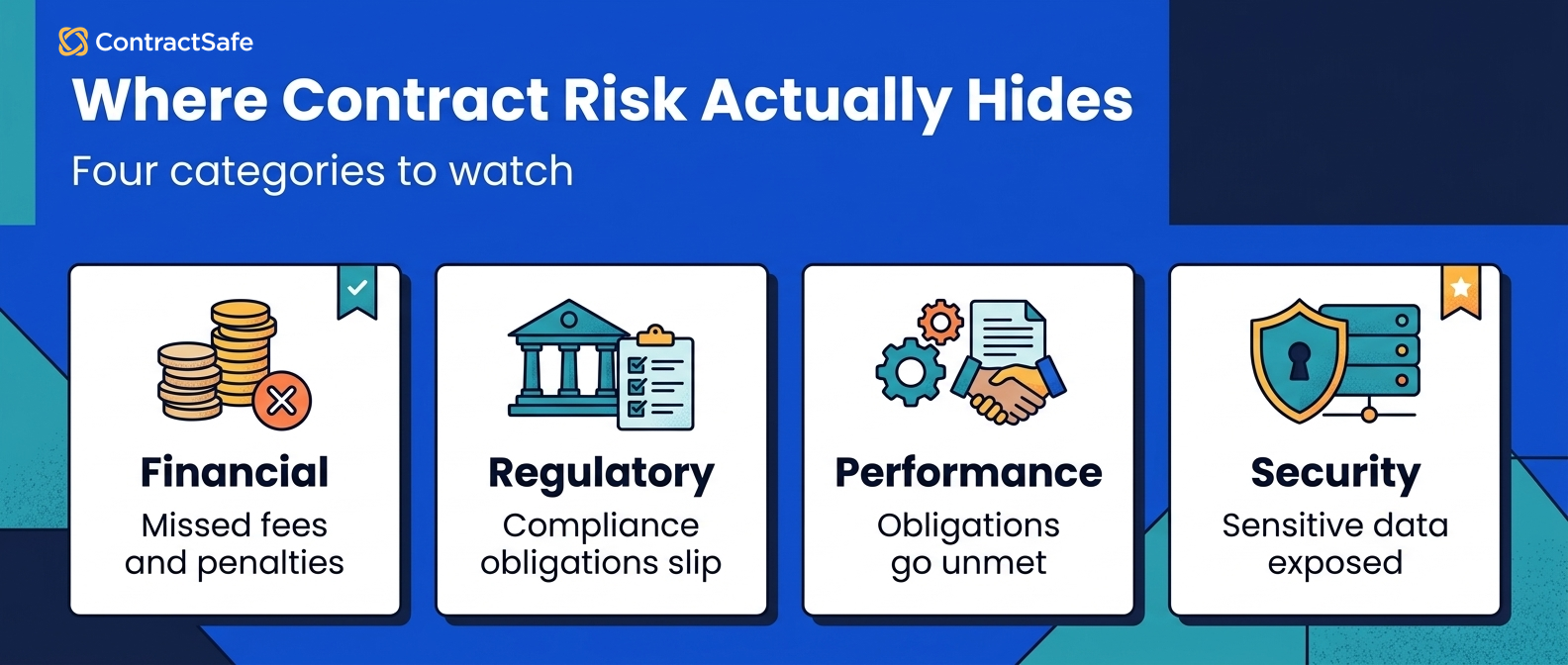
Most contract risks fall into four core categories: financial, regulatory, performance, and security. Understanding these categories makes it easier to spot gaps and prioritize where to focus.
Financial Risks
Financial risks impact revenue or cost exposure directly. These often include missed renewals or unintended auto-renewals, weak pricing protections, poor vendor due diligence, and incomplete budgeting assumptions.
A renewal that slips by unnoticed can lock you into unfavorable terms for another full year. A discount that was supposed to be temporary becomes permanent because nobody flagged it.
Regulatory Risks
Regulatory risks arise when contracts fail to meet legal or industry requirements. Think non-compliance with regulations like HIPAA or GDPR, missing data protection or audit provisions, inadequate insurance requirements, and contracts that don't reflect recent regulatory changes.
The tricky part about regulatory risk is that laws change, and contracts don't update themselves. What was compliant two years ago might not be today.
Performance Risks
Performance risks happen when expectations or obligations aren't met. Common causes include vague scope definitions, poor service level tracking, weak dispute resolution language, and a lack of clear contract ownership.
If nobody owns the contract post-signature, nobody's watching whether the other party is actually delivering what they promised.
Security Risks
Security risks relate to data protection and operational resilience. Storing the agreements themselves in a system with audited contract security controls closes one of those gaps. These might involve unauthorized access to sensitive data, weak cybersecurity obligations in vendor agreements, vendor security failures, and poor incident response language.
In a world where a single data breach can cost millions, the security language in your contracts is a very important frontline defense.
Vendor and Supply-Chain Risks
Vendor and supply-chain risks sit across the four categories above: a counterparty that can’t deliver is a performance risk, one that goes out of business is a financial risk, and one that handles your customer data is a security risk. Three checks catch most of it before signature: counterparty due diligence (financial health, litigation history, references), single-source dependency (what happens to your operation if this vendor stops), and insurance certificates that are current and match the coverage the contract requires.
After signature, the risk is concentration. Track which vendors you can’t replace inside a notice window, and give those agreements a higher likelihood score in the matrix below regardless of how clean the paper looks.
RELATED READ: Contract Lifecycle Management Process Best Practices: The Ultimate Guide
How to Assess Contract Risk with a Matrix You Can Use
A contract risk assessment scores each agreement on two questions: how likely is it that something goes wrong, and how bad is it if it does. Multiply the two and you get a number from 1 to 9 that tells you which contracts need a lawyer this month and which just need an alert. The rules below are deliberately simple so a procurement or operations person can apply them without Legal in the room.
Scoring rules
| Score | Likelihood (how likely a risk event is during the term) | Impact (what it costs if it happens) |
|---|---|---|
| 1 | Low: standard paper, a counterparty you’ve worked with before, no past incidents, term under a year | Low: exposure under roughly 1% of annual revenue, no regulatory penalty, no operational stop |
| 2 | Medium: some negotiated deviations, a new counterparty, or a multi-year term with an auto-renewal | Medium: a five- or six-figure loss, a compliance finding, or a service interruption you can work around |
| 3 | High: non-standard terms on the counterparty’s paper, a vendor you can’t replace inside the notice window, past disputes or missed obligations | High: uncapped liability, a regulatory penalty or breach notification, or an operational stop with no fallback |
The matrix
Risk score = likelihood × impact. Read across for likelihood, down for impact.
| Impact \ Likelihood | Likelihood 1 (low) | Likelihood 2 (medium) | Likelihood 3 (high) |
|---|---|---|---|
| Impact 1 (low) | 1: file and alert | 2: file and alert | 3: file and alert |
| Impact 2 (medium) | 2: file and alert | 4: owner review at renewal minus 90 days | 6: owner review at renewal minus 90 days |
| Impact 3 (high) | 3: file and alert | 6: owner review at renewal minus 90 days | 9: legal review now and escalation |
Three examples, scored
| Contract | Likelihood | Impact | Score and control |
|---|---|---|---|
| Vendor MSA on the vendor’s paper, three-year term, 90-day notice window, uncapped indemnity running one way | 3: non-standard paper, a vendor that runs your billing, hard to replace in 90 days | 3: uncapped exposure, and switching vendors would stop invoicing | 9: legal review now. Negotiate a mutual cap and a carve-out list before renewal; set the renewal alert at notice minus 90 days |
| Customer SaaS agreement on your template, one negotiated change (a 99.9% SLA with service credits) | 2: one deviation, a customer you know, one-year term | 2: credits are bounded; a missed SLA costs money but not the relationship | 4: owner review at renewal minus 90 days. Confirm the SLA is being measured; decide whether to keep the credit schedule |
| Contractor NDA on your template, mutual, two-year term | 1: standard language, no deviations | 1: worst case is a confidentiality dispute with a single individual | 1: file it with the term captured, set an expiry alert, move on |
What each score triggers
1 to 3, file and alert. Store it with its dates captured and an alert on the end date. No review until renewal.
4 to 6, owner review at renewal minus 90 days. The contract owner reads the agreement against what actually happened during the term and decides whether to renew, renegotiate, or exit while there’s still time to act.
7 to 9, legal review now and escalation. Legal reviews the specific clauses that drove the score, the business owner and Legal agree a mitigation, and the agreement goes on a quarterly watch list until the score comes down.
Where the score lives matters as much as the score. In ContractSafe, a custom field on each contract record holds it, so the 7-to-9 list is a saved report rather than a spreadsheet someone maintains, and the renewal alert at notice minus 90 days fires from the same record.
Score every active contract once, then re-score at renewal and whenever an amendment lands. The first pass usually finds that fewer than one in ten agreements score 7 or above, which is the list Legal actually needs to own.
Clause-by-Clause Contract Risk Checklist
Categories tell you what kind of risk you carry. Clauses tell you where it lives. When you assess an agreement, these are the nine places to look, what a bad answer looks like, and what to do about it.
| Clause | What to look for | Risk category | Mitigation | Where it usually lands on the matrix |
|---|---|---|---|---|
| Auto-renewal and notice window | Renews automatically; notice window of 60 to 180 days; notice must be delivered a specific way | Financial | Capture the notice deadline (not the end date) and alert 60 days before it; negotiate a shorter window or opt-in renewal | Likelihood 2 to 3 on any multi-year term |
| Limitation of liability | One-sided cap, a cap far below your exposure, or no cap; carve-outs missing for confidentiality and data | Financial | Mutual cap at a defined multiple of fees; carve-outs for the breaches that would actually hurt you | Impact 3 when uncapped |
| Indemnification | Indemnity running one way; broad triggers; no procedure for notice and control of defense | Financial, regulatory | Mutual indemnity limited to third-party claims, IP, and data breach; defense procedure written in | Impact 3 when one-way and uncapped |
| Termination for convenience | Only the counterparty can terminate without cause; long notice; early-termination fees | Performance | Mutual termination for convenience with a notice period you can live with; no fee after year one | Likelihood 2 on vendor paper |
| Payment and price escalation | Automatic annual increases with no cap; CPI-plus clauses; late fees above your policy | Financial | Cap on annual increase; increases only at renewal; fees mutual | Impact 2, likelihood 2 on quote-based vendors |
| Data security and privacy | No breach-notification timeline; no subprocessor list; customer data used for training or analytics | Security, regulatory | Notification within a defined window; subprocessor approval; data-use limits; audit right | Impact 3 for any vendor holding customer or employee data |
| Insurance | Required coverage below your standard; no certificate on file; no obligation to maintain | Financial, regulatory | Coverage minimums in the contract; certificate collected at signature and at each renewal | Likelihood 2 when no certificate is on file |
| Assignment and change of control | Counterparty can assign freely; no right to exit if they’re acquired | Performance | Consent required for assignment; termination right on change of control | Impact 2; likelihood rises for venture-backed vendors |
| Scope, SLA, and acceptance | Vague deliverables; no measurable service levels; no acceptance criteria or remedy | Performance | Measurable SLAs with credits; defined acceptance and cure periods; a named owner on both sides | Likelihood 3 when scope is vague; impact depends on dependency |
The first row is the one a system can fill for you: ContractSafe’s AI extraction pulls the renewal term and notice window out of executed agreements, so the notice deadline is captured when the contract is filed rather than found the week after it passed. The other eight rows still need a person reading the clause.
For the audit version of this list, with the evidence to collect for each clause, see our contract audit checklist.
The Contract Risk Management Process in Five Steps
Risk management, in contracts or anywhere else, runs in the same order: identify, assess, mitigate, transfer, monitor. The ten practices in the next section are the actions; this table is the order you do them in and the four choices you have once a risk is on the list.
| Step | What you do | Practices below that implement it |
|---|---|---|
| 1. Identify | Inventory every active agreement, find the ones nobody owns, and read each against the clause checklist above. Include vendor due diligence and single-source dependencies. | Practices 7 and 9 |
| 2. Assess | Score each contract on the likelihood-by-impact matrix and sort by score. | Practice 1 |
| 3. Mitigate | For each risk on the list, pick one of the four strategies: avoid (don’t sign, or strike the clause), reduce (cap it, shorten the term, add an SLA), transfer (indemnity, insurance, a subcontractor), or accept (document why the exposure is tolerable and who decided). Most risks get reduced; the mistake is accepting them by default because nobody made the choice. | Practices 2, 5, 8, and 10 |
| 4. Transfer | Where you chose to transfer, make the transfer real: the indemnity has a cap and a procedure, the insurance certificate is on file and current, the dispute path is written down. | Practice 6 |
| 5. Monitor | Alerts on notice windows, obligation tracking against what was promised, an annual review of high-score agreements, and a re-score whenever an amendment or a regulatory change lands. | Practices 3, 4, and 9 |
Best Practices That Reduce Risk Without Adding Complexity
Effective contract risk management comes down to consistent processes, clear ownership, and good visibility. The following best practices help teams reduce risk without adding unnecessary complexity.
1. Perform Regular Risk Assessments
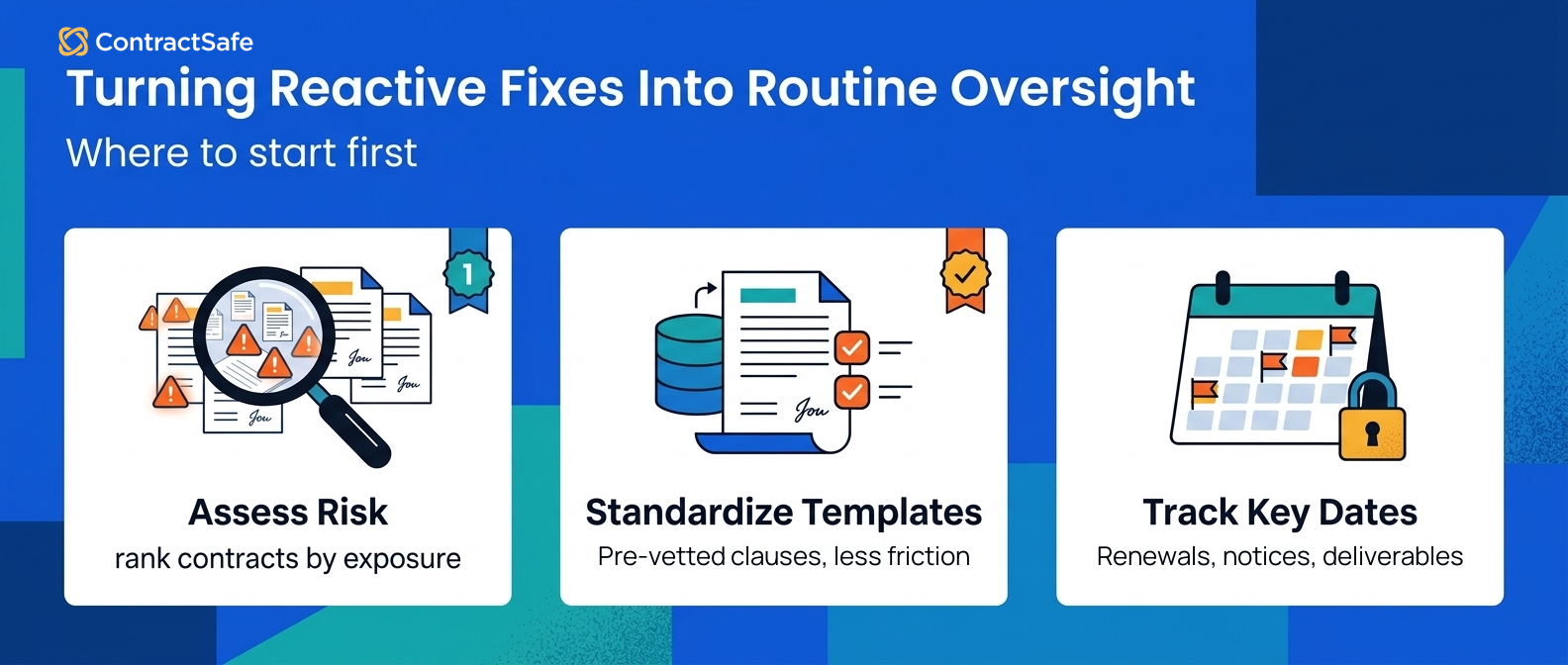
Regular contract risk assessments help teams identify high-risk agreements and prioritize mitigation efforts. This typically involves reviewing the likelihood, impact, and potential consequences of identified risks.
The likelihood-by-impact matrix above is the assessment: score every active agreement, sort by score, and let the 7-to-9 list set Legal’s priorities. Re-score at renewal and after every amendment, and watch for trends across vendors or departments (one counterparty accumulating high scores is a relationship problem, not a clause problem).
Risk assessment works best as a cross-functional effort. Legal, finance, procurement, and operations each see different risks. Get them in the same room, or at least looking at the same data, and you'll catch things that siloed reviews miss.
2. Standardize and Automate Contract Creation
Standardized contract templates reduce risk by ensuring approved language is used consistently. Instead of reinventing the wheel for every new agreement, teams start with pre-vetted clauses that already reflect legal and compliance requirements.
Common clauses worth standardizing include force majeure, limitation of liability, indemnification, and warranty language.
Templates aren't just a time-saver. They create consistency, which reduces negotiation friction and minimizes the chance that somebody accidentally leaves out a critical protection.
3. Track Key Dates and Obligations
Missed deadlines are one of the most preventable contract risks, and one of the most expensive. Tracking renewals, notice periods, milestones, and deliverables ensures nothing slips through the cracks.
Shared calendars can help, but they rely heavily on manual upkeep. Dedicated contract tracking tools add automated alerts, obligation visibility, centralized date tracking, and backup notifications for key stakeholders.
Being proactive with deadlines turns risk management from reactive scrambling into routine oversight. You shouldn't learn about a renewal deadline the day it passes.
4. Maintain Regulatory and Legal Compliance
Regulatory compliance risk increases when contracts don't evolve alongside laws and policies. Regular reviews ensure agreements reflect current requirements and industry expectations.
To stay ahead, monitor regulatory updates in your industry, review high-risk agreements annually, ensure insurance and security clauses remain adequate, and align contract language with updated policies.
Compliance isn't a one-time exercise. It's an ongoing process tied to contract lifecycle management, and the organizations that treat it as such are the ones that avoid expensive surprises.
5. Establish Clear Stakeholder Communication
Clear communication reduces risk by ensuring contracts are reviewed from multiple perspectives. Legal, finance, procurement, and operations all bring unique insights that strengthen agreements.
Strong communication practices include defined approval workflows, visible contract ownership, shared access to contract records through role-based permissions, and documented review comments and decisions.
When everyone can see the same information, risks get caught earlier and disputes are easier to resolve.
6. Prepare for Contract Disputes
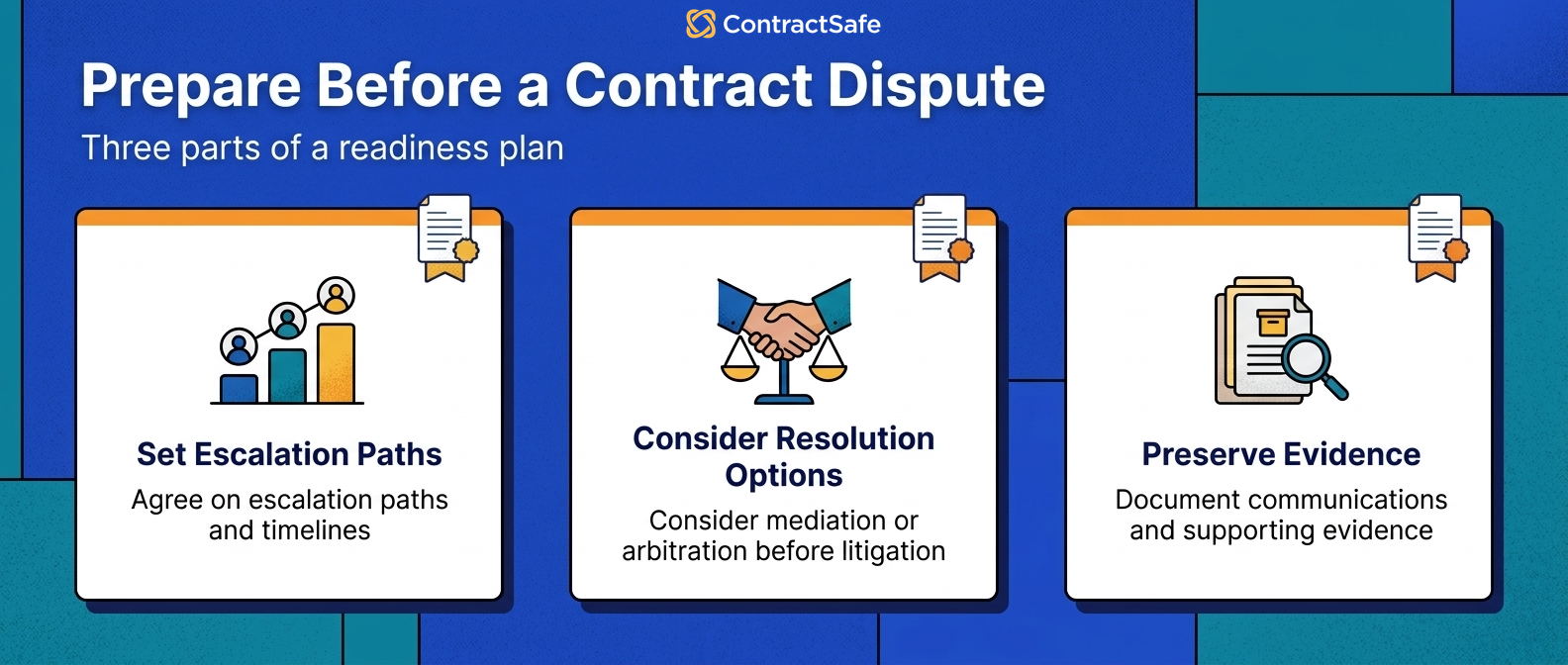
A documented dispute resolution plan reduces uncertainty when conflicts arise. Contracts should clearly define escalation paths, resolution methods, and timelines, before anyone's emotions are running high.
A basic dispute readiness plan includes reviewing contract dispute clauses, considering mediation or arbitration before litigation, creating escalation timelines, documenting communications and evidence, and planning fallback options.
Preparation doesn't prevent disputes. But it dramatically reduces their impact, and the cost of resolving them. Understanding the consequences of a breach of contract before it happens puts your team in a much stronger position.
7. Train Employees on Contract Awareness
Employee training reduces risk by ensuring teams understand contract obligations and escalation triggers. Even small awareness gaps can lead to missed deadlines or compliance oversights.
Helpful training topics include contract lifecycle basics, renewal and notice obligations, approval and review processes, and risk identification signals.
Designating a contract point person or champion within each department also improves consistency and accountability. Someone needs to own this, not just as a task, but as a responsibility.
8. Streamline Legal Review Processes
A structured legal review process reduces bottlenecks and oversight risk. Without clear workflows, contracts can stall or skip important scrutiny entirely.
To improve review efficiency, use standardized intake processes, define review timelines and responsibilities, implement risk-based review tiers (not every contract needs the same level of scrutiny), and use AI-assisted tools for preliminary checks.
Efficiency and risk management aren't opposites. A well-designed workflow improves both, reviews happen faster because people know exactly what's expected and when.
9. Perform Regular Contract Audits
Regular contract audits help teams verify compliance, confirm obligations are met, and uncover hidden risks. Audits also highlight process gaps that could create future exposure.
Audits can reveal missing amendments or supporting documents, incomplete metadata, expired or inactive agreements still in active use, and untracked obligations or commitments.
Even lightweight periodic reviews can significantly reduce long-term risk. You don't need a full forensic audit every quarter, but you do need someone checking the basics on a regular schedule.
10. Use Technology to Strengthen Risk Controls
Technology reduces contract risk by improving visibility, consistency, and accountability. Centralized repositories, automation, and search capabilities help teams find information faster and manage obligations more effectively.
Contract management software typically supports centralized storage and search, automated reminders and alerts, approval workflows, e-signature integration, and reporting and analytics.
Technology doesn't eliminate risk. But it makes risk dramatically easier to detect, manage, and prevent, which is the next best thing.
RELATED READ: How to Audit Your Contract Management Process
Related Reading
- The 7 Stages of Contract Lifecycle Management
- Contract Renewal vs Extension
- The Ultimate Guide to Vendor Contract Management: A 3-Step Framework
How ContractSafe Helps Reduce Contract Risk
ContractSafe helps teams reduce contract risk by giving them visibility, automation, and control across the entire contract lifecycle. Instead of juggling spreadsheets, inboxes, and shared drives, everything lives in one searchable system.
Teams use ContractSafe to:
-
Store contracts in a centralized repository with secure access controls
-
Track renewal dates and obligations with automated alerts
-
Maintain clear ownership and approval history
-
Search contracts using metadata and AI-powered search
-
Prepare for audits with organized, accessible documentation
The result is fewer surprises, faster decision-making, and a more proactive approach to risk management. And because implementation is lightweight and pricing is transparent, teams can improve risk oversight without taking on unnecessary complexity.
De-Risk Your Contract Management Processes
No process can eliminate contract risk entirely. But the right practices and tools can dramatically reduce exposure and help teams stay ahead of potential issues.
If your contracts are scattered, deadlines are manual, or visibility is limited, improving your contract management approach is one of the fastest ways to reduce risk.
Curious what that looks like in practice? Schedule a demo and see how ContractSafe helps teams manage contracts with confidence.







.svg)







.svg)