Post-signature contract management is the operating work that starts the moment a contract is executed: tracking obligations and owners, watching renewal and notice deadlines, reporting on performance, and keeping compliance evidence current. It’s what turns a signed document into a live record that legal, finance, procurement, and operations can actually use. ContractSafe supports that work as part of a full-lifecycle contract management platform.
Quick answer: Post-signature contract management is best evaluated by the work it helps legal, finance, procurement, and operations teams complete: finding the right contract, trusting the data attached to it, and turning that data into the next action.
Think of it as a handoff, not a finish line. Everybody exhales, somebody sends a congratulations email, and then the real work quietly begins: assigning commitments, maintaining records, acting before deadlines, and being able to prove what happened when someone asks six months later.
WorldCC’s 2025 contracting benchmark found that 48% of respondents lacked clarity over accountability for contracting or commercial process quality and integrity, the exact gap a named owner is meant to close. Its analysis placed the broader lack-of-accountability range at 70% to 80% of organizations. That’s a lot of signed paper with nobody’s name on it.
Key Takeaways
- Post-signature contract management is an operating process with named owners, due dates, and evidence, not a folder where finished PDFs go to rest.
- Obligations need an owner, a deadline, and proof of completion, or they’re just sentences in a document nobody rereads.
- Renewal and notice windows can be among the portfolio’s most consequential deadlines because missing them may trigger an auto-renewal or remove an exit option.
- Reporting and compliance evidence should be a byproduct of daily tracking, not an emergency project every time an auditor asks.
- A searchable repository is necessary but not sufficient: storage answers “where is it,” while post-signature control answers “what do we owe, when, and did we do it.”
Choose your next step:
If you need a quick definition, read the snapshot first.
If you’re choosing software, use the buyer checklist before comparing vendors.
If you’re cleaning up an existing process, skip to records, owners, alerts, and reports.
Buyer Snapshot for Post-Signature Contract Management
The post-signature contract management checklist should compare the work the system must support: clean records, trusted answers, clear ownership, and next actions the team can actually take.
| Reader question | Short answer | What to do next |
|---|---|---|
| What is it? | Post-Signature Contract Management should create a searchable, governed contract record | Confirm the system stores documents plus metadata, owners, dates, and permissions |
| Who needs it? | Legal, finance, procurement, and operations teams that act on signed agreements | Map which teams need access and which fields they can see |
| What matters most? | Findability, metadata, alerts, reports, permissions, and audit history | Use those capabilities as the core buying checklist |
| Where does AI fit? | AI helps extract contract data for people to validate inside the governed record | Require source traceability and human review |
| What is the first step? | Inventory contracts and define the minimum metadata model | Start with active and high-risk agreements before historical cleanup |
Decision Check
Can the team find a signed agreement by party, date, owner, and clause?
Can the system show what needs action this month?
Can non-legal users answer basic contract questions without creating a new access problem?
Evidence Checklist
| Planning claim | Evidence to request |
|---|---|
| Contracts are searchable | Find a scanned agreement by party, clause, date, and business owner |
| Metadata is usable | Show required fields, review status, reporting, and cleanup ownership |
| The rollout is realistic | Show launch-critical work separately from historical cleanup |
What Is Post-Signature Contract Management?
Post-signature contract management is the operating work that starts when a contract is executed: extracting terms that create work, assigning owners, tracking obligations and milestones, managing renewal and notice deadlines, monitoring performance, reporting on the portfolio, and keeping completion evidence current.
The nature of the work changes completely at signature. Drafting, negotiation, and approval are projects with a finish line, and you can feel yourself getting closer to it.
After signature, performance becomes an operating routine spread across teams who may never have sat in a single negotiation call. The broader contract lifecycle management stages still matter, but this article is about that handoff moment and everything after it.
WorldCC’s 2026 post-signature value research says procurement organizations lose 11% of contract value after signature, and it frames operating-model redesign as part of the response.
KPMG’s contract execution research explains why terms can sit still in static documents while execution actually happens across finance, invoicing, procurement, and operational systems. Those are two different worlds, and the contract only lives in one of them.
Government Commercial Function’s GovS 008 draws a similar line, separating award from mobilisation and ongoing management, and it includes a management plan, performance, payments, change control, risk, and transition or exit. Award is the party. Everything after is the housekeeping.
Signature Is a Handoff, Not a Finish Line
| Before signature | After signature |
|---|---|
| Project with a defined end date | Ongoing routine across the full term |
| Legal and the deal owner drive it | Finance, ops, procurement, and business owners drive it |
| Success is “we agreed” | Success is “we performed and can prove it” |
| Documents are the work product | Dates, owners, and evidence are the work product |
| Risk is bad terms | Risk is good terms nobody follows |
Turn the Signed Contract Into an Operating Record
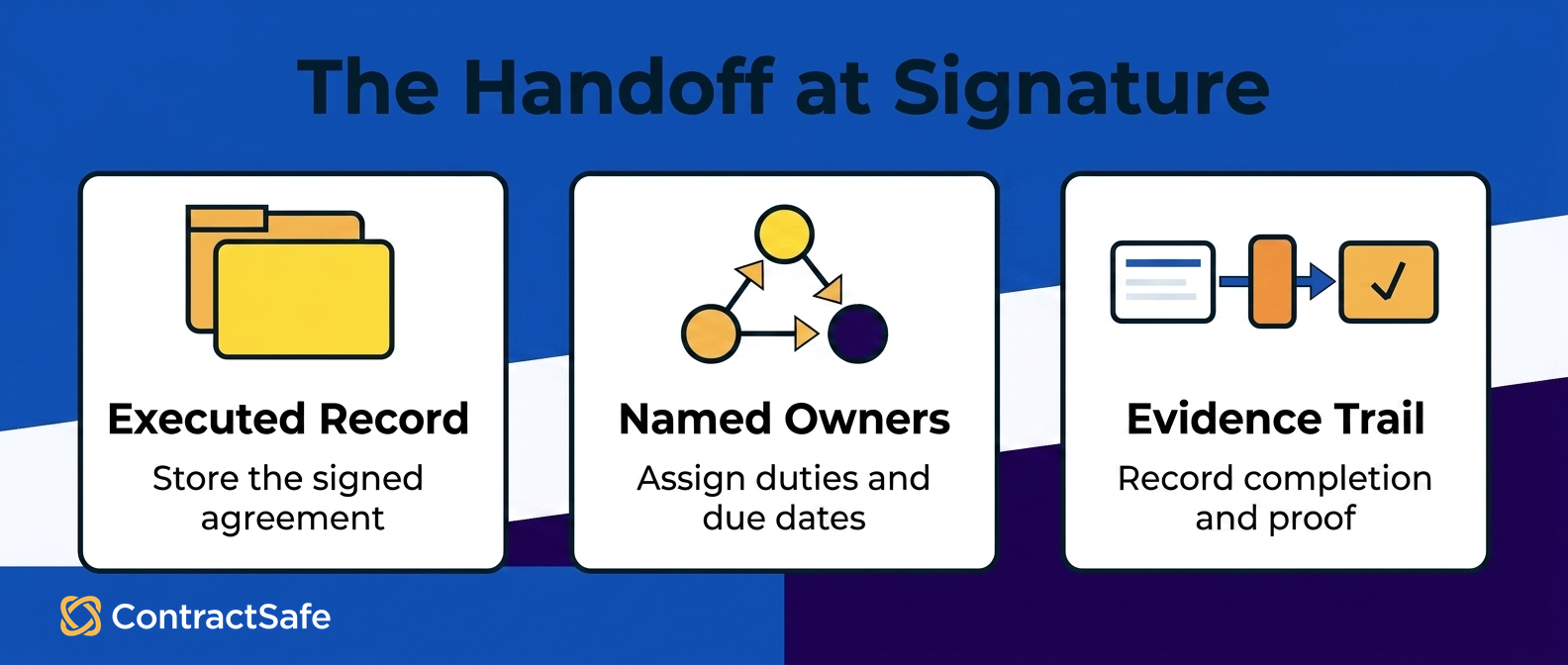
A signed contract becomes an operating record when someone extracts the terms that create future work, stores them as structured fields, assigns a human owner to each one, and connects the file to alerts and reports. The PDF is the evidence.
The operating record is what the business actually runs on during the contract term. The operating record separates the document from the terms that create work.
A long master agreement may reduce down to a fairly focused set of fields: effective and expiration dates, renewal type, notice period and recipient, payment terms, price controls, service levels, insurance, audit rights, data duties, and named owners. Those fields can drive filters, reminders, and reports in a way a PDF sitting on a shared drive simply can’t, no matter how neatly it’s named.
In ContractSafe, AI-assisted extraction can pull dates, parties, deadlines, and key clauses for a first pass, which saves an enormous amount of squinting. But a person has to verify the values before the team builds controls on top of them. The system reads and organizes. An accountable human confirms the operating record and owns the next action.
What Belongs in the Operating Record
| Layer | What it holds | Who maintains it |
|---|---|---|
| Document | Executed PDF, amendments, exhibits, SOWs, signature evidence | Whoever runs intake |
| Metadata | Dates, term structure, notice window, value, counterparty, entity | Contract admin, confirmed after AI extraction |
| Obligations | Deliverables, reporting duties, insurance, audit rights, data handling | Named business owner |
| Calendar | Renewal, notice, milestone, and review dates with lead times | Named owner using configured reminders |
| Evidence | Certificates, completed reports, sign-offs, audit trail | Owner, reviewed by compliance |
ContractSafe’s OCR-enabled search solves the first problem: finding the agreement. Structured dates, owners, evidence, and decisions turn retrieval into post-signature control. Amendments still have to stay connected to the parent record and update the controlling metadata, which sounds obvious right up until it isn’t.
If an amendment changes a notice period from ninety days to thirty, the alert needs to follow the amended term, not the original agreement that everyone still thinks of as “the contract.”
Assign Obligations, Owners, and Completion Evidence
Contract obligation management works when three things are attached to every commitment: a named human owner, a specific due date or recurring cadence, and a record of what proof counts as done. Miss any one of those and the obligation is decorative.
That third one is the easiest to skip, because without it “done” stays a matter of opinion, and opinions aren’t what you want to bring to an audit. The UK standard is genuinely useful here because it refuses to leave accountability vague. The same UK standard assigns day-to-day contract delivery and maintenance of the contract management plan to a contract manager who is accountable to a senior business owner, and it requires evidence that effective contract management plans exist.
Two roles, one accountable to the other, and a paper trail. That’s a much more specific answer than “legal owns contracts,” which in practice tends to mean nobody owns the shipping SLA buried in section 9.
The same standard also spells out what the owner is supposed to do during the term: track delivery against contractual obligations and KPIs, monitor performance and quality, manage operational issues, and take corrective action within the contract when requirements are missed. Noticing the miss isn’t enough. The owner also needs the contractual remedy or escalation path, plus a record of what they actually did about it.
Use this sequence on a contract you just signed:
Read the executed version for work. Pull every recurring duty, deadline, report, certificate, and payment trigger.
Name one owner and a backup for each obligation. Use people, not department names.
Define completion evidence before the deadline, such as an invoice, report, certificate, or delivery confirmation.
Set a lead-time reminder that leaves enough time to decide and act.
Record the contractual remedy or escalation path for missed performance.
Review high-value obligations monthly and the rest on a risk-based cadence.
The deeper contract obligation management guide covers register design in more detail.
Proof to Ask For
Before you trust any obligation register, whether it lives in a platform or a spreadsheet somebody inherited, ask it four questions and see whether it answers in under a minute:
Which obligations are due soon, and who owns each one?
Which obligations came due last quarter, and what evidence was filed for each?
Which contracts have obligations with no assigned owner at all?
When a vendor missed a commitment, what did we do about it and where is that recorded?
A register that can’t answer the third question is the one that will eventually hurt you. Unowned obligations don’t announce themselves or send a polite reminder. They surface during an audit, a dispute, or a renewal negotiation where the other side happens to know your performance history better than you do, which is an unpleasant way to learn it.
Control Renewals, Notice Windows, and Contract Deadlines
Renewal control means knowing, for every active agreement, the exact date the notice window opens, who owns the decision, what happens if nobody acts, and how much money rides on the answer. Auto-renewal isn’t a villain on its own.
Auto-renewal without a calendar entry and a named decision-maker is how a contract you stopped using in March quietly renews for another year in April, and how somebody in finance discovers it in June.
Notice windows deserve their own attention because the consequence may be automatic renewal or the loss of a termination right, depending on the agreement. Do the arithmetic: a ninety-day notice window puts the working deadline a full quarter before renewal. A reminder that cheerfully fires a month later is technically a reminder, but for that contract it’s a notification of something that already happened.
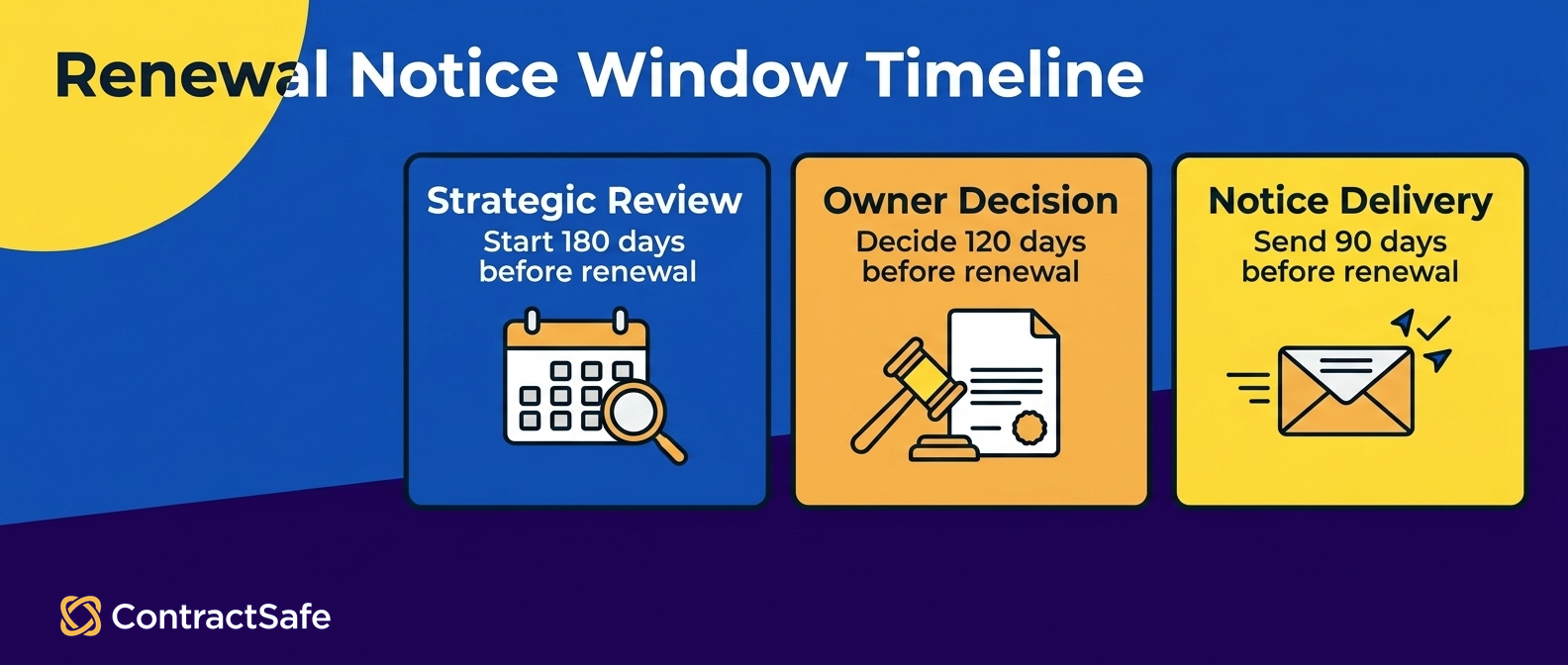
That’s the mechanic behind lead-time stacking. One alert on one date is a single point of failure that depends on one person reading one email on one busy Tuesday. What actually works is a ladder, where each rung does different work.
| Lead time | Trigger | What actually happens |
|---|---|---|
| Six months | Strategic review opens | Owner and finance begin the renew, renegotiate, or exit analysis |
| Five months | Performance pull | Usage, spend, SLA credits, and issue history are assembled |
| Four months | Decision due | The accountable owner records a decision and required approvals |
| About three months | Notice preparation | The team confirms the contractual delivery method and prepares notice |
| Notice deadline | Example notice deadline | Required notice is delivered and evidence is saved, or renewal proceeds by decision |
The early rungs create time to decide, and the later rungs escalate a decision nobody has made yet. The exact intervals should reflect the agreement, the switching costs, and how long your internal approvals realistically take. Our contract renewal best practices guide covers the deeper renewal workflow.
ContractSafe reminders can surface renewal, notice, milestone, and other contract dates. Keep a named owner and backup in the operating process, and include the contract, counterparty, deadline, and direct record location so the team can act without starting another search.
Renewal Control Decision Points
Is the notice window calculated from the right date? Renewal date minus notice period, not renewal date. Check the amendment for a changed period.
Does one named person own the decision? A department isn’t an owner. Names get held accountable; functions don’t.
Will performance data exist when the decision arrives? If you can’t pull spend and usage in an afternoon, start pulling four months before renewal.
Does the alert reach a second person? A single-recipient reminder creates a preventable point of failure during vacation, leave, or departure.
Is the outcome recorded either way? “We chose to renew” and “we forgot” look identical in a system that only logs exceptions.
Do finance and legal see the same date? Two calendars means one is wrong and nobody knows which.
Build Post-Signature Reporting and Compliance Evidence
Post-signature reporting turns scattered contract activity into something a CFO, an auditor, or a board can actually read: what’s expiring, what’s overdue, what was completed and proven, and where the portfolio is concentrated.
Compliance evidence is that same data with receipts attached, gathered as the work happens rather than reconstructed in a panic the week before a deadline.
The UK standard gives a clean target here: timely reporting frameworks that meet the needs of the people receiving them, supporting a view at both the organization level and the individual-contract level. Executives want portfolio rollups. The person managing one troubled vendor wants contract-level detail, and telling either of them to squint at the other’s report doesn’t work. The reporting model should support both.
ACC’s 2025 contract management technology findings surveyed 772 chief legal officers across 20 industries and 48 countries. It found 70% managing at least two additional functions such as risk, compliance, privacy, and ethics; 44% planned to adopt new legal technology in the next year, and contract management was the most cited category at 62%. Contract evidence may support several reporting duties when one leader covers several functions; that last point is an operational implication, not a separate survey finding.
Build the first reports in this order:
Expirations and renewals by quarter, filtered by auto-renew status and notice window.
Overdue obligations by owner, so each exception has an accountable next step.
Spend and value by counterparty, giving procurement context before renewal.
Missing metadata, including records with no owner, end date, or department.
Evidence completeness for regulated or audited obligations.
Practical contract compliance tracking and reporting starts with reliable metadata captured during handoff.
The contract tracking and reporting capability should then turn those fields into timely portfolio and contract-level views.
Post-Signature Contract Management Checklist
Run this at handoff for new contracts, and as a risk-based audit of the portfolio you already have. It makes missing owners, stale evidence, and approaching decisions visible while they’re still boring, which is the only time they’re easy to fix.
Within the first week after signature
Executed document uploaded, OCR’d, and searchable by counterparty name
Key dates extracted and confirmed by a human, not left as AI output
Business owner and legal owner named on the record
Notice window calculated and entered as a date, not a rule
Alert ladder configured with at least two recipients
Payment terms and total value passed to finance
Ongoing, every quarter
Obligations reviewed for completion and evidence attached
Insurance certificates and required attestations refreshed before expiry
Amendments linked to parent agreements and metadata updated
Owner changes reflected after any reorg or departure
Reporting duties confirmed as actually delivered, not just assigned
Before every renewal window opens
Performance data assembled: spend, usage, SLA credits, open issues
Renew, renegotiate, or exit decision made and recorded with a rationale
Notice drafted and routed if exiting, with delivery method matching the contract
Price escalators checked against the cap in the agreement
Replacement timeline started if exiting a system anyone depends on
Annually, at the portfolio level
Contracts with no named owner flagged and reassigned
Records missing key dates identified and completed
Auto-renewing agreements listed with total annual value
Compliance evidence gaps closed before an auditor finds them
What to Test in Post-Signature Contract Management Software
Evaluate post-signature contract management software on the work that happens during the term, not the work that happens during a polished demo. Bring your own scanned agreement and a real amendment chain instead of relying on the vendor’s suspiciously clean sample files.
| Criterion | What to actually test | Failure signal |
|---|---|---|
| Extraction | Upload a scanned amendment and check dates, parties, and renewal terms | Fields come back blank or wrong and require full manual entry |
| Search | Search for a clause phrase, not a filename | Only finds titles and metadata, not text inside documents |
| Alerts | Set a notice-window reminder with multiple recipients and escalation | Single-recipient email that dies when that person leaves |
| Obligations | Assign an owner and attach completion evidence | No way to record proof, only a checkbox |
| Reporting | Build an expirations-by-quarter report yourself in the trial | Requires a support ticket or a paid services engagement |
| Permissions | Give a business owner access to their contracts only | All-or-nothing access that forces legal to be the gatekeeper |
| Adoption | Have a non-legal colleague find a contract with no training | They give up and email legal, which is where you started |
| Pricing | Confirm total cost with every user who needs access | Per-seat pricing that punishes org-wide adoption |
Pricing quietly determines adoption. If only legal can afford access, legal becomes the help desk for every contract question in the building, which is a strange thing to pay software for.
Before buying, run a two-contract pilot: one clean active agreement and one scanned agreement with an amendment. Ask a business owner to find the controlling renewal clause, confirm which amendment governs, assign the decision, and attach evidence from a completed obligation. Then have finance build the expirations report and change the owner as if an employee left. Record the time and help required. This reveals whether source traceability, permissions, reporting, and ownership changes work without a vendor services project.
Test whether the system covers the whole term, too, not just storage. A searchable contract repository answers where the document is. Post-signature controls have to surface owners, evidence, deadlines, and decisions.
Related Reading
How ContractSafe Helps With Post-Signature Contract Management
ContractSafe supports post-signature work as part of a full-lifecycle platform. AI-assisted extraction pulls effective dates, expiration dates, renewal deadlines, party names, and key clauses for human confirmation.
OCR makes scanned and legacy agreements searchable, and structured records keep the current document family, owners, and dates together instead of scattered across three systems.
Teams can configure proactive reminders for renewals, notice windows, milestones, and other contract dates. And because ContractSafe pricing is $450 per month billed annually or $540 month-to-month with unlimited users, legal can hand business owners access without doing per-seat math first.
ContractSafe dashboards and reports can show upcoming renewals, missing owners, and expiring terms. Version control, audit trails, permissions, and security controls help teams preserve history and govern who sees what. ContractSafe also includes implementation, migration, and customer success support to help the organization actually adopt the system. Book a ContractSafe demo and bring several messy renewals to test.









.svg)







.svg)