
Contract obligation management is the process of tracking, assigning, and completing the promises a company makes after a contract is signed.
Think of a signed contract like a recipe card. Signing isn’t dinner. Somebody still has to buy the ingredients, follow the steps, watch the timing, and make sure nothing burns.
Those promises can be obvious, like renewal notice dates and payment terms.
They can also be easy to miss, like insurance certificates, reporting duties, price-escalation windows, confidentiality steps, and customer-specific service commitments.
If your team has ever found an obligation by accident, you already know the problem.
Key Takeaways
- Contract obligation management starts after signature, when contract promises need owners, dates, alerts, and follow-up.
- The most common failure isn’t bad legal drafting. It’s nobody owning the work after the agreement is filed.
- A useful obligation process tracks what must happen, who owns it, when it's due, and where the contract text lives.
- Legal, finance, procurement, HR, sales, IT, and operations may all own different obligations in the same contract.
- ContractSafe helps teams connect signed agreements to searchable records, alerts, owners, and reports.
Choose Your Next Step
Contract obligation management programs go faster when teams start from their sharpest current question instead of reading front to back. Jump to the part of this guide that answers yours.
- Not sure what to track? Start with the six obligation types worth tracking first.
- Building the tracker? Use the obligation record structure so entries stay tied to the contract.
- Ready to operationalize? Follow the process workflow and the weekly review checklist.
- Rolling out across teams? Go to the staged rollout plan before you announce anything.
- Whichever entry point you pick, assign one owner per obligation and set the alert before you move to the next contract. Owners and dates are the whole game. Contract obligation reminders in ContractSafe attach both to the record so the alert reaches the right person.
- Need the foundation first? Our contract repository requirements guide covers what the underlying system must do.
What Is Contract Obligation Management?
Contract obligation management means turning contract promises into tracked work: every duty gets an owner, a due date, an alert, and a link back to the clause that created it.
A contract shouldn’t become invisible once signatures are complete.
Every agreement creates follow-up.
A vendor may need insurance updates. A customer agreement may include service commitments. A lease may include notice periods. A supplier agreement may include pricing, audit, or reporting terms.
The job is simple to describe and easy to neglect: identify the obligation, assign an owner, set the date, keep the contract text handy, and confirm completion.
Contract management is a whole discipline, not just the negotiation part.
It's about the full lifecycle, not just a signing workflow. That's how WorldCC and Thomson Reuters frame it too.
That lifecycle framing matters because most risk shows up after the contract is already in force.
You don’t need a perfect system to start.
You need a reliable way to see the promises your team must keep this week.
Why Obligation Tracking Breaks Down
Obligation tracking breaks down when contract ownership moves from legal drafting to the business teams who need to act on it. The handoff is where dates, duties, and owners get lost.
Before signature, everyone knows the contract is active.
Legal is reviewing. Sales is waiting. Finance is checking terms. Procurement is asking questions.
After signature, the document often disappears into a folder.
The team assumes the work is done because the deal is closed.
That’s the dangerous part.
Your contract may still require notices, renewals, reporting, compliance steps, audit support, payment reviews, or service commitments.
The work didn’t end.
It just became easier to ignore.
For example, a vendor MSA gets signed in March. By June, the procurement lead who negotiated it has changed roles, the insurance certificate has expired, and the first quarterly report was never delivered.
Nothing broke loudly. Three obligations just quietly stopped having owners.
The Obligations Worth Tracking First
Start with obligations that can create financial, operational, legal, or relationship problems if your team misses them.
Don’t try to track every sentence on day one.
This isn’t a legal-only list.
It’s a list for how the business actually runs.
If only legal sees the obligations, the business owners who need to act may never know the work exists.
That’s when the process starts depending on memory.
| Obligation type | What to capture | Who may own it |
|---|---|---|
| Renewal and termination | Notice date, renewal date, termination rights | Legal, finance, procurement |
| Payment and pricing | Fees, escalators, discounts, payment windows | Finance, procurement |
| Insurance and compliance | Certificate duties, audit rights, required evidence | Legal, operations |
| Service commitments | Support duties, uptime terms, delivery milestones | Operations, customer success |
| Data and confidentiality | Security duties, data handling, breach notice steps | Legal, IT, security |
| Reporting duties | Required reports, delivery cadence, recipients | Finance, operations |
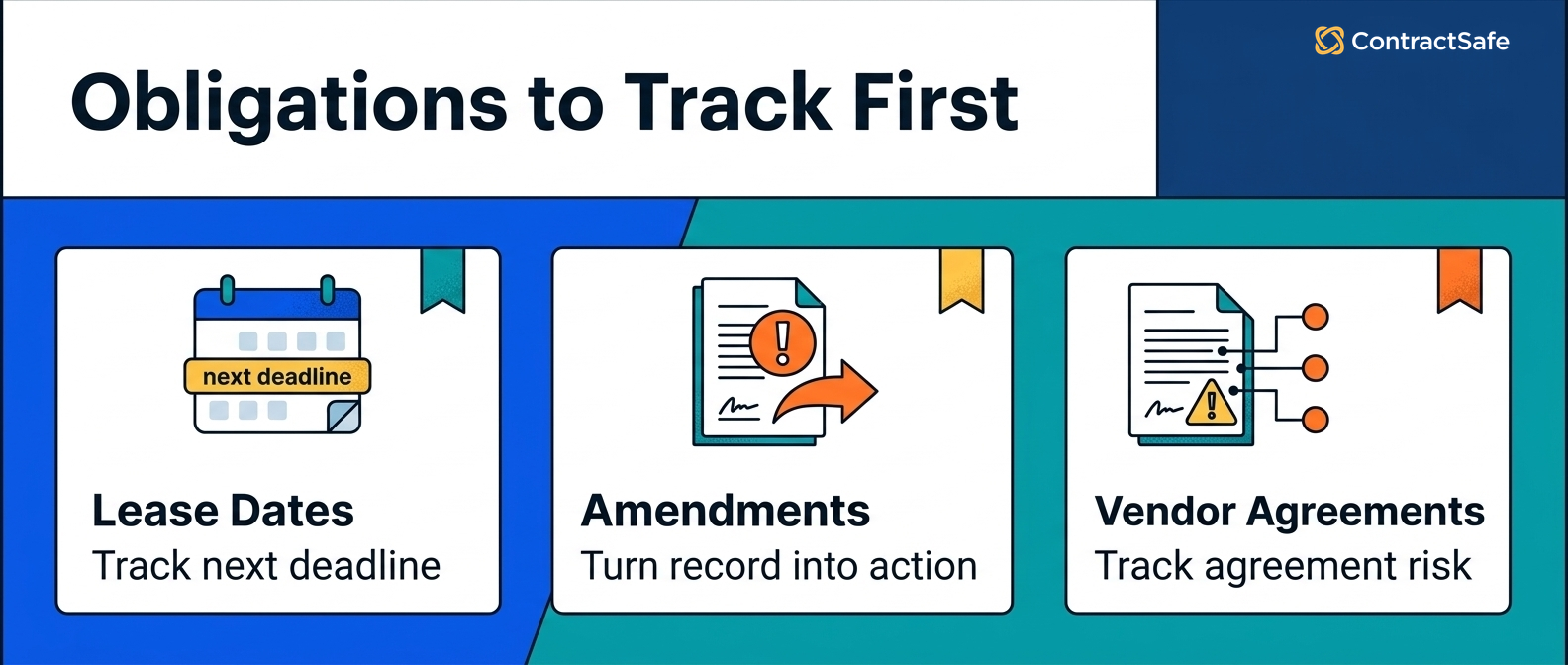
Here’s each of the six in working detail, with what to capture and the mistake that usually breaks it.
Buyer checklist: before you call any obligation handled, run each entry through the seven questions below. This is the difference between a contract that lives in a folder and one your team actually acts on. If an obligation can't answer all seven, it's not tracked yet. It's just written down somewhere, waiting to become a surprise later.
- Owner: Is one named person accountable, not a team or a shared mailbox? "Procurement owns it" usually means nobody does. Put a human name on every obligation.
- Source clause: Does the record link back to the exact clause that created the duty? If checking it means rereading the whole contract, the next reviewer will skip it.
- Due date: Is there a real date, plus lead time to act before it? Notice windows and renewals need the decision scheduled ahead of the deadline, not on it.
- Evidence: Does the record name what proves the duty was met, like a certificate, report, or invoice, and is that proof actually attached?
- Escalation: If the owner misses the alert, who gets pinged next, and when? One unread email should never quietly cost you a year.
- Reporting: Can you pull a list of what is due this month, who owns it, and what is overdue, without asking around?
- Ownership change: When the owner switches roles or leaves, does the obligation get reassigned the same week, or does it go dark?
Use this as a pass or fail filter, not a wish list. Take your ten highest risk contracts, the ones with the biggest spend, tightest deadlines, or worst fallout if missed, and score each obligation against all seven questions. Every "no" is a gap to close this week: assign the owner, set the date, attach the evidence, or write the handoff rule. Once those ten pass clean, run the same seven questions on the next batch. Owners and dates first, always.
1. Renewal and Termination Obligations
Renewal and termination obligations are the notice dates, renewal windows, and termination rights that decide whether an agreement continues on your terms or by default.
Capture the notice date, the renewal date, the required notice method, and who decides.
For example, a lease with a six-month notice window needs the decision meeting scheduled well before the window opens, not when the reminder fires.
ContractSafe’s alerts belong on these dates first, with escalation, so a missed email doesn’t become a missed year.
The renewal decision itself needs a date too. Schedule it for when the window opens, with the usage data and pricing history the decision needs attached to the record.
- Watch for: auto-renewing vendor agreements nobody has re-priced.
- Watch for: notice requirements that demand a specific delivery method, like certified mail.
2. Payment and Pricing Obligations
Payment and pricing obligations cover fees, escalators, discounts, and payment windows, the terms that quietly move money when nobody reviews them.
Capture the base fees, every escalation clause with its trigger date, earned discounts, and payment deadlines.
Say a supplier agreement allows an annual price increase tied to an index. If finance doesn’t hold the trigger date, the increase arrives as a surprise invoice instead of a negotiation.
- Watch for: escalators that compound because prior increases were never logged.
- Watch for: early-payment discounts your team earned but never took.
Log every escalator the week the contract is signed, assign the trigger date to a finance owner, and review payment obligations alongside renewals so pricing and continuation decisions happen together.
Then set a quarterly review on the vendor agreements with the largest spend: confirm the invoice matches the contract terms, check the discount was applied, and flag any fee that has no clause behind it.
The record should also name the evidence finance needs.
That might be the invoice, the usage report, the pricing exhibit, or the email where a counterparty gave notice of an increase.
If the proof lives outside the contract record, the next review starts with detective work.
3. Insurance and Compliance Obligations
Insurance and compliance obligations are the certificate duties, audit rights, and required evidence that protect you exactly when something else goes wrong.
Capture certificate expiration dates, required coverage amounts, audit windows, and the evidence each clause demands.
The common scenario: a vendor’s insurance certificate expired eight months ago, and the team discovers it during an incident, when it matters most and helps least.
Make the evidence part of the record. A compliance obligation without its certificate, report, or audit trail attached is a claim, not a defense.
Set the certificate expiration alert to fire ahead of the date, assign the re-request to a named owner, and confirm the new certificate is attached to the contract record before closing the task.
For higher-risk vendors, add a second owner.
One person requests the evidence. Another person confirms the evidence satisfies the contract requirement.
That second check isn't bureaucracy. It’s how you avoid filing a certificate that exists but doesn’t meet the required coverage.
- Watch for: certificates filed at signing and never re-requested.
- Watch for: audit rights you hold but have never exercised on high-risk vendors.
4. Service Commitment Obligations
Service commitments are the support duties, uptime terms, and delivery milestones your company promised, the obligations customers actually feel.
Capture each commitment in plain language, the measurement that proves it, and the report or review where it gets checked.
These are the obligations where the owner is rarely legal. Customer success and operations need them visible in their own queues, not buried in a contracts folder.
Review these commitments quarterly against what was actually delivered. Renewal conversations go very differently when your side arrives knowing its own record.
Assign each service commitment to the team that performs it, set the review cadence in the record, and pull the delivery evidence into the contract file before each customer review.
For customer-facing obligations, connect the obligation record to the team that hears the complaint first. A Private Status Page can give customer success and operations a shared view of uptime and incidents before they respond to the customer.
If customer success owns the relationship, customer success should see the promise before the customer reminds them.
That's how the contract stops being legal’s file and becomes an operating record.
- Watch for: service credits that customers can claim but your team never reconciles.
- Watch for: milestones owed by your side with no internal due date.
5. Data and Confidentiality Obligations
Data and confidentiality obligations cover security duties, data handling, and breach notice steps, where a missed duty can become a legal event.
Capture data-handling requirements, breach notification clocks, return-or-destroy duties at termination, and who in IT or security owns each.
Breach notice clocks deserve special attention. A clause that requires notice within a fixed period is unworkable if nobody knows which contracts contain it until after the incident.
Build the breach-notice list before you need it: every agreement with a notification duty, its clock, and its named contact, in one report security can pull in minutes.
- Watch for: differing breach windows across customer agreements.
- Watch for: termination-time data duties that nobody triggers because termination is treated as an ending, not a checklist.
6. Reporting Duties
Reporting duties are the required reports, delivery cadences, and named recipients written into agreements, the most forgettable obligation type because missing one is silent.
Capture what each report contains, when it’s due, who sends it, and who receives it.
Nobody calls the day a quarterly report isn’t sent. The relationship damage compounds quietly until renewal time, when the counterparty’s file shows every miss.
Treat owed-to-you reporting as an obligation too. Tracking what counterparties owe your team is how the contract stays a two-way agreement instead of a one-way duty list.
Assign every report a sender, set the alert ahead of the deadline, and review the missed-report list monthly so a silent gap gets a follow-up before it becomes a pattern.
Good reporting records include the report name, cadence, recipient, source data, due date, and proof of delivery.
They also include a backup owner.
If only one person knows how to prepare the report, the obligation is fragile even if the due date is correct.
- Watch for: reports owed to you that the counterparty stopped sending.
- Watch for: report duties created by amendments that never reached the tracker.
Who Owns Which Obligations
Obligation ownership follows the work, not the contract file: legal owns the record, but the duty belongs to whichever team performs it.
- Legal owns nonstandard terms, termination rights, and the contract record itself.
- Finance owns payment windows, escalators, renewal exposure, and value reporting.
- Procurement owns vendor renewals, notice dates, and supplier performance terms.
- Operations and customer success own service commitments and delivery milestones.
- IT and security own data handling, breach notice steps, and access duties.
- HR owns employment agreement obligations, from review dates to restrictive covenants.
Review the assignment map whenever a team reorganizes. Ownership rot, not bad intentions, is how tracked obligations quietly become untracked.
What a Good Obligation Record Includes
A good obligation record is specific enough that a business owner can act without rereading the whole contract.
At minimum, capture:
- The obligation in plain language.
- The source clause or section where it lives.
- The contract owner.
- The business owner.
- The due date or trigger for action.
- The alert schedule.
- The current status.
- Proof of completion, when proof is needed.
That structure keeps the record tied to the signed agreement.
It also prevents the spreadsheet version of the problem, where obligations are copied into a tracker and slowly drift away from the source.
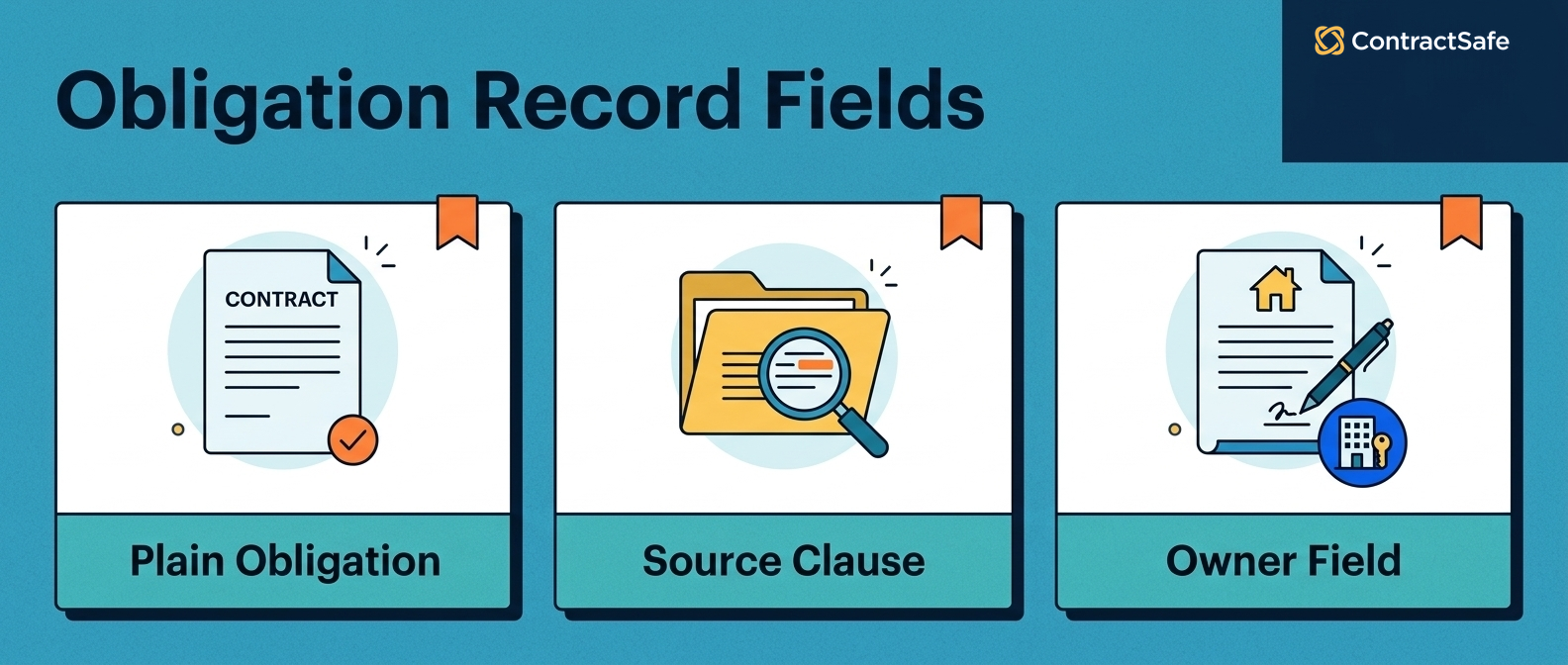
Extraction can do the first pass here. ContractSafe’s AI-assisted extraction surfaces dates, parties, and terms from the signed documents and presents them for review, so building records means verifying instead of retyping.
Quick gut check before you build anything. Pick one signed vendor agreement and list its obligations from memory. Then read the contract.
The gap between those two lists is the size of your problem. The proof to ask of any process is that it closes that gap.
Obligation Management Compared With Contract Storage
The difference between contract storage and contract obligation management is the difference between finding the document and acting on what it requires. Only one of those prevents missed duties.
| The job | Contract storage | Obligation management |
|---|---|---|
| Find the agreement | Yes, if you know where to look | Yes, searchable by text and fields |
| Know what’s due | Only if someone rereads the contract | Dates and duties tracked with alerts |
| Know who acts | Whoever remembers the deal | Named business owner per obligation |
| Prove completion | Scattered emails | Proof saved on the contract record |
| Survive turnover | Knowledge leaves with people | Records and owners reassigned in the system |
A shared drive can hold a signed agreement.
It can’t reliably tell finance that a pricing review is due, procurement that a vendor renewal window is approaching, or operations that a service report is owed.
A contract repository is a better foundation because it connects the document to metadata, owners, dates, alerts, and reports.
But even a repository needs rules.
The team has to decide which obligations are tracked, who owns cleanup, and how often reports are reviewed.
How to Build an Obligation Management Process
Build your process around the contracts that carry the highest risk or require the most follow-up.
Historical perfection can wait.
Start with active customer, vendor, lease, employment, and partnership agreements.
For each one, identify the obligations that would create a problem if missed.
Then use a simple workflow:
- Find the source clause.
- Translate the obligation into plain language.
- Assign a business owner.
- Add the due date or trigger.
- Set reminders before the deadline.
- Review open obligations weekly.
- Keep completion notes tied to the contract record.
This turns the contract from a static PDF into an operating record.
Set a hard rule for new contracts too: no agreement gets filed until its obligations are extracted, assigned, and dated. Cleanup is a project; intake discipline is a habit.
For the first pass, don’t ask the team to classify every clause.
Ask them to find the obligations that could cause the next bad surprise: renewal misses, payment surprises, evidence gaps, customer commitments, and reporting duties.
Once that workflow works, add more detail.
Rolling Out Obligation Management Across Teams
An obligation management rollout works best as a staged pilot: one contract category, one team, one month, then expand. The fastest path to a dead program is announcing it everywhere at once.
- Pick one category with visible pain. Vendor renewals usually win, because misses cost money the same quarter.
- Build records for the top agreements in that category, highest value first.
- Name the business owners and confirm each one knows what they own. Ownership announced isn't ownership accepted.
- Run the weekly review for a month, with one assigned action per open item.
- Bring leadership one month of caught-before-deadline items. Buy-in follows evidence.
- Expand one team at a time, each with the same record structure and review cadence.
Time-to-value is the honest test of the rollout. If the pilot team can’t point to a caught renewal or a completed duty in the first month, simplify the records before expanding.
Governance stays small: one person owns the tracker’s health, definitions live with the records, and any new obligation type names its owner before it gets a row.
Obligation Management Mistakes to Avoid
Most obligation management failures come from the setup, not the software. Five mistakes account for nearly all of them.
- Tracking everything. A tracker with four hundred minor duties buries the eleven that matter. Start with the obligations that cost money or create legal exposure.
- Copying obligations into a side spreadsheet. The copy drifts from the contract within a quarter. Keep records attached to the source agreement.
- Assigning teams instead of people. “Finance owns this” means nobody owns it. Every obligation gets a name.
- Setting alerts at the deadline. An alert on the due date is a notification of failure. Set it when there’s still time to act.
- Skipping proof. If completion isn’t recorded on the contract, the next audit, dispute, or renewal starts the archaeology again.
Review this list once a quarter against your own tracker. Catching one of these early is cheaper than rebuilding trust in the records later.
Weekly Obligation Review Checklist
A weekly obligation review should be short enough to finish and concrete enough to change the work queue.
Review:
- Obligations due soon.
- Contracts with missing owners.
- Renewal or termination windows approaching.
- High-value contracts with incomplete metadata.
- Open obligations waiting on another department.
- Completed obligations that need proof saved to the record.
The goal isn’t a perfect dashboard.
The goal is to make sure no important contract promise is floating around without an owner your team can name.
Close the loop in the meeting itself: assign each open item, set the next date, and confirm last week’s completions have proof attached before the list resets.
In ContractSafe, this review runs from saved report views: obligations by due date, records by owner, and agreements with missing fields, pulled from the live contract data instead of a side spreadsheet.
Use four questions to keep the review honest:
- What needs action before the next review?
- Who owns the action?
- What proof should be attached?
- Which missing field keeps the report from being trusted?
If the meeting ends without assigned work, it was a dashboard tour, not an obligation review.
Related Reading
- Contract renewal best practices, for turning renewal obligations into a working renewal process.
- Contract effective date rules, for getting the trigger dates right so obligation deadlines compute correctly.
- Contract management metrics, for measuring whether obligation follow-through is actually improving.
How ContractSafe Helps With Contract Obligation Management
ContractSafe helps teams manage contract obligations by connecting signed agreements to searchable records, dates, owners, alerts, and reports.
The repository keeps the signed contract and related metadata together, so obligation records stay tied to their source clauses.
AI-assisted extraction surfaces dates, parties, and terms for review, and the team keeps control of verification and ownership.
That balance matters because obligation management depends on trustworthy records.
Alerts with escalation cover the notice dates, certificate expirations, and reporting deadlines, and saved reports run the weekly review without a side spreadsheet.
If your team is still building the foundation, start with the guide to contract management software. The fastest proof is a free demo with a few of your own signed agreements.









.svg)







.svg)