
The difference between a digital signature and an electronic signature is really about scope. Every digital signature is an electronic signature, but not every electronic signature is digital.
Electronic signatures are the broad legal category covering any electronic consent, while digital signatures are the cryptographically verified subset.
Think about the last time you showed ID at a hotel front desk.
You could have used a driver's license, a state ID, or a gym membership card with your photo. All of those "count" as identification.
But try crossing an international border with that gym card. You need a passport for that. Something with embedded security features and government-backed verification.
That's the relationship between electronic signatures and digital signatures. One is the broad, forgiving category. The other is the verified, tamper-proof subset.
If you're managing contracts in 2026 with contract management tools like ContractSafe, a contract management platform built for legal and ops teams, knowing which one you need matters. It saves you from choosing the wrong one.
And occasionally from pulling out a passport when a library card would do.
- An electronic signature is any electronic mark showing consent: typed names, checkbox clicks, stylus scribbles on a tablet
- A digital signature is a specific type of e-signature that uses cryptographic technology to verify identity and detect tampering
- All digital signatures are electronic signatures, but most electronic signatures are not digital signatures
- Digital signatures add security but also cost and complexity; not every contract needs that level of verification
- Your signature type should match the risk level and regulatory requirements of the specific agreement
What Is an Electronic Signature? (The Broad Legal Category)
An electronic signature (e-signature) is any electronic indication that a person agrees to the contents of a document. That includes typed names, mouse-drawn squiggles, "I Accept" buttons, and tapping "approve" on your phone.
The category is intentionally wide. Back to our ID metaphor: your driver's license works at most domestic checkpoints. An e-signature works for most everyday agreements.
You've probably created a dozen this month without thinking about it. That checkbox on a software update? E-signature. Your name at the bottom of an email approving a vendor proposal? Same thing. The esignature examples in everyday business are almost comically common.
Legally, e-signatures carry real weight. The U.S. ESIGN Act of 2000 and UETA gave them the same standing as wet ink for most situations. The EU's eIDAS regulation does the same across Europe.
What qualifies something as a valid e-signature? Four things:
-
Intent to sign. The person meant to indicate agreement.
-
Consent to do business electronically. Both parties accepted the format.
-
Association with the record. The signature connects to the specific document.
-
Record retention. The signed document can be stored and reproduced.
No cryptography required. No certificate authority lurking in the background.
For most contracts moving through the contract lifecycle stages, a basic e-signature is perfectly sufficient. NDAs, vendor agreements, internal approvals. Your library card gets you into the building just fine.
Once you're processing more than a handful per week, understanding contract management software and how it handles signatures becomes more than idle curiosity.
What Is a Digital Signature? (The Verified Subset)
A digital signature is a specific type of electronic signature that uses cryptographic algorithms to verify the signer's identity and guarantee the document hasn't been altered after signing. It's the passport:
More secure, harder to forge, required when the stakes demand it.
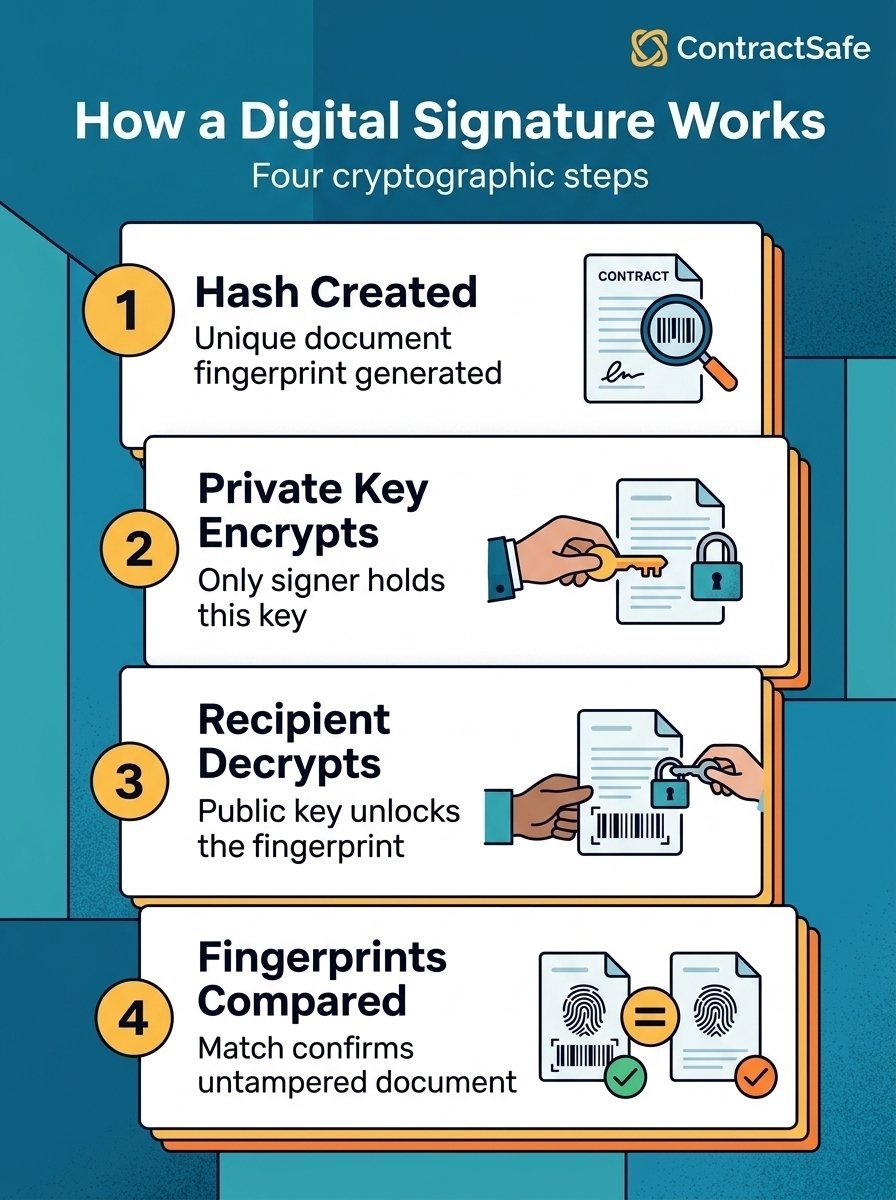
How does it actually work, though? In plain language:
-
A hash is created. The software generates a unique mathematical fingerprint of the document's contents, according to the National Library of Medicine
-
Your private key encrypts the hash. Only you possess this key.
-
The recipient decrypts it. They use your public key to unlock the fingerprint and compare it against the document.
-
If the fingerprints match, the document is verified as authentic and untampered.
Two keys. One fingerprint. A mathematical handshake. That's basically it.
The first commercial software offering digital signatures was Lotus Notes 1.0 in 1989, using the RSA algorithm. The underlying logic hasn't changed much since, even as the applications have exploded.
And the demand is real. The question isn't whether people want electronic signing.
It's what level of verification a given agreement actually needs.
(Which, if you think about it, is the same question border control asks. Not "should we check IDs?" but "how thoroughly?")
When thinking about the stages of contract management that teams work through, digital signatures typically appear at execution. High-value deals, regulated agreements, government contracts, healthcare records.
Pros and Cons of Digital Signatures for Contract Workflows
Digital signatures offer strong security and legal defensibility, but they carry trade-offs in cost, complexity, and friction that don't make sense for every agreement.
A passport is universally recognized, extremely secure, and difficult to forge. But you wouldn't flash it to sign for a pizza delivery.
Same principle applies here.
Advantages
-
Tamper detection. If anyone changes even a comma after signing, the signature invalidates. You know immediately.
-
Identity verification. Certificate authorities confirm the signer is who they claim to be. No "my assistant signed that" disputes.
-
Built-in audit trails. Timestamps and certificate details come baked in, which proves valuable during disputes or compliance audits.
-
Regulatory compliance. Finance, pharma, government contracting: certain industries simply require them. This isn't a preference.
-
Fast payback. According to AIIM, 68% of digital signature users saw payback within 12 months.
Disadvantages
-
Cost. Digital certificates aren't free. Certificate authorities charge for issuance, and enterprise solutions carry subscription fees on top.
-
Technology dependency. Both parties need compatible software. Interoperability between platforms isn't always smooth.
-
Overkill for routine work. Most everyday contracts don't face tampering risks that warrant cryptographic verification.
-
Certificate expiration. Certificates have shelf lives. Managing renewals across an organization adds administrative weight over time.
The honest question: does this agreement carry enough risk? A multimillion-dollar acquisition? Absolutely use digital signatures. A mutual NDA with a freelance designer? Probably not worth the overhead.
If you're wondering whether you need full lifecycle contract management to handle all this, the answer depends on volume. A few high-security contracts per quarter can be managed by hand. Dozens per month?
You need a system that tracks which contracts used which signature type, and whether those signatures are still valid.
Digital Signature vs. Electronic Signature: Key Differences at a Glance
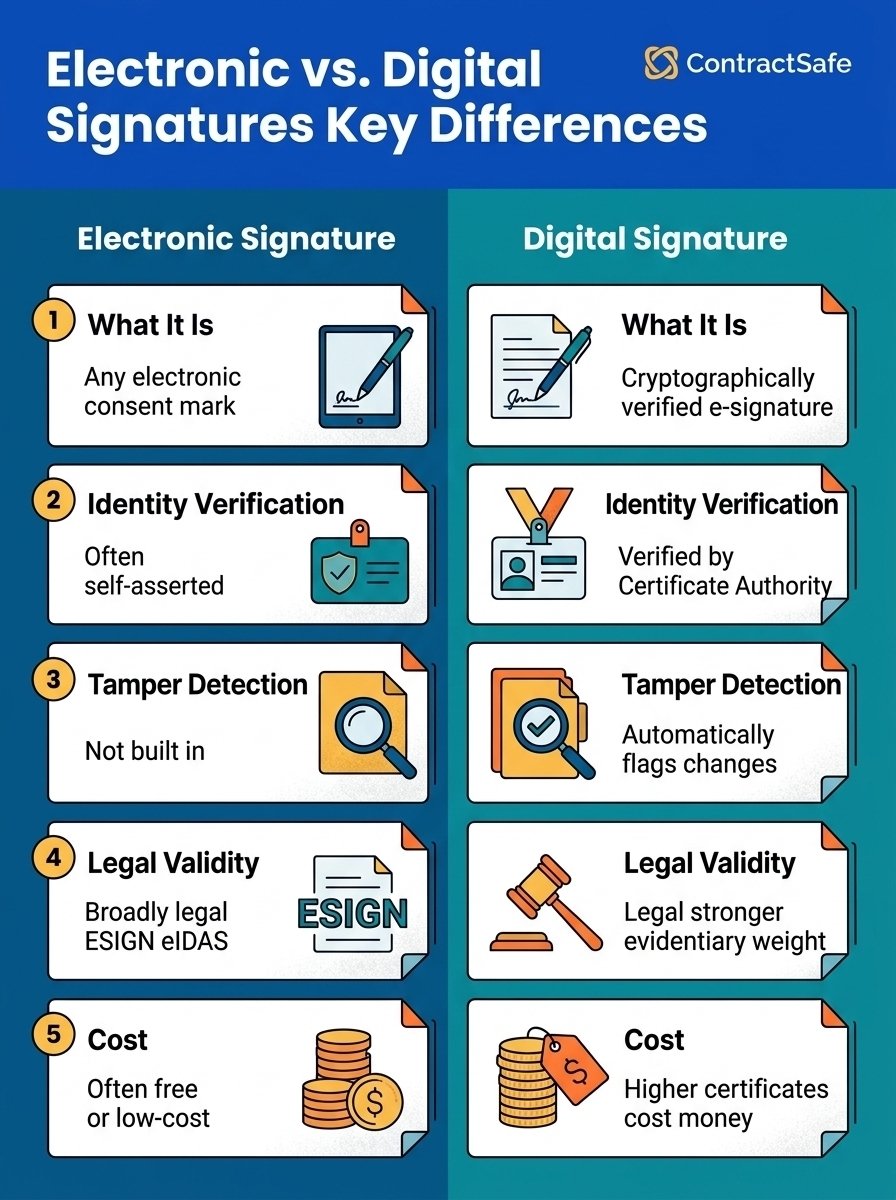
A digital signature is a specific, cryptography-backed type of electronic signature. An electronic signature is any electronic indication of consent. That's the core distinction, and everything else flows from it.
Think of it like transportation. "Vehicle" covers cars, bikes, scooters, horse-drawn carriages if you're feeling romantic. "Car" is one specific kind of vehicle. Nobody calls a bicycle a car. But every car is definitely a vehicle.
Same logic here. Every digital signature counts as an electronic signature. But a typed name at the bottom of an email? That's an e-signature, not a digital one.
The confusion makes sense. The terminology has overlapped for decades. People use the phrases interchangeably because, honestly, most of the time nobody corrects them.
Where the differences actually matter:
| Electronic Signature | Digital Signature | |
|---|---|---|
| What it is | Any electronic mark showing consent | A cryptographically verified e-signature |
| Security mechanism | Varies (can be minimal) | Public key infrastructure (PKI) encryption |
| Identity verification | Often self-asserted | Verified by a Certificate Authority |
| Tamper detection | Not built in | Yes, automatically flags changes |
| Legal validity | Broadly legal (ESIGN Act, eIDAS) | Legal, with stronger evidentiary weight |
| Common use cases | NDAs, internal approvals, HR forms | Regulated industries, cross-border deals |
| Cost | Often free or low-cost | Typically higher (certificates cost money) |
For most internal contracts, an electronic signature works fine. Your standard NDA, your vendor agreement, your consulting contract. These don't need cryptographic verification.
But when you're dealing with regulated industries, government filings, or international agreements where authentication really matters? That's digital signature territory. The integrations between your signing tools and contract storage become genuinely important at that point.
According to AIIM, 68% of existing digital signature users saw payback within 12 months. So while digital signatures cost more upfront, the math works out quickly.
Digital Signature vs. Digital Signature Certificate (DSC): Not the Same Thing
This is a term that trips people up constantly. A digital signature and a digital signature certificate (DSC) are related but different things. Like a driver and a driver's license.
The digital signature is the act. It's the cryptographic output that gets attached to your document, proving you signed it and that nobody altered the file afterward.
The DSC is the credential. It's issued by a Certificate Authority (think of them as the DMV of the digital world). The certificate contains your identity information and your public key.
It's what lets other people verify your digital signature is legitimate.
You can't produce a valid digital signature without a DSC backing it up. But the certificate itself doesn't sign anything. It just proves you're you.
This matters in practice because some compliance frameworks specifically require a DSC, not just any digital signature. India's IT Act, for instance, requires Class 2 or Class 3 digital signature certificates for certain government filings.
If your team encounters "DSC" in a regulatory requirement, they need the certificate, not just the signature technology.
Which Signature Type Does Your Contract Actually Require?
Most business contracts in the U.S. require only an electronic signature for legal enforceability. Digital signatures become necessary when regulations, industry standards, or counterparty requirements demand cryptographic verification.
The honest answer to "which do I need?" is: it depends on the contract, and it depends on who's on the other side.
If you're filing documents with a government agency that mandates digital signatures, you need digital signatures. If your counterparty's compliance team requires them, you need them.
If you're operating in the EU under eIDAS and need a "qualified electronic signature," that's the digital signature flavor.
According to AIIM's research on signature workflows, paper-based interruptions still slow down a significant proportion of document workflows, even in 2026. Choosing the right electronic or digital signature type for each contract eliminates that friction before it starts.
And this is the part that gets overlooked. Not because of the signature itself, but because of what happens (or doesn't happen) next. Renewals get missed. Obligations get forgotten. The signed contract disappears into someone's inbox.
The signature type matters less than what happens to the contract afterward. Which brings us to the uncomfortable truth: signing is one of the contract lifecycle stages where teams focus the most energy, when post-signature management is where the value actually leaks.
How ContractSafe Keeps Every Signed Contract Visible and Trackable
Whether your agreements carry simple electronic signatures or cryptographically verified digital ones, they all end up in the same place eventually: storage. And storage is where contracts go to be forgotten.
ContractSafe, a contract management software platform, solves this by pulling every signed agreement into a centralized digital contract repository that's searchable, sortable, and actually usable. Its AI automatically extracts key dates, party names, renewal deadlines, and critical clauses.
You don't have to read every contract to know what's in it.
ContractSafe's OCR technology makes even scanned, wet-signed documents fully searchable, so your older agreements aren't locked in PDF purgatory.
Automated alerts and reminders mean no renewal sneaks past your team. Custom dashboards show you what's expiring, what needs attention, and what's sitting unsigned.
With unlimited users on every plan, your entire organization can access the contracts they need without bottleneck or per-seat cost surprises. Setup takes minutes, not months.
If you're wondering whether you need full lifecycle contract management or just better visibility into what you've already signed, ContractSafe gives you a practical starting point that scales with you.









.svg)







.svg)