Quick answer: Contract compliance tracking is the practice of monitoring whether post-signature obligations are met on time. It keeps deliverables, payment schedules, and regulatory requirements on track and protects your organization from revenue loss and legal trouble, which is hard to do by hand without a system in place.
It's three days before an audit. Your teams are getting everything in order, and then your procurement officer uncovers a lapsed certificate of insurance. Now you're wondering whether anything could have warned you about that COI's termination date.
Something could have, if the insurance requirement had been recorded with a named owner and a reminder tied to its date. Most missed obligations go the same way: nobody forgot them on purpose, they just weren't written down anywhere that would speak up.
Choose your next step:
- Defining the work? Start with the five obligation categories.
- Building the process? Use the obligation record framework.
- Compare systems by running the decision checklist on your own agreements.
Key Takeaways
- Contract leakage often starts with preventable tracking failures: unrecorded changes, missed obligations, and price escalations that no owner reviewed.
- Contract obligations like renewal windows, SLAs, compliance certifications, and insurance conditions can become out of sight and out of mind once an agreement is signed and filed away.
- Certificate of insurance mistakes can delay work and leave an organization exposed when required coverage lapses unnoticed. Contract date tracking with reminders tied to each certificate's expiry is the simplest fix.
- Memory and personal calendars fail when an owner changes roles, leaving notice windows, insurance renewals, reports, and service reviews without a reliable handoff.
- ContractSafe keeps these key obligations top-of-mind no matter who is in office or onboarding an agreement by transforming static documents into a searchable repository, using structured date fields and automated, custom alerts to warn of upcoming commitments before deadlines arrive.
What Are Contract Obligations and Why Do They Get Missed?
Contract obligations are the promises that continue after signature, including notices, reports, payments, insurance conditions, service duties, and indemnification terms. They get missed when no named owner, reminder, and completion evidence stays attached to the controlling contract language.
There are five common categories: renewal and notice dates, service level and performance requirements, reporting and certification requirements, insurance requirements, and indemnification conditions.
| Obligation Type | Example | Who Owns It | What to Track | What Happens if It's Missed |
|---|---|---|---|---|
| Renewal & notice dates | Renewal windows, termination notice periods, and auto-renewal trigger dates. | Legal, finance, and procurement. | Notice dates, renewal dates, required notice methods, and the specific internal decision-makers. | Rushed renegotiations, lock-ins to unfavorable terms, and unbudgeted auto-renewals at higher rates. |
| Service level & performance requirements | Ongoing SLA benchmarks, delivery timelines, customer service metrics, and support duties. | Operations and customer success. | Plain-language commitments, objective performance measurements, and scheduled review timelines. | Degraded performance thresholds, missed delivery windows, and vendors operating entirely without accountability. |
| Reporting & Certification Requirements | Recurring financial reports, compliance certifications, audit results, and required regulatory filings. | Finance and operations. | Report contents, due dates, specified senders/recipients, and definitive proof of delivery. | Hard regulatory penalties, silent relationship erosion, and compounding operational gaps uncovered late at renewal time. |
| Insurance Requirements | Insurance coverage requirements and certificate of insurance (COI) delivery mandates. | Legal, operations, and contract administration roles. | Certificate expiration dates, mandated minimum coverage levels, and automated proactive renewal alerts. | Lapsed coverage, unmonitored policy changes, and significant liability exposure during an active operational incident. |
| Indemnification Conditions | Allocation of legal defense costs, third-party lawsuits, and data breach financial liabilities. | Legal and finance leadership. | Stated liability caps, exception carve-outs, clause symmetry, and alignment with active insurance tracking metrics. | Unlimited financial exposure, expensive legal disputes, and evidence failures that indicate weak corporate governance. |
Renewal and Notice Dates
Dates that govern whether a contract continues, changes, or ends (a.k.a. renewal windows, termination notice periods, and auto-renewal trigger dates) are the most commonly missed obligations.
The problem is a mismatch between the contract end date and the earlier notice window. The owner needs an alert early enough to review performance, gather approvals, negotiate terms, and send notice using the method the agreement requires.
Service Level and Performance Requirements
Routine vendor management can hide whether anyone is checking the response clock for priority support, the agreed uptime threshold, delivery timing, or the records needed to challenge a service failure.
When no one is actively monitoring service level agreement (SLA) obligations, delivery timelines, and performance benchmarks, it’s like never opening your credit card statement when someone else is charging your card.
Missed delivery windows and service failures continue when no owner checks the required performance record, documents the gap, and asks the vendor to cure it under the contract. For example, require the service owner to review the monthly uptime report, record any exception, and preserve the notice sent to the vendor.
Reporting and Certification Requirements
Within a lot of vendor agreements, grant contracts, and regulated industry agreements you’ll find obligations that require one party to submit something on a recurring basis. This includes milestones like quarterly financial reports, annual compliance certifications, or recurring regulatory filings.
These requirements can feel like just passive calendar events, but fail without careful documentation. Organizations need to track proof of delivery, such as a receipt confirmation or submitted filing, and have systems in place for recurrence and escalation paths.
Demo test: Pick one active contract and verify its owner, source clause, next due action, reminder path, and completion evidence before you trust the portfolio report.
Insurance Tracking
Insurance coverage mandates and COI delivery guidelines can be overlooked despite their high consequences. Tracking insurance obligations requires careful date-based tracking through logging specific certificate expiration dates and required coverage amounts and making sure they all stay active.
A vendor's insurance policy can lapse during active work if no one tracks the certificate, required coverage, and renewal evidence together. In construction and other high-risk work, a missing or expired certificate can stop access to a site and leave the organization exposed during an incident. For example, track the certificate expiration, required limits, broker request, replacement certificate, and reviewer approval as one obligation record.
Indemnification Conditions
Unlike certificate expiration dates, indemnification conditions don't operate on a standard calendar timeline. Indemnity is a structural risk allocation framework that dictates which party covers legal defense costs, damages, or regulatory fines resulting from third-party lawsuits, operational failures, or data breaches.
Because these obligations are contingent on real-world events, managing them requires strict clause governance and insight into contracts across your portfolio. Legal and operations teams need to track:
Liability Caps and Triggers: Track the financial exposure limits stated in your contracts versus the real hazards in your SOW, like data-breach liabilities.
Specific Clauses: Monitor mutual provisions to make sure you maintain your ability to arbitrate.
Insurance Alignment: Check to make sure your indemnity promises match your insurance timelines.
Why Obligations Disappear After Signing
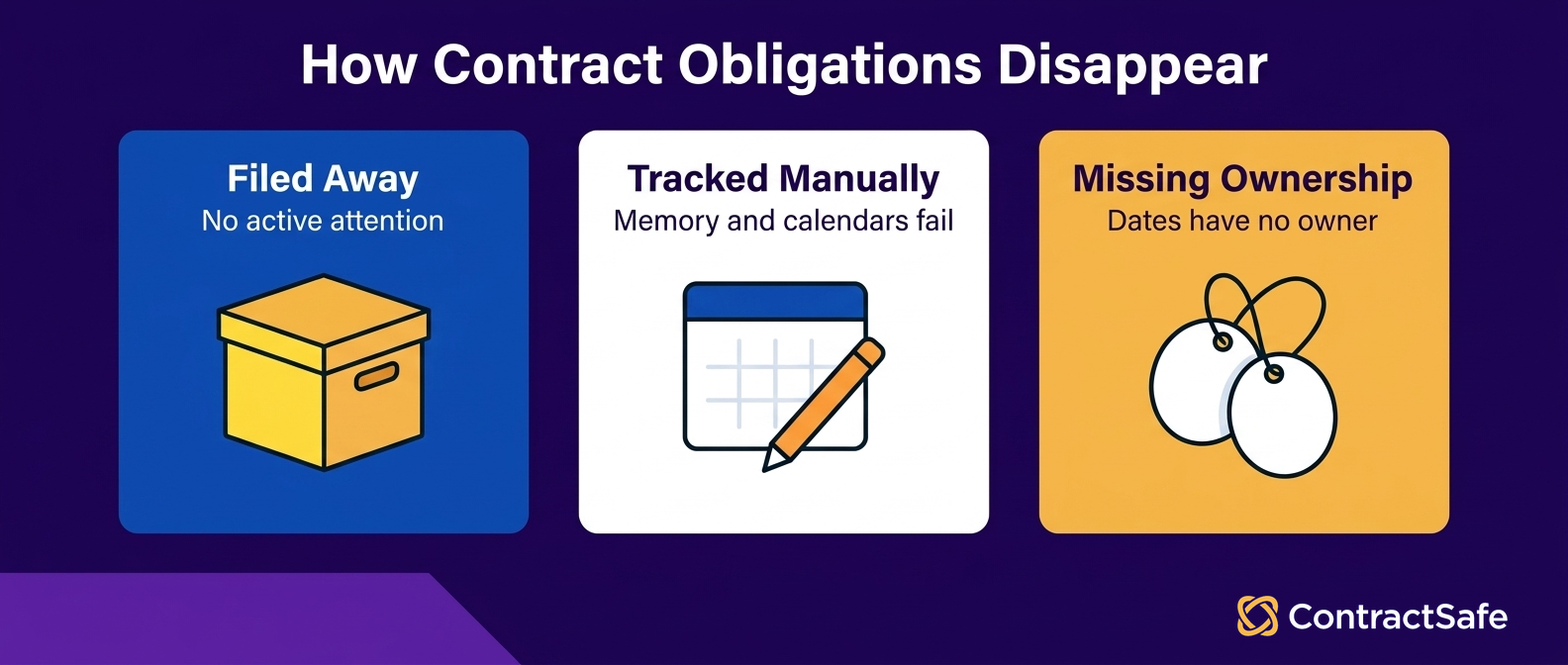
Signed contracts disappear from active attention when storage has no owner, dates have no reminders, and duties are not recorded as fields that drive work. A shared drive can preserve the PDF, but it can't assign the next action or remind the person responsible.
Granted, the legal and ops teams know that their contracts have ongoing obligations. The lapse isn’t due to their lack of knowledge. It’s due to poor infrastructure. Organizations struggle because they have contract storage without ownership, key dates with no reminders, obligations without structured fields, and no portfolio-level reporting. This is the post-signature side of contract lifecycle management: turning signed terms into owned, monitored work.
Without a way to track a contract’s lifecycle more efficiently, obligation tracking defaults to memory or manual calendar management. Both fail at scale and crumble if the person with the necessary institutional knowledge leaves the company.
Build an Obligation Record That Survives Turnover
A durable contract obligation record connects the source clause, named owner, trigger, due date, evidence, and next action. Missing any field can leave a team aware of a promise but unable to complete the work after an owner changes roles.
Start With the Controlling Language
Record the clause or schedule that creates the duty, not only a summary someone typed during intake. The record should point back to the signed agreement, current amendment, exhibit, or statement of work so a reviewer can confirm exactly what controls. When an amendment changes a date or threshold, keep the relationship between documents clear and mark which language is current.
This matters most when a short label hides a conditional promise. “Insurance renewal” is not enough if the contract also specifies the coverage type, delivery method, recipient, and cure period. Capture the condition in plain language, then keep the source beside it.
Name the Person Who Can Complete the Work
Departments don't act on reminders; people do. Assign one business owner who can complete or coordinate the obligation, then name legal, finance, procurement, security, or operations reviewers only where their approval is actually required. A shared inbox can receive a copy, but it shouldn't be the only owner.
Ownership also needs a handoff rule. When someone leaves or changes roles, a report should show every open obligation attached to that person. Reassign the records, confirm the new owner, and keep the history so an audit doesn't depend on reconstructing an email chain.
Define the Trigger and Proof of Completion
Some duties follow a date; others follow an event. A renewal notice follows a contractual window. A security notification may follow discovery of an incident. A rebate report may follow the close of a measurement period. Record the trigger in terms the owner can recognize, then state what counts as done.
Proof might be a sent notice, accepted certificate, approved report, payment record, signed amendment, or screenshot from a vendor portal. Attach that evidence to the contract record and record who checked it. “Completed” without evidence is only a status label.
| Record Field | Question It Must Answer | Proof to Keep |
|---|---|---|
| Source | Which signed clause, amendment, or exhibit creates the duty? | Link to the controlling document and page |
| Owner | Who can complete the work or make the decision? | Named person and reassignment history |
| Trigger | What date or event starts the work? | Verified date, event record, and alert rule |
| Completion | What must happen before the duty can be closed? | Notice, certificate, approval, report, or payment |
| Escalation | Who steps in when the owner doesn't act? | Reminder and escalation history |
Contract Compliance Tracking Decision Checklist
A useful decision checklist tests the work on real agreements. Choose contracts with different obligation types, assign owners, create alerts, attach completion evidence, and run a report. The system passes only when another person can verify each result without asking the administrator what happened.
Prepare a Representative Test Set
Use an agreement with a renewal window, one with recurring reporting, one with an insurance condition, and one with a performance duty. Include an amendment that changes a controlling term. Clean sample contracts prove very little; the test set should include the document relationships and messy wording your team handles every week.
Run the Obligation From Clause to Closure
- Find the source. Open the signed contract and locate the exact clause without relying on a prewritten summary.
- Create the record. Capture the obligation, owner, trigger, due date, lead time, and required evidence.
- Change the owner. Reassign the duty and confirm that the new person receives the same context and reminders.
- Complete the work. Attach the notice, certificate, report, approval, or other proof and close the obligation.
- Audit the history. Confirm that a reviewer can see the source, changes, reminders, completion evidence, and final status.
- Report across contracts. Filter open, overdue, and completed duties by owner, department, contract type, and due period.
Don't accept a demo that skips the handoffs. A vendor can show an attractive dashboard while leaving ownership changes, amendment relationships, or completion proof to email. Ask the presenter to perform each step in front of you, then repeat the test in a trial account with your own documents.
Set Pass-Fail Rules Before the Demo
Write the pass condition beside every test. Search passes when the controlling clause is found and linked to the correct document. Alerts pass when the owner and escalation recipient both receive the right context. Reporting passes when each row can be traced back to the obligation record and source language. Export passes when the documents, reviewed data, and history can be retrieved without a services project.
The same rules help after purchase. Keep the test set as a regression pack for configuration changes, new contract types, and team handoffs. If a new workflow breaks a reminder or hides the controlling amendment, the team should discover it during a test rather than during an audit.
Test Regulated Duties Against the Source Rules
Contract compliance tracking also needs a path for duties imposed by regulation or public-sector terms. The record should distinguish what the contract says, what an outside rule requires, who interprets that rule, and what evidence proves the team acted. Do not bury that distinction inside a generic “compliance” tag.
For healthcare agreements, the business associate contract requirements in 45 CFR 164.504 cover safeguards, incident reporting, subcontractor restrictions, access to records, and return or destruction of protected health information. Those are different work items with different owners and proof. A tracking record should point to the applicable agreement language and identify what closes each duty.
Public-sector agreements can create a different evidence trail. FAR 42.1502 requires past-performance evaluations for covered federal contracts and orders at defined points in the work. A team handling those agreements needs the evaluation trigger, responsible contracting role, required system, and completion record connected to the contract instead of treated as an informal calendar reminder.
During a demo, ask the vendor to model both examples without pretending the software interprets the law. The platform should store the reviewed requirement, route it to the right person, alert on the agreed trigger, retain evidence, and let a reviewer trace the record back to its source. Legal judgment stays with the team; the system makes the resulting work observable and repeatable.
How ContractSafe Uses Structured Tracking and Date-Based Reminders To Close the Gap
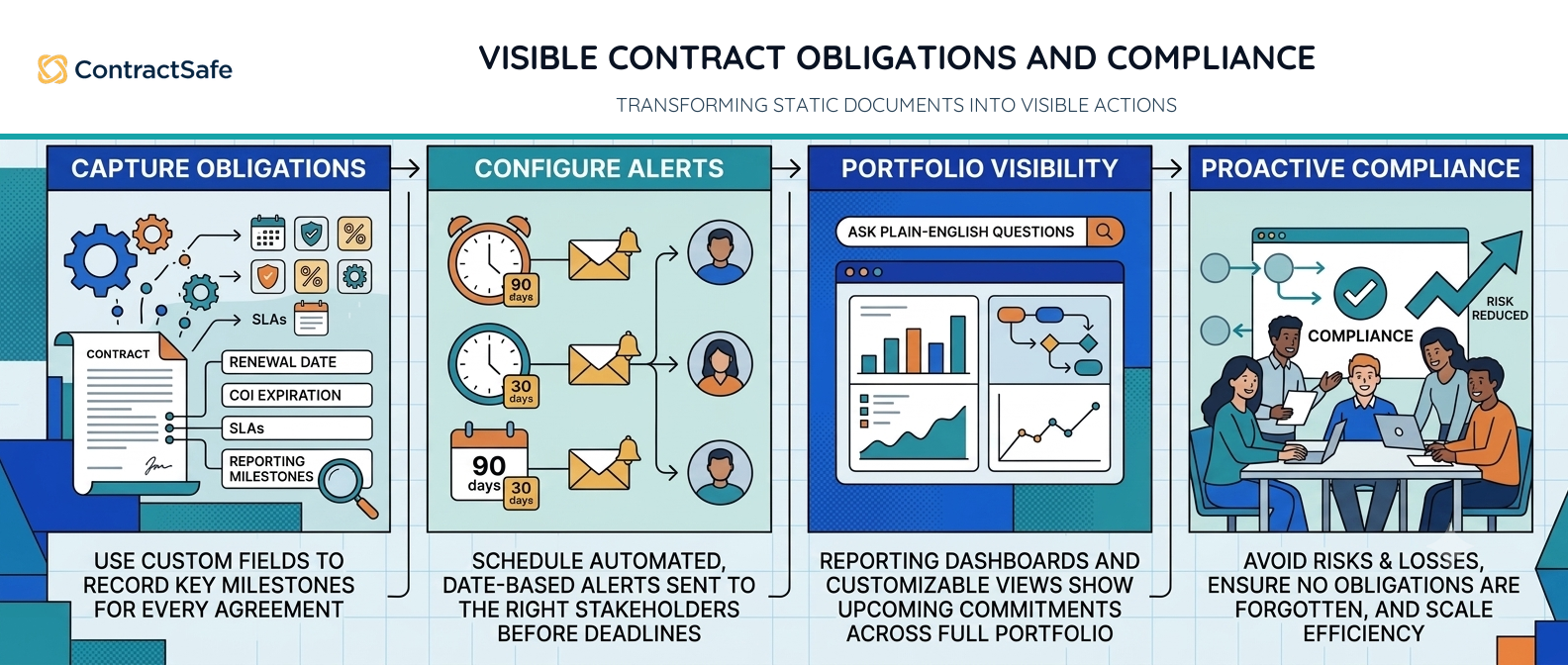
You don’t need a JD and a magnifying glass to understand your contract obligations. ContractSafe provides structured fields, searchable contract storage, and customizable date-based alerts so you can. This means teams record key dates and milestones in custom fields and then ContractSafe’s alert system surfaces those dates to the named owners before the window for that action closes.
Structured Fields That Capture What Matters
That turns obligation tracking from a memory problem into something you can actually report on. Custom fields make it easy for teams to record the specific obligations that matter for each agreement type, including renewal dates, notice deadlines, insurance renewal dates, reporting due date, SLA review periods, or any other milestones the team needs to monitor. Once that data is captured, the system can act on it automatically, alerting those who need to know.
Automated Alerts That Surface Obligations Before It's Too Late
Date-based alerts are the best way to track contract obligations and help your team avoid missing important renewal dates. Notifications are sent to the right people at the right time weeks or months before a renewal window closes, an insurance certificate needs to be renewed, or before a reporting deadline arrives.
ContractSafe’s alerts help you track everything from renewals and expirations to compliance or payment dates. You can schedule automated email reminders to be sent to anyone on your team and even people outside your organization. In the platform, you can view a calendar of upcoming dates that’s sortable by vendor, department, manager, or any other way you'd like.
Set each lead time to the work required before the contractual deadline. A renewal decision needs time for performance review and negotiation; a certificate update may need time for a broker and vendor to respond; a recurring report needs time for review and delivery.
Reporting That Shows the Full Picture
ContractSafe offers contract compliance tracking and reporting at the portfolio level. With dozens or hundreds of contracts, teams need reporting that shows which obligations are upcoming, which are overdue, and which contracts require attention across the full portfolio.
Reporting dashboards have a drag-and-drop interface that allows you to quickly add or remove fields and columns and sorting is completely customizable. So if your report looks like a longer version of what’s below you can quickly sort by lead time, status, or anything else.
| Contract | Obligation | Owner | Department | Due Date | Lead Time | Status | Next Action |
|---|---|---|---|---|---|---|---|
| Logistics MSA | COI Update | Sarah J. | Procurement | Verified COI expiry | Broker response window | At Risk | Re-request COI |
| Imaging Lease | Renewal Review | Radiology Director | Radiology | Verified renewal date | Review and negotiation window | In Progress | Review maintenance history |
| Brightline MSA | Data Destruction | Mark T. | IT & Security | Verified destruction deadline | Evidence collection window | Pending | Request shred certification |
An exportable report lets legal, operations, and finance sort obligations by owner, due date, status, and next action before a review meeting. Each row should open the contract record and the source language behind the duty.
How ContractSafe AI and Search Support Compliance Work
ContractSafe makes contract obligation tracking practical. We don't claim that our AI will magically interpret every nuanced legal promise or automatically populate an obligation field for you. Instead, our contract management AI handles the initial grunt work by automatically extracting key parties, execution status, and renewal terms.
From there, your team populates custom fields to record the milestone dates that matter to your business: an insurance certificate expiration, a regulatory reporting deadline, an SLA review window, or anything else. Because any custom date field can trigger an automated alert, you can configure custom lead times so the right owner gets reminded weeks or months before a deadline window closes.
When questions do come up, we’re here to help. Our secure contract repository allows anyone on your team to run full-text searches and locate specific provisions in seconds. You can even ask plain-English questions across your entire library like, "Which contracts have indemnification clauses above our approved cap?" and receive instant, traceable answers linked directly to the text.
It’s simple, effective software that replaces reactive status-chasing with a controlled, visible pipeline. Schedule a demo to see how obligation tracking looks in real life.
Related Reading
- Contract obligation management explains how to identify, assign, and complete post-signature duties.
- Contract deadlines covers notice windows, renewals, and the dates that control when a contract changes or ends.
- Contract lifecycle management places compliance tracking inside the full process from request through renewal.
Stop Letting Contract Obligations Slip Through
When a signed contract gets filed away, the obligations don't disappear. They accumulate, compound, and eventually surface as missed deadlines, lapsed coverage, or auto-renewals that no one asked for. These invisible obligations need to be monitored, and that only happens when the tracking is built into a system.
A good system doesn't just store obligations, it surfaces them at the right moment, the way a good bank doesn't just keep records but actively tells you when action is needed. ContractSafe’s system captures obligation dates, alerts the right people before deadlines arise, and gives leadership a clear view of what the organization has agreed to across its whole portfolio.
Stop letting commitments get lost in the vast clutter of shared drives and email archives. Because ContractSafe features unlimited users on every plan and a deployment timeline that gets your team up and running in days instead of months without a heavy IT project, closing your compliance gaps can happen right now. Take control of your agreements today and book a demo to experience simple contract tracking firsthand.








.svg)







.svg)