A basic contract repository is usually an organization’s first move. But as contract volume, contract complexity, and team size increase, it can quickly stop being useful. After a certain point, a repository doesn’t solve bottlenecks and backlogs throughout the contract lifecycle.
For a team coming off spreadsheets and shared drives, getting every contract into one searchable place is a genuine win. No more digging through someone’s inbox to find a signed NDA, no more guessing which folder has the current version.
But growth changes what a team needs. Departments outside legal start asking for access. Pre-signature work (the drafting, the routing, the back-and-forth before anyone signs anything) becomes the issue. A repository is built to store contracts, not to manage the process of getting them signed in the first place, and that gap is exactly where this article begins.
Think of a repository as a storage unit, everything you put in it is safe, organized, and easy to find again. What a storage unit doesn’t have is a desk, phone line, or a place for people to actually get work done before the box gets sealed and shelved. That’s the difference between a repository and a scalable contract lifecycle management (CLM) platform meant for multi-department collaboration. Let’s get into it.
Key Takeaways
- For teams that are mostly managing contracts after they’re signed, a repository handles the job.
- For organizations who need support from contract drafting through renewal negotiations, using the wrong software can mean going back to managing contracts by hand.
- Deloitte legal operations research shows that most legal leaders believe their teams spend too much time on manual, administrative traffic control rather than strategic legal judgment.
- ContractSafe is a scalable CLM platform for multi-department collaboration that offers a path from post-signature storage to full-lifecycle CLM with unlimited users on every plan, enabling seamless expansion into intake forms, automated approval workflows, and AI review without per-user price increases.
What a Contract Repository Does Well
| Contract Repository: A centralized, searchable system for storing signed contracts and tracking key dates like renewals and expirations. |
|---|
A well-built contract repository is a genuinely good storage unit. Teams can have a centralized, post-signature storage so contracts stop living in someone’s inbox. A repository provides full-text search across every document, so finding a specific clause takes seconds instead of an afternoon. Repositories can also help set up date-based alerts for renewals and expirations. They can provide role-based access controls so the right people see the right agreements, and audit trails that show who touched what, when.
For teams that are primarily managing contracts after they’re signed, without multi-step pre-signature workflows to coordinate, a repository with these capabilities handles the job well. However, the question was never whether a repository is good, it’s whether it’s still enough for where the team is headed.
Still not sure which is right? Review our CLM software checklist to use when comparing products.
6 Signals That You Have Outgrown Your Contract Repository
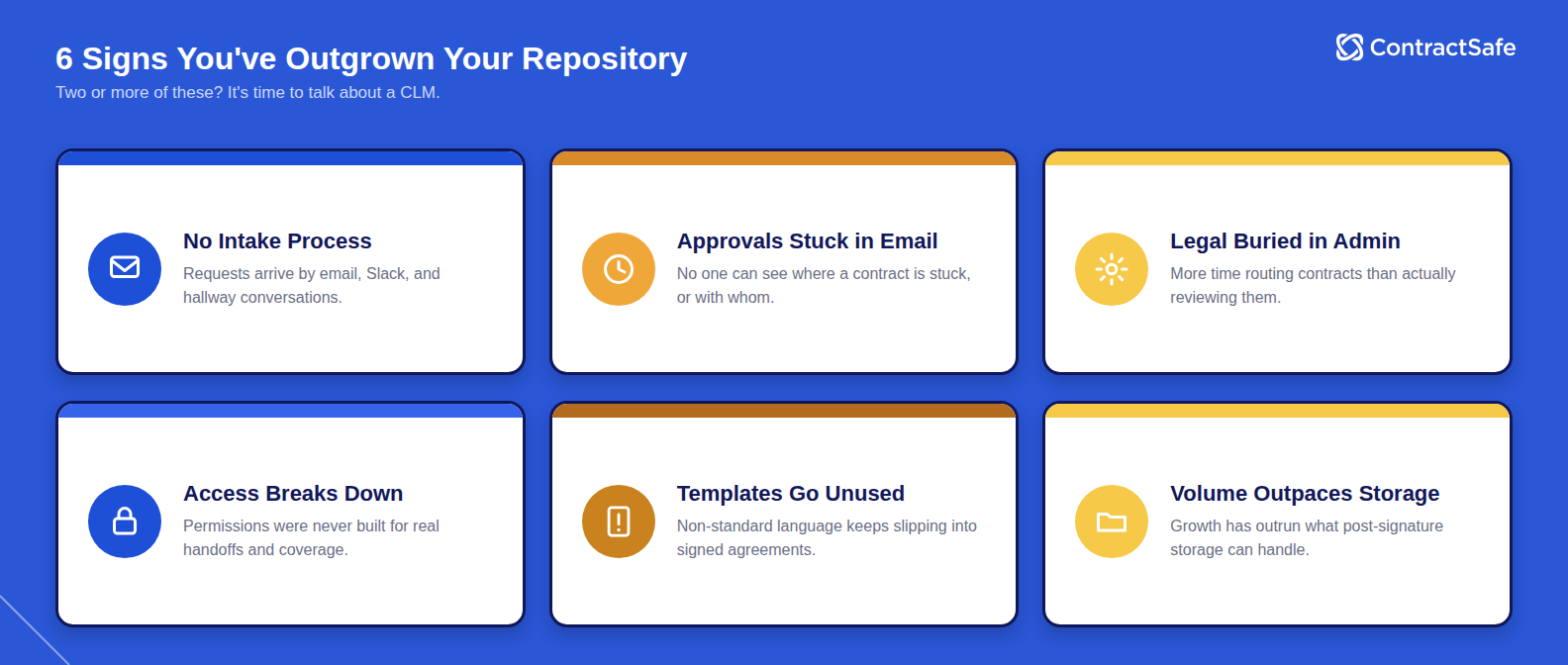
The shift from “a repository is great” to “our repository isn’t doing enough” is usually triggered by a pattern of issues that build frustration, until someone on the team finally asks whether there’s a better way to do things. If two or more of the following feel familiar, that question is worth asking now rather than later.
Contract requests arrive through email, Slack, and hallway conversations, with no consistent intake process. No one can say how many requests are open now or who’s waiting on what, because there’s no single place for those requests to land.
Approvals are tracked in email threads. A contract sits with one approver for days because no one else can see where it’s stuck, and “following up” means searching your sent folder instead of checking a dashboard.
Legal spends more time routing and chasing contracts than actually reviewing them. The job has quietly shifted from legal judgement to administrative traffic control. Deloitte’s research on legal operations found that most legal leaders believe their teams spend too much time on manual, admin tasks rather than the work that actually needs a lawyer.
Access breaks down at the worst moments. Someone goes on vacation and nobody else can pull up the contracts they own, or a customer accidentally gets a look at internal-only terms because permissions were never built for that level of control.
Templates exist, but aren’t used consistently. Non-standard language keeps showing up in signed agreements, and legal ends up cleaning up contract language after the fact instead of setting it up front.
Volume has outpaced what post-signature storage can handle. The team has grown, or the business has acquired new entities, and the number of contracts moving through the pipeline each month has outgrown a system that only picks up once a contract is already signed.
None of these signals are hypothetical. A 2025 industry survey found that roughly half of legal teams still manage contracts using email, Word documents, and shared folders well past the point where their contract volume can support it. And these struggles don’t mean something is wrong, necessarily. They just mean it’s likely time to transition to a full-lifecycle CLM.
| Contract Lifecycle: The full course a contract moves through, from the first request and draft, through negotiation and signature, to ongoing obligation tracking and eventual renewal or termination. |
|---|
What CLM Software Does That a Stand-Alone Repository Can't
| Contract Lifecycle Management (CLM) Software: A platform that manages a contract at every stage of the lifecycle, including the presignature work that a repository wasn't built to handle. |
|---|
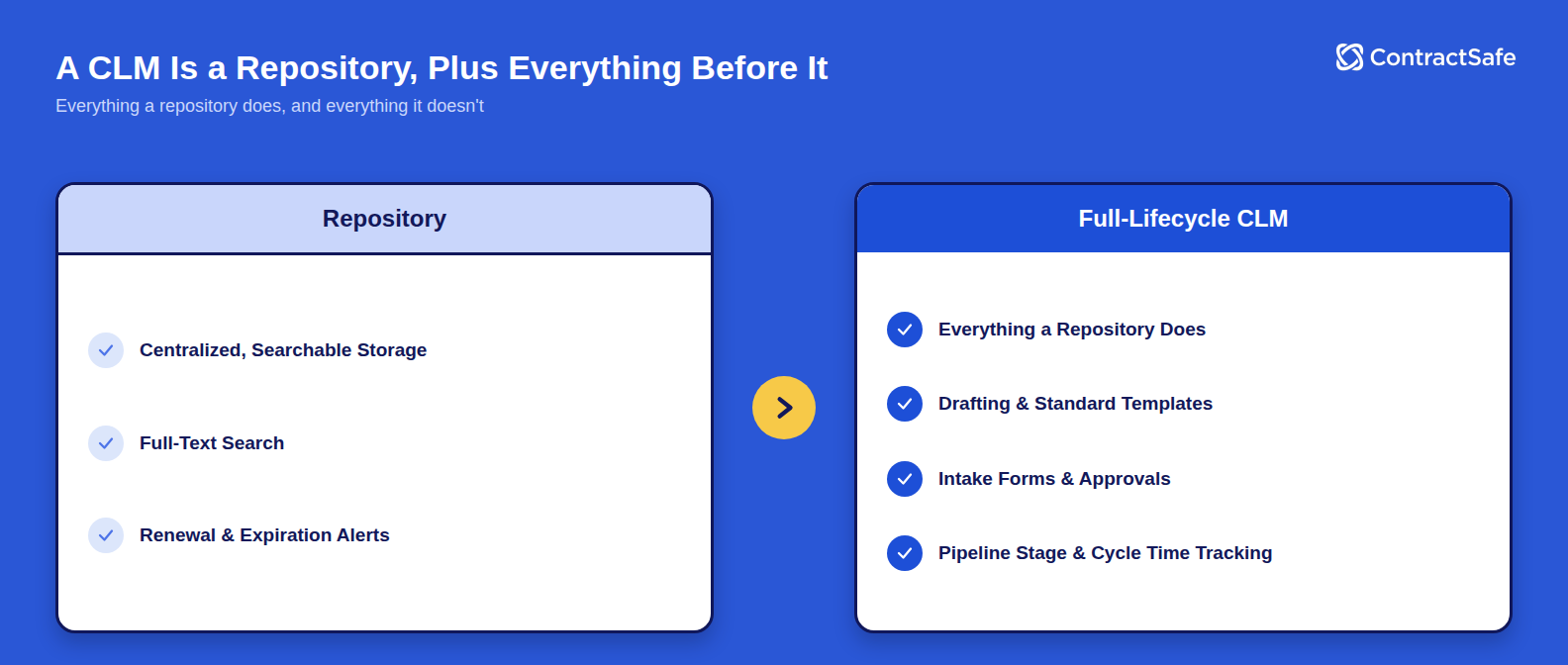
Since a repository is part of a CLM platform, the real question is what a full-lifecycle CLM adds on top of storage. The answer lives almost entirely on the pre-signature side of the contract.
Contract Drafting and Standardized Templates
A repository stores a finished document. A CLM platform is where that document gets created in the first place. Pre-approved template libraries let non-legal teams generate their own agreements using language legal has already signed off on, instead of sending every NDA request to an attorney’s inbox. That self-service layer is a big part of how CLM scalability holds up as a business grows. The volume of deals can soar without having legal personally review every draft from a blank page.
Pre-Signature Workflow and Intake
The clearest gap between a repository and a CLM is everything that happens before a contract gets signed like negotiations, redlining, or even just setting up the right contract template. CLM software routes a new contract to the right stakeholders automatically from intake to execution. It houses your playbook of approved language and helps new contract drafting through intake forms, rather than legal asking for a checklist of data points before anything can begin.
Pipeline Stage Tracking and Cycle Time Reporting
A repository stores a contract once it’s signed. A CLM platform like ContractSafe tracks a contract while it’s still in motion, moving through drafting, internal review, and external negotiation so you can quickly see exactly where every deal sits. That visibility lets a team measure cycle time and other key contract KPIs and pinpoint precisely where contracts get stuck, whether that’s a slow approver, a missing template, or a negotiation that’s dragged on longer than it should.
How ContractSafe Scales With You
ContractSafe is built to serve teams at more than one stage of contract management maturity, which matters because most teams don’t jump straight from spreadsheets to a custom-built enterprise CLM. A team can start with the post-signature side: centralized storage, AI-powered search, date-based alerts, and reporting. As pre-signature needs grow or complexity ramps up, the same platform can initiate intake forms, approval workflows, templates, e-signature, and AI contract review, all alongside the deadline tracking and reporting already in place.
With ContractSafe, you get:
Templates: Make contract creation simple with the ability to create your own templates, helping maintain consistency and compliance. Select the template, fill in the required fields and generate your contract with all the standard clauses in place. No more hunting through shared drives for last year's versions.
Intake Forms: Customizable intake forms to gather key details up front and give your legal team clean, consistent information from the start.
AI Contract Review: Upload an agreement and let AI flag risky clauses, missing terms, and anything that strays from your playbook before it goes out for signature. Your first-pass review drops from hours to minutes, and nothing slips through.
Simple Approvals: Conditional routing that gets a contract to the right decision-maker based on value or risk, without extra unnecessary administrative steps in between.
AI-powered organization and categorization: Automatically organize and categorize contracts based on their content, making it easy to find what you need when you need it.
Centralized repository: Store all your contracts in a secure, searchable, cloud-based repository with granular access controls.
Optical character recognition (OCR): Makes sure that even scanned documents are fully searchable, maximizing the value of your contract data.
Automated reminders: Receive timely notifications for key dates like renewals, audits, and payments, so you never miss an important obligation.
Customizable reporting: Gain valuable insights into your contract portfolio with customizable reports tailored to your specific needs including pipeline stage and cycle time.
ContractSafe includes unlimited users on every plan, transparent pricing that doesn’t punish a team for growing, and fast onboarding so new capabilities come online without turning into a new implementation project. For teams weighing whether to make that move now, our guide to choosing the right CLM and our CLM software checklist cover what to look for.
Ready to Scale Beyond Your Contract Repository?
The moment a repository starts creating problems instead of solving them, the answer isn’t a bigger shared drive or a more disciplined filing system. It’s a platform built to grow with the business, the way an office grows by adding more rooms instead of forcing everyone to rent a second building.
ContractSafe gives teams a clear path from basic contract storage to full contract lifecycle management, without switching platforms, absorbing enterprise complexity, or paying per-user pricing that makes growth expensive.
Request a demo or start a free trial to see where your team fits today.








.svg)







.svg)