
Quick answer: The 2027 Medicare fee schedule is the set of physician payment rates CMS finalized on November 4, 2026, and it takes effect January 1, 2027, with the standard conversion factor falling 2.31% to $32.6286, according to CMS's fact sheet. Any commercial or Medicare Advantage contract that pays a percentage of the current Medicare fee schedule reprices on the same date, and nobody has to sign an amendment. ContractSafe customers can search every payer agreement, exhibit and scanned amendment for that language and put the notice dates on alerts before the new rates hit claims.
Say your group signed a commercial agreement that pays 110% of the prevailing Medicare fee schedule, and a later rate amendment sits as a scanned PDF in a shared drive. On January 1, that contract's per-RVU rate drops from about $36.74 to about $35.89, and the only page that tells you so is an exhibit nobody's opened since it was signed. Finding those contracts starts with knowing exactly what CMS changed and when it applies.
Choose your next step:
AI contract management software, for the contracts owner who needs to search payer agreements in plain English
How ContractSafe approaches practical AI, for finance and compliance leads deciding how much to trust AI in contract work
Key Takeaways
- Plan to the final rule's figures: the nonqualifying APM conversion factor falls 2.31% to $32.6286 and the qualifying factor falls 1.83% to $32.9548, per the final rule.
- Treat the cut as current law from January 1, 2027, because Public Law 119-21 limited the 2.5% increase to 2026.
- Sort every commercial and Medicare Advantage agreement into floating references, which reprice, and fixed-year references, which hold.
- Search exhibits, amendments and scanned PDFs, since that's where the Medicare language usually hides.
- Put notice and renewal dates on reminders that reach billing and finance, which ContractSafe's custom notifications do on every plan.
What CMS Finalized for the Medicare Fee Schedule and When It Takes Effect
The final rule sets the 2027 nonqualifying APM conversion factor at $32.6286, down $0.77 (2.31%) from $33.4009, and the qualifying APM factor at $32.9548, down $0.62 (1.83%) from $33.5675. Floating payer contracts follow those per-RVU numbers once the 2027 Medicare fee schedule takes effect.
CMS got there in three steps, which Tables D-B1 and D-B2 lay out. The agency took the 2026 factors without the one-year 2.5% increase ($32.5863 for nonqualifying), applied a 0.12% budget-neutrality reduction, then added the statutory updates of 0.25% for nonqualifying and 0.75% for qualifying clinicians.
The 2.5% increase disappears in 2027 because the law that created it gave it an end date. Section 71202 of Public Law 119-21, which CMS calls the Working Families Tax Cut legislation, amended section 1848(t) of the Social Security Act to raise payment for "(F) such services furnished on or after January 1, 2026, and before January 1, 2027, by 2.5 percent." The law left the conversion factor formula in subsection (d) alone, so the increase expires on its own terms.
The final rule, published in the Federal Register on November 9 (91 FR 70992), applies to services furnished on or after January 1, 2027, and CMS's fact sheet says the 2.5% increase "will no longer be in effect for CY 2027." Because the cut comes from statute, only new legislation could change it, before or after January 1, and nobody can say yet whether that'll happen.
Why the Cut Reaches Your Commercial and Medicare Advantage Contracts
Commercial and Medicare Advantage contracts feel the cut whenever an agreement pays a percentage of the current Medicare schedule, because the non-Medicare rate moves with Medicare. If you're a practice administrator, contracts manager, compliance manager or finance lead at a medical group, every floating agreement belongs on your review list.
CMS's impact analysis notes that total practice revenue changes by less than the Medicare impact, because practices also see non-Medicare patients. Every floating commercial or Medicare Advantage contract shrinks that cushion.
Medicare Advantage reaches you two ways. Under 42 CFR 422.214, a provider with no contract with an MA coordinated care, MSA or private fee-for-service plan "must accept, as payment in full, the amounts that the provider could collect if the beneficiary were enrolled in original Medicare", so what an out-of-network provider can collect from those MA plans is tied to the new original Medicare amounts. In-network MA agreements often reference Medicare rates as well, so check those next to the commercial ones.
Percent of Medicare is the common yardstick for these deals. Milliman's 2025 benchmark put national commercial reimbursement for professional services at 148% of Medicare, though that figure doesn't tell you how many contracts float.
Groups rarely know the answer offhand, because the deciding words hide in places nobody rereads:
Fee schedule exhibits behind the base agreement
Rate amendments signed years later
Scanned PDFs that keyword search can't read
Copies spread across shared drives and spreadsheets
Take the 110% contract from the opening. Unless an update lag applies, it moves on January 1, and if it follows the nonqualifying factor, its per-RVU payment falls by the same 2.31% the final rule applies to the nonqualifying factor.
How Floating and Fixed-Year Medicare Rates Compare in Your Contracts
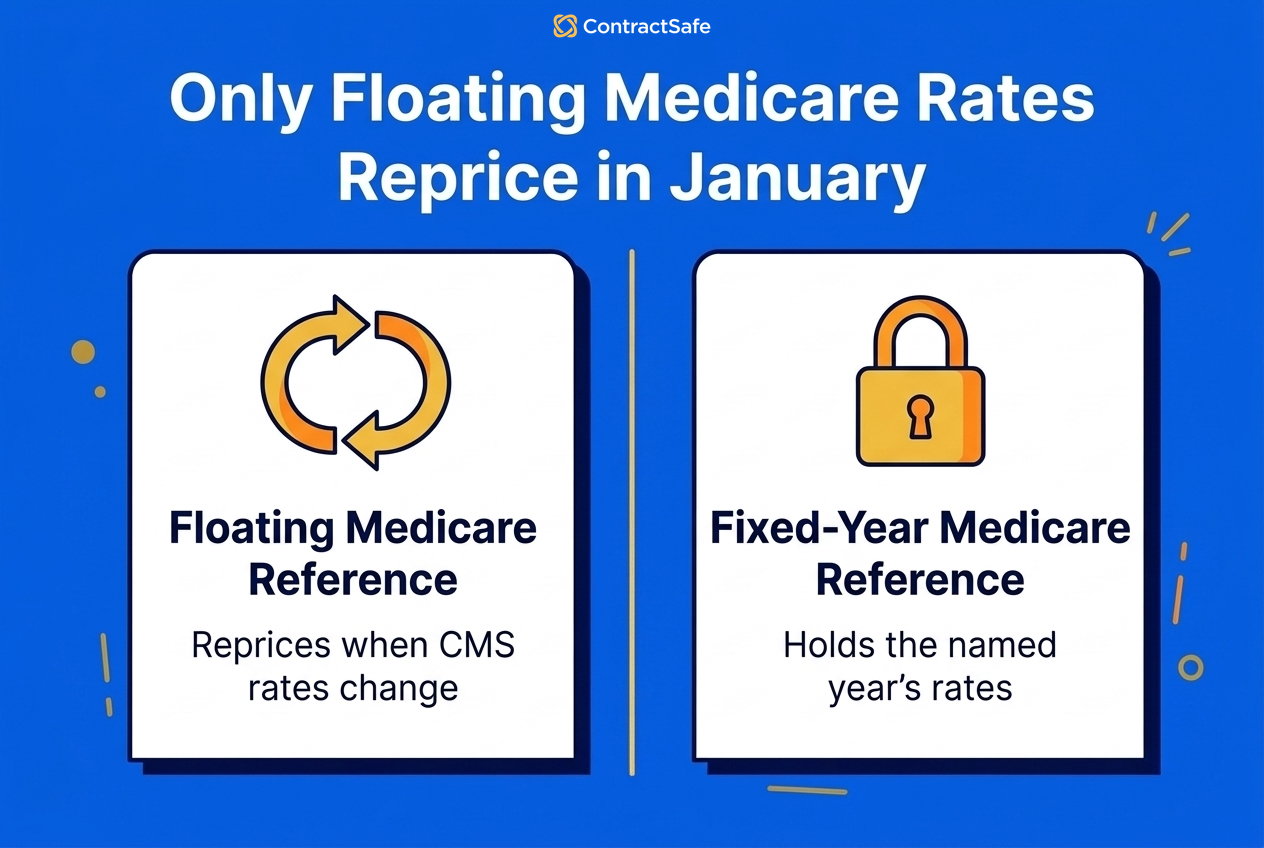
Each payer contract's own fee schedule language decides whether the rate floats with CMS or holds at one year's schedule. A floating reference says current, prevailing or as updated by CMS, while a fixed-year reference names the Medicare RBRVS for a stated year and keeps paying the old rates.
| Contract term | Floating Medicare reference | Fixed-year Medicare reference |
|---|---|---|
| January 1 repricing | Picks up the new CMS rates unless a lag applies | Keeps the named year's rates |
| Update or effective-date lag | May delay the switch for a stated period | Matters less, since the year doesn't change |
| Lesser of billed charges or a percentage of Medicare | The Medicare side drops | The Medicare side stays put |
| Anesthesia rates | Follow the estimated factors of $20.1056 nonqualifying and $20.3068 qualifying in Tables D-B3 and D-B4 | Keep the named year's anesthesia factor |
| Notice windows and evergreen renewal | Renews at whatever Medicare pays next | Renews at the old year's rates |
For instance, an MA agreement might pay the lesser of billed charges or the current Medicare allowable. When the Medicare side falls, more claims land on the Medicare number, and payment drops even though your billed charges didn't move.
What to Read in Each Fee Schedule Exhibit
Before you put a contract in either column, read for these points:
Whether the rate names a year or says current, prevailing or as updated
Whether an update clause delays new CMS rates
Whether a lesser-of clause sets a ceiling
Whether anesthesia uses its own Medicare conversion factor
Which notice, renegotiation and renewal dates come before year end
ContractSafe's AI detects whether a contract is fixed-term, evergreen, terminable at will or auto-renewing, which shows you which agreements could roll over at the new rate. On every plan, ContractSafe's chat-based Q&A lets a reviewer ask whether a contract's Medicare reference floats or is fixed to a year. Then read the clause yourself, because the contract's own words decide. None of this is legal or billing advice.
Seven Steps to Take With Your Team Before January 1
Your team has until January 1, 2027, when the new rates take effect, to find every floating contract and every notice window each agreement sets. The person who owns contracts leads, billing updates expected reimbursement, finance models the impact, compliance checks notice obligations and outside counsel reviews any amendment.
Contracts owner: pull every payer agreement, fee schedule exhibit and amendment into one place.
Contracts owner: search for phrases like prevailing Medicare, current Medicare fee schedule, RBRVS, lesser of and Medicare allowable.
Contracts owner with billing: sort each hit as floating or fixed-year.
Billing and revenue cycle: record any update-lag language and when each floating contract switches.
Compliance: list the notice, renegotiation and evergreen dates before year end, and the notice each requires.
Finance: model the impact with the per-RVU figures of $32.6286 against $33.4009 from CMS's rule.
Contracts owner with outside counsel: decide contract by contract whether to raise the rate with the payer.
For example, a search for current Medicare fee schedule might turn up a rate amendment that replaced the original exhibit's named-year RBRVS reference with the current schedule. You'd already have the base agreement from pulling the full file in step one, but the amendment decides, so that payer goes on the floating list.
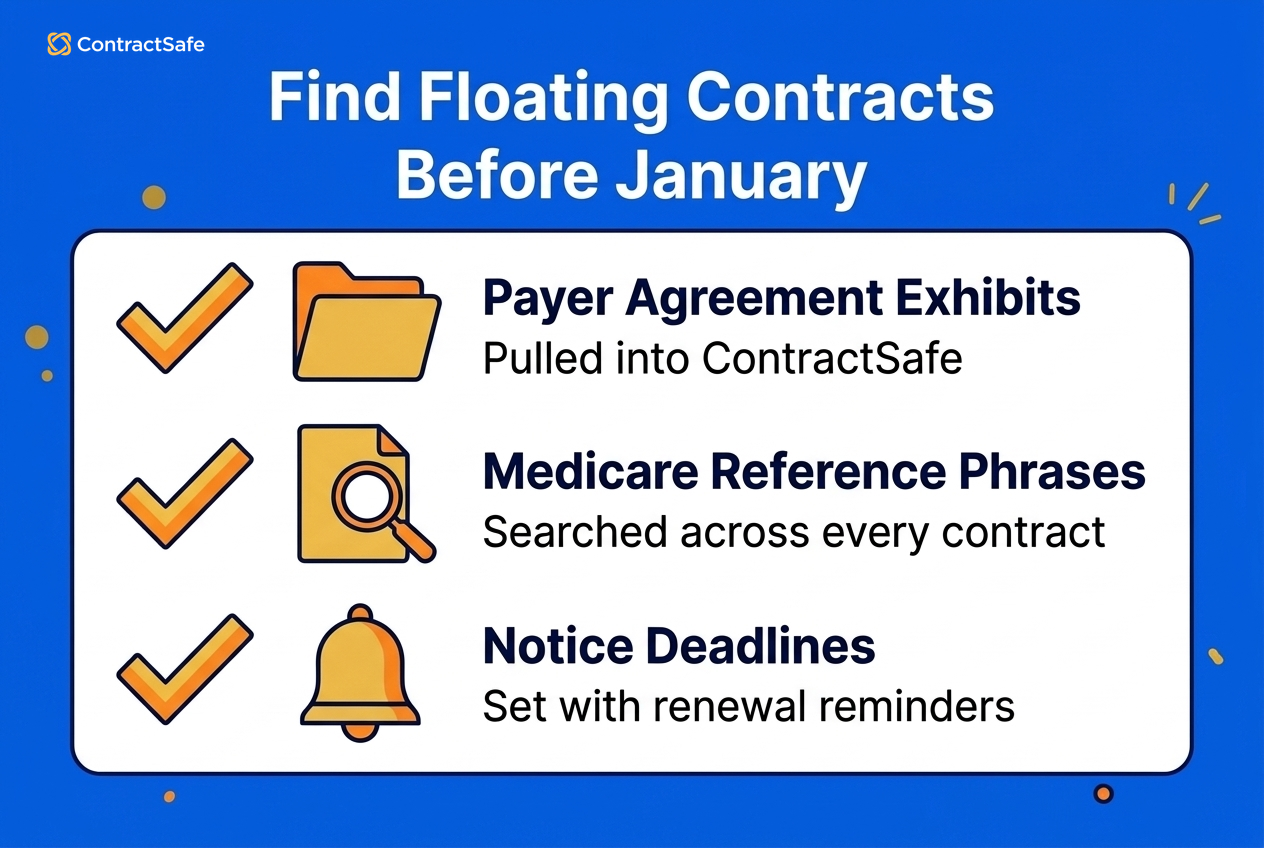
If your payer agreements and amendments are already in ContractSafe, step one is done and you can run step two today, on every plan. OCR makes scanned PDFs keyword-searchable, Google-like search covers every document in the account, and smart search lets you ask in plain English for agreements that pay a percentage of Medicare. For step five, turn on Autorenew for an auto-renewing contract and ContractSafe rolls the renewal date and the deadline to renew forward each cycle, with reminders resetting for the next renewal on their own.
Common Mistakes to Avoid When Payer Rates Reset
The common mistakes during a payer rate reset come from reading too little of each contract and trusting the calendar too much. Each mistake below has a fix your team can put in place before year end.
Reading only the base agreement. A later amendment may have changed the Medicare reference. Fix: keep amendments linked to the base agreement, which ContractSafe does on every plan with amendment tracking and connected related documents.
Assuming Congress will reverse the cut. Fix: plan to current law, since P.L. 119-21 limited the 2.5% increase to 2026 and only new legislation changes that.
Assuming total revenue falls by the full Medicare percentage. Fix: model traditional Medicare plus the floating contracts, and leave fixed-year contracts flat, because the rule's impact discussion says total revenue moves less than the Medicare impact alone.
Catching a renegotiation window after it closes. Fix: set recurring reminders with custom messages to any email address, so billing and finance hear about the date too. ContractSafe includes both on every plan.
Skipping scanned exhibits. Keyword search can't read an image of a page. Fix: run OCR on every scan first.
Say you have an evergreen agreement with a regional payer that renews each January unless either side gives written notice by mid-December. If that notice date slips by while everyone's reading CMS headlines, the contract renews on its floating terms, and your next chance to reopen the rate is a year away.
Related Reading
Contract roles and sharing, for giving billing and finance their own access
Contract approval workflow, for routing a rate amendment to the right reviewers
Contract signing software, for getting a renegotiated amendment signed
How ContractSafe Helps With AI Search and Renewal Alerts for Payer Contracts
ContractSafe is a full-lifecycle CLM where teams request, approve, sign and track agreements and renewals, with the complete set on Maximize. ContractSafe is made for the one person who owns payer contracts at a medical group (a practice administrator, contracts manager, compliance manager or finance lead acting as a legal department of one), and unlimited users on every plan let billing and finance self-serve.
For this rate change, term-type detection flags auto-renewing contracts, Autorenew rolls their renewal dates forward, and renewal alerts reach anyone by email before a notice window closes. OCR, Google-like search and smart search cover every exhibit, scans included, and chat-based Q&A answers questions about one contract, so you can build your list of affected contracts before January 1. ContractSafe pricing starts at $450/month (Organize plan, billed annually; $540 month-to-month), with unlimited users on every plan. The pricing page shows no implementation fee, with onboarding, training and data migration included on every plan, and ContractSafe is HIPAA and GDPR compliant.