Contract lifecycle management best practices are the standardized processes, centralized digital controls, and automated tracking mechanisms organizations implement to take agreements from initial request through post-signature renewals. But like anything else, there are challenges to overcome before getting into a perfect contract workflow.
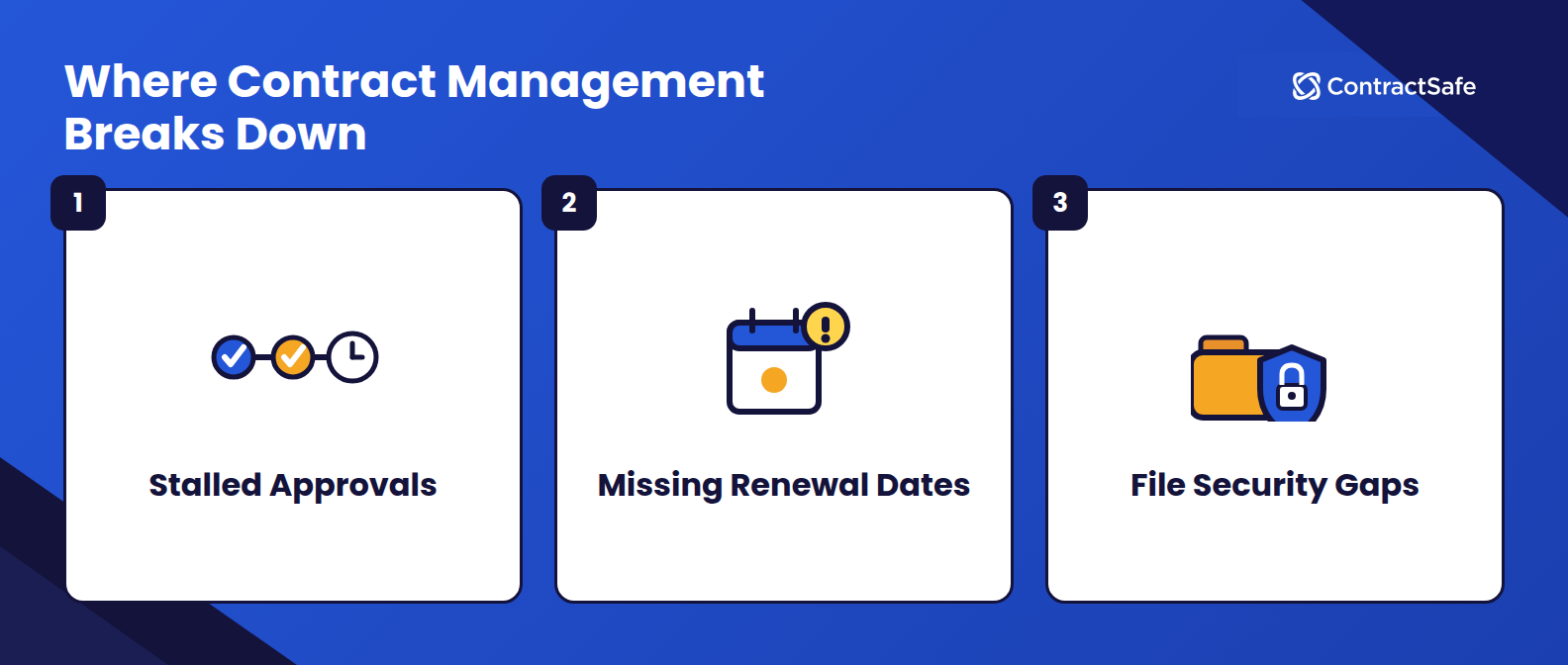
Without a system in place, your contracts live everywhere. Sales has some in CRM, Procurement has them all stored in an email folder, and Legal has a shared drive. There’s no way to search, so everyone is getting “just a quick question” pings, and no one is quite sure if the Johnson deal is stalled waiting for an internal approval or if it already needs a signature. On top of that, your cloud storage is about to auto renew with a 15% price increase because no one noticed the date.
Your contract process is like an assembly line in a manufacturing plant. When every worker on the line has quick access to the right parts, the product moves smoothly from start to finish. When a worker has to walk across the factory floor to search through dusty cardboard boxes for a single missing screw, the entire production line grinds to a halt. In many offices, Sales and Legal are constantly stepping off the line to chase down missing signatures, hunting for missing expiration dates, or pulling the wrong version of an agreement off a shared drive.
Key Takeaways
- Disconnected files across Sales, Legal, and Procurement leave important agreements trapped in email inboxes and create bottlenecks that stall deals.
- Workers spend 47% of their time searching for documents across inboxes and desktop folders instead of completing core work.
- Adding AI can save up to 60% of time spent on reviewing contracts, with humans stepping in to review accuracy and control final decisions.
- ContractSafe helps cut down on contract management challenges with smart search, role-based access control, and clear status dashboards without requiring weeks of software training.
The Top 6 Contract Lifecycle Management Challenges and Practical Solutions
Even if you know contract lifecycle management really well, it’s still possible to fall into common traps in the process. These mistakes crop up when your internal systems are a little shaky or your tools aren’t fulfilling their promises. If you’re struggling with slow cycle times or forgetting key dates or obligations, we’ve rounded up some of the most common contract management challenges and have recommendations for how you can solve them.
1. Tracking Progress Across Departments
Your sales team is ready to close, but the agreement gets stuck in an email chain between Legal and Finance. Nobody knows who holds the ball, which version has the latest redlines, or if legal even opened the attachment yet.
This lack of tracking creates a ripple effect of status chasing and stalled work. You find out a deal is dead on the last day of the quarter simply because a redline was never addressed in a buried email chain. Or a certificate of insurance expires because no one noted when it needed to be renewed.
The solution: Switch from reactive contract management to proactive contract lifecycle tracking and look for where agreements are stalling before it’s an emergency. Watch for where the contract workflow is breaking down. If contracts sit in intake, the request form may be incomplete. If they sit in approval, nobody may own the business decision. If they sit after signature, the problem may be the hand off into the repository.
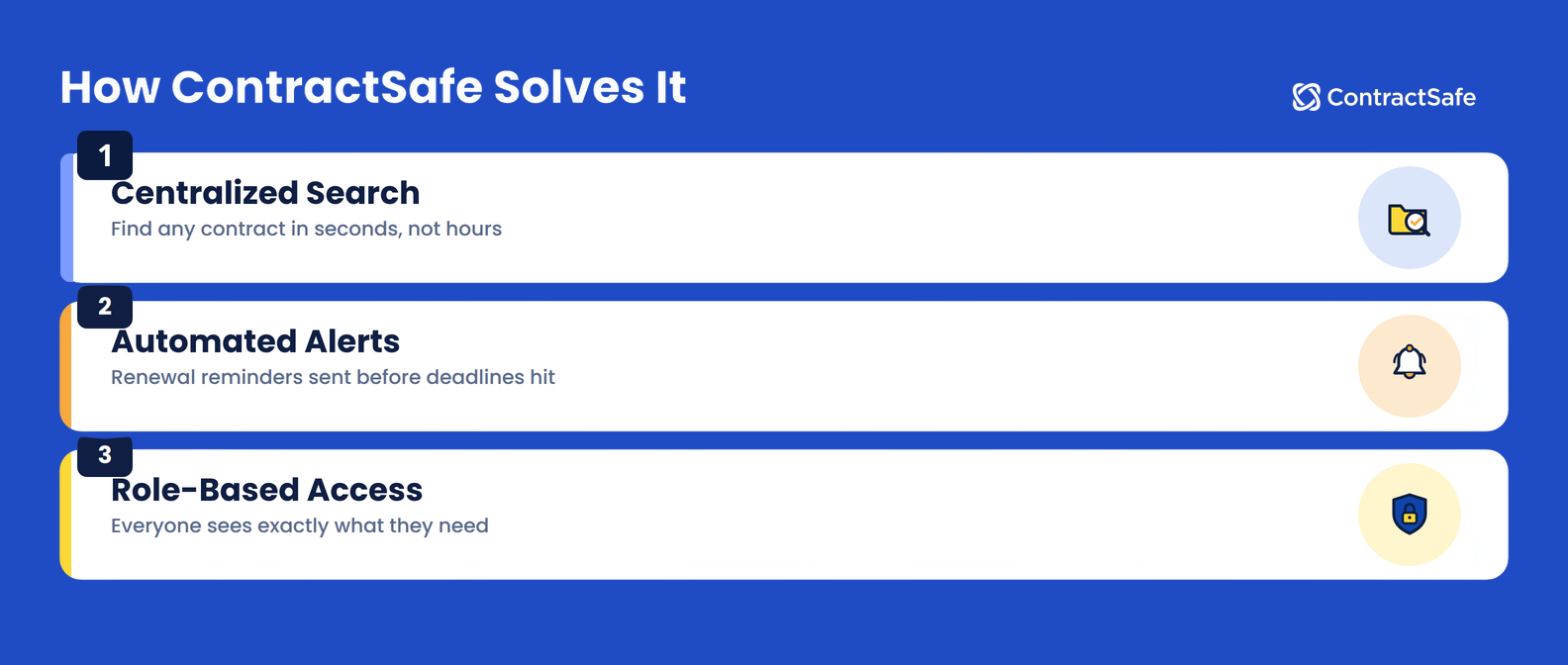
ContractSafe gives your team a clean dashboard where anyone can check if a document is marked as Received, In-Progress, Approving, or Signing instead of bugging Legal. If you find progress is stalling out in approvals, version control makes sure everyone is always looking at the most recent version and approvers get automated reminders until they’ve reviewed.
2. Maintaining Compliance
When an auditor asks for every active vendor agreement over $50,000 alongside every signed amendment from the past three years, they don’t want to wait. And if you need to confirm your certificates of insurance are valid through a new contract, it shouldn’t take an hour to check yes or no.
When those documents live across separate inboxes and desktop folders, you spend your workday just searching for answers. The average worker spends 47% of their time searching for information and documents instead of completing their actual daily work tasks. This time spent hunting for documents can make conducting a proactive audit almost impossible. Without regular internal audits, you’re at risk for finding issues when a real regulatory audit is needed. Missing even one out-of-date agreement can land your company in hot water with auditors or leave you paying for substandard vendor service.
The solution: A centralized repository turns a week-long audit into a five-minute job. ContractSafe uses smart search technology that reads the actual text inside your documents, including scanned PDFs. When new regulations drop, your compliance team types in the term they need and pulls up every matching contract instantly. You get the reports you need without stopping work or pulling hair out.
3. Missing Expiration and Renewal Dates
Relying on static spreadsheets to track expiration dates or deadlines is a risky move only slightly better than jotting on a sticky note. If an employee forgets to log a vendor termination window into a personal calendar, or doesn’t update the shared sheet, your company might automatically renew an expensive software subscription that nobody has used for six months. And if the employee who owned all the date reminders on their personal calendar leaves, you’re likely to end up with lost deals, unfavorable renewals, and expired coverage that can put your business at risk.
The solution: Automated alerts help you track everything from renewals and expirations to compliance or payment dates. You can schedule automated email reminders to be sent to anyone on your team at a lead time that makes sense for you.
ContractSafe sends these updates directly to designated users. That means you won’t have to log into the system every single morning just to check dates. Teams can organize upcoming renewal dates by department, vendor name, or account owner to keep every project moving along the assembly line on schedule.
4. Making Your Spreadsheets and Software Too Complicated
You’ve decided to upgrade from inboxes and spreadsheets, but choosing the first CLM you see can also be a trap. A factory worker would have a hard time jumping from a manual assembly line to a fully autonomous robot, just like your business maybe isn’t ready for an enterprise CLM designed for Fortune 500 companies.
While basic shared drives lack file controls, massive platforms are designed to handle thousands of contracts across multiple departments and locations. In order to do that, these platforms offer a large set of features, but can require dedicated experts and intensive training to use effectively. The complexity means adoption drips away, people drift back to email and spreadsheets, and a year later you’re paying for a system nobody opens and your contracts still can’t be found.
The solution: Look for a right-sized CLM for your organization that matches technology to your exact needs. This keeps you from spending on unused features or immediately growing out of capacity, and takes into account what your team will actually use without endless training.
ContractSafe works right out of the box with zero hidden implementation costs. Your team can upload documents instantly, integrate with existing tools like DocuSign or Salesforce, and organize files without spending weeks in software training sessions.
5. Managing File Security and User Permissions
Remote work and multiple offices can make contract management security even harder, and more challenging, than in an in-office setting. If you keep all your contracts accessible through cloud storage, you risk letting someone who isn’t need-to-know view sensitive financial records or HR documents. And if each individual person needs to have individual sharing permissions turned off, there are likely to be slips that potentially cause financial or legal issues. A former FinWise Bank employee retained access to shared files after their employment ended, exposing data on roughly 689,000 people and triggering a $5 million class action lawsuit.
The impulse to protect everything behind a password or intense sharing restrictions isn’t a perfect solution either. Keeping everything locked down will just lead to your legal department, with full access, spending half their day answering questions like “what were the delivery timeline obligations for this IT vendor?” or the rest of the company will operate in the dark.
The solution: A contract management software with role-based access control allows you to tailor these permissions in a single login, granting standard access to one folder, read-only in another, and no access to a third. This way no one needs two accounts, and no one gets more access than their role actually requires.
6. Managing Heavy Workloads with Limited Staff
Contract management risks are even higher when small teams need to handle hundreds of vendor agreements without additional headcount. The increasing contract volume can overwhelm a lean legal team, leaving them looking at the same six contract types every day with little time for anything else. Deloitte’s research on legal operations found that most legal leaders believe their teams spend too much time on manual, admin tasks rather than the work that actually needs a lawyer. Just handling fewer contracts isn’t a real option, which means Legal needs more bodies or more help.
The solution: AI helps legal teams handle higher workloads by taking over the slow, repetitive parts of review. A study by Axiom and DraftPilot found that letting AI help with routine contract review tasks resulted in 40%-60% average time savings and tasks that previously took 5 days took 1. It reads first-pass documents, extracts key terms, flags risky clauses, and opens contract data to other departments, so the same headcount can handle a growing pile of agreements without burning out.
ContractSafe is built for teams that want AI to do the boring parts and then get out of the way. Every AI feature is bundled on every plan, so Finance, Ops, and Legal all work from the same tools with no per-seat fees and no extraction caps.
Keep Your Contract Assembly Line Running Smoothly, With ContractSafe
Stop losing valuable working hours to missing files, forgotten renewal dates, and overly complex software systems. ContractSafe gives your team a fast, secure, and user-friendly platform to store, search, and track every agreement. You get:
Self-Serve Templates: A clean way to generate standard agreements, via a simple intake form.
Intake Automation: Customizable intake forms to gather key details up front and give your legal team clean, consistent information from the start.
Flexible, Simple Approvals: Conditional routing that gets a contract to the right decision-maker based on value or risk.
Familiar Editing: Native integration with tools teams are already familiar with, like Microsoft Word.
A Useable Post-Signature Repository: A searchable repository where anyone on the team can find documents or set an expiration date or renewal alert in seconds.
Automated Deadline Alerts: Customizable deadline alerts help you track everything from renewals and expirations to compliance or payment dates. You can schedule automated email reminders to be sent to anyone on your team at a lead time that makes sense for you.
If you’re ready to see how a simple contract management solution can make a real difference in your business, start your free trial today.