ContractSafe's 2026 Contract Lifecycle Report
Benchmarks from 55,000+ contracts at 450+ companies showing which stages take the most time, which contracts wait longest, and the practical fixes that get agreements moving.
Download the complete white paper (PDF). Page references below refer to the white paper.
What’s Inside
This report analyzes more than 55,000 contracts at more than 450 companies that use ContractSafe, from August 2025 to September 2026. It’s built on actual usage data, not surveys.
Every organization in this white paper uses a contract lifecycle management (CLM) tool, which means they’re already ahead of the game in terms of contract speed and visibility. You’ll find more information about CLM at the end of this report.
| Measure | Median | Slowest 10% |
|---|---|---|
| Start to signed | 2.8 days | 24 days or more |
| Approval step | 2.7 days | 14 days or more |
| Signature step | 6.2 hours | 7 days or more |
How Each Contract Step Is Timed
The clock starts when a contract is added to ContractSafe and stops when the last person signs. In between, the time splits into four steps.
- Waiting to start runs from the moment a contract is added until someone first acts on it, such as assigning an owner.
- In progress runs from that first action until the contract goes out for approval or signature. This is where terms are negotiated, comments gathered, and edits made.
- Approval runs from the first approval request until the final yes or no, while the contract routes to the approvers it needs.
- Signature runs from the moment the signature request goes out until the last person signs.
Three sets of contracts stand behind the numbers. Some contracts are in more than one group; together they cover more than 55,000 contracts at more than 450 companies.
| Figure | Based on |
|---|---|
| Start to signed | 6,000+ contracts followed from added to fully signed |
| Approval | 15,000+ approval requests |
| Signature | 48,000+ e-signature requests |
Key Findings
Most Contracts Are Signed in Days. The Slowest 10% Take Weeks.
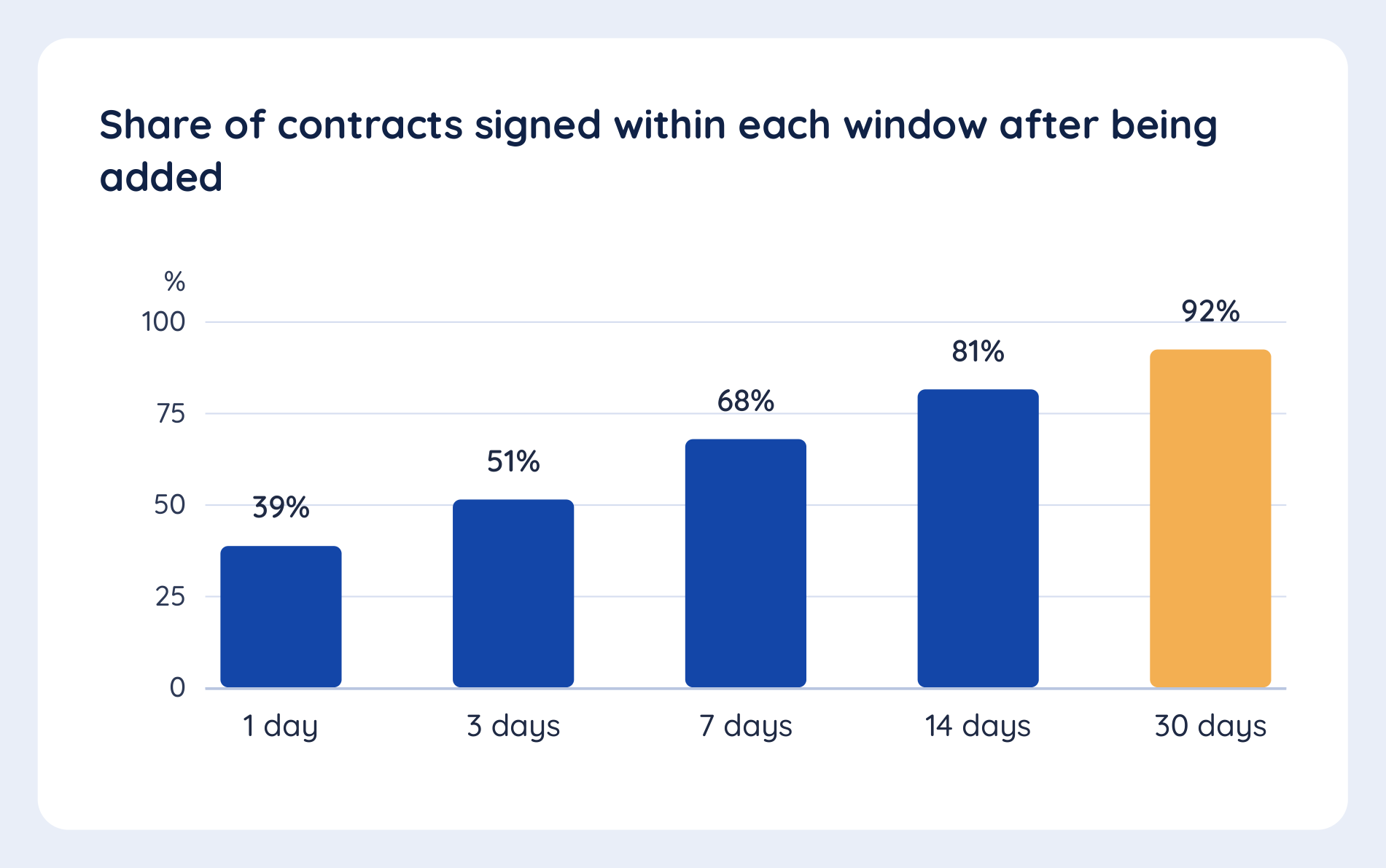
The median contract gets signed 2.8 days after being added to ContractSafe. The slowest 10% take 24 days or more, and together they account for 57% of all the days contracts take to get signed. Their delay builds up across all four steps, most of all at the signature. Clear that 10% and more than half of the total wait goes with it.
| Time after being added | Share signed |
|---|---|
| 1 day | 39% |
| 3 days | 51% |
| 7 days | 68% |
| 14 days | 81% |
| 30 days | 92% |
Based on the more than 6,000 contracts followed from added to fully signed (page 3); 8% took more than 30 days. Where this report says median, it means the middle value: half were faster and half were slower.
Six Findings at a Glance
Each finding comes from timestamps recorded when each step happened, at companies already using a CLM.
- Waiting to start. The median wait for a first action is 6 minutes, and the slowest 10% wait 5.7 days or more. Miss the first day and a contract will more likely than not wait over a week, so give each one an owner the day it’s added.
- Approval. A median of 2.7 days, the longest of any step, and the slowest 10% take 14 days or more. Only 31% of contracts go through it, and signatures take more time overall.
- Approvers. A single approver decides in a median of 17 hours. Four or more take 7.4 days, and the slowest 10% of those take 27.7 days or more, so ask only the approvers you need.
- The slow approver. When approvers are asked one at a time, the slowest one accounts for 79% or more of the wait on half of requests, so that’s the person to remind.
- Signers. A request with one signer is fully signed in a median of 1.5 hours; with two it’s 22 hours and with four or more 5 days, so keep signers to the people who have to sign.
- The calendar. Approvers take about two working days whichever weekday they’re asked, so send approvals by Wednesday or they wait through the weekend. Signature requests are fastest on Friday.
Every Step Has a Slow 10%
At three of the four steps, the median contract moves on within hours, and approval takes a median of 2.7 days. At every step, the slowest 10% take days or weeks. Approval has the longest median. Signature is shorter, but every signed contract goes through it, and it adds up to the most time overall.
| Step | Median | Slowest 25% take more than | Slowest 10% take more than |
|---|---|---|---|
| Waiting to start — from being added until the first action, such as assigning an owner | 6 minutes | 1.2 hours | 5.7 days |
| In progress — from that first action until it goes out for approval or signature | 6 minutes | 1.3 days | 16.1 days |
| Approval — from the request until the final decision | 2.7 days | 6.9 days | 14.2 days |
| Signature — from the request until the last person signs | 6.2 hours | 2.8 days | 7.0 days |
The first two rows come from step tracking, the last two from approval and e-signature requests. Many contracts move on in one sitting, so the first two medians are in minutes.
For the Slowest Contracts, the Signature Takes the Biggest Share
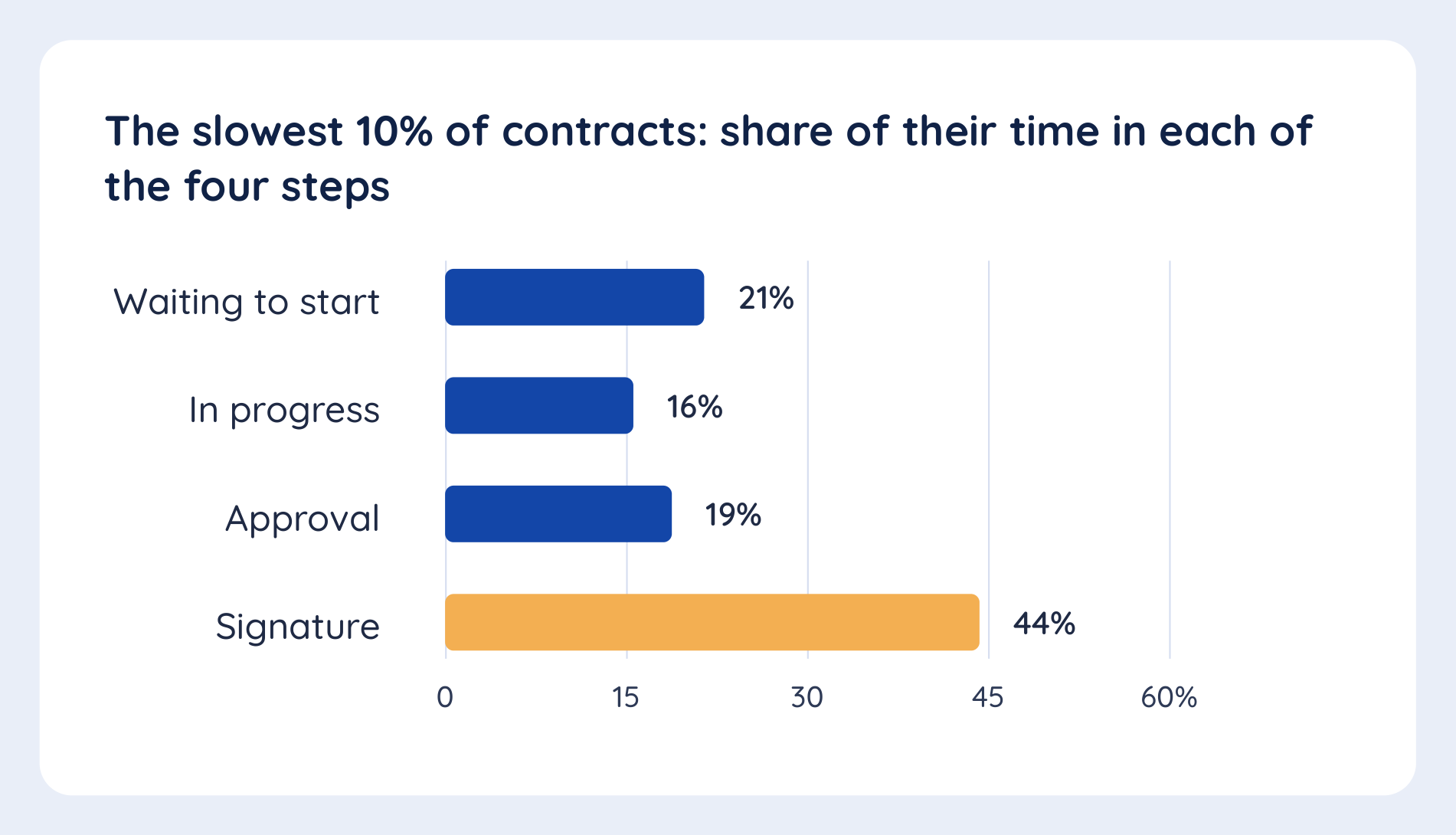
Here’s how the slowest 10% of contracts, the ones that take 24 days or more to get signed, split their time across the four steps. You might expect approval to take the biggest share. Instead, these agreements spent 44% of their time in those steps waiting for signatures, more than at any other step, and a fifth of it waiting for someone to start on them.
| Step | Share of time in the four steps |
|---|---|
| Waiting to start | 21% |
| In progress | 16% |
| Approval | 19% |
| Signature | 44% |
At a typical company with ten or more signed contracts, the slowest 10% of its own contracts account for 54% of the days all its contracts take to get signed. Shares are of the time spent in the four steps, which cover 91% of these contracts’ days from added to signed; the other 9% was spent filed in storage between steps.
Waiting to Start
Not Started on Day One? Expect It to Wait a Week.
Among contracts someone went on to work on, the median wait for a first action is 6 minutes after being added. The slowest 10% wait 5.7 days or more before anyone acts on them.
- 6 minutes vs 5.7 days
- the median wait for a first action, compared with the slowest 10%
- 96%
- of the time these contracts spent waiting to start belongs to the slowest 10% of waits
What the data shows
Give every contract an owner on day one. Miss that day and odds are it waits more than a week.
84% of the contracts someone went on to work on get their first action within a day of being added. Of the other 16%, 56% wait more than a week. None were filed for storage: every one went on to be worked, approved, or signed. Contracts that don’t have owners usually sit in the outbox for at least a week.
How to Shorten the Wait to Start
Timestamps can’t show why a contract waited. These three habits are based on what works for ContractSafe customers.
- Give every new contract an owner the day it’s added, however it comes in.
- Use a short intake form for new requests, so each one arrives with the key facts filled in.
- Use AI to extract key dates, parties, whether it’s already signed, and other key fields from uploaded contracts.
Start with the owner
Name an owner the day a contract is added.
Intake forms and AI extraction fill in the facts, so the owner can start on the contract.
ContractSafe’s AI pulls in fields like term dates and company names, so I can review and confirm instead of entering everything manually.
Shayne HussainSr. Operations Manager, Covalent
In Progress
Most Contracts Arrive Close to Final Form
In progress is the step for negotiating, commenting, and editing. Most contracts barely stop at that step. When a contract passes through it, the median stay is 6 minutes.
- 56%
- of contracts followed from added to signed were sent straight for signature, with no in-progress or approval step
- 19 hours vs 7.2 days
- median time to fully signed, sent straight for signature vs through in progress or approval
What the data shows
Bring drafts in early. Negotiating, commenting, and editing in ContractSafe puts the whole cycle on one clock, so you can see where each contract waits.
Of the contracts followed from added to signed, 56% were sent straight for signature. 19% went through approval only, 13% through in progress only, and 12% through both. Sent straight for signature, a contract was fully signed in a median of 19 hours; the rest took a median of 7.2 days.
Approval
Approval Has the Longest Median of Any Step
Approval takes a median of 2.7 days from request to final decision, longer than any other step. The slowest 10% of approvals take 14 days or more. 31% of the contracts followed from added to signed went through approval.
- 2.7 days vs 6.2 hours
- median time spent at approval vs at signature, the next longest step
- 14 days vs 7 days
- the slowest 10% of approvals take more than this, compared with the slowest 10% of signatures
What this means
Some of that time is the review itself. Some of it is waiting on people.
Contracts that need approval may be the ones with more at stake, and they deserve the review. Three factors affect how much of that time is waiting: how many approvers are asked, who hasn’t responded, and whether they review together or in turn. An approver group for each contract type sends every request to the right people at once.
More Approvers = Longer Waits
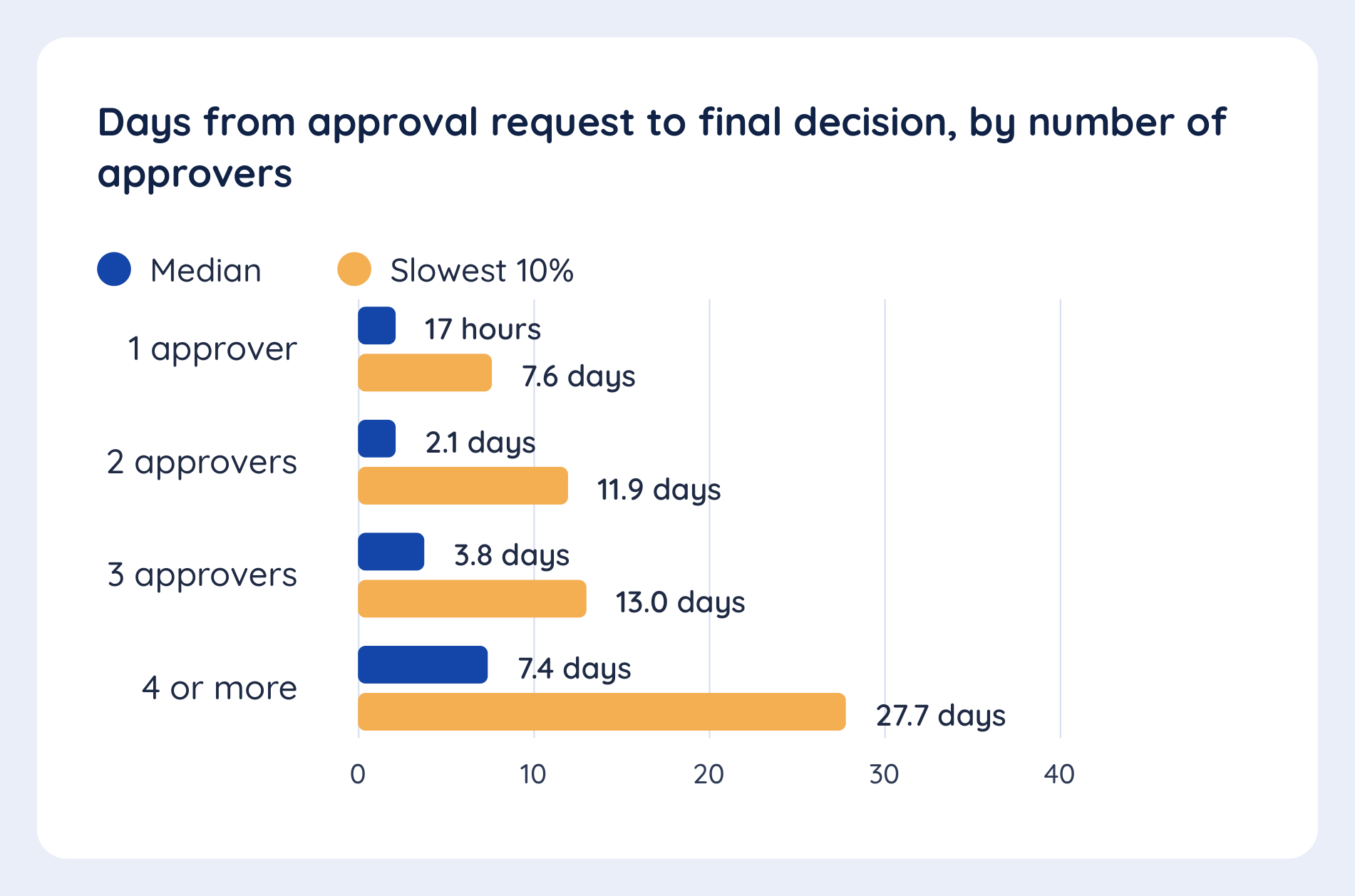
A request with one approver is decided in a median of 17 hours. Requests with four or more approvers take a median of 7.4 days, and their slowest 10% take 27.7 days or more. 38% of approved requests have a single approver.
| Approvers | Median | Slowest 10% |
|---|---|---|
| 1 approver | 17 hours | 7.6 days |
| 2 approvers | 2.1 days | 11.9 days |
| 3 approvers | 3.8 days | 13.0 days |
| 4 or more | 7.4 days | 27.7 days |
Both climb with each extra approver. Requests approved only by the person who sent them are left out. Bigger contracts probably need more approvers, so part of each increase may come from the contract itself.
One of the Approvers Accounts for Most of the Wait
When approvers are asked one at a time, the wait isn’t spread evenly down the list. On half of these requests, the slowest approver’s turn is 79% or more of the whole wait.
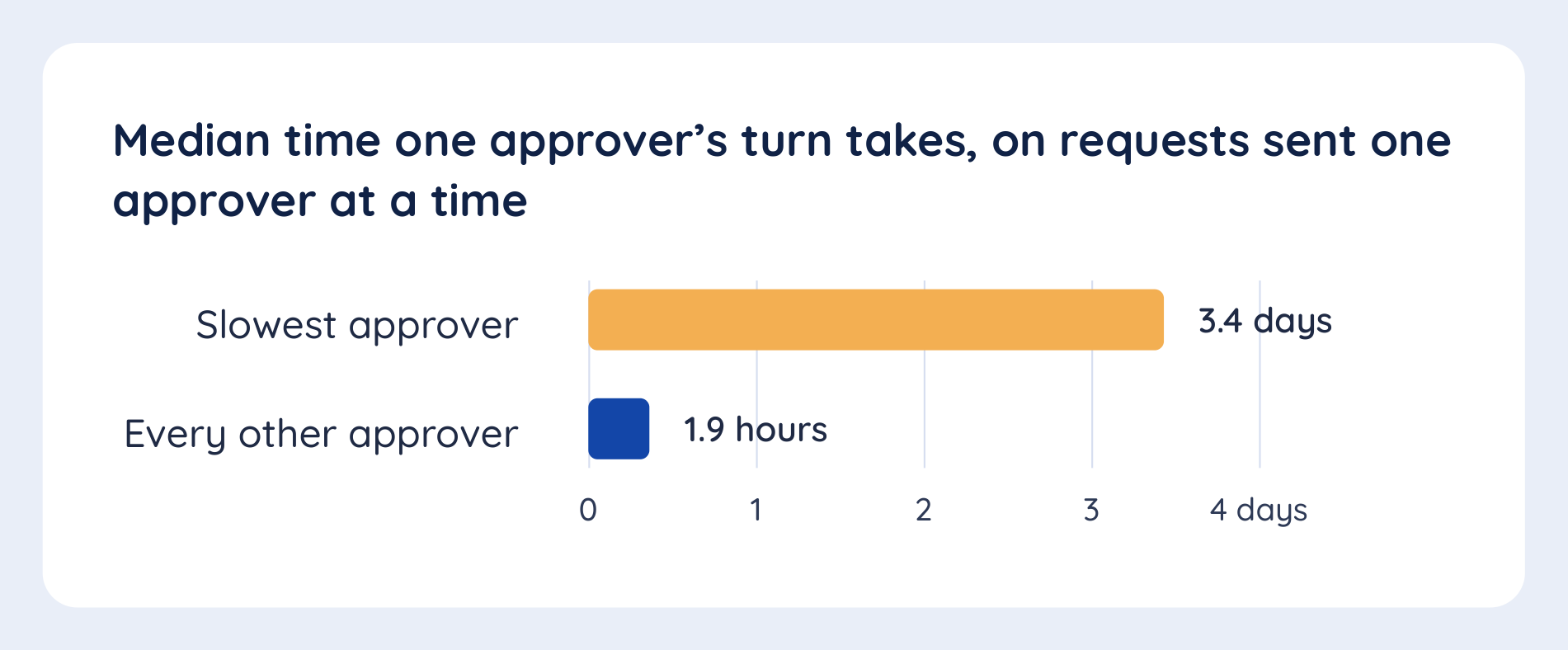
| Approver | Median time |
|---|---|
| Slowest approver | 3.4 days |
| Every other approver | 1.9 hours |
What this means
If it’s always the same approver, have the conversation.
A repeat hold up costs you money, so drop approvers you don’t need, or let any one approver from the group sign off. With a CLM, the reminders are automatic.
Among approvers with ten or more decisions on record, the median approver averages 1.5 days per decision, and the slowest 10% average 6.7 days or more.
Ask Both Approvers at Once
A request with two approvers can go to one and then the other, or to both together. Either way, two people review one contract. Asked together, neither waits for the other.
- 2.2 days vs 1.3 days
- median wait for a two-approver request, asked one at a time vs both at once
- 12.9 days vs 11.0 days
- the slowest 10% of those requests, one at a time vs both at once
What this means
Ask both at once unless one review depends on the other.
When both approvers are asked at once, the median request is decided 21 hours sooner, and the slowest 10% finish 1.9 days sooner.
Signature
Every Signer Adds Time. Four Is Where It Breaks.
A request with one signer is fully signed in a median of 1.5 hours. A second signer makes it 22 hours and a third 2 days. At four or more, the median is 5 days and the slowest 10% take 17.9 days or more, so that’s the number to stay under. One-signer requests can look faster because the other party may have signed separately.
| Signers | Share of requests | Median | Slowest 10% take more than |
|---|---|---|---|
| 1 signer | 54% | 1.5 hours | 3.5 days |
| 2 signers | 36% | 22 hours | 9.0 days |
| 3 signers | 7% | 2.0 days | 12.8 days |
| 4 or more | 3% | 5.0 days | 17.9 days |
More than 48,000 completed e-signature requests, August 2025 to September 2026. Signer counts include only the people on the e-signature request.
The Days Add Up Between the Signers
The first signature usually comes fast. On requests with two or more signers, most of the time is spent waiting for the people after the first.
- 1.5 hours vs 1 day
- median time to the first signature vs the last, on requests with two or more signers
- 62%
- of total signing time across all multi-signer requests comes after the first signature
What this means
Fewer signers, all on one request.
Ask whether each person must sign or only needs a copy. Put all signers on one request, remind the one it’s waiting on, and avoid four or more.
At Every Company Size, the Slowest 10% Take More Than 6 Days
Companies with under 100 employees are fastest: their median request is fully signed in 4.1 hours, compared with 8.8 hours at companies with 100 to 999 employees. At every size, the slowest 10% take more than 6 days, so small teams wait on slow signatures just as large ones do.
| Employees | Median | Slowest 10% take more than |
|---|---|---|
| Under 100 | 4.1 hours | 6.1 days |
| 100 to 999 | 8.8 hours | 7.8 days |
| 1,000 and up | 6.1 hours | 6.9 days |
Company size comes from third-party business data on employee counts. Companies without a recorded size aren’t shown.
The Calendar
Send Approvals by Wednesday
Approvers take 1.7 to 2.0 working days whichever weekday they’re asked. A request sent by Wednesday is typically back in 1.9 calendar days; one sent Thursday or Friday takes 3.9.
- 1.9 days vs 3.9 days
- median calendar days to an approval decision, requested Monday to Wednesday vs Thursday or Friday
- 1.7 to 2.0 days
- median working days to an approval decision, whichever weekday it’s requested
What this means
Need it back this week? Send it by Wednesday.
Approvers don’t work slower on Fridays. An approval takes about two working days, so a Thursday or Friday request runs into the weekend. Need a decision before the week runs out? Send it Monday to Wednesday. If it has to go out Thursday or Friday, say when you need it back and set a Monday reminder.
For Signatures, Friday Is Fastest
In working hours, a Friday signature request is signed in a median of 4.7 hours, the fastest of any weekday; Monday to Thursday run from 5.1 to 6.4 hours. Friday only looks slowest on the calendar because 26% of its requests finish over the weekend or on Monday, so there’s no reason to hold a request until Monday.
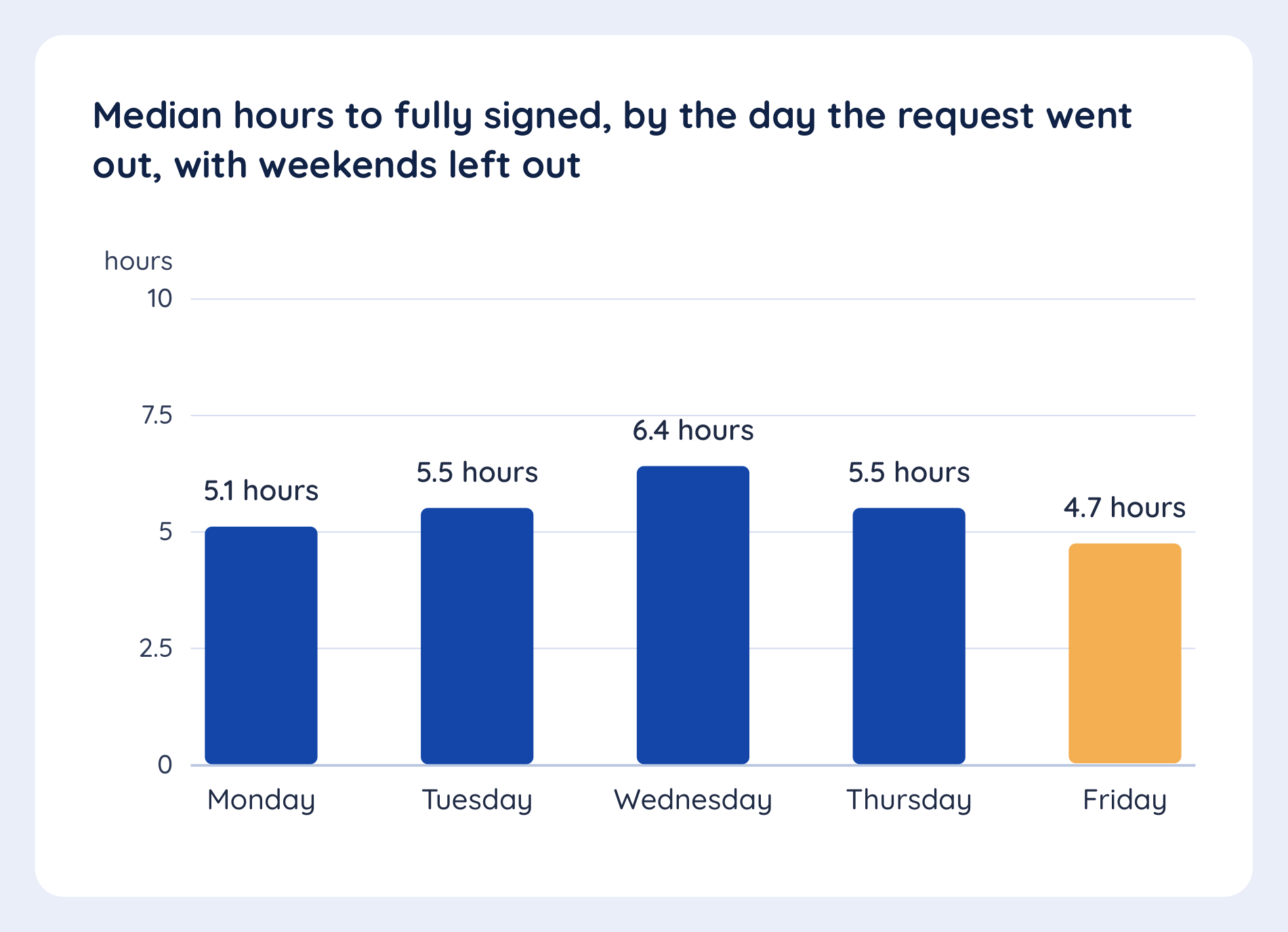
| Day requested | Median working hours |
|---|---|
| Monday | 5.1 hours |
| Tuesday | 5.5 hours |
| Wednesday | 6.4 hours |
| Thursday | 5.5 hours |
| Friday | 4.7 hours |
Completed e-signature requests, August 2025 to September 2026, by the weekday each was sent. Saturday and Sunday hours are left out of each request’s time.
After the Signature
After the Signature, the Clock Keeps Running
The last wait starts after everyone has signed. This report’s timestamps stop at the final signature, so this section is based on what works for ContractSafe customers. Renewal dates arrive whether or not anyone’s tracking them, and teams that stay ahead start with the contracts that carry the most risk.
A contract needs a reminder first if:
- It renews on its own unless someone acts
- It has a notice window that closes before the renewal date
- A missed date could cost money or create a compliance issue
- Its price or terms may change at renewal, which could mean renegotiating
Try This With Your Own Contracts
This check takes an afternoon and pays for itself the first time it keeps a renewal from slipping through.
Pull your ten biggest auto-renewing contracts and check two things: is the renewal date confirmed, and does a reminder fire before the notice window closes?
If you’ve got renewals and reminders set up for all ten, you’re in good shape. If not, you’ve just found where to start.
ContractSafe helps us stay ahead of renewals and saves me at least a few hours every week. I can pull the contract report I need and keep the process moving.
Carrie McClainProcurement Specialist, Vitality Living
Seven Moves That Get Contracts Unstuck
Every one of these is something a team can start this quarter.
- Give every new contract an owner the day it’s added; miss that day and it will likely wait a week.
- Remind the slow approver, and if it’s always the same one, have the conversation.
- Ask two approvers at once unless one review depends on the other.
- Keep approvers to those whose sign-off is required. If any one of several people could approve, don’t wait on all of them.
- Limit signers to the people who have to sign, put them on one request, and keep the count under four.
- Need an approval this week? Send the request by Wednesday.
- Put a reminder on every auto-renewal before its notice window closes.
Why ContractSafe
ContractSafe Shows You the Wait and Helps You Clear It.
Most contracts are signed within days. The slowest 10% account for most of the total time, waiting to be started, approved, or signed. ContractSafe shows you which contract, which step, and whose turn it is, and lets you act on it right there.
- See where every contract waits. Lifecycle stages show what’s waiting, who owns the next step, and the average time to full execution.
- Move every step forward. Intake forms start requests with the facts, AI pulls key dates, parties, and terms, approvals go to a saved group at once, and e-signature sends the reminders. Coming soon: AI sets up the approval, and any one of a group signs off.
- Bring the whole team in. Unlimited users on every plan, with reminders on any date, from renewals to notice deadlines, sent to anyone who needs them.
Features vary by plan. Current details at www.ContractSafe.com/pricing
Find Where Your Own Contracts Get Stuck.
Every team has its own slowest 10% of contracts. The seven moves get easier once you can see which ones they are and where each one is waiting. Then you can start fixing the bottlenecks.
Consolidating our team's multiple e-signature accounts into one ContractSafe account saved us 40% off the top.
Edward SoykaHead of Legal and Compliance, Rugiet Health
READY WHEN YOU ARE
See every step, from intake to renewal. Book a demo
About This Report
Where These Numbers Come From
These findings are based on timestamps from ContractSafe customers’ contracts, August 2025 to September 2026. Every figure rests on at least 50 companies, and it’s all completely anonymized. Every org already uses a CLM platform; teams without one wait far longer on approvals and signatures.
Step-by-step timing
More than 50,000 contracts carry step-by-step timestamps. Most were filed for storage or never started. More than 6,000 were followed from added to fully signed, and they’re part of the 55,000.
Approvals
More than 15,000 approved requests, each timed from the request to the final decision, with a timestamp for every approver.
Signatures
More than 48,000 completed requests through the built-in e-signature. With the approvals, these contracts make up the rest of the 55,000.
Company size
Employee counts come from third-party business data.
How the Data Was Measured
How to read the numbers, and what the timestamps can and can’t show.
- The four steps are defined on page 3. Times under an hour are in minutes, under 24 hours in hours, longer ones in days.
- When an approval request was sent more than once, our data has only the latest round, so those approval times can look shorter. 17% of step-tracked contracts that went through approval went through it more than once. A request counts as sent to everyone at once when all its approvers were notified within a minute.
- All times are calendar time, weekends included, except the working-time figures in The Calendar section, and slowest 10% and 25% figures are rounded down. Contracts already signed when added, or loaded in bulk at setup, are left out of the step-by-step timing. In the step split on page 7, time in the signing stage that the system entered automatically, with the built-in e-signature, Docusign, or Dropbox Sign, counts as signature time.
Download Where Contracts Get Stuck (...and How to Fix It)