
Contract management KPIs are the numbers legal, finance, procurement, and operations teams use to track how contracts move through drafting, signing, and renewal, showing what's on schedule, what's stuck, and what needs action this week.
Think of them like the dashboard lights on your car. They don't drive for you, but they warn you when you're low on fuel or the engine's about to overheat, so you can fix the problem before you're stranded on the shoulder.
The hard part is knowing which numbers actually matter and which just look busy. The metrics below are the ones worth watching, so you can put your attention where it moves the needle instead of drowning in dashboards that tell you nothing.
Key Takeaways
- Track contract management metrics that change decisions, not numbers that look good in a dashboard.
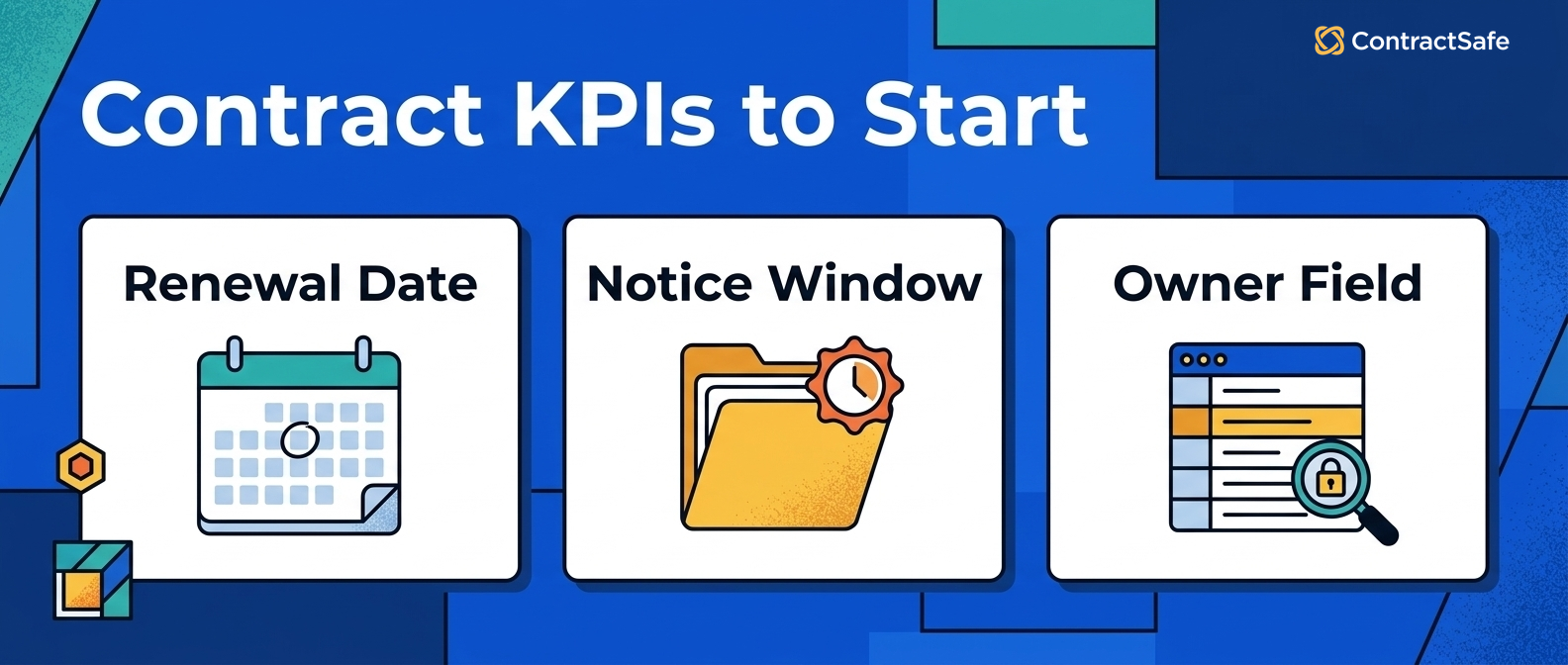
- Start with cycle time, renewal risk, missing metadata, owner coverage, contract value under management, and obligation follow-through.
- Separate leading indicators from lagging indicators so the team can prevent problems instead of only explaining them later.
- Use formulas that a non-legal leader can understand in one sentence.
- Tie every metric to an owner and a weekly action, or the report becomes decoration.
Choose Your Next Step
Building a contract metrics program goes faster when you start from the question your team is asking right now. Jump to the part of this guide that answers it.
- Starting from zero? Begin with how to choose your first KPIs and resist the urge to track everything.
- Already tracking some numbers? Check the six core metrics against your current scorecard.
- Report exists but nobody acts on it? Read leading vs. lagging metrics and the weekly scorecard.
- Rolling this out across teams? Go to the metrics program rollout plan.
- Whatever you pick, write down the owner and the weekly action for each metric before you build anything. That one habit separates scorecards from decoration.
- Need the data foundation first? Our contract repository requirements guide covers what the system underneath must do.
What Are Contract Management Metrics?
Contract management metrics are practical measures of contract work, contract data, and contract risk. If the underlying discipline is new to your team, start with the basics of contract management first.
The best ones tell you what needs attention before a deadline, renewal, or obligation gets missed. Reminder-based contract date tracking is the mechanism behind that early warning.
- A weak metric says, “We uploaded more contracts.”
- A useful metric says, “These renewal notices are due soon, these records have no owner, and these agreements need review before finance closes the quarter.”
That difference matters because contract management isn’t just storage.
WorldCC keeps pointing to the same operating truth: better contract practices lead to better business outcomes.
Thomson Reuters makes the same case from the systems side: a contract management system earns its keep through search, key-date tracking, and reporting, the exact capabilities these metrics measure.
For lean teams, the goal is simple: fewer surprises, cleaner ownership, and faster answers.
Use the definition as a filter. Before a number joins the scorecard, assign the renewal, owner, or deadline decision it changes. If you can’t name one, leave the metric out.
Here's a quick field test: if the number goes up or down, who changes what they're doing by Friday? If the answer is "nobody," you've found an interesting statistic, not a KPI.
That sounds fussy, but it saves a lot of dashboard clutter. A small legal team doesn't need twelve charts quietly aging in a reporting folder, it needs the two or three signals that make someone open a contract record, assign an owner, or call finance before a renewal window closes.
What Goes Wrong Without Contract Metrics
Teams without contract metrics don’t feel the absence until something expensive happens. The failure stories repeat, which means you can measure against every one of them.
The quiet auto-renewal. For example, a vendor agreement renews for another full term because the notice window passed and no number anywhere counted “renewals approaching without an owner.”
The quarter-close scramble. Finance asks how much contract value renews next quarter. The answer takes three people two days because nobody tracks value under management.
The invisible bottleneck. Say your approvals stall in one department every month. Without cycle time by stage, the pattern hides inside anecdotes, and the fix never gets prioritized.
Each of these is a missing metric, not a missing effort. The team was working hard the whole time. Nothing was counting the right things.
The fix is the same in all three stories: assign an owner, set the alert on the notice date, and review the exceptions every week.
Think of contract metrics like the little warning lights on a car dashboard. The light itself doesn’t fix the engine. It tells you which problem deserves attention before the car gives up on the highway.
That’s the level of usefulness to aim for. Not “we have a lot of contracts.” More like “these vendor agreements are close to renewal, these records have no owner, and these high-value agreements need CFO review.”
Now legal has work it can assign. Finance has exposure it can plan around. Procurement has conversations it can start before the vendor controls the clock.
Why Contract Metrics Matter Beyond Legal
Contract metrics matter because contracts encode money, risk, and obligations for every team, so the numbers built on them change decisions far outside legal.
Finance gets renewal exposure it can plan against instead of discovering. A renewal pipeline with values and dates turns next quarter from a guess into a schedule.
Procurement walks in prepared. Showing up to a vendor conversation with the notice date, the current terms, and the spend history changes who controls the meeting.
Operations gets fewer interruptions, because the answer to “where is that agreement and who owns it?” stops being a hallway question.
And leadership gets the benefit that compounds: trust. When the contract numbers are right every week, the team that produces them gets asked better questions and handed bigger decisions.
To start earning that trust, give finance the renewal exposure report first, then ask procurement to review vendor notice dates monthly.
That first report should be boring in the best possible way.
List the agreements, renewal dates, contract values, business owners, and next actions. Don’t hide behind a trendline until the underlying records are clean enough to trust.
Once leaders see that the report names real contracts and real decisions, the metrics stop feeling like legal housekeeping. They become part of how the business plans cash, risk, and work.
How to Choose Your First Contract KPIs
Choose your first contract KPIs by working backward from decisions: pick the five or six numbers that would change what someone does this week, and ignore the rest until these are trusted.
Three criteria keep the list honest.
- It answers a real weekly question. If nobody asked, don’t measure it.
- It names a next action and an owner. A number without a follow-up is decoration.
- It can be calculated from data you actually have. A KPI that needs fields nobody fills will be wrong by week two.
Scope matters as much as the criteria. Start with executed agreements in one system of record. A metrics program that spans four shared drives inherits four sets of bad data.
And requirements run both ways. If your repository can’t report on owners, dates, and values, fix the contract metadata first. The metrics are only as good as the fields underneath them.
Start with one operating question from each group:
- Legal: Which contracts need review before they create risk?
- Finance: What money renews, expires, or changes this quarter?
- Procurement: Which vendors need a decision before the notice window closes?
- Operations: Where are contracts stuck, missing, or hard to find?
Then turn those questions into fields. Renewal risk needs notice dates, renewal dates, owners, and status. Cycle time needs request date, approval date, and signature date. Value reporting needs contract value, vendor, department, and renewal window.
This is where a lot of KPI projects get backwards. They build the chart first, then discover the data underneath it is a junk drawer. Build the field list first. The chart can wait.
The Metrics Worth Tracking First
The best contract management metrics cover speed, risk, ownership, data quality, and financial follow-up.
If a metric doesn’t point to a decision, leave it out.
| Metric | What it tells you | Weekly action |
|---|---|---|
| Contract cycle time | How long contracts take from request to signature | Find stalled approvals or drafting bottlenecks |
| Renewal risk | Which agreements need review before notice dates | Assign owners before renewal windows close |
| Missing metadata | Which records lack dates, values, owners, or status | Clean the fields that drive reports and alerts |
| Owner coverage | Which contracts have a named business owner | Reassign orphaned agreements before deadlines |
| Obligation follow-through | Whether post-signature commitments are being tracked | Move obligations into tasks, alerts, or reports |
| Contract value under management | How much contract value sits in the system | Help finance understand portfolio exposure |
You don’t need every possible KPI on day one. You need a short list that helps the team decide what to fix next.
Here’s each of the six in working detail: what it measures, the plain-English formula, and the action it should create.
1. Contract Cycle Time
Contract cycle time measures how long a contract takes from request to signature. It’s the single best indicator of whether your process helps the business move or makes it wait.
Formula: time from request to signature, tracked as a trend.
Track it for every agreement type you sign regularly: NDAs, vendor MSAs, customer order forms, and renewal amendments.
What good looks like: the trend moves down without skipping review steps.
The weekly action is specific. When cycle time rises, break it down by stage and find the queue. One slow approval desk can hide inside a healthy-looking average.
Common mistake: measuring one average across all contract types. An NDA and a master services agreement shouldn’t share a benchmark, so segment by agreement type before you judge the trend.
- Watch for: one approval stage holding most of the wait time.
- Watch for: contracts that skip review entirely to look fast.
2. Renewal Risk
Renewal risk counts the contracts that are approaching their notice dates without a named owner or a renewal decision. Of the six core contract metrics, it prevents the most expensive surprises.
Formula: contracts with notice dates inside the review window that have no assigned owner.
What good looks like: zero. Every approaching notice date has a human attached.
Each week, assign an owner to every flagged agreement and set the renewal decision date before the notice window opens.
For example, a renewal that surfaces ninety days out is a negotiation. The same renewal discovered after the window closes is a bill.
This is also where the system does the watching for you. ContractSafe’s alerts attach reminders to notice dates and escalate them, so the metric trends toward zero instead of depending on memory.
3. Missing Metadata
Missing metadata counts records that lack the fields your reports and alerts depend on: dates, values, owners, and status.
Formula: complete required fields divided by total records.
What good looks like: required fields trend toward complete, starting with high-value agreements.
This is the foundation metric. Every other number on the scorecard is computed from these fields, so a metadata gap is silently a gap in everything else.
Cleanup scales when extraction does the first pass. ContractSafe’s AI extraction pulls dates, parties, and values from the documents and shows the result as a review queue, so humans verify instead of retype.
Common mistake: requiring twenty fields. Require the seven that drive alerts and reports, and let the rest be cleanup-later fields.
4. Owner Coverage
Owner coverage measures which contracts have a named business owner who answers for renewals, obligations, and questions.
Formula: contracts with assigned owners divided by contracts that need one.
What good looks like: every material agreement has an owner, and departures trigger reassignment within the week.
Say a procurement manager leaves. Owner coverage is the number that tells you, the same week, which forty agreements just became orphans.
Common mistake: treating owner as a one-time field. Owners change with reorganizations and departures, so the metric only works when reassignment is part of the weekly review.
- Watch for: high-value agreements owned by people who left the company.
- Watch for: one person owning so many contracts that ownership means nothing.
5. Obligation Follow-Through
Obligation follow-through measures whether post-signature commitments are tracked as work, not just stored as clauses.
Formula: tracked obligations divided by known obligations.
What good looks like: important commitments exist as tasks, alerts, or report lines with owners.
Signed agreements are full of promises someone made. This metric, more than any other, connects the repository to contract obligation management after the signature.
Common mistake: tracking only your counterparty’s obligations. Your own commitments, delivery dates, reporting duties, insurance requirements, are the ones that turn into breach letters when they slip.
- Watch for: obligations that live only in the contract text, with no task or alert attached.
- Watch for: recurring duties, like annual certifications, that reset after each completion.
6. Contract Value Under Management
Contract value under management totals the contract value sitting in the system, sliced by renewal date, vendor, and type.
Formula: sum of contract values on records with complete value fields.
What good looks like: finance can answer “what renews next quarter, and for how much?” from a report, not a hunt.
This is the metric that earns the program executive attention, because it translates contract operations into money.
- Watch for: agreements with no value recorded, which silently understate exposure.
- Watch for: auto-renewing contracts whose renewal value nobody has re-checked against usage.
Leading vs. Lagging Contract Metrics
Leading contract metrics warn you before a problem lands, and lagging contract metrics explain what already happened. A working scorecard needs both, doing different jobs.
A lagging metric can tell the CEO that cycle time improved. A leading metric can tell legal which approval queue needs help before the month ends.
| Metric type | Example | Best use |
|---|---|---|
| Leading | Contracts with notice dates approaching and no owner | Prevent missed renewals |
| Leading | Records missing expiration dates | Clean data before reporting fails |
| Leading | Approvals waiting on one department | Remove bottlenecks before signature |
| Lagging | Average cycle time after signature | Measure whether process changes worked |
| Lagging | Renewals completed on time | Report operational performance |
| Lagging | Contracts with complete metadata | Track repository health over time |
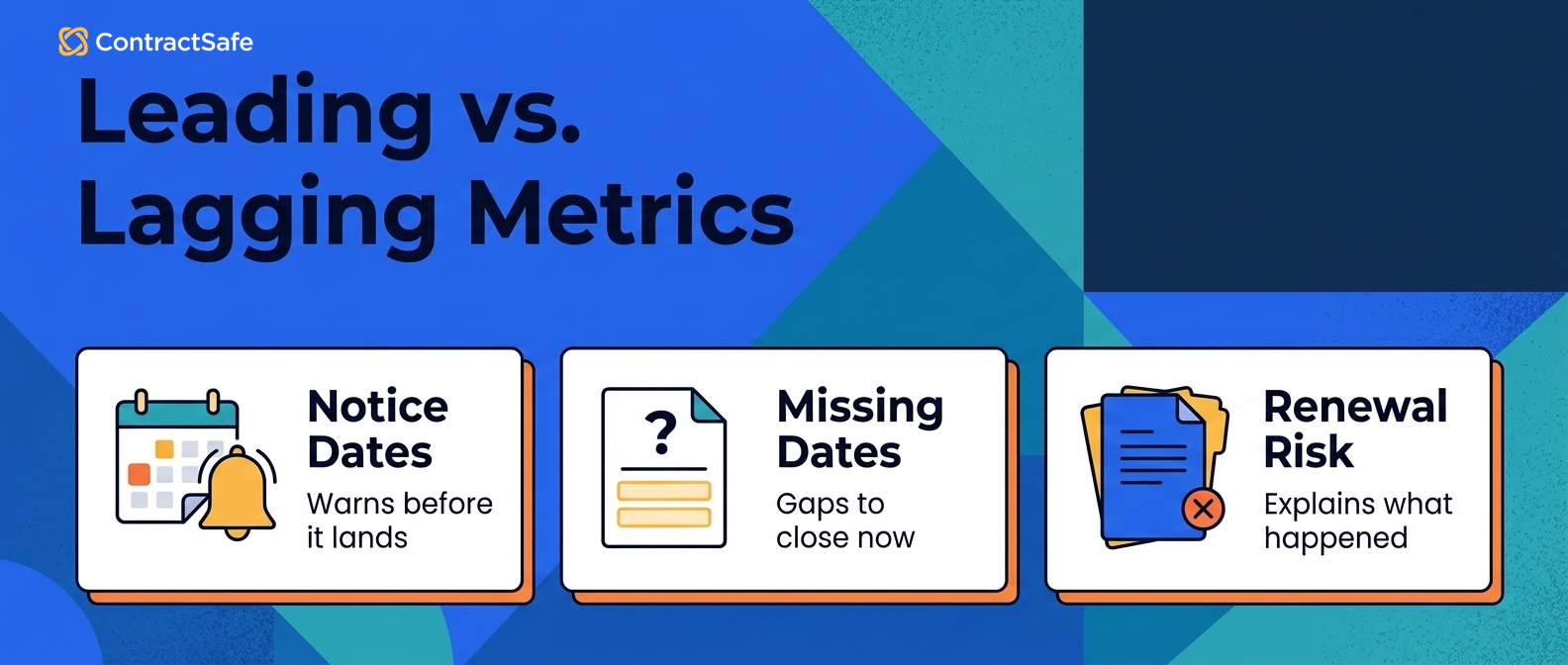
The scorecard should include both. If you only track lagging metrics, the report becomes a rearview mirror; if you only track leading metrics, leadership may not see whether the work is improving.
How to Calculate Contract Management KPIs
Contract KPI formulas should be simple enough for legal, finance, and operations to use the same way.
A formula nobody trusts won’t survive the first meeting.
Use these as a practical starting point:
| KPI | Plain-English formula | What good looks like |
|---|---|---|
| Cycle time | Time from request to signature | The trend is moving down without skipping review |
| Renewal coverage | Contracts with assigned renewal owners divided by renewable contracts | Every material contract has an owner |
| Metadata completeness | Complete required fields divided by total records | Required fields support reliable reporting |
| Alert coverage | Contracts with active alerts divided by contracts with key dates | Deadlines are tied to reminders |
| Obligation coverage | Tracked obligations divided by known obligations | Important commitments are owned after signature |
| Search success | Searches that find the right contract divided by total tested searches | Users can find records without legal help |
The formula is only half the work. The other half is deciding what happens when the number is bad: if metadata completeness drops, assign cleanup; if renewal coverage is weak, name owners; if cycle time rises, find the queue. The metric should create work, not just commentary.
Quick gut check before you build the dashboard. Can you list the five questions your team asked about contracts last week? Those questions are your KPI list. A checklist built from real questions beats a template copied from a vendor.
A second gut check helps too: can a new manager understand the metric without a translator?
“Contracts with notice dates in the next ninety days and no owner” is clear. “Renewal readiness index” sounds polished, but it makes people ask what’s inside it.
Use plain labels until the process is boring. Boring is good here. Boring means everyone knows what the number means and what happens next.
Role-Based Metrics for Each Team
Each team needs a different slice of contract metrics: legal watches process and risk, finance watches value and exposure, procurement watches vendors and dates, and operations watches flow.
The shared report can be short, but the action queue should match how each team works.
| Team | Metrics to watch | Decision it should drive |
|---|---|---|
| Legal | Approval cycle time, nonstandard terms, missing owners, obligations, upcoming notice dates | Where should legal unblock work or reduce risk this week? |
| Finance | Contract value, renewal exposure, payment terms, auto-renewals, vendor obligations | What spend or revenue needs planning before month-end? |
| Procurement | Vendor renewal dates, pricing terms, assigned owners, termination windows, contract status | Which vendor conversations should start before the clock favors the vendor? |
| Operations | Workflow delays, handoff points, user access, missing operational fields, search success | Where is contract work slowing the team down? |
The point isn’t to create four separate reporting empires. It’s to give each team the slice of the same contract record that helps them act.
If finance keeps asking legal for renewal exposure, don’t build finance a new spreadsheet. Fix the contract value and renewal fields, then give finance the report.
If procurement keeps losing vendor notice windows, don’t hold another process meeting. Put notice dates, owners, and alerts in the repository, then review the exceptions on a schedule.
What Not to Measure
Bad contract metrics create false comfort: they make the dashboard look busy while deadlines keep getting missed. The usual offenders are volume counts that measure activity instead of health.
Be careful with vanity metrics like total contracts uploaded, total searches, total users, or total reports created.
Those numbers can be useful context, but they don’t prove that contract work is healthier.
A repository with a huge upload count can still be a mess if half the records are missing expiration dates.
A report with many viewers can still be useless if nobody owns the next action.
Use vanity metrics only when they support a real operational question. Otherwise, keep them out of the weekly scorecard.
Here’s the practical distinction.
Total contracts uploaded is a weak metric by itself. Contracts uploaded with complete renewal dates, assigned owners, and searchable text is useful.
Total users is weak by itself. Business owners who logged in and resolved renewal tasks this month is useful.
Total searches is weak by itself. Searches that found the right contract without legal help is useful.
Most vanity metrics can be rescued if you attach them to a decision. If you can’t attach the decision, keep the number in the background.
Rolling Out a Contract Metrics Program
A contract metrics rollout works best as a staged pilot: one team, six metrics, four weeks, then expand. Programs that launch company-wide on day one usually die in the second month.
- Pick the pilot team. Legal or procurement usually works, because they feel the contract pain weekly and own the fixes.
- Verify the data foundation. Confirm the required fields exist and are filled for the pilot team’s agreements, with AI extraction doing the first pass and a human verifying the high-risk records.
- Stand up the six core metrics. Use the formulas above, unchanged, for the first month. Resist customization until the team trusts the numbers.
- Run the weekly review. Fifteen minutes, the scorecard, and one assigned action per bad number.
- Take it to leadership with one month of trend. Executive buy-in comes from a story the numbers already told, not from a proposal.
- Expand team by team. Each new team gets the same six metrics plus at most two of its own.
Governance stays light on purpose. One person owns the scorecard, the definitions live in one document, and any new metric must name the question it answers and the owner who acts on it.
Adoption is the real success metric for the program itself. If the weekly review keeps happening without you chasing people, the program works.
A simple pilot rollout is enough:
| Stage | Work | Proof you’re ready to move on |
|---|---|---|
| Define | Pick the pilot group and the fields each KPI needs | You can name the owner for every required field |
| Clean | Clean dates, owners, values, and status for the pilot contracts | The first scorecard can be generated without manual hunting |
| Review | Run the review and assign actions from the exceptions | Every bad number has a person and a next step |
| Explain | Show the trend, the fixes, and the open risks to leadership | Leadership sees decisions, not just charts |
Don’t skip the pilot because the dashboard software makes a full rollout look easy. Contract metrics are really a behavior change disguised as reporting.
The system can count. People still have to decide what the count means.
A Weekly Contract Metrics Scorecard
A weekly contract scorecard is a one-screen report listing the contracts that need action this week: renewal risks, missing owners, stalled approvals, and assigned cleanup. One screen is the discipline.
If the report needs a meeting just to explain itself, it’s too complicated.
Use a simple structure:
- This week’s renewal risks.
- Contracts missing owners or key dates.
- Approval queues that need help.
- High-value agreements with incomplete records.
- Obligations that need a named owner.
- Data cleanup assigned for the week.
In ContractSafe, this scorecard is a saved report view: expiring agreements by owner, records with missing required fields, and value by renewal window, refreshed from the live contract data.
That’s the level where metrics become useful.
They show the work, name the owner, and make it harder for contract risk to hide in a folder.
A good weekly review sounds less like a metrics meeting and more like dispatch.
“These three agreements need owners.” “This vendor renews in sixty days.” “This approval has waited eight business days.” “These five records need dates before finance can trust the quarter-end report.”
That language matters because it keeps the team out of dashboard theater. Nobody is admiring the chart. They’re clearing the work.
Once the scorecard is stable, keep a monthly view for leadership. Show the trend in cycle time, renewal coverage, metadata completeness, and obligation coverage. Then include the exceptions that still need help.
That’s usually enough. The weekly report runs the work. The monthly report explains whether the work is making contract operations healthier.
Related Reading
- Contract renewal best practices, for turning the renewal-risk metric into a working renewal process.
- Contract effective date rules, for getting the date fields right so every metric built on them can be trusted.
- Evaluating contract management software, for choosing a system that can actually report these numbers.
How ContractSafe Helps Track Contract Management KPIs
ContractSafe helps teams track contract management metrics by turning signed agreements into searchable records with dates, owners, alerts, permissions, and reports.
The system is useful because the data lives close to the contract.
You can search the agreement, see key fields, assign alerts, review owner coverage, and build reports without rebuilding the same spreadsheet every week.
ContractSafe’s repository gives teams one place for executed agreements and metadata, and alerts help teams act before renewal and expiration dates pass.
For AI-supported cleanup, use ContractSafe’s guide to AI contract management software.
The fastest proof is your own data. Bring a sample of real agreements to a free demo and see the six core metrics built from them live.









.svg)







.svg)