
Quick answer: A contract renewal starts a new term, usually under a new agreement with renegotiated price, scope or service levels. A contract extension keeps the existing agreement alive for more time on the same terms. Renew when something needs to change; extend when you only need time. Both turn on dates written into the contract, so the real work of contract renewals and extensions is knowing the end date and the notice period before they arrive.
Say a software vendor signed you up on a first-year price, under a contract that renews automatically each October unless you give 60 days' notice. If nobody is watching the date, the renewal lands at the full rate and you're committed for another year. The same contract could instead be extended for three months while you finish a renegotiation, on the terms you already have. Which one you want depends on what you're trying to change, and whether you noticed in time.
Choose your next step:
If you're trying to stop an auto-renewal sneaking past you, start with contract reminders and date tracking.
If you're heading into a renegotiation, read our guide to contract negotiation before the renewal date.
If you're comparing a calendar to a contract system, bring your auto-renewing contracts to a ContractSafe demo.
Key Takeaways
- A renewal starts a new term, usually in a new agreement with renegotiated terms; an extension keeps the existing agreement running for more time.
- Renew when price, scope or service levels need to change; extend when you only need time.
- An auto-renewal clause rolls the contract into another term unless you give notice inside the notice window.
- Missing a notice window locks you into another term, so the renewal date and the notice deadline both need an owner and a reminder.
- Before you renew, check the market, review the terms, and bring data to the negotiation.
What's the Difference Between a Contract Renewal and a Contract Extension?
A renewal creates a new term and usually a new contract, with the chance to renegotiate pricing, service levels, deliverables or risk allocation. An extension adds time to the agreement you already have, with the original terms left in place. Both continue the relationship past the original end date; they differ in how much you can change and how much work it takes.
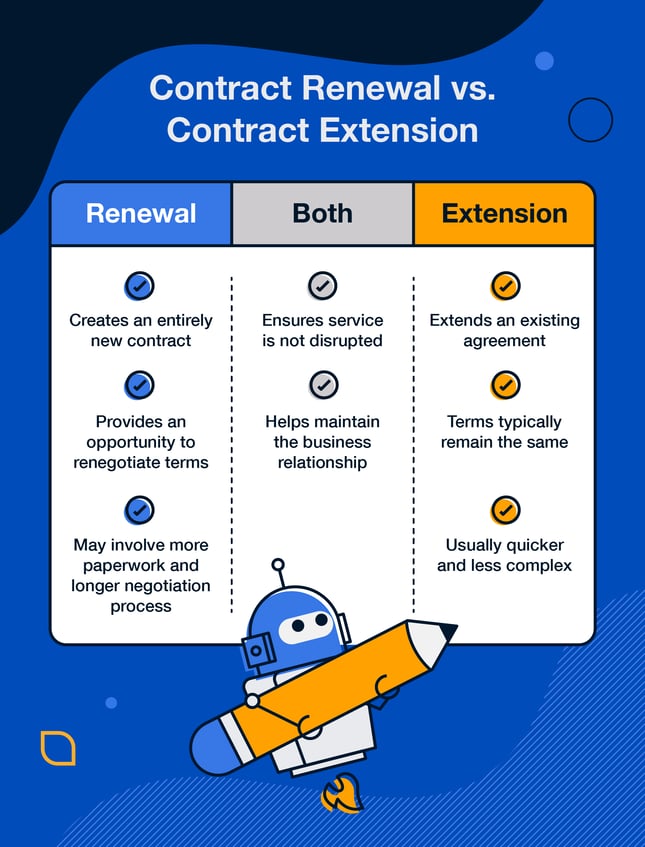
If all you need is a little more time, an extension is the right tool: it's quicker, it needs less paperwork, and nobody has to reopen the commercial terms. If you want a better price, a different scope or a change to the risk terms, a renewal is the moment to do it, because the other side is already at the table.
What Is a Contract Renewal?
A contract renewal is the point where the current term ends and a new one begins, either under a fresh agreement or under a renewal clause in the one you already have.
Contracts renew in one of two ways:
Actively: both parties decide to continue and negotiate the new term together.
Passively: an automatic renewal clause continues the contract for another term unless you stop it before the deadline.
Either way, you have to act before the date in the contract to renegotiate, change the scope or walk away, which is why the end date and the notice period belong on a tracked record rather than in someone's memory.
Renewing with a vendor you already know usually costs less than switching: there's no onboarding, and the service keeps running without an emergency sourcing exercise.
What Is a Contract Extension?
A contract extension is an agreement between the parties to continue an existing contract beyond its original end date without replacing or re-signing the whole agreement. Extensions are for when the work ran long, the renegotiation isn't finished, or you need a bridge before a new agreement is signed.
Extending a contract takes three steps. Agree on the new end date with the other side, the same way you agreed on the original term. Check that nothing in the extension conflicts with a law or regulation that's changed since the contract was signed. Then put the extension in a signed amendment, so the new date is enforceable and shows up in your records rather than in an email thread.
What Are Automatic Contract Renewals?
Automatic contract renewals happen when an automatic renewal clause rolls the contract into another term unless one party gives notice. The new term usually runs on the existing terms, but some clauses raise the price at each renewal, so check yours for an escalator.
Pros and Cons of Automatic Contract Renewals
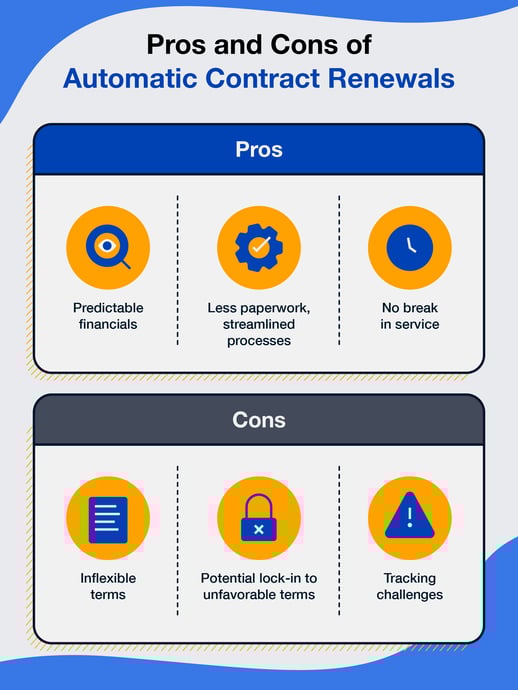
An auto-renewal clause gives you three things:
Convenience: the contract continues without a renegotiation.
Predictable financials: both sides can plan revenue and expenses around the next term.
Uninterrupted service: there's no gap while a new agreement is signed.
It costs you three things:
Potential lock-in: miss the deadline and you're in another term on terms you may no longer want.
Inflexible terms: you can't adjust anything unless you opt out of the renewal first.
Tracking work: every auto-renewing agreement needs its date and notice period tracked.
If you're still negotiating a contract with an auto-renewal clause, an AI contract review can flag a short notice window or a price increase at renewal before you sign, while you can still change them.
How To Get Out of an Auto-Renewal Contract
Getting out of an auto-renewal comes down to the contract's own terms and acting before its deadline:
Know your deadlines: check how much notice, if any, the contract requires if you intend to terminate.
Submit written notice: follow the procedure in the contract, which is usually a formal written notice by email or certified mail.
Be on time: deliver the notice inside the notice period. Late notice can carry penalties or lock you into another term even if you told the vendor you were leaving.
Why Renewals Deserve a Strategy, Not Just a Reminder
A renewal is the one point in a contract's life when either side can reopen the terms, so it's also where much of a contract's value is won or lost. A first-year discount that rolls into the full rate because nobody was watching the date, a vendor whose scope has shrunk while the fee hasn't, an underperforming agreement that renews because no one reviewed it: each of these is money left on the table, and each one was avoidable with a date and an owner.
That cuts both ways. On your vendor contracts, a tracked renewal date is the chance to renegotiate price, scope or service levels before the term rolls over. On your customer contracts, it's the chance to reach a client before their term ends with a well-timed retention conversation or an upsell, instead of finding out after they've lapsed. Either way, the opportunity only exists if you know the date is coming.
Two things decide how much of that value you keep:
Set your plan weeks or months ahead. The renewal window is open season for renegotiation, and timing is most of the leverage. Set contract alerts that fire well before the notice deadline. If your company has grown significantly over the initial term, you're negotiating from a much stronger position than when you signed.
Give the right people the right access. Renewals touch finance, procurement, IT, HR and sales as well as legal. With customizable roles and sharing, each of them can see the contracts they're responsible for, and an audit trail shows who changed or viewed each agreement scheduled for renewal, so nobody has to chase feedback through interoffice email.
How To Manage Contract Renewals Effectively
Manage renewals with seven habits: one repository, a written process, scheduled reviews, tracked dates, a market check, the right people in the room, and a negotiation plan. Together they turn a renewal from a surprise into a scheduled decision.
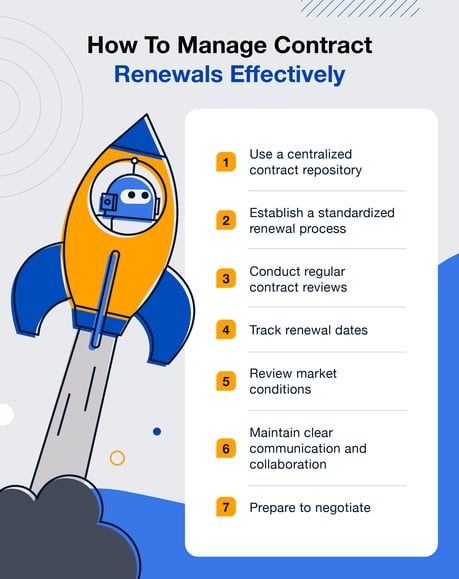
1. Use a Centralized Contract Repository
Contracts scattered across drives and inboxes are how deadlines get missed. Keep every agreement in a digital contract repository with fields for renewal dates, notice windows and term lengths, so the whole team can see what's coming. ContractSafe's contract repository software is built as that single place.
2. Establish a Standardized Renewal Process
A standard process keeps contract management on a schedule instead of reacting to whichever agreement expires next. A written process decides who owns each renewal and when the work starts:
Define who is responsible for staying on top of renewals.
Set up automated reminders ahead of each renewal.
Set timelines for the review, negotiation and approval phases.
Spell out the documentation and legal review each renewal needs.
3. Conduct Regular Contract Reviews
Review each contract well before its renewal date. Renewal is the last stage of contract management, and a review that starts early pays off in three ways. First, it prevents last-minute surprises: you find the issues while there's still time to fix them. Second, it turns up savings, because a close read of the terms is what lets you negotiate a better rate. Third, it keeps the contract aligned with the business as it changes, including your policies and your obligations under HIPAA, SOC 2 or data-processing rules.
Once the review is done, act on what you found: renegotiate, terminate, or take whatever step protects your position.
4. Track Renewal Dates
Losing track of a renewal date leads to an unwanted auto-renewal, a term you can't change, or a gap in service. A calendar can hold the dates for a handful of contracts; past that, you need them on the contract record, and you shouldn't have to type them in, because reading dates out of a signed agreement is now routine work for AI in contract lifecycle management. ContractSafe's contract management features extract those dates from each contract and let you set automated reminders, so nobody has to remember them.
5. Review Market Conditions
Before you renew, check what comparable services or products cost now. Compare pricing from other vendors and consult industry benchmarks to see whether your current terms are still competitive. That check matters most for recurring services like software, maintenance, outsourced staffing and consulting, where prices and offerings change every year.
6. Maintain Clear Communication and Collaboration
A renewal touches legal, procurement, finance and the business owner, and each of them knows something the others don't. A system with contract commenting keeps the renewal conversation next to the contract instead of in four inboxes.
7. Prepare to Negotiate
Be ready to negotiate, especially if the market has moved or you want changes to the contract. Come with data to support your points, decide your target outcome in advance, and know where you'll walk away; that preparation is what turns a renewal into an improvement in contract value rather than a rollover.
The Risks of Managing Renewals Manually
Once you're past a handful of contracts, manual tracking fails in predictable ways, and each failure has a fix a contract system handles for you:
Missed deadlines. Auto-renewals trap you in agreements you meant to renegotiate, and fixed-term contracts lapse altogether. A reminder set ahead of the notice window catches both.
Last-minute reviews. A review squeezed into the final week trades quality for speed and lets costly terms through. A shared renewal calendar gives every review the time it needs.
Out-of-date versions. Negotiating from stale language risks noncompliance. Version control with an audit trail means everyone's working from the latest draft and you can see who changed it.
Delayed approvals and signatures. A renewal that's agreed but unsigned stalls the new term and the revenue with it. Approval workflows and built-in e-signature keep it moving.
Compliance gaps. As contract volume grows, milestones, penalties, discounts and business terms stop being monitored, and that's when a missed obligation turns into a dispute. Consistent tracking keeps compliance from scaling worse than the contracts do.
Next step: see how renewal alerts and notice-window reminders work in ContractSafe's contract tracking software.
Related Reading
How ContractSafe Helps With Renewals and Extensions
ContractSafe reads each uploaded contract with AI-powered data extraction, pulls out the end date, the renewal term and the notice period, and sends reminders to the person who owns the contract ahead of the notice deadline.
When you need an answer across the whole set, ask the AIssistant a plain question, such as which MSAs auto-renew next quarter. To find the clause itself, use contract search; automatic OCR makes scanned contracts searchable too.
ContractSafe covers the whole contract lifecycle, so the renewal itself doesn't have to leave the system: on the Finalize and Maximize plans you can route a renewal or extension amendment through approval workflows and sign it with built-in e-signature, and the signed copy files itself on the contract record.
Date extraction, reminders and search are on every plan. Pricing starts at $450/month (Organize plan, billed annually; $540 month-to-month), with unlimited users on every plan, so legal, finance and procurement can all work from the same renewal calendar.







.svg)







.svg)