
A vendor contract audit is a reality check on signed agreements: do the contracts, dates, owners, obligations, amendments, and payment terms in your system match what the business is actually using and paying?
Think of it like opening the junk drawer before an auditor does. You want to find the missing keys first.
The audit is not only about money. It is about whether the contract record matches what the business is doing.
Key Takeaways
- Most organizations negotiate vendor contracts carefully, sign them, and then never check whether the terms are being honored. That post-signature gap is where money disappears.
- CTM’s £77.6 million overbilling problem sat in UK client billings for years. The company only caught it after switching auditors.
- PaymentAccuracy.gov tracks agency-reported improper-payment rates and recovery performance, showing why payment and contract audits deserve routine attention.
- You don’t need to hire a third-party audit firm to start. You need a platform where you can actually see your contracts.
- ContractSafe gives you a searchable repository, automated alerts, AI extraction, and audit trails that make vendor contract audits possible without a six-month project.
Choose Your Next Step
A vendor contract audit starts faster when you pick the entry point that matches your situation: the cautionary case, the findings list, or the do-it-yourself path through your own agreements.
- Need the case for auditing? Start with the £77.6 million nobody caught.
- Want to know what you’ll find? Read the eight findings audits uncover, from rate drift to missing trails.
- Ready to run one? Use the self-serve audit path and the audit checklist table.
- Whichever it is, check one contract today: pull your highest-spend vendor agreement and compare the last invoice to the contracted rates, line by line. Twenty minutes answers whether the drift is real.
- Fixing the foundation first? Our contract repository software guide covers where the agreements should live.
What Happens After You Sign a Vendor Contract
After a vendor contract is signed, someone still has to know where it lives, who owns it, which dates matter, and what happens next.
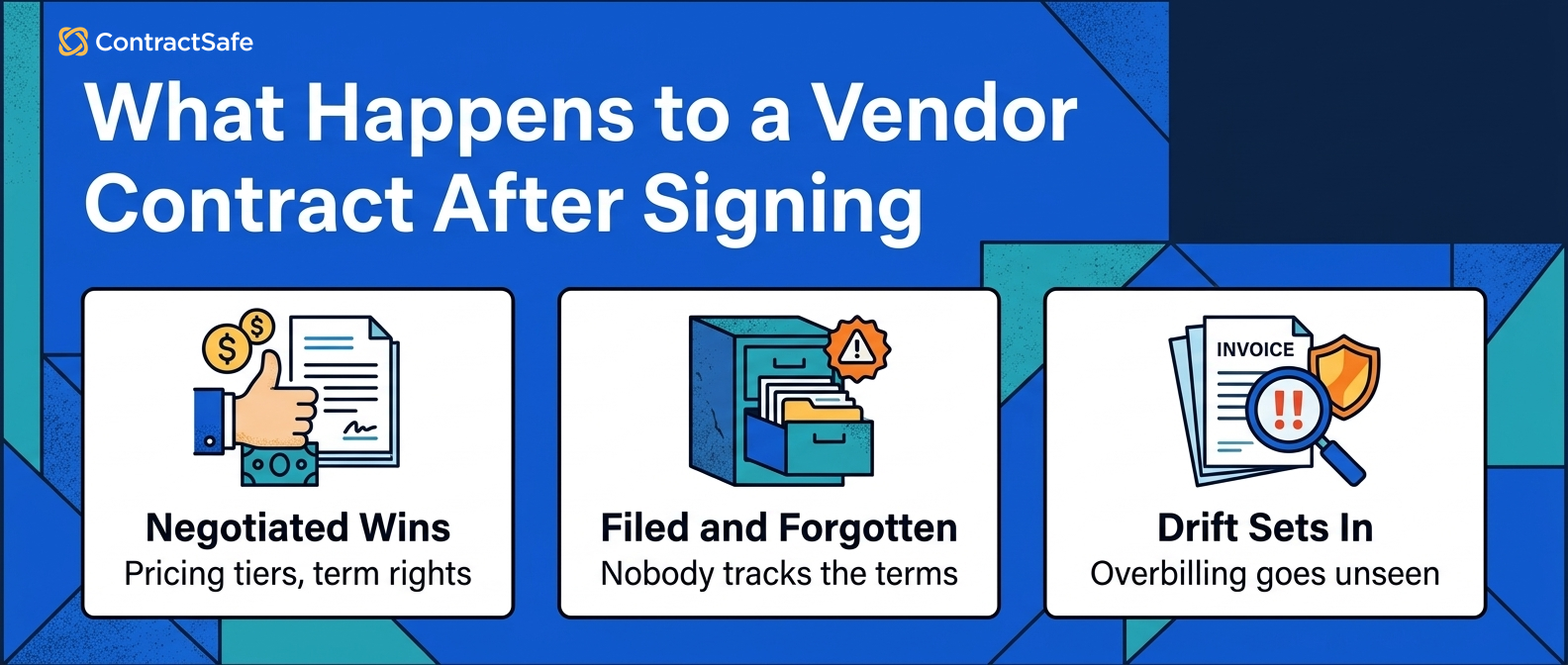
Your procurement team spent weeks negotiating a vendor contract. They fought for better pricing tiers. They got a termination clause. They locked in SLA requirements with penalty provisions for non-performance. Everyone was pleased with the result.
Then the contract got signed, filed, and forgotten.
The invoices started arriving. Accounts payable matched them against purchase orders and paid them.
Nobody compared the invoiced rates to the contracted rates. Nobody checked whether the SLA penalties had ever been triggered. Nobody noticed when an annual price escalator kicked in six months early. Contract date reminders would have flagged the escalator before the invoice did.
The negotiation worked. The follow-through didn’t. And for most organizations, this is the default, not the exception.
That missing-contract problem is not rare. Procurement Magazine found that fewer than half of teams had clear, central access to contracts, so plenty are still hunting through inboxes, drives, and department folders.
When you can’t find the contract, you can’t check it. And when you can’t check it, discrepancies compound. A pricing error in January becomes twelve months of overpayment by December.
Remember those duplicate and wrong payments? They can hit between 0.8% and over 2% of annual spending across industries. That sounds small until you do the math. For a company spending $50 million a year with vendors, 1.5% is $750,000.
The vendors aren’t stealing from you. The pricing errors and duplicate invoices just accumulate because nobody compares the bills to the contract.
£77.6 Million in Overcharges Nobody Caught for Years
In November 2025, Corporate Travel Management said its UK and Europe division had overcharged clients by £77.6 million. That is not a typo-sized problem.
The overcharges weren’t a single billing error. They spanned multiple years.
The CTM billing mess shows how ugly this can get at scale. Engine tied the £77.6 million in overcharges to unreturned refunds and revenue that had been recorded but never billed.
CTM fired the UK and Europe CEO. KPMG came in to pick through the books.
Then the fallout widened: the shares were suspended, the UK Home Office opened an investigation, and Australia demanded an independent audit of domestic contracts.
The part of this story that matters most for contract management: the overcharging was only discovered when CTM switched auditors. The new auditors found that revenue figures didn’t match what clients had actually been billed.
Years of discrepancies had gone undetected because nobody had compared the contract terms to the actual charges.
And get this: CTM's clients weren't just any businesses; they included government agencies handling super sensitive operations. These were not small organizations without resources. They simply weren’t auditing their vendor contracts.
The legal consequences ran in every direction: regulatory investigation, forced refunds, governance damage, and contract reviews demanded by clients on two continents.
The remedies clients can pursue in a case like this, from clawbacks to termination for cause, all start from the same place: someone finally compared the agreement to the bills.
CTM’s clients felt fine. Invoices were being paid. Travel was being booked. The service worked. But underneath, £77.6 million in overcharges had been accumulating silently, the way high blood pressure damages arteries without symptoms.
The new auditors caught it within months. The previous ones hadn’t looked.
Check your own exposure with the same comparison: pick one high-spend vendor and reconcile a quarter of invoices against the contracted rates. The result decides how urgent the rest of this article is.
What a Vendor Contract Audit Means in Practice
A vendor contract audit means systematically comparing each signed agreement against the invoices, service reports, and renewal calendar the business actually produced.
Decide the scope by contract spend and the cadence by risk tier, then keep both decisions written down.
The category of tool that makes the audit routine is contract management software: the searchable repository, extracted terms, alerts, and audit trails that put the comparison data on one screen per agreement.
Check the definition against your own setup. If the comparison requires opening four systems and two inboxes per vendor agreement, the audit will keep not happening, whatever the written policy promises.
The audit cadence follows from the tooling: quarterly reconciliation on top-spend contracts, annual checklist on the rest.
What Vendor Contract Audits Actually Find
A vendor contract audit typically uncovers drift, not fraud. Prices change, terms get misapplied, people leave, and nobody keeps comparing the agreement to the billing reality.
Choose your audit order by spend, and the biggest findings surface first.
Drift compounds quietly, month after month, which is the whole danger of the unaudited contract.
The vendor isn’t trying to overcharge you. Nobody is checking whether the original contract terms still match what’s being billed and delivered against the agreement, year after year.
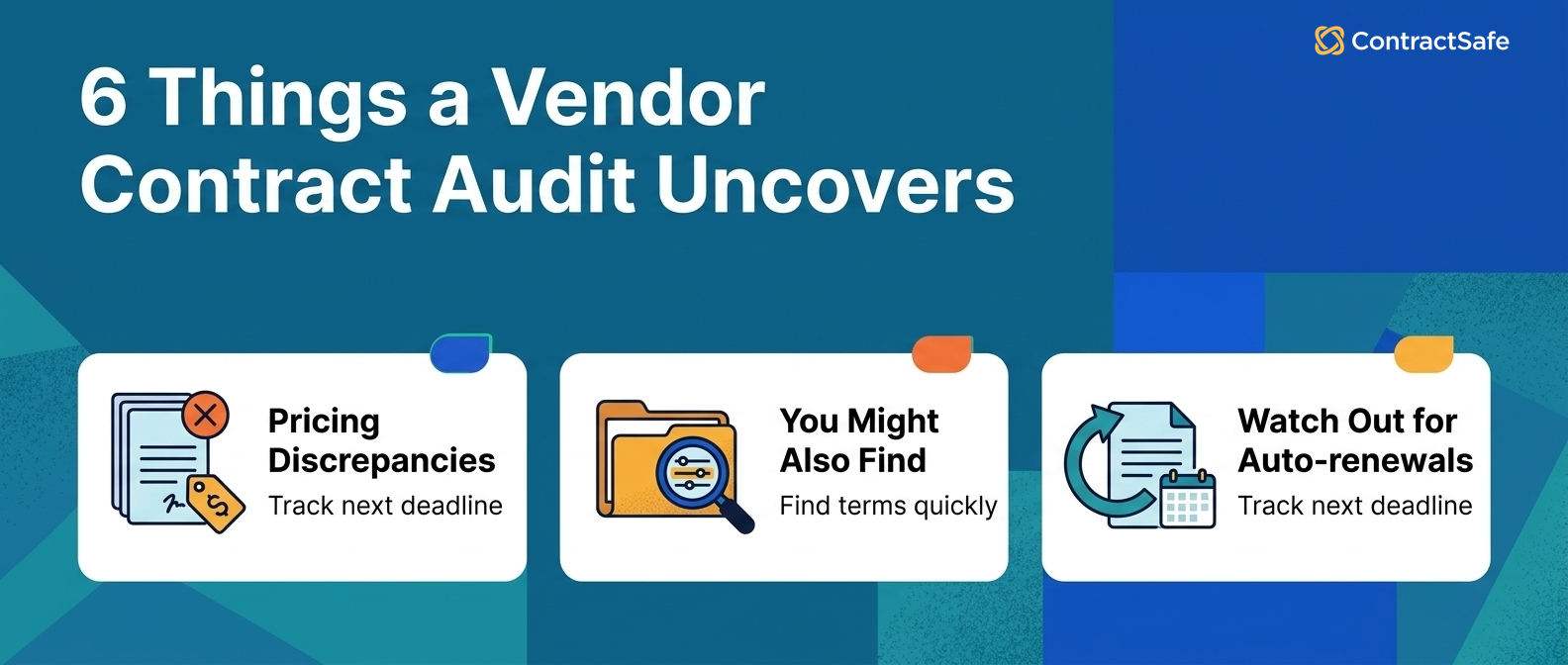
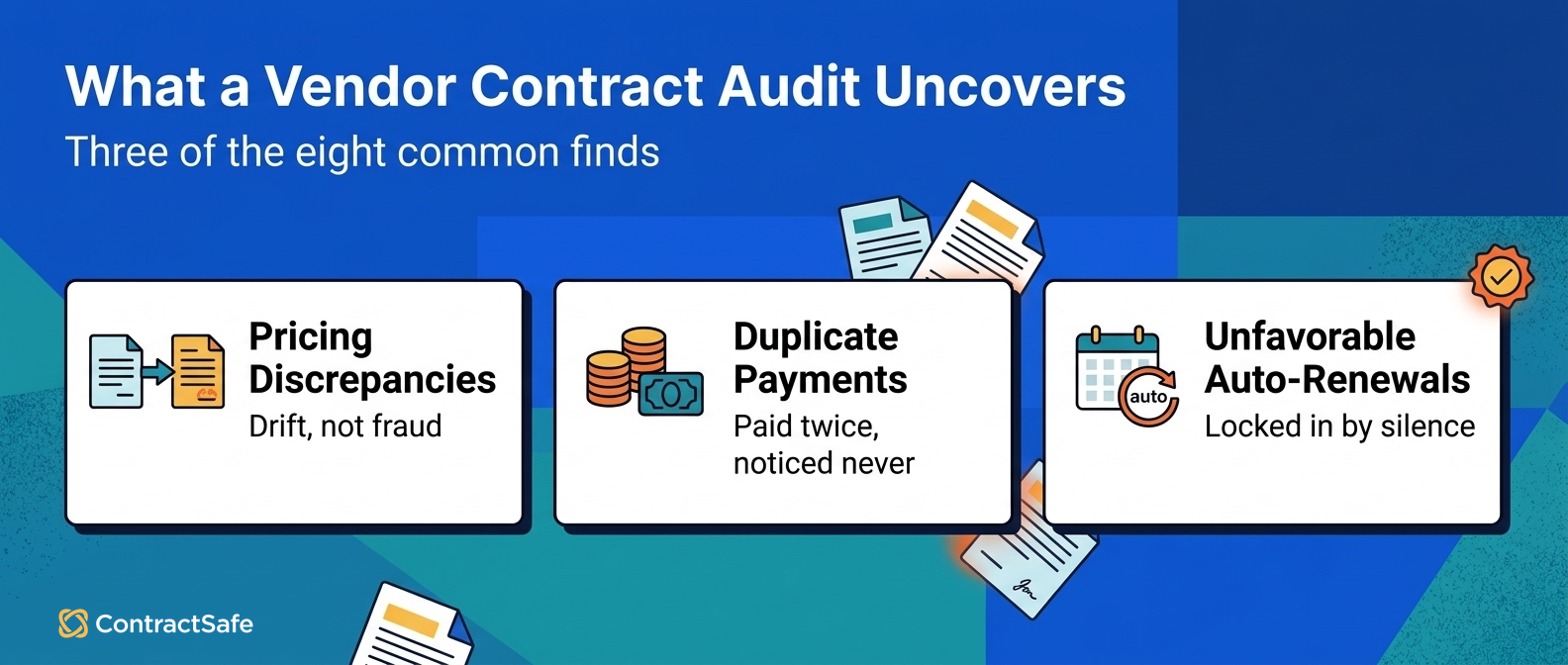
The eight findings below cover most vendor contract audits, with the check that surfaces each one.
Work the list against your top ten vendors first, then sample the rest of the agreements on a rolling schedule that touches every contract within two years.
1. Pricing Discrepancies
Pricing discrepancies are invoiced rates that don’t match the contracted rates, and the first finding most vendor contract audits surface.
The mismatches happen when vendors update billing systems for a new pricing tier but miss one line item, or when a negotiated discount quietly expires from the agreement and the rate steps back up.
Check the highest-spend agreements first: rate errors scale with volume, and one wrong unit price on a busy account outweighs ten errors on smaller contracts in the same portfolio.
For example, a 4% rate error on your largest logistics contract usually exceeds every error on the bottom half of the vendor list combined.
- Watch for: price escalators applied early, or applied to a base that already included the escalation.
2. Duplicate Payments
Duplicate payments are the same invoice paid twice, or two invoices for the same contracted service arriving from slightly different billing systems on the vendor’s side of the agreement, weeks apart.
For example, a vendor migrating billing platforms can issue the same monthly charge from both systems for a quarter before anyone reconciles the contract account.
Duplicates cluster around vendor system migrations and company mergers, when two billing systems run side by side.
Check those windows specifically in the payment history, and reconcile the vendor’s statement against your own register once a year, on the top contract accounts at least. Recovered duplicates are the fastest dollars an audit returns.
- Watch for: invoice numbers that differ only by a prefix or suffix.
3. Auto-Renewals at Unfavorable Terms
An unfavorable auto-renewal is a contract renewed automatically because nobody flagged the cancellation window. Now you’re locked in for another year at last year’s rates, which were already above the market price.
The fix is structural: a notice-window alert with a named owner on every auto-renewing agreement, set against the deadline to nonrenew, not the renewal date the calendar shows.
Check the renewal queue monthly with whoever owns the budget, so renewals become decisions on the contract record instead of surprises in the spend report. The agreements that auto-renewed unexamined last year are the first audit targets this year, rates included.
- Watch for: renewal terms that quietly changed in an amendment while the alert stayed pointed at the original contract date.
4. SLA Non-Performance With No Consequences
SLA non-performance with no consequences means the contract includes penalty clauses for missed service levels, but nobody tracks whether the SLAs are being met. The penalties never trigger because nobody measures the delivered service against the agreement’s table.
Negotiated penalties you never enforce are pure giveaway: the vendor priced the risk into the contract rates, and you paid for protection that never operates on any invoice or credit memo.
Check one quarter of service reports against the SLA table in the agreement, and the measuring gap becomes visible immediately, along with the credits the contract owed you all along.
- Watch for: SLA credits the contract grants automatically that were never claimed on any invoice or credit memo from the vendor.
5. Services You Stopped Using
Paying for services you stopped using looks like a software license for a team that was reorganized, a consulting retainer for a project that ended, or a maintenance agreement for decommissioned equipment still billing quarterly.
Cross-check the contract list against business reality once a year: every agreement should have a named owner who confirms the service still exists, still matters, and still earns the renewal decision.
For example, the easiest savings most audits find is the subscription for the team that was reorganized eighteen months ago and the consulting retainer for the project that shipped last spring, both still billing.
- Watch for: per-seat subscriptions that never shrank after a reduction in force changed the headcount the agreement was priced on.
6. Vendors Who Changed Ownership
Vendors changing ownership means your vendor was acquired, the service terms changed, or the contract transferred to a new legal entity, and nobody reviewed whether the original agreement terms still apply to the relationship.
For example, an acquirer consolidating billing platforms is exactly when rates drift and discounts vanish, so the ownership change is an audit trigger in its own right.
Assignment and change-of-control clauses exist for exactly this moment. Check who you’re actually paying against who signed the agreement, and confirm the original contract terms survived the transfer intact.
- Watch for: invoices arriving from a new legal entity with no assignment notice anywhere on the contract record.
7. Amendments That Never Reached the Record
Loose amendments are renegotiated rates, extended terms, or scope changes agreed by email and never filed against the parent agreement on the contract record.
For example, a discount agreed verbally on a renewal call exists nowhere the audit can see, so the audit flags compliant invoices as discrepancies.
The audit then compares invoices to a contract that no longer reflects the deal. Link every amendment at intake, and check for loose ones quarterly in the e-signature tool and inboxes.
- Watch for: rate changes honored by the vendor’s billing but absent from any signed document, which is a different and worse contract problem to surface now rather than in a dispute.
8. The Missing Audit Trail
The missing audit trail shows up when someone asks who changed the payment terms, when the discount was removed, or which contract version governed in March, and nobody can answer with evidence.
An audit trail on the contract record settles these questions with timestamps instead of recollection. Without one, every dispute becomes a credibility contest.
- Watch for: shared logins, which turn the trail’s “who” into a shrug. Check the access list against real names before relying on the history.
PaymentAccuracy.gov compiles agency-reported information on improper payments so organizations can track progress and identify risks.
The Vendor Contract Audit Checklist
The audit itself is a checklist comparison, run vendor by vendor. Check each row against the contract record and the last quarter of invoices.
| Check | Compare | Finding if mismatched |
|---|---|---|
| Rates | Invoiced rates vs contracted rates and tiers | Pricing discrepancy, early escalator |
| Payments | Payment history vs invoice register | Duplicate payment |
| Renewals | Renewal and notice dates vs alert calendar | Auto-renewal nobody chose |
| SLAs | Service reports vs penalty clauses | Unenforced penalties |
| Usage | Active services vs business reality | Paying for the decommissioned |
| Counterparty | Paid entity vs signing entity | Unreviewed ownership change |
| Record | Filed contract vs amendments and history | Incomplete record, missing trail |
Quick gut check before scheduling anything. Can you produce your top vendor’s agreement, with amendments and the current rate table, in under five minutes? If not, run the repository step first; the audit will go twice as fast.
You Don’t Need an Audit Firm. You Need to See Your Contracts.
A lot of vendor audit advice comes from firms that sell the audit.
That does not make the advice wrong, but it often makes the project bigger than what your team needs this week. For high-value, high-risk contracts, a forensic review may still be right.
But for most organizations, simply locating their contracts is a challenge, let alone auditing them.
If your vendor agreements are scattered across shared drives, inboxes, and departmental filing systems, you can’t run an audit even if you wanted to.
You don’t know what’s active. You don’t know what’s expiring. You can’t search for a pricing clause across all your vendor contracts at once.
The first step of any vendor contract audit is gathering every active agreement in one place.
Next, you need to be able to search through them. Then, you'll want to know when important dates are approaching, giving you time to review terms before an auto-renewal kicks in.
That’s a Tuesday afternoon with the right platform, not a six-month consulting engagement.
When you shortlist the best contract management tools for audit work, test four things on your own documents: full-text search across scans, extracted rates and dates you can verify, alerts tied to the deadline-to-nonrenew, and a readable audit trail.
ContractSafe gives you a searchable repository where every vendor contract lives in one place. OCR makes even scanned documents searchable.
The AI extracts key terms automatically, so you can see pricing structures, renewal dates, and SLA requirements across your entire vendor portfolio without reading every page.
Automated alerts flag renewals and expirations before they pass. Role-based permissions let procurement, legal, and finance all access what they need. And full audit trails document every change, every access, and every modification.
Once the contracts are visible, searchable, and tracked, the audit becomes a regular Tuesday task instead of a once-a-decade budget line item.
Connecting the Audit to the Contract Record
The contract repository is where the guessing stops: the signed agreement, the important contract details, and the next contract task should all point to the same answer.
If dates keep causing trouble, check the contract renewal checklist and effective-date rules before you mark the file done.
Use the vendor contract record like a map, then check it again when the project, vendor, owner, or deadline changes.
WorldCC resources and NCMA’s guidance can help, but only if they send you back to better questions about the contracts on your desk.
Your First Audit in Four Steps
The first vendor contract audit fits in a month when the scope stays disciplined.
- Gather: confirm every active agreement for your top ten vendors is in the repository, amendments linked, scans searchable.
- Extract: verify the rates, renewal dates, notice windows, and SLA terms on those records by hand.
- Compare: reconcile one quarter of invoices and service reports against the verified terms, and log every mismatch.
- Decide: for each finding, choose recover, renegotiate, or fix-the-record, and assign an owner with a date.
Check the results against the 0.8%-to-2% drift range above. Your own number, on your own contracts, is the budget argument for making the audit a quarterly habit instead of a project.
Related Reading
- Contract obligation management, for turning the audit’s findings into tracked work with owners.
- Contract renewal best practices, for the notice-window discipline that prevents finding #3.
- Contract metadata mistakes, for keeping the fields the audit reads trustworthy.
How ContractSafe Helps With Vendor Contract Audits
ContractSafe gives teams one place to find vendor contracts, see the owner, track dates, connect related files, and pull the report before the audit request turns into a fire drill.
Most teams can start quickly. The AI extracts key terms and identifies execution status automatically. You get enterprise-grade security, SOC 2 and HIPAA included, with full audit trails and everything searchable in one place.
You'll get support from real humans on every plan, and you can customize your vendor contract reports to focus on the exact dates and obligations your team cares about.
If you’ve been burned by overbuilt CLM platforms in the past, this one’s for you. Bring your top vendor’s agreement to a free demo and run the rate-reconciliation drill on the real document.






.svg)







.svg)