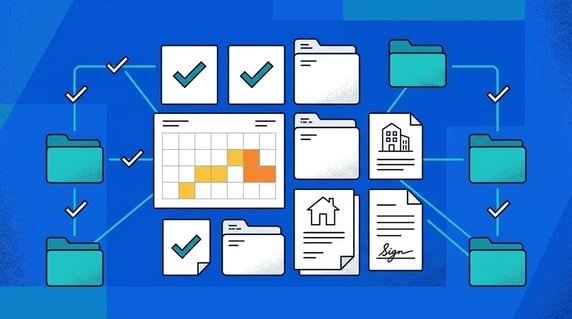
Real estate contract management software is software for managing leases, purchase agreements, vendor contracts, amendments, options, and notices.
Think of it like a key ring for property obligations. Every key needs a label before someone is locked out of the answer.
A lease option or vendor term does not care that the old property manager left.
TL;DR
-
Generic contract tools treat a ten-year commercial lease the same as a SaaS subscription. Real estate needs something built for the volume and the variety.
-
Transaction management gets you to closing. Contract management tracks everything after. You probably need both.
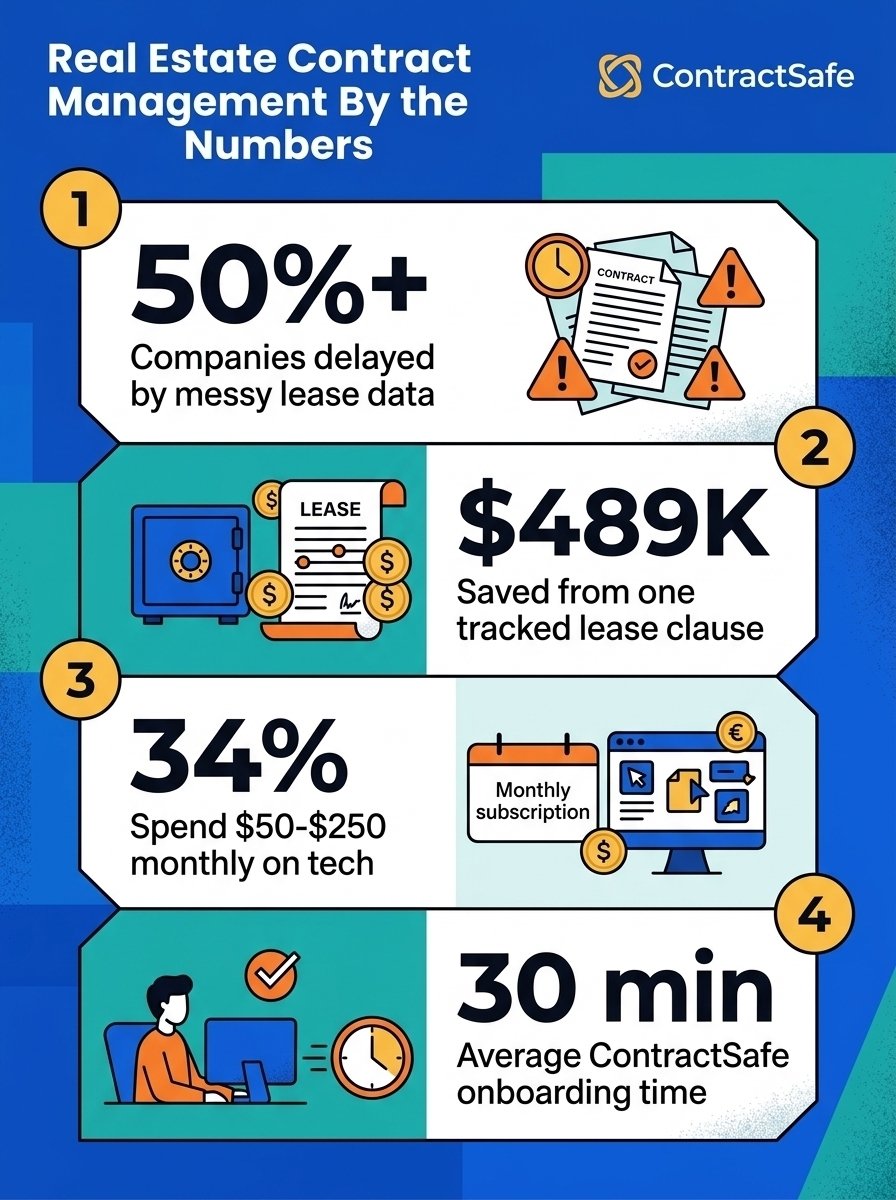
- Jo-Ann Stores tracked a co-tenancy clause and saved a significant amount when two anchor tenants closed. Most companies would have missed it.
-
Since ASC 842, every lease hits the balance sheet. According to PwC, over 50% of private companies hit delays from messy lease data.
-
ContractSafe offers unlimited users, AI extraction, full-text search across every document. Most teams can start quickly.
What Is Real Estate Contract Management Software?
Think about every agreement your real estate operation touches in a given month: leases, purchase agreements, vendor contracts for property management, landscaping, and security. Don't forget broker agreements, title documents, amendments, and even addenda to those amendments.
Real estate contract management software puts all of those in one searchable place and tracks what matters: who signed what, when it expires, and what happens if nobody pays attention.
It’s not a CRM. It won’t manage your client relationships or track your sales pipeline. It’s also not a transaction management platform (more on that distinction in a minute).
The confusion happens because real estate involves so many overlapping tools. You’ve got your MLS, your CRM, your transaction coordinator’s platform, and the actual contracts floating between all of them.
Contract management software doesn’t replace those tools. It makes sure the documents they generate don’t vanish into someone’s downloads folder while a renewal deadline quietly passes.
A good platform tracks key dates like renewal deadlines and option periods. It lets you search inside documents, not just file names. And it keeps an audit trail so you know who changed what and when.
If you’ve been relying on spreadsheets and shared drives, you already know what that feels like. The version that says “FINAL” isn’t final. The one that says “FINAL_v2_SIGNED” might be, but you’d have to open it to check.
And somewhere in your inbox is a scan of the actual signed copy that nobody uploaded anywhere.
Why Real Estate Teams Have Different Contract Management Needs
Go back to the building superintendent for a second. The thing nobody tells you about running a building is that none of the systems coordinate their schedules.
The boiler doesn’t care that you’re dealing with a plumbing emergency on the fourth floor. The elevator inspection is due whether or not you’re in the middle of a roof replacement.
Everything needs attention on its own timeline. None of those timelines were designed with your calendar in mind.
Real estate contract management works the same way. A commercial lease might run years with annual escalation clauses. A purchase agreement might need signatures from multiple parties within a tight deadline. A vendor contract for landscaping renews every April.
These are not interchangeable workflows. Software that treats them identically will frustrate you fast. The specific pressures real estate puts on contract management:
- Overlapping timelines. Every contract type runs on its own schedule, and none of them coordinate. A single commercial property can involve leases, vendor agreements, service contracts, and insurance policies all active at once. Multiply that across a portfolio.
- Real estate has compliance requirements other industries don’t share. Think state-specific disclosure rules, fair housing regulations, and environmental provisions. Your software needs to handle these without adding bureaucratic layers.
- You'll often find too many people touching the same documents. Brokers, attorneys, property managers, tenants, investors. ContractSafe handles this with collaborative access and unlimited users, so you’re not paying per seat every time someone new needs to review a lease.
- Seasonal volume swings. Deal flow surges and retreats. You need software that handles the quiet months without wasting money and the busy months without buckling.
How Is Contract Management Different from Transaction Management?
Understanding how contract management differs from transaction management matters. Your real estate contract needs a clear record, owner, date, and next action before your team can rely on it.
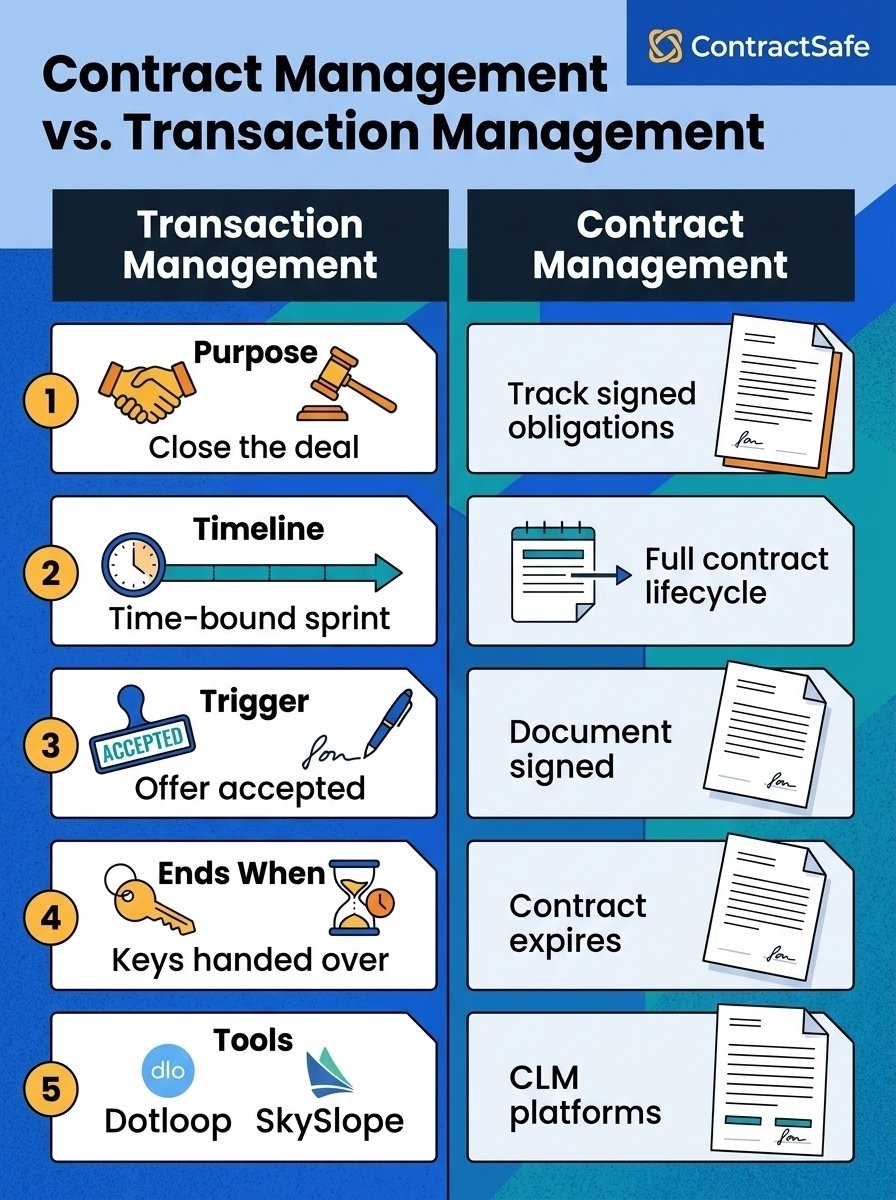
Transaction management is the sprint to the finish line. It coordinates inspections, appraisals, title work, and the dozen moving pieces between “offer accepted” and “keys handed over.” It’s intense, time-bound, and then it’s done.
Contract management treats every signed document as a living asset. It tracks obligations, flags upcoming deadlines, and makes sure that long commercial lease doesn’t quietly auto-renew because nobody set a reminder.
Most real estate professionals need both. The confusion happens when you buy a tool designed for one and expect it to do the other.
Transaction management platforms like Dotloop or SkySlope are built for shepherding a deal through its stages. But once that deal closes, the contract often disappears into a folder no one opens again. That’s where contract management picks up.
What Contract Management Features Should Real Estate Teams Look For?
So, what contract management features should real estate teams look for? Your real estate contract needs a clear record, owner, date, and next action before your team can rely on it.
The right real estate contract management software should keep your documents findable and protect your deadlines. Beyond that, it should let every person who needs access get it without a bureaucratic maze.
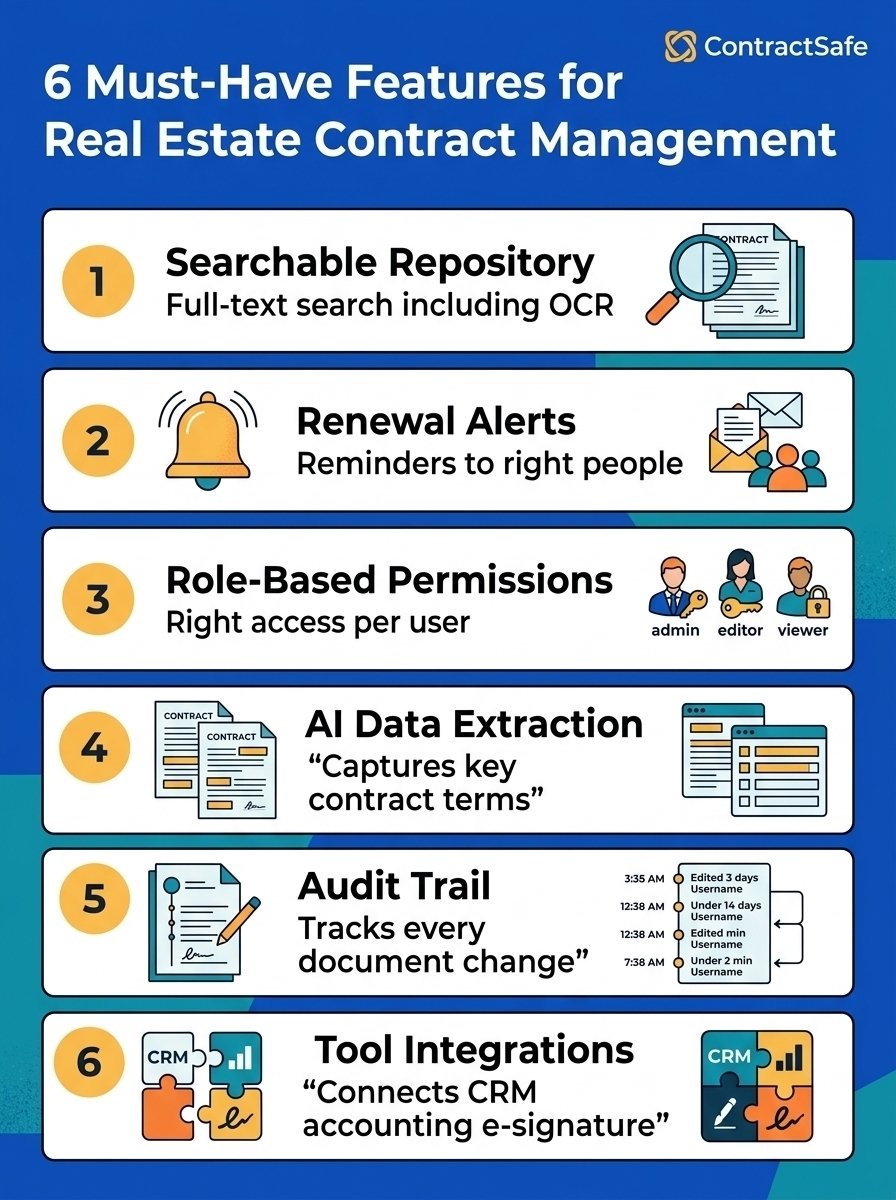
- Centralized, searchable repository. Every lease, purchase agreement, amendment, and addendum should live in one place. You need full-text search (including OCR for scanned documents) so you can find a clause by typing a few words.
Look for automated deadline and renewal alerts. Your software should send automated reminders weeks or months in advance, to the right people, without anyone having to set them manually.
-
Role-based permissions. Not everyone needs access to everything. Your property managers might need lease details. Your brokers might need purchase agreements. Your investors might need summaries only.
-
AI-powered data extraction. Manually entering key dates, dollar amounts, and party names from hundreds of contracts breeds errors. ContractSafe uses AI to automatically extract key terms from uploaded documents and organize them into searchable fields.
-
Audit trail. If a dispute arises (and in real estate, disputes always arise), a clean audit trail showing who changed what and when is your best friend.
Look for integrations with your existing tools. Your contract management software shouldn’t exist on an island. It should connect to your CRM, accounting platform, and e-signature tools so data moves without manual re-entry.
How Much Does Real Estate Contract Management Software Cost?
Turns out, real estate pros are spending a good chunk of change on tech. A 2025 REALTOR® Technology Survey from NAR found 34% spent $50-$250 monthly, and another 24% dropped over $500.
So, the desire to invest in technology is there.
But a lot of that money goes to tools that don’t solve the contract management problem. CRMs handle relationships. Transaction platforms handle closings. The contracts themselves? Those often end up in the same shared drive they’ve been in since 2019.
And since ASC 842 went into effect, every lease on the books has to be reflected on the balance sheet. Talk about a headache: PwC reported over 50% of private companies faced delays or restatements from messy lease data during their transition.
Disorganized contracts aren’t just an inconvenience anymore. They’re a compliance liability.
User count is the biggest pricing variable. Some platforms charge per seat. If your team includes agents, paralegals, property managers, and attorneys who all need access, per-seat pricing adds up fast.
ContractSafe takes a different approach: unlimited users on every plan, with pricing based on contract volume instead of headcount.
A few other pricing variables to watch:
- Storage caps. Real estate contracts come with attachments: floor plans, inspection reports, title documents. These eat through storage limits fast.
- Implementation fees. Enterprise platforms can charge five figures just to get you set up. ContractSafe has most teams live in under 30 minutes. No consultants. No six-week onboarding.
- Hidden add-ons. E-signature fees, API access charges, “premium” support tiers. The vendors worth your time bake those into the base price.
How ContractSafe Can Simplify Your Contract Management Strategy
ContractSafe helps teams manage real estate contracts with search, alerts, owners, related files, and reporting all in one system.
Most teams can start quickly. The AI extracts key terms and identifies execution status automatically. You get enterprise-grade security (SOC 2, GDPR, full audit trails) with everything searchable in one place.
Support comes from real humans on every plan, and your real estate contract reporting can be set up around the dates and obligations your team actually tracks.
If you’ve been burned by overbuilt CLM platforms in the past, this one’s for you.
To keep everything connected, your real estate agreements need to live in a central repository that tracks all the details and obligations.
If missing dates are a risk for your real estate contracts, double-check your renewal checklist and effective date rules before you mark any file as complete.
Use the real estate contract record like a map, then check it again when the project, vendor, owner, or deadline changes.
If you're looking to dive even deeper into contract management, WorldCC and NIST have some great stuff.
Your team should be able to answer any real estate contract question without waiting on the one person who remembers where the file lives.
That means your real estate contract owner, your dates, your related files, your obligations, and your renewal path all need to be clear before the record is treated as done.
You should know what real estate contract you signed, where you stored it, who you assigned it to, and what you need to do next.









.svg)







.svg)