
Contract kpis 2026 are the numbers that tell you whether contracts are moving, renewing, surfacing when someone needs them, and turning into action after signing. Contract management KPIs are how a lean team tracks what's stuck, what's overdue, and what needs a decision, all from one place instead of scattered folders.
Picture the Thursday renewal meeting. Finance wants to know which vendor contracts need a decision before the quarter closes. Legal wants to know which agreements have no owner. Operations wants to know why one approval queue keeps stalling. The right KPI answers each of them in seconds.
A weak contract report answers with file counts, searches, and dashboard activity, which tells you nobody's stuck but nothing about what to do next. The KPIs below cut past that noise so you can see what's actually moving, what's at risk, and where to act first.
Key Takeaways
- Contract management KPIs should measure action, risk, ownership, speed, and data quality. File counts are context, not proof that contract operations are healthy.
- Start with the KPIs that match your biggest risks right now, usually cycle time, renewal coverage, missing contract owners, and missing required fields, then add the rest as they earn their place.
- Every KPI needs an owner and a trigger. If the number changes, the team should know who acts and what they do next.
- Leading indicators help prevent missed renewals and bad data. Lagging indicators show whether process changes are working.
- ContractSafe helps teams keep KPI data close to the contract record so reports can point back to the source agreement, owner, date, and next action.
Choose your next step:
- Build the first KPI report if the team is starting from raw repository data.
- Clean required fields if renewal, owner, value, or status data is incomplete.
- Build the weekly scorecard if leadership needs a shorter operating view.
Quick Gut Check
Before adding another metric to the dashboard, ask three questions:
- Would this number change what legal, finance, procurement, or operations does this week?
- Can the team trace the number back to actual contract records, fields, owners, and dates?
- If the number gets worse, does somebody own the fix?
If the answer is no, the metric may still be interesting but it probably doesn't belong in the weekly contract KPI report.
What Are Contract Management KPIs?
Contract management KPIs are metrics that show whether the contract process and the signed contract portfolio are helping the business make better decisions before and after signing. KPIs only mean something on top of a sound contract management practice.
A KPI should measure progress against a specific goal. That includes pre-signature work, like how long agreements take to move from request to signature. It also includes post-signature work, like whether renewals have owners, whether required fields are complete, whether obligations are tracked, and whether people can find the right contract without asking legal. The post-signature side is where many reports get weak.
Signing feels like the finish line because everyone is tired by then. Legal has reviewed the terms. Finance has checked the price. Procurement has asked the vendor one more question. Somebody finally clicks sign.
But the contract isn't done.
It still has dates. It still has payment terms. It still has service commitments, termination windows, renewal notice periods, reporting duties, confidentiality obligations, and business owners who need to make decisions later.
KPIs are how you keep those promises from disappearing into a folder.
File Counts Are Not Contract KPIs
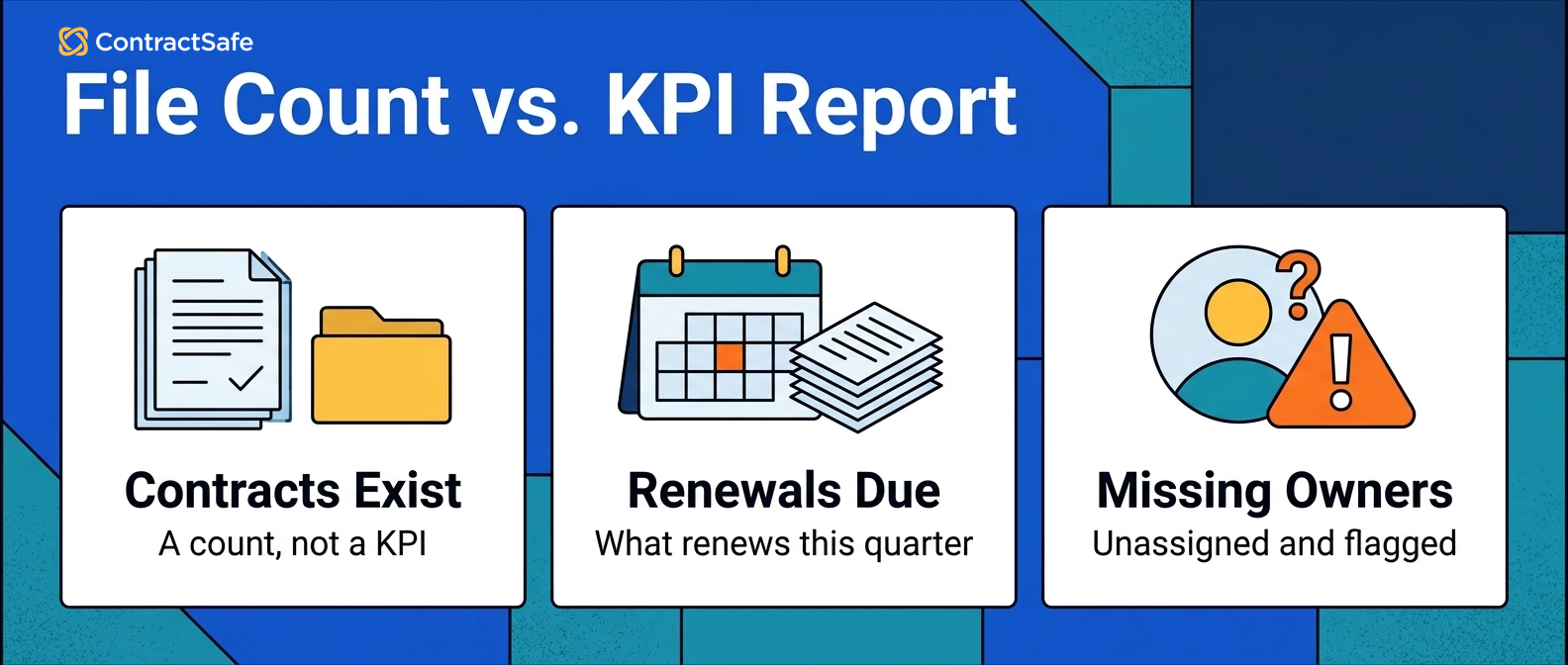
A file count tells you how many contracts exist. A KPI tells you whether the business can act on them. That difference matters.
"We have 4,000 contracts in the system" may sound like progress. But it doesn't tell you whether the records have renewal dates, owners, values, status fields, permissions, or alerts.
A better report says, "These 23 agreements renew this quarter, 6 have no owner, 4 are missing notice dates, and 2 high-value vendor agreements need finance review before the window closes." Now the team has a work queue.
That's the standard. A KPI should lead to a decision, cleanup task, escalation, or management conversation. If it only makes the dashboard busier, leave it out.
The test is simple: can the business get controlled, usable contract information when it needs it? Storage alone doesn't pass that test.
Contract KPI checklist:
- Does the metric point to a contract record, owner, date, or obligation?
- Does the report show what changed since the last review?
- Does the number create a cleanup task, decision, escalation, or process fix?
- Can someone outside legal understand what to do next?
Why Contract KPIs Matter in 2026
Contract KPIs matter in 2026 because teams are handling more contract work without more people. CLOC's 2026 State of the Industry report found only 32% of legal departments expect to add attorneys, even as compliance and security workloads climb. KPI reporting shows where the work actually is, so a smaller team spends its time on the contracts that matter.
The cost of not doing this is well documented. WorldCC research puts average contract value erosion at almost 9%, and WorldCC's separate procurement value-gap study pegs post-signature leakage even higher, near 11%.
The lost value is rarely one big mistake. It shows up as missed renewal windows, billing errors, unmanaged price changes, late deliverables, and obligations no one owns. You can see the fuller picture in the latest contract management statistics, but the pattern is simple: most of the leakage happens after signing, which is exactly where KPI reporting lives.
And the gap is capability, not awareness. EY's Law research found that 99% of organizations lack the data and technology needed to improve contracting. That's the gap KPI reporting has to close.
The Contract KPIs Worth Tracking First
The good starting set covers 8 areas: speed, renewal risk, ownership, data quality, financial exposure, obligations, search, and vendor problems.
You don't need every possible number on day one. You need enough signal to see where contract work is breaking down and what the team should do next.
| KPI | What it tells you | What to do when it moves |
|---|---|---|
| Contract cycle time | How long agreements take from request to signature | Find the stage waiting on intake, legal review, business approval, negotiation, signature, or handoff |
| On-time renewal and expiry rate | Whether renewable agreements have owners, dates, alerts, and decision status before notice windows close | Assign or escalate owners before the decision window gets tight |
| Contracts missing owners | Where accountability has fallen out of the portfolio | Name a business owner or backup owner for every active material agreement |
| Contracts missing required fields | Whether reporting can be trusted across dates, values, owners, and status | Clean the fields that drive alerts, renewals, search, and leadership reporting |
| Total contract value | How much money sits inside active agreements | Prioritize high-value agreements with missing owners, dates, or review status |
| Spend under management | How much outgoing spend is covered by managed contracts | Move unmanaged spend into a contract record before finance has to reconstruct it |
| Active contracts by type or department | Where volume, workload, and bandwidth pressure sit | Use the data to decide where intake forms, templates, or support should go |
| Obligation completion rate | Whether milestones, deliverables, service levels, and other duties are being met | Move important obligations into tasks, alerts, reports, or owner review |
| Search and retrieval time | Whether users can find the right agreement and confirm it's current | Fix naming, OCR, metadata, related documents, and permissions that block self-service |
| Vendor dispute frequency | Which relationships create repeat contract, invoice, service, or amendment problems | Bring issue history into renewal, procurement, and finance decisions |
The table isn't the report. It's the starting menu. A lean legal team should choose the KPIs that match the problems it's trying to manage this quarter.
How to Build the First KPI Report
Start with the contracts that create the most avoidable work. For most teams, that means renewals, high-value vendor agreements, customer contracts with service commitments, and agreements that finance or operations asks about often.
Don't begin by designing a beautiful dashboard. Begin by pulling ten to twenty real contract records and asking whether the team can answer the basic questions from the repository itself:
- Who owns the agreement?
- When does it renew or expire?
- What's the notice deadline?
- What's the contract value or business importance?
- Is the agreement active, expired, superseded, or still in draft?
- What obligation, approval, or follow-up does someone need to handle next?
If those answers are missing, the first KPI report shouldn't pretend the data is clean. It should show the cleanup work. That might look unexciting, but it's the work that makes every later report trustworthy.
A good first report has three sections.
The first section shows decisions due soon, usually renewals and notice windows. The second section shows missing data that blocks action, such as owner, date, value, or status gaps.
The third section shows process friction, such as approvals sitting too long or contracts that users can't find without legal help.
That structure keeps the report grounded. It also keeps legal from being blamed for every contract problem.
If a renewal has no business owner, that's an ownership problem. If an approval is waiting on finance, that's an approval problem. If the signed PDF never made it into the repository, that's a handoff problem.
The KPI report should make those distinctions clear.
One more rule helps: keep the source contract one click away from the number.
If the report says several vendor contracts are missing notice periods, the reviewer should be able to open those records and see the gap.
If the report says a renewal needs a decision, the reviewer should be able to open the agreement, confirm the date, and see who owns the next step.
That traceability is what separates a contract KPI from a spreadsheet opinion.
1. Contract Cycle Time
Contract cycle time measures how long an agreement takes from request to signature.
This is the first number to watch when business teams say legal is slowing work down. But the useful version isn't just one average across every contract.
Break cycle time into stages:
- Request submitted
- Intake complete
- Legal review started
- Business approval received
- Negotiation completed
- Signature completed
- Signed agreement stored and handed off
That stage view matters because each delay points to a different fix.
For example, if contracts sit in intake, the request form may be incomplete. If they sit in approval, nobody may own the business decision. If they sit after signature, the problem may be handoff into the repository.
The point isn't to shame a team. The point is to find the delay you can actually fix.
In ContractSafe, teams can use statuses such as Received, In-Progress, Approving, and Signing to see where work is sitting.
A contract management software evaluation should test whether the system can show these stages without manual spreadsheet reconstruction.
2. On-Time Renewal Rate and Coverage
On-time renewal coverage measures whether renewable agreements have owners, dates, and decision status before the notice window closes.
This is one of the most practical contract KPIs because missed windows are easy to understand and painful to explain.
A renewal report should show:
- Counterparty
- Business owner
- Expiration date
- Notice deadline
- Renewal type
- Contract value
- Decision status
- Next action
The owner field is the difference between a reminder and a result. Without an owner, an alert is just noise.
ContractSafe's contract alerts help teams send reminders before dates become problems. The useful part isn't only the reminder. It's the connection between the date, the contract record, and the person who can act.
For deadline tracking, ContractSafe's contract alerts can go out 30, 60, or 90 days ahead with the contract attached for immediate review.
3. Contracts Missing Owners
Contracts missing owners show where accountability has fallen out of the system.
This KPI is less glamorous than cycle time. It may be more useful.
If nobody owns a vendor agreement, nobody is responsible for pricing changes, renewal decisions, service problems, security follow-up, or obligation review. The same is true for customer agreements, leases, employment agreements, and partner contracts.
Track missing owner fields by department, contract type, and contract value.
Then make owner cleanup part of the weekly operating rhythm, not a once-a-year archive project.
The contract metadata model should treat owner as a required field for active material agreements. If the owner is unknown, the record should be marked for cleanup instead of quietly passing through the report.
4. Contracts Missing Required Fields
Contracts missing required fields show whether KPI reporting can be trusted across renewals, obligations, values, owners, and status.
If expiration dates, notice periods, values, departments, or statuses are blank, the report is already weaker than it looks.
This metric is a quality check on the repository itself. Useful reporting depends on fields that are complete enough to support decisions. Otherwise, every dashboard meeting turns into a debate about whether the data is real.
| Required field | Why it matters | If it is missing |
|---|---|---|
| Expiration date | Shows when the agreement ends | Renewal and termination reporting can't be trusted |
| Notice period | Protects renegotiation and termination windows | The team may find the renewal too late |
| Business owner | Makes the next action assignable | Legal becomes the default owner for everything |
| Contract value | Helps finance prioritize attention | Low-risk and high-risk agreements can look the same |
| Status | Separates active, expired, superseded, and draft records | Old contracts can pollute active reports |
5. Contract Value by Owner or Department
Contract value by owner or department shows where money, workload, and risk sit in the portfolio.
Total contract value shows the size of the commitment. Spend under management shows whether outgoing spend is covered by a formal contract or scattered across unmanaged purchases.
That's not theoretical. JourneyApps recovered $10K a year by catching billing errors after bringing contract data into ContractSafe.
Finance doesn't only need total contract value. Finance needs context.
Which department owns the spend? Which vendor contracts renew soon? Which agreements are high value but missing review status? Which customer agreements have service obligations that need follow-up?
A repository report should answer those questions without a custom spreadsheet every time.
WorldCC's contracting research is a reminder that contract work doesn't end with legal review. The numbers have to help the business manage money, risk, and follow-through after the contract is signed.
Thomson Reuters guidance on contract management systems makes the same practical point: control only matters if people can use the information.
For this KPI, value data should help finance and legal choose which agreements to review first.
Contract value isn't a perfect risk score. A low-value agreement can still carry sensitive obligations. But value is a useful prioritization filter when finance and legal need to decide where to look first.
6. Obligation Completion
Obligation completion is the share of tracked contract obligations that have an owner, a due date, and a completed or current status.
Those duties may include deliverables, certificates, reporting deadlines, service levels, payment steps, confidentiality obligations, insurance requirements, or customer-specific commitments.
This KPI is harder than renewal tracking because obligations don't always look like dates. That's exactly why it belongs in the report.
For example, if obligations live only in the document text, the business will miss some of them. Track obligations by owner, due date, status, and source clause where possible.
If a commitment matters enough to negotiate, it matters enough to monitor.
For a deeper operating model, use the ContractSafe guide to contract obligation management.
7. Search and Retrieval Time
Search and retrieval time measures how quickly a user can find the right contract and confirm it's current.
This may sound small until legal becomes the lookup desk for the whole company.
If finance, procurement, sales, or operations can't find the right contract, they ask legal. That steals time from review work and creates avoidable delay.
A good contract repository should make active agreements searchable by counterparty, type, date, owner, department, and text. OCR matters because scanned PDFs shouldn't become invisible.
Measure search with practical tests. Ask a non-legal user to find a vendor MSA, the latest amendment, a renewal date, and an agreement with a specific clause. If the user can't find those records, the KPI has exposed a real operating problem.
8. Reported Issues by Vendor
Reported issues by vendor show which relationships create repeated contract or performance problems.
The issue could be invoice disputes, missed service commitments, late deliverables, repeated amendment work, unclear renewal language, data-security exceptions, or contract records that never seem to be complete.
The goal isn't to create a complaint log. It's to make renewal decisions better.
For example, if a vendor looks cheap but creates repeated legal, finance, or operations work, the contract report should make that cost easier to see. That gives procurement and finance a better starting point before renewal talks begin.
What to Do When a KPI Moves
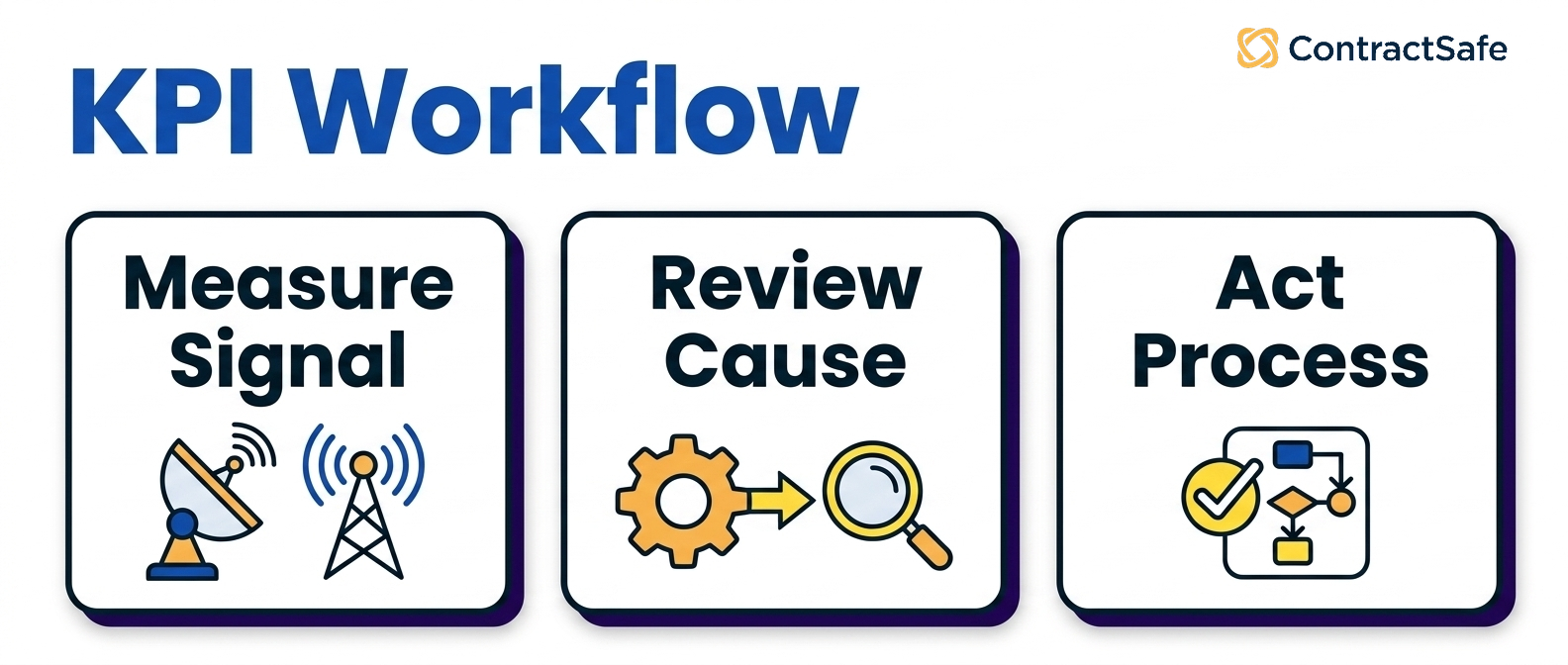
When a contract KPI changes, the report should name the likely cause, the first response, and the owner of the next step.
A KPI without a response plan creates another meeting. Before a metric goes into the report, decide what happens when it gets better, worse, or stays stuck.
| Signal | What it probably means | First response |
|---|---|---|
| Renewal coverage falls | Renewal records are missing owners, dates, alerts, or decision status | Assign owners for the highest-value agreements first |
| Cycle time rises | One step in the process is waiting too long | Break the number into intake, review, approval, negotiation, and signature stages |
| Metadata completeness drops | New records are entering the repository without required fields | Fix the upload or intake step before cleaning records one by one |
| Search failures increase | Users can't find current agreements on their own | Check naming, OCR, permissions, related documents, and duplicate records |
This is where contract KPIs become operational. The report isn't saying, "Here is a number." It's saying, "Here is the work this number created."
That's also how to keep the report from becoming a blame document. A rising cycle time doesn't automatically mean legal is slow.
It may mean the business sends incomplete requests, approvals stall with the wrong owner, or the signature step has no handoff. The KPI should point to the queue, not the scapegoat.
When the response is clear, the team can treat the metric as a management tool. When the response is vague, remove the metric until the team knows what it would do with it.
Leading vs. Lagging Contract KPIs
Leading KPIs warn the team before a problem lands. Lagging KPIs explain what already happened.
Both matter, but they do different jobs.
| KPI type | Example | Best use |
|---|---|---|
| Leading | Contracts with notice dates approaching and no owner | Prevent missed renewals |
| Leading | Records missing expiration dates or notice periods | Clean data before reporting fails |
| Leading | Approvals waiting on one department | Remove bottlenecks before signature |
| Lagging | Average cycle time after signature | Measure whether process changes worked |
| Lagging | Renewals completed on time | Report operational performance |
If you only track lagging KPIs, the report becomes a rearview mirror. If you only track leading KPIs, leadership may not see whether the process is getting healthier.
The weekly report should contain both: what needs action now and whether the work is improving over time.
How to Calculate Contract Management KPIs
Contract KPI formulas should be simple enough for legal, finance, and operations to use the same way. A formula nobody trusts won't survive the first meeting.
Use plain-English formulas first:
- Cycle time: time from request to signature, broken out by stage.
- Renewal coverage: renewable contracts with owner, notice date, alert, and decision status divided by renewable contracts.
- Metadata completeness: complete required fields divided by required fields across active records.
- Owner coverage: active material contracts with assigned business owners divided by active material contracts.
- Alert coverage: contracts with key dates and active reminders divided by contracts with key dates.
- Obligation coverage: tracked obligations divided by known obligations that need follow-up.
- Search success: tested searches that find the right current record divided by total tested searches.
The formula is only half the work. The other half is deciding what happens when the number is bad.
If metadata completeness drops, assign cleanup. If renewal coverage is weak, name owners. If cycle time rises, find the queue. The metric should create work, not just commentary.
Who Should Own Each KPI?
Different teams need different contract KPIs. The shared report can be short, but the action queue should match how each team works.
Legal should watch approval cycle time, nonstandard terms, missing owners, obligation tracking, and upcoming notice dates. These metrics protect the process and the contract record.
Finance should watch contract value, renewal exposure, payment terms, auto-renewals, and vendor obligations. These metrics help finance plan cash, budgets, and audit support.
Procurement should watch vendor renewal dates, pricing terms, assigned owners, termination windows, and contract status. These metrics keep vendor management from becoming email archaeology.
Operations should watch workflow delays, handoff points, user adoption, and contract records that are missing operational fields. These metrics show where the system is slowing people down.
Executives usually need the shortest view: what changed, what risk is rising, what decision is needed, and whether the trend is improving.
That's why a contract KPI report shouldn't dump the same chart on every audience. The CEO needs the trend and the consequence. The legal, finance, procurement, or operations owner needs the work queue.
What Not to Measure Every Week
Bad contract metrics create false comfort. They make the dashboard look busy while the team still misses deadlines.
Be careful with vanity metrics like:
- Total contracts uploaded.
- Total users with access.
- Total searches.
- Total reports created.
- Total contract types in the system.
Those numbers can be useful context. They don't prove that contract work is healthier.
A repository with a huge upload count can still be a mess if half the records are missing expiration dates.
A report with many viewers can still be useless if nobody owns the next action. A search count can rise because people are engaged, or because nobody can find anything the first time.
Use these numbers only when they support a real operational question. Otherwise, keep them out of the weekly scorecard.
A Weekly Contract KPI Scorecard
A weekly contract KPI scorecard should fit on one screen. If it needs a meeting just to explain the report, it's too complicated.
Use a simple structure:
- This week's renewal risks.
- Contracts missing owners or key dates.
- Approval queues that need help.
- High-value agreements with incomplete records.
- Obligations that need a named owner.
- Vendor issues that should affect renewal or negotiation.
- Data cleanup assigned for the week.
That's the level where KPIs become useful. They show the work, name the owner, and make it harder for contract risk to hide in a folder.
The monthly version can show trend lines. Are missing owner records going down? Are renewal decisions happening earlier? Are approval bottlenecks moving? Are search failures getting rarer?
Weekly reports should create action. Monthly reports should show whether the action is working.
A simple weekly review might start with one sentence: "We have upcoming renewals, missing owners, high-value contracts with incomplete notice data, and an approval queue waiting on finance."
That sentence is worth more than a page of charts because it tells the team where to work.
The next sentence should name the owner of the fix. "Procurement owns the vendor renewals, finance owns the payment-term review, and legal owns the missing notice fields." Now the KPI report has moved from measurement into management.
That's the bar. If a contract KPI report can't tell the team what to do next, it isn't finished yet.
Related Reading
- Contract metadata: Use this when KPI reports are failing because required fields are missing.
- Contract repository: Start here if the team still needs one searchable place for signed agreements.
- Contract management software evaluation: Use this before a vendor demo to test whether reporting works without spreadsheet reconstruction.
- Contract obligation management: Use this when the report needs to track what happens after signature.
How ContractSafe Helps Track Contract KPIs
ContractSafe works as contract tracking software for the KPIs that matter most: renewals, owners, required fields, contract value, obligations, search, alerts, reports, permissions, and practical AI.
| ContractSafe capability | What it makes measurable |
|---|---|
| Contract Lifecycle Tracking | Follow each agreement through Received, In-Progress, Approving, and Signing. |
| Automatic Data Extraction | Pull dates, values, parties, and other fields from uploaded agreements. |
| Custom Alerts | Send reminders to the right people before renewal and expiration windows close. |
| Smart Search | Find any word, clause, counterparty, or agreement without opening every file. |
| Real-Time Reports | See what's pending, high value, incomplete, or close to expiration. |
The system is useful because the data lives close to the contract. You can search the agreement, see key fields, assign alerts, review owner coverage, and build reports without rebuilding the same spreadsheet every week.
ContractSafe's repository gives teams one place for executed agreements and metadata. ContractSafe's alerts help teams act before renewal and expiration dates pass.
- Upcoming renewals and notice windows.
- Contracts missing owners or required fields.
- Active contracts by department or type.
- High-value agreements that need attention.
- Searchable clauses and contract text.
- Alert status and deadline coverage.
ContractSafe's AI contract management features can help extract and find contract data, while the team still decides what is safe enough to use in reports and decisions.
ContractSafe's AI can extract up to 29 fields, on every plan, and admins choose which ones it pulls. Those fields are searchable, so KPI reporting starts from the contract record instead of a manual spreadsheet.
The goal isn't to make legal a reporting factory. The goal is to make the right contract information visible before it becomes a fire drill.
If your weekly report can show the risk, name the owner, and point to the contract record, the KPI is doing its job.








.svg)







.svg)