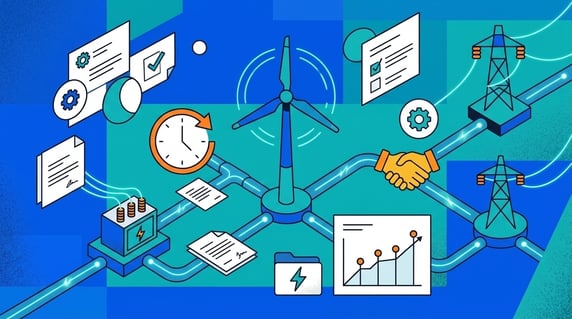
Energy contract management software is software for managing long-lived commercial, vendor, land, interconnection, power, and service agreements.
Think of it like a time capsule with alarms. The agreement may outlast the team that negotiated it.
In practice, the software means four jobs: storage that survives ownership changes, search across inherited portfolios, alerts that span decades, and proof of what was in force when.
When ownership changes, the contract record has to survive the handoff.
Key Takeaways
- Energy contracts live longer than almost any other industry’s. PPAs run 10 to 25 years. Pipeline easements are often permanent. Wind and solar land leases span decades.
- When a contract outlives the people who negotiated it, the document IS the institutional memory. If you can’t find it, the memory is gone.
- Energy M&A keeps accelerating: global energy, utilities, and resources deal values rose 27% in 2025 according to PwC, on top of a record consolidation wave the year before. Every acquisition means inheriting a contract portfolio you didn’t build.
- ContractSafe was built by founders who ran a solar company and couldn’t find a CLM that worked for energy. It offers unlimited users, OCR for decades-old scans, and AI extraction across inherited portfolios.
Choose Your Next Step
Energy contract problems get solved faster when you start from the agreement that scares you most. Jump to the part of this guide that matches it.
- Holding decades-old agreements? Start with what a twenty-year contract looks like at year fifteen.
- Inheriting a portfolio through M&A? Read when contracts change hands and run the audit first.
- Mapping the portfolio? Use the contract types that live the longest.
- Evaluating tools? Work through the nine energy CLM requirements and the rollout plan.
- Whichever path you take, confirm every long-lived agreement has a current owner and a next alert date. Those two fields are what survive a handoff.
- Building the foundation? Our contract repository requirements guide covers the underlying system, from OCR coverage to audit trails and export terms.
What a 20-Year Contract Looks Like at Year 15
At year fifteen, a twenty-year energy contract is governed by terms nobody in the current organization personally negotiated, and the document itself is the only witness left.
A utility signs a power purchase agreement with a wind farm operator. The terms cover delivery schedules, capacity payments, curtailment procedures, force majeure protections, and price escalation formulas.
Seven years in, the person who negotiated the agreement has moved to a different company. The internal knowledge of why certain clauses were structured the way they were leaves with them.
A few years later, the utility is acquired by a larger regional operator. The PPA transfers as part of the deal.
The acquiring company’s legal team reviewed it during due diligence, but due diligence reviews material contracts, not every clause in every agreement.
Then the environmental regulation that shaped the compliance terms in Section 12 gets updated. Does the PPA require amendment? Somebody needs to check. But the person who would know is three jobs removed.
Now a field engineer needs to understand what the delivery obligations require during a curtailment event. The answer is in the original PPA. Where is it?
This is not a fringe scenario. According to pv magazine, PPAs typically run 10 to 25 years, with 20- and 25-year terms the most common.
Thousands of these agreements are in the middle of their lifecycle right now, governed by terms that nobody in the current organization personally negotiated.
Check your own oldest operating agreement against the story: can today's team produce it, explain its curtailment terms, and name its owner? Every "no" is the gap the rest of this guide closes.
When Contracts Change Hands at Record Pace
Energy M&A transfers whole contract portfolios to owners who didn't build them, and the pace is at a multi-year high.
The time-horizon problem gets worse when companies merge. And energy companies are merging at a pace the industry hasn’t seen before.
PwC's global deals analysis found energy, utilities, and resources M&A values rose 27% in 2025, driven by twenty megadeals, after a record consolidation wave the year before.
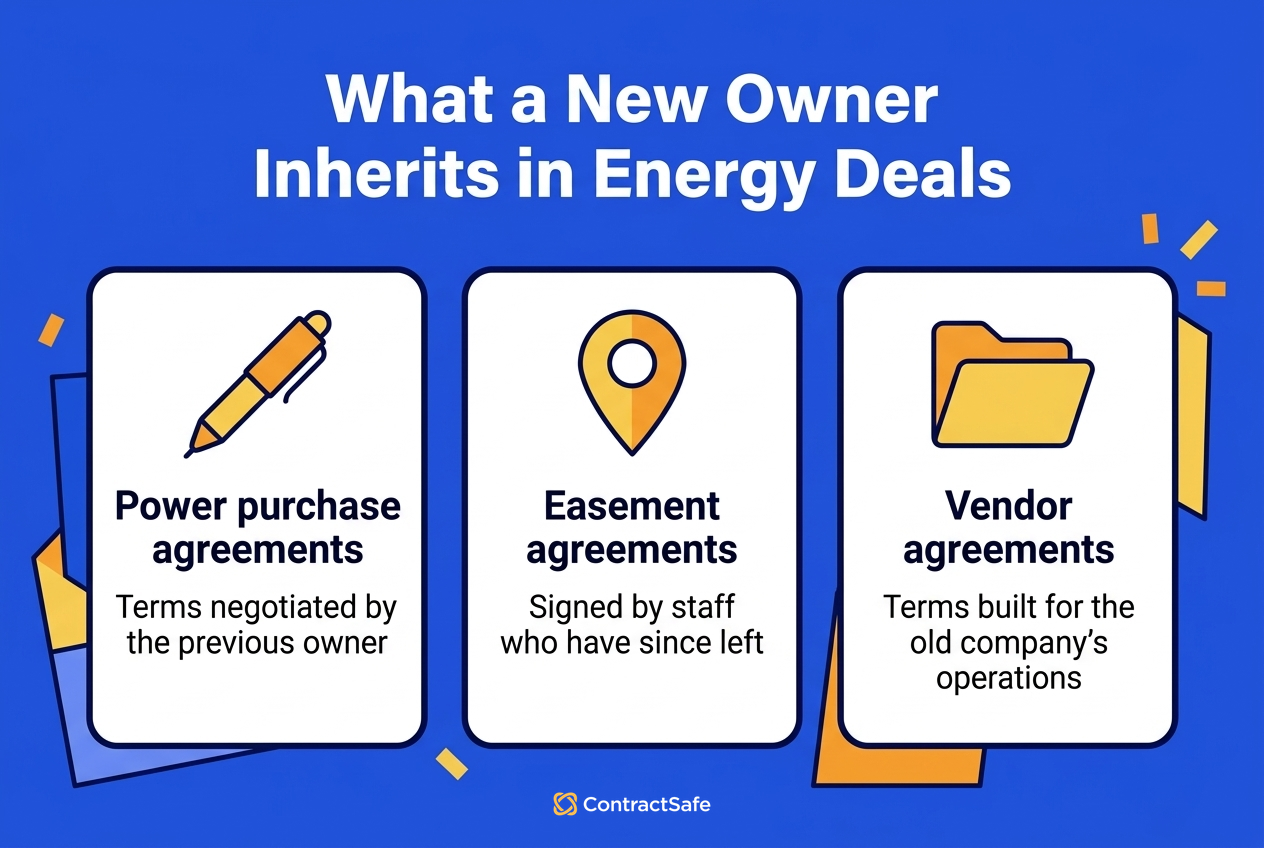
Every one of those deals means one company inheriting another company’s entire contract portfolio. PPAs the acquiring team didn’t negotiate. Easements signed by people who no longer work there.
Vendor agreements with terms that only made sense in the context of the old company’s operations.
Due diligence catches the big ones. The material contracts get reviewed.
Operations finds the gaps on a deadline. A land manager needs the original easement terms for a crossing dispute. The regulatory team needs every agreement citing a standard that changed last month.
A contract audit of an inherited portfolio isn’t optional in energy. It’s the first thing the new owner should do.
Energy Contract Types Compared by Lifespan
Energy contracts accumulate like geological strata. The pipeline easement from decades back is the bedrock. The PPA from the last build cycle is the next layer.
The vendor service contracts from last year sit on top. Each layer was deposited by different people under different conditions.
Here’s what that looks like in practice:
| Contract Type | Typical Duration | What Makes It Hard to Manage |
|---|---|---|
| Power Purchase Agreements (PPAs) | long-term | Price escalation formulas, delivery schedules, curtailment clauses. Terms interact with regulations that change over the contract’s life. |
| Pipeline Easements | Often permanent | Signed decades ago, sometimes by landowners who’ve since sold. May include embedded rights from oil and gas leases. |
| Wind/Solar Land Leases | 20-30 years | Renewal options, decommissioning obligations, and environmental covenants that span generations of ownership. |
| Interconnection Agreements | Term of the generating asset | Tied to grid infrastructure that may change hands or be upgraded. |
| Vendor Service Contracts | 1-5 years, recurring | Shorter duration but high volume. Hundreds of these across multiple operating sites. |
| Regulatory Compliance Documents | Ongoing | Permits, licenses, environmental certifications. Each tied to specific contract obligations that need to be cross-referenced. |
The shorter contracts are a volume problem. The longer ones are a memory problem. Both need to be searchable from one place.
Map your own portfolio against the table and assign an owner per layer. The bedrock documents usually have none.
What Energy Companies Need from a CLM That Other Industries Don’t
Energy companies need nine things from contract management software that generic CLM checklists don't cover, and all nine come from the time-horizon problem.
The existing guide to energy contract management challenges on this blog covers the broad picture. This section is the buying checklist.
Score every tool against each requirement with your own documents in the demo, and require a written answer for anything the vendor defers. The vendor comparison in our 2026 guide is a fair place to build that shortlist.
The order below follows the risk: the bedrock documents first (reading and finding them), then the decades problem (alerts, custody, linking), then the purchase itself (users, extraction, reporting, security).
Check all nine before pricing enters the conversation, and bring a real easement, a current PPA, and a vendor agreement to every demo.
1. OCR for Documents That Predate Your Staff
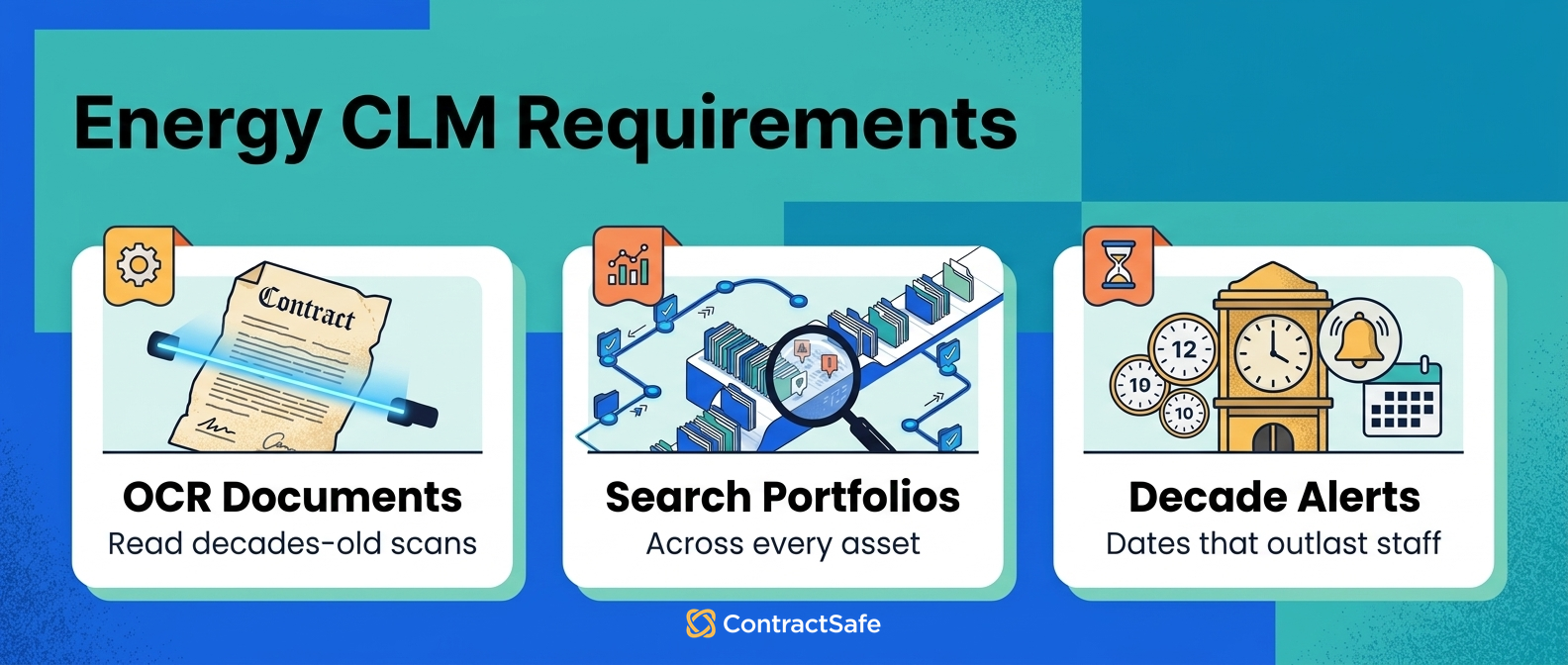
OCR makes decades-old scanned agreements searchable: the grainy easement PDF is still governing obligations today, and if your CLM can't read inside that scan, the agreement is invisible.
For example, a pipeline easement scanned years ago decides today's access rights; the search that can't read it returns a confident, wrong "no results."
Test OCR in the demo with your worst real scans: a faxed signature page, a typewritten exhibit, a hand-annotated amendment.
Then check the OCR output is searchable text on the contract record, not just a viewer overlay, because extraction and alerts both depend on it.
- Watch for: OCR sold as an add-on, which quietly excludes the archive.
- Watch for: extraction that runs only on new uploads, leaving the bedrock unread.
2. Search Across Inherited Portfolios
Inherited-portfolio search means finding every agreement that references a specific regulation, counterparty, or asset after an acquisition, as one cross-portfolio query.
That’s a clause-level search, not a folder-by-folder hunt. The regulatory team asking "which contracts cite this standard?" needs minutes, not a quarter.
Check the search on scanned and born-digital documents together, because inherited portfolios are always both, and confirm results link to the clause inside the agreement, not just the file.
For example, an acquired fleet of land leases citing a superseded environmental standard is a compliance project. The search defines its size in an afternoon or hides it for a year.
- Watch for: search that finds filenames but not clause language.
- Watch for: portfolios that stay siloed by legacy company after the merger closes.
3. Alerts That Span Decades, Not Quarters
Decade-scale alerts mean a contract renewal date fifteen years out is in the system today, assigned to a role that will exist when the alert fires.
The person who’ll need to act on it hasn’t been hired yet. The alert has to outlive the org chart.
Set escalation paths on every long-horizon date, and re-confirm owners annually; a decade alert pointed at a departed employee is a decade of silence.
For example, a land lease's renewal option exercisable in year eighteen is worthless discovered in year nineteen. The alert set at signing is the only version of that reminder that works.
- Watch for: alert systems that cap reminder windows at a year or two.
- Watch for: alerts tied to people instead of roles with reassignment rules.
4. Audit Trails That Prove Chain of Custody
Chain-of-custody audit trails show which contract version was in effect on a given date, who accessed it, and what modifications were made, across two or more changes of ownership.
For example, a dispute over curtailment payments from years back turns on which amendment governed that quarter. The audit trail is the proof.
Check the trail covers metadata changes too, not just document uploads, and confirm it survives migration intact. The acquiring company inherits the obligation to prove history it didn't witness.
Run one custody test in the demo: change a date field, reassign an owner, and ask the system to show who did what and when.
- Watch for: histories that reset at migration, erasing the prior owner's record.
- Watch for: retention windows shorter than your longest agreement.
5. Unlimited Users Across Operating Sites
Unlimited users means the land manager in West Texas and the regulatory attorney in Houston both reach the same easement without a seat-license negotiation.
Energy companies have field offices, generation sites, pipeline operations centers, and corporate headquarters. Per-seat pricing rations access exactly where the answers are needed.
Count everyone who asked legal a contract question last quarter; that's the real user number to price.
For example, a curtailment event at a generation site gets resolved by whoever can read the PPA's procedures right then. If the site lead has no login, the contract answer arrives after the decision needed it.
- Watch for: view-only seats that still cost money but can't run reports.
- Watch for: renewal pricing that re-meters users after adoption succeeds.
6. Parent-Child Linking for Project Document Families
Parent-child linking keeps a project's master agreements connected to their amendments, exhibits, consents, and estoppels, so the current truth is findable in one chain.
For example, a land lease with four amendments and a lender consent is one legal position spread across six documents. Unlinked, someone acts on the wrong layer.
Decide the linking convention before migration and apply it during upload, project by project: master agreements at the top, amendments and consents beneath, exhibits attached where they're cited.
Check the chain renders in date order, because a consent read out of sequence changes what the lease appears to allow.
- Watch for: relationships stored in filename conventions instead of real links.
- Watch for: amendments orphaned in the prior owner's folder structure.
7. AI Extraction Verified by Humans
AI extraction reads inherited agreements and proposes the parties, dates, formulas, and renewal terms, so an acquired portfolio becomes searchable data in days instead of a manual-entry year.
Treat the output as a review queue: verify the material contracts by hand, spot-check the volume layer, and require the extraction to link the clause it read.
For example, a price-escalation formula captured as "CPI-linked" instead of the actual clause text is a future billing dispute. Require exact capture on the money terms.
- Watch for: extractions without source links to the clause text.
- Watch for: price-escalation formulas summarized instead of captured exactly.
8. Reporting for Regulators and Leadership
Reporting means producing the contracts behind a rate case, an audit, or a board question without a consultant: renewals by year, agreements by asset, records with missing fields.
For example, "every agreement touching this substation" is a routine regulatory request and a brutal shared-drive exercise.
Check that a business user can build the renewal-by-year report in the demo without help, and that the report reflects the verified fields, not the raw extraction.
- Watch for: reports only administrators can build.
- Watch for: exports that strip the fields and links from the documents.
9. Security That Survives Decades
Decade-scale security means role-based permissions, access logs, and encryption that hold up across staff turnover, site changes, and audits years apart.
Confirm SOC 2 certification, check how access is revoked when a site changes operators, and read the data-export terms before signing; energy agreements outlast software vendors too.
- Watch for: permission models that can't separate land records from HR documents.
- Watch for: exit terms that hold your bedrock documents hostage at renewal.
Quick gut check before you shortlist anything. Time how long it takes today to produce your oldest easement and state who owns its next obligation. That number is what the software has to beat.
The Inheritance Audit, Step by Step
An inherited contract portfolio gets safe the same way every time: enumerate, read, extract, assign, and alert, in that order.
- Enumerate every source: the data room, the legacy shared drives, the field offices, and the predecessor's CLM export. Inherited portfolios always have one more source than the deal team listed.
- Read the material agreements in full. Due diligence summarized them; operations has to live with the clauses the summary skipped.
- Extract the terms into fields, with the clause linked. Price formulas, curtailment rules, option windows, decommissioning duties.
- Assign every agreement an owner by role, and confirm the role exists in the post-merger org chart.
- Set the alerts, with escalation, before integration work buries the calendar.
Time-box the audit to the first quarter of ownership. The seller's institutional memory has a short half-life, and every month makes the easement questions harder to answer.
Mistakes That Surface Years Later
Energy contract mistakes have long fuses: the miss happens quietly, and the cost arrives years later with interest.
- Migrating documents without their amendment chains. The version someone finds in year twelve is whichever one survived the move.
- Treating decommissioning obligations as far-future trivia. They're priced into the project economics; unbudgeted, they land on whoever holds the lease last.
- Letting easement payments run on autopilot without confirming the landowner of record. Land changes hands too.
- Setting alerts on people instead of roles. A decade is three reorganizations.
- Skipping the scan-quality check at migration. An unreadable bedrock document fails silently for years, then fails loudly in a dispute.
Check the portfolio for all five now. Each is an afternoon to verify and a litigation budget to discover late.
A Rollout Plan for Long-Lived Portfolios
An energy contract rollout works oldest-first: the bedrock documents carry the most risk and the least institutional memory.
- Week one: upload everything, starting with easements, land leases, and PPAs. Let OCR and AI extraction make the first pass on the scans.
- Week two: verify the extracted terms on the material agreements by hand, link each project's document family, and assign owners by role.
- Week three: set the decade alerts: renewals, options, decommissioning obligations, and regulatory cross-references, all with escalation.
- Week four: run the inheritance drill. Pick one asset and produce every agreement touching it, timed. That number is the acceptance test.
After an acquisition, run the same plan on the inherited portfolio before integration planning settles. The audit is cheapest while the seller's people still answer the phone.
Related Reading
- Energy contract management challenges, for the broad picture around this buying guide.
- Contract audit checklist, for the inherited-portfolio audit every acquisition needs.
- Contract repository requirements, for the system checklist underneath these nine requirements.
How ContractSafe Helps With Energy Contract Management
ContractSafe is the CLM built for teams who want power without the pain. You get everything you need to manage contracts from intake to renewal, with no steep learning curve.
ContractSafe’s founders know the energy problem firsthand. They built ContractSafe because they ran a solar company and couldn’t find a CLM that fit: long-duration agreements, multi-site operations, inherited documents from prior operators.
Most teams can start quickly. AI extracts key terms and identifies execution status automatically. Custom dashboards and reports come standard. Every plan includes unlimited users. SOC 2 certified, enterprise-grade encryption, and support from real humans on every plan.
The nine requirements above map directly: OCR reads the bedrock scans, search crosses inherited portfolios, alerts span the decades, and the audit history proves chain of custody through every handoff.
Connect the work to your contract repository, your contract metadata, and your obligation management process, with effective date hygiene on every record.
For outside context, WorldCC's contract resources and the National Contract Management Association's journal cover the discipline beyond the software.
The fastest proof is your own bedrock. Bring your oldest scanned easement and a current PPA to a free demo and run the inheritance drill live.







.svg)







.svg)