Quick answer: Ironclad vs Juro is a choice between an enterprise contract platform and a mid-market one: Ironclad is built for complex approval workflows run by a legal-ops team, and Juro is built around a browser editor and quick adoption. If you're a lean team where budget and time-to-value decide the purchase, ContractSafe deserves a hard look, since every plan includes unlimited users and there's no implementation charge (ContractSafe pricing).
Picture the week after your CLM budget finally gets approved. You've booked demos with Ironclad and Juro, both reps were lovely, both platforms looked polished, and now your CFO wants a one-page recommendation by Friday. You're a small team (you, a paralegal, and a contracts manager who also handles vendor onboarding), and you're quietly wondering whether you're shopping in the right aisle at all. That's the question this guide answers before it gets anywhere near feature lists.
Choose your next step:
See how ContractSafe tracks renewal dates and notice deadlines, for lean teams that mostly need to stop missing renewals.
Read our guide to contract lifecycle management, for anyone still mapping out which lifecycle stages they actually need software for.
Key Takeaways
- Ironclad fits enterprises with complex workflows and a legal-ops owner, and the median buyer in Vendr's Ironclad purchase data pays about $40,055 a year before implementation fees.
- Juro suits mid-market teams that want quick adoption, with the median buyer in Vendr's Juro purchase data paying about $31,164 a year and small teams often quoted $18,000 to $35,000.
- Ask both Ironclad and Juro for a written implementation timeline and migration scope, because Ironclad reviewers on Capterra say setup takes time when workflows are complex.
- ContractSafe is the lean-team option, with unlimited users on every plan and no implementation charge, per the ContractSafe pricing page.
- Test each vendor's AI on your own contracts and buy for what your team will use this quarter, not for roadmap announcements.
Match the Platform to Your Team Size Before You Compare Features
Pick the contract platform that matches the team you have today, not the team in the vendor's case study. Ironclad sits at the enterprise end of the ladder, Juro sits in the mid-market, and ContractSafe sits where a lean legal team needs value quickly on a modest budget.
Here's why the rung matters so much right now. In the 2026 ACC Chief Legal Officers Survey, 35% of CLOs named chronic budget and resource constraints as their top barrier to success, and 63% expect headcount to stay flat. So the software you buy has to work with the people you already have, because nobody's hiring a legal-ops analyst to babysit it.
| Platform | Best fit | Who usually owns the rollout | What decides the purchase |
|---|---|---|---|
| Ironclad | Enterprises with complex, conditional approval workflows | A dedicated legal-ops team | Workflow depth and CRM integration |
| Juro | Mid-market teams drafting and negotiating in-platform | Legal plus a business sponsor | Editor experience and quick adoption |
| ContractSafe | Lean legal or contract teams | Whoever already manages contracts | Cost, unlimited users and quick setup |
Think of it like buying a truck. A semi hauls enormous loads beautifully, but if you're moving a couch across town, you'll spend the whole trip looking for parking.
Budget Around $40,000 a Year for Ironclad, Plus Implementation
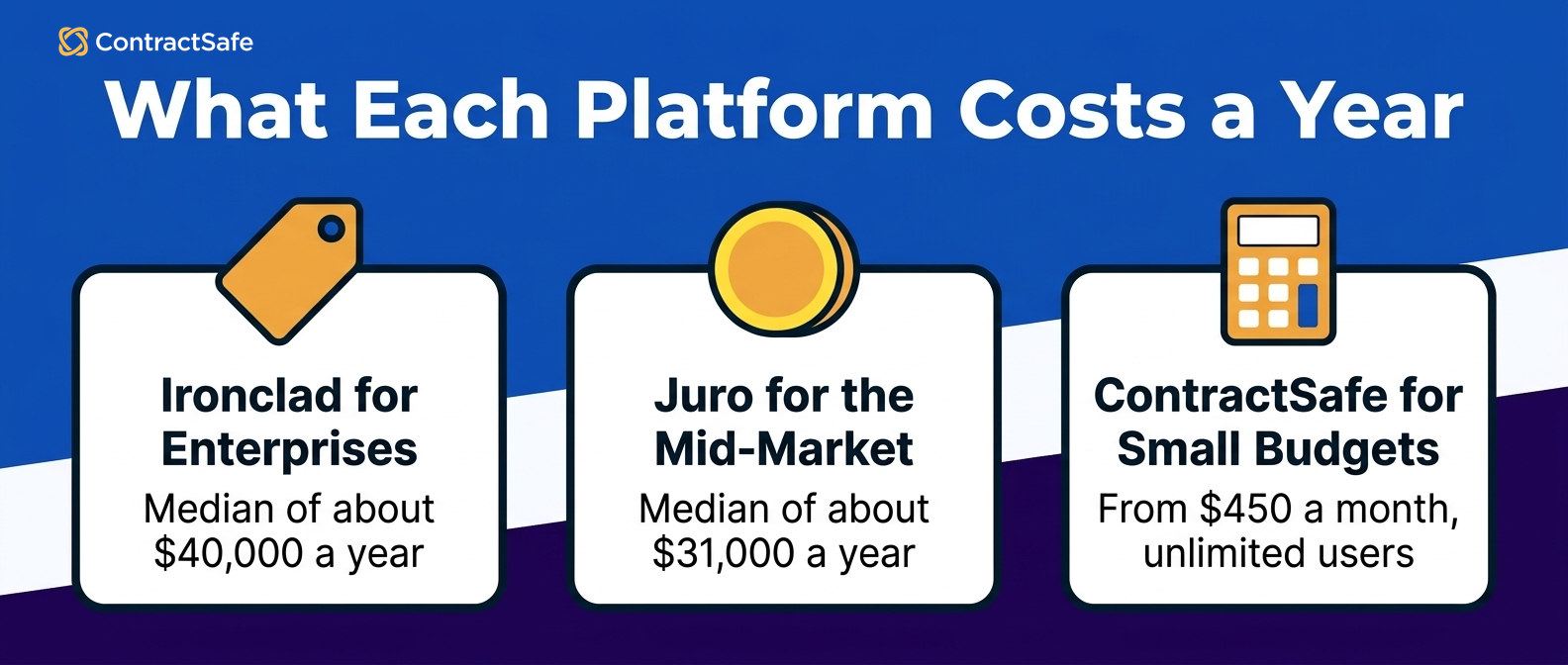
Budget about $40,000 a year for an Ironclad contract, based on the median buyer in Vendr's Ironclad purchase data, then add implementation on top. Ironclad doesn't publish a price list, so every deal starts with a quote.
The spread is wide. According to Vendr, total annual contract values typically run from $30,000 to $250,000+ depending on scope, with the median buyer at about $40,055. Implementation is billed separately, at roughly $10,000 to $40,000 for standard projects and more than $75,000 for complex ones.
When you build your first-year number, model the whole thing:
The license fee at the tier you'll actually need once every department is on board
The implementation fee, in writing, with what's in and out of scope
Internal time from whoever owns configuration and training
Migration of legacy contracts, which is often scoped separately
Once you've got the median in hand, use it as your negotiation anchor. A rep quoting well above the Vendr median should be able to explain exactly what you're getting for the difference.
Expect Juro to Cost Less Than Ironclad but Still Reach Five Figures
Juro contracts are quote-based too, and the median buyer in Vendr's Juro purchase data pays about $31,164 a year. That's below Ironclad's median, but most teams will still be signing a five-figure agreement.
Team size moves the number a lot. Vendr reports that small teams of 5 to 10 users handling fewer than 500 contracts a year are often quoted $18,000 to $35,000, while mid-market and enterprise buyers see $50,000 to $120,000+.
So ask Juro how the price scales as you add users. It's easy to sign a comfortable year-one deal that gets uncomfortable the moment sales ops wants logins too. Get the pricing for next year's headcount, not just this year's.
Ironclad vs Juro on Rollout Time and Setup Effort
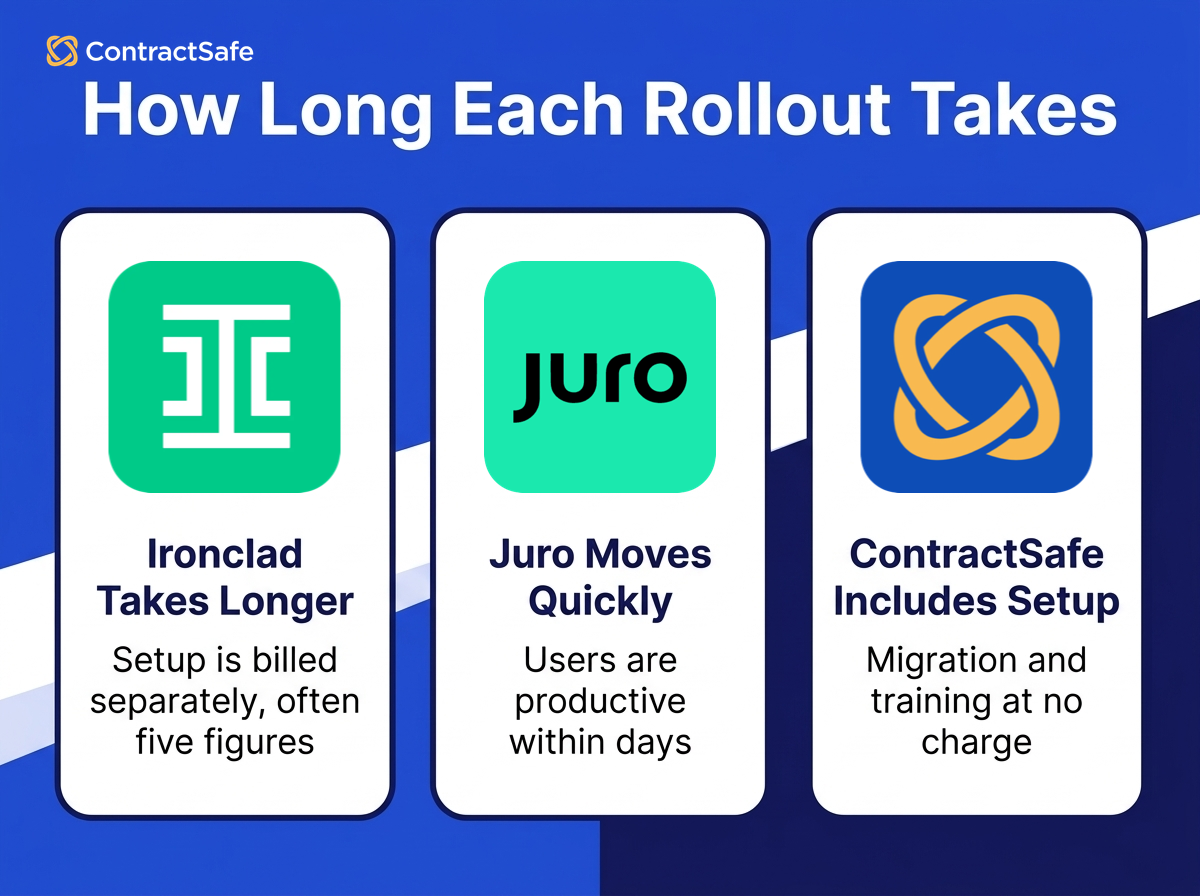
Expect an Ironclad contract rollout to take longer than a Juro rollout when your approval workflows are complex. Ironclad reviewers on Capterra say setup and customization take time, while Juro reviewers on Capterra describe new users getting productive within days.
The money follows the effort. Vendr records Ironclad's implementation fees as a separate line, which tells you the vendor expects real project work before your first contract moves through the system.
A slow rollout isn't automatically a bad one. If you're building conditional approvals across finance, security and procurement, you want that configuration done properly. The trouble starts when a small team buys an enterprise rollout and then discovers nobody has the hours to finish it, so the old shared drive quietly stays in charge.
Decision Check
Before you sign with either vendor, run through this checklist on the call:
Ask for a written implementation timeline with named milestones.
Name an internal owner who has protected time for the rollout.
Confirm that migration of your legacy contracts is inside the scope, not a later add-on.
Get the implementation fee, or the absence of one, in the order form.
Agree on what "live" means, such as your first contract routed and signed in the tool.
Weigh What Reviewers Praise and Criticize in Each Tool
Read contract software reviews for the complaints that repeat, because a repeated complaint usually shows up in your own rollout too. Turn each recurring gripe about Ironclad or Juro into a pointed demo question.
On Capterra, Ironclad reviewers praise its no-code conditional approval workflows and its Salesforce integration, and they criticize a long learning curve and a price that sits "on the higher end of the price spectrum," which some find cost-prohibitive for small companies.
Juro reviewers on Capterra like its ease of use, its e-signature and its quick support. The recurring complaints are integrations with existing tools, advanced formatting that "remain[s] limited compared to traditional word processors," and cost that some teams find hard to justify.
Those complaints make good demo questions:
For Ironclad, ask to see a non-lawyer build a simple approval rule without help.
For Ironclad, ask what training your business users will need before they can submit a request.
For Juro, ask to see your heaviest-formatted template imported and redlined.
For Juro, ask which of your current tools integrate natively and which need a workaround.
Test the AI Features Your Team Will Actually Use
Test contract AI on your own agreements before you buy, and judge the tool by how errors get caught. Roadmap announcements make great demos, but your team will live with whatever the extraction gets wrong on an ordinary Tuesday afternoon.
Ironclad's AI story is ambitious. Ironclad has announced a conversational assistant that answers questions from both executed and in-flight agreements, plus early-access Renewal, Cost Savings and Archive agents that build on its Jurist assistant. That's a strong fit for high-volume enterprise programs with someone to tune and supervise it.
Most lean teams need something plainer: reliable extraction of key dates and terms so renewals don't sneak up on them. ContractSafe's AI extraction suggests values, and you accept, correct or skip each one before it's saved, because (as the product page puts it) "AI isn't perfect. Your data should be."
Whichever vendor you're testing, bring a small pile of your own messiest contracts and check:
Whether the AI finds the auto-renewal clause buried in an amendment
What happens when the AI gets a date wrong, and who notices
Whether a reviewer can fix a value before it flows into reports and alerts
Related Reading
AI contract management software, for teams that want reviewable AI extraction of dates and terms.
Contract approval workflow, for teams tired of chasing approvals by email.
Contract signing software, for teams that want e-signature without per-envelope limits.
How ContractSafe Helps Lean Legal Teams Manage Contracts
ContractSafe is built for the team from the opening scenario, the one where the contracts manager also runs vendor onboarding. According to the ContractSafe pricing page, there's no implementation charge, and every plan includes help with implementation, migration of existing data and documents, and training. ContractSafe pricing starts at $450/month (Organize plan, billed annually; $540 month-to-month), with unlimited users on every plan. That means everyone from sales to procurement can log in without anyone recalculating the budget.
Once you're live, ContractSafe covers the working parts of the lifecycle. Approval workflows let you send a contract once, route it to individual approvers or saved groups, and get automatic reminders until it's approved and ready to sign. E-signature powered by Dropbox Sign lets signers sign in one click without an account, with unlimited signatures and no envelope limit. Date alerts and renewal tracking keep renewal dates, notice deadlines and reminders current as each term rolls forward, and AI extraction surfaces those dates for you to confirm.
To be honest about the fit, ContractSafe isn't a replacement for Ironclad's deep enterprise workflow customization. If you've got a legal-ops team building conditional approvals across a dozen departments, Ironclad was designed for you. If you need approvals and signing working next month without a consulting project, ContractSafe is the one to demo.








.svg)







.svg)