
Disclaimer: This template is a starting point, not a substitute for legal advice. Always consult an attorney before finalizing any lease agreement.
Commercial lease agreements can be complex, but they're crucial for protecting the interests of both lessors and lessees. That's why we've created a free, customizable commercial lease agreement template to help you get started.
And for the ultimate contract management solution, read on to learn how ContractSafe can help you improve your processes.
Table of Contents
- Understanding a Commercial Lease Agreement
- When to Use a Commercial Lease Agreement
- What’s Included in a Commercial Lease Agreement?
- Commercial Lease Agreement Management Challenges
- How ContractSafe Can Help You Manage Your Lease Agreement
- How to Customize Your Service Agreement
- Lease Agreement FAQ
Understanding a Commercial Lease Agreement
A commercial lease agreement is a type of legally binding contract that spells out the terms and conditions under which you're renting a property, equipment, or other asset.
It's the document that clearly defines the responsibilities and rights of both the owner (lessor) and the renter (lessee).
Lease agreements are essential because they:
- Set clear expectations: Everything from rent amount to maintenance responsibilities is laid out in black and white.
- Provide legal protection: Both parties know their rights and obligations, reducing the risk of misunderstandings or disputes.
- Ensure financial clarity: Payment schedules, security deposit details, and potential fees are transparent from the get-go.
- Mitigate risks: By addressing potential issues like property damage or early termination, lease agreements help avoid nasty surprises down the road.
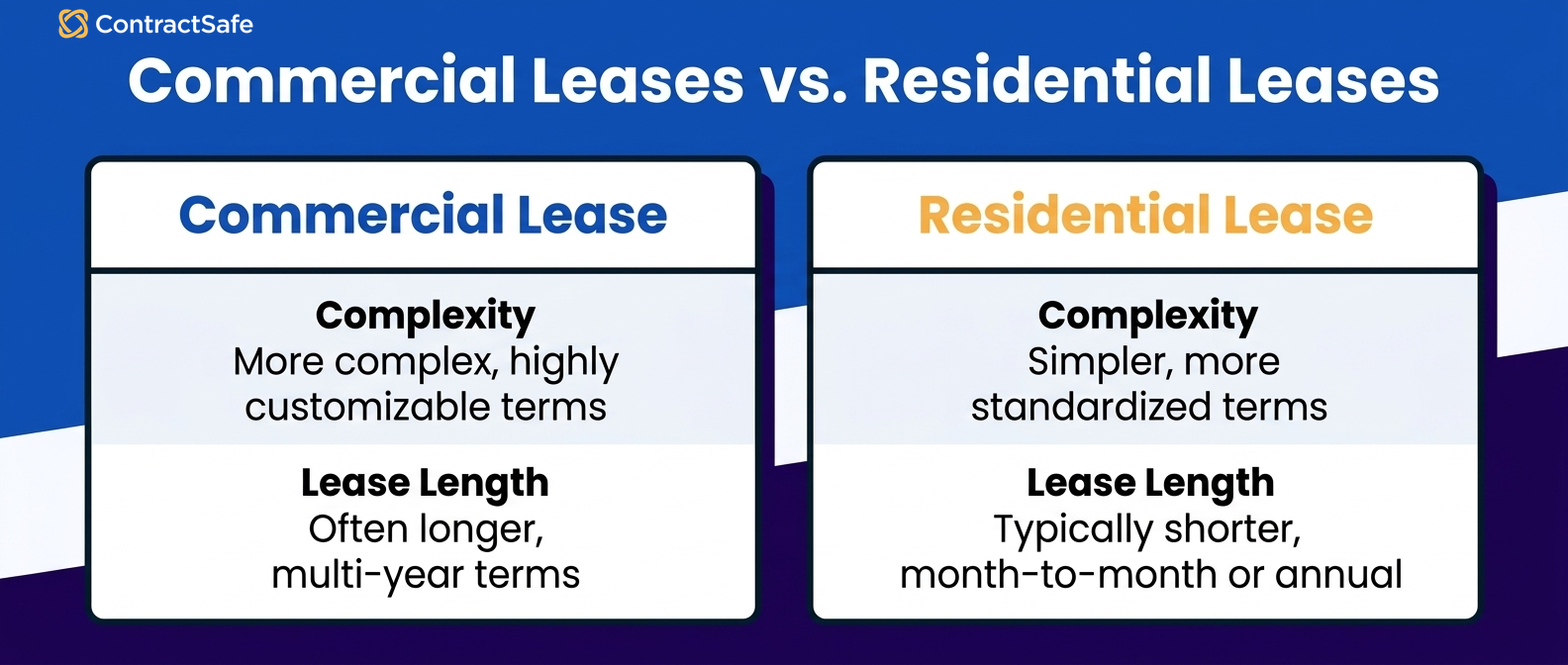
Commercial Leases vs. Residential Leases
Commercial leases differ significantly from residential leases. They are generally more complex and offer greater flexibility for customization. This is because commercial properties are used for business purposes and often have unique requirements compared to residential properties.
For example, commercial leases may include provisions for:
- Limits on the type of businesses that can operate on the property
- The size, location, and content of any signs displayed on the property
- Hours of operation
- Fees charged to cover the cost of maintaining common areas in the property
- Exclusive use rights to certain areas of the property
Commercial leases are often longer than residential leases, and they may include more complex terms and conditions. For example, commercial leases may include provisions for renewal options, subletting, and assignment of the lease.
Who Manages a Commercial Lease Agreement?
Lease agreements involve various stakeholders who contribute to their management:
- Real estate agents: Often involved in drafting and negotiating lease agreements on behalf of landlords or property management companies.
- Legal teams: Ensure the agreements are legally sound and adhere to local regulations.
- Property owner: The property owner owns the commercial property or asset being leased. They are ultimately responsible for providing the space or asset in accordance with the lease terms and ensuring that the property remains in a condition fit for its intended purpose.
- Property managers: Acts on behalf of the property owner to handle day-to-day management tasks, including enforcing lease terms and collecting rent.
- Commercial real estate attorneys or brokers: May be involved in larger or more complex transactions to provide specialized expertise.
The specific parties involved can vary depending on factors such as the lease's complexity, the property's size, and the sophistication of the landlord and tenant.
When to Use a Commercial Lease Agreement
Whether you're expanding your operations or you need a temporary piece of equipment, commercial lease agreements are your go-to tool for establishing a smooth rental experience.
Let's dive into some common scenarios where lease agreements are indispensable:
Leasing a Commercial Space
Unsurprisingly, businesses use commercial lease agreements for all sorts of commercial spaces: offices, retail stores, sprawling warehouses, you name it.
These agreements often include specific provisions tailored to the type of business, such as signage rules, operating hours, or exclusive use rights.
And if you're thinking long-term, a commercial lease can outline the terms for renewing or subleasing the space.
Leasing Equipment
Need a bulldozer for a construction project or an MRI machine for your medical practice? Leasing equipment can be a cost-effective solution.
Lease agreements for equipment clearly outline payment terms, who's responsible for maintenance, and even potential options to purchase the equipment at the end of the lease.
Leasing Agricultural Land
For farmers and landowners, lease agreements are the backbone of their operations.
These agreements cover everything from how crops will be shared to who's responsible for maintaining the land and water rights. They might even specify what types of crops can be grown or restrictions on pesticide use.
Other Use Cases
While commercial spaces, equipment, and agricultural land represent some of the most common applications for lease agreements, these versatile contracts can be used in a variety of other scenarios.
For instance, individuals might use lease agreements for residential properties, parking spaces, or even shared office spaces.
Additionally, lease agreements can cover intangible assets like intellectual property or software licenses.
Ultimately, any situation where one party wants to grant another party the right to use an asset for a specified period in exchange for payment can benefit from the clarity and legal protection offered by a well-drafted lease agreement.
What’s Included in a Commercial Lease Agreement?
Think of a lease agreement as a recipe for a successful rental relationship. It contains all the essential terms and conditions:
- Identification of parties: Who's the lessor (the owner or provider of the asset)? Who's the lessee (the renter or user of the asset)? Include their full names and contact information.
- Property or equipment description: Provide a clear and detailed description of the leased asset. For real estate, this would include the address, type of property, and any included amenities. For equipment, specify the type of equipment, model number, serial number, condition, and quantity.
- Lease term: Is it a fixed-term lease with a specific end date, or a month-to-month arrangement?
- Rent details: How much is the rent? When is it due? How should it be paid? What happens if it's late?
- Security deposit: The amount, how it can be used, and under what conditions it will be returned.
- Maintenance and repairs: Who's responsible for what? This section spells it out. It should clearly state who is responsible for specific tasks and any limitations on alterations or improvements. In the case of equipment leases, it may also address equipment upgrades or replacements if the equipment becomes obsolete.
- Insurance: Any requirements for both parties regarding insurance coverage.
- Rules and regulations: Pet policies, noise restrictions, and other rules to ensure a harmonious working environment.
- Termination conditions: Notice periods and potential penalties for early termination.
- Dispute resolution: How will disagreements be handled? Mediation, arbitration, or court?
- Signatures: The final touch that makes the agreement legally binding.
In addition to these core components, commercial lease agreements often include additional clauses tailored to the specific needs of the property and the parties involved. Some common examples include:
- Modifications and improvements: Details any restrictions or requirements regarding tenant-initiated modifications or improvements to the property.
- Signage rights: Specifies the tenant's rights to display signs on the property, including size, location, and content restrictions.
- Parking: Outlines the number of parking spaces allocated to the tenant and any associated fees or restrictions.
- Subletting and assignment: Addresses whether the tenant is allowed to sublet the property or assign the lease to another party and under what conditions.
- Use restrictions: Limits the types of businesses or activities that can be conducted on the property.
- Common area maintenance (CAM) charges: Details the tenant's share of expenses for maintaining common areas in the property.
- Renewal options: Outlines the conditions under which the tenant can renew the lease at the end of the initial term.
Remember, the specific clauses and provisions included in a commercial lease agreement will vary based on several factors, including:
- The type of property being leased (office, retail, industrial, etc.)
- The specific needs and concerns of the landlord and tenant
- Local laws and regulations
It's crucial to carefully review and understand all the terms of a commercial lease agreement before signing it. If you have any questions or concerns, it's always recommended to consult with a qualified legal professional.
Commercial Lease Agreement Management Challenges
Whether you're a seasoned property manager juggling multiple properties or a business scaling its operations, contract administration and management burdens can quickly pile up.
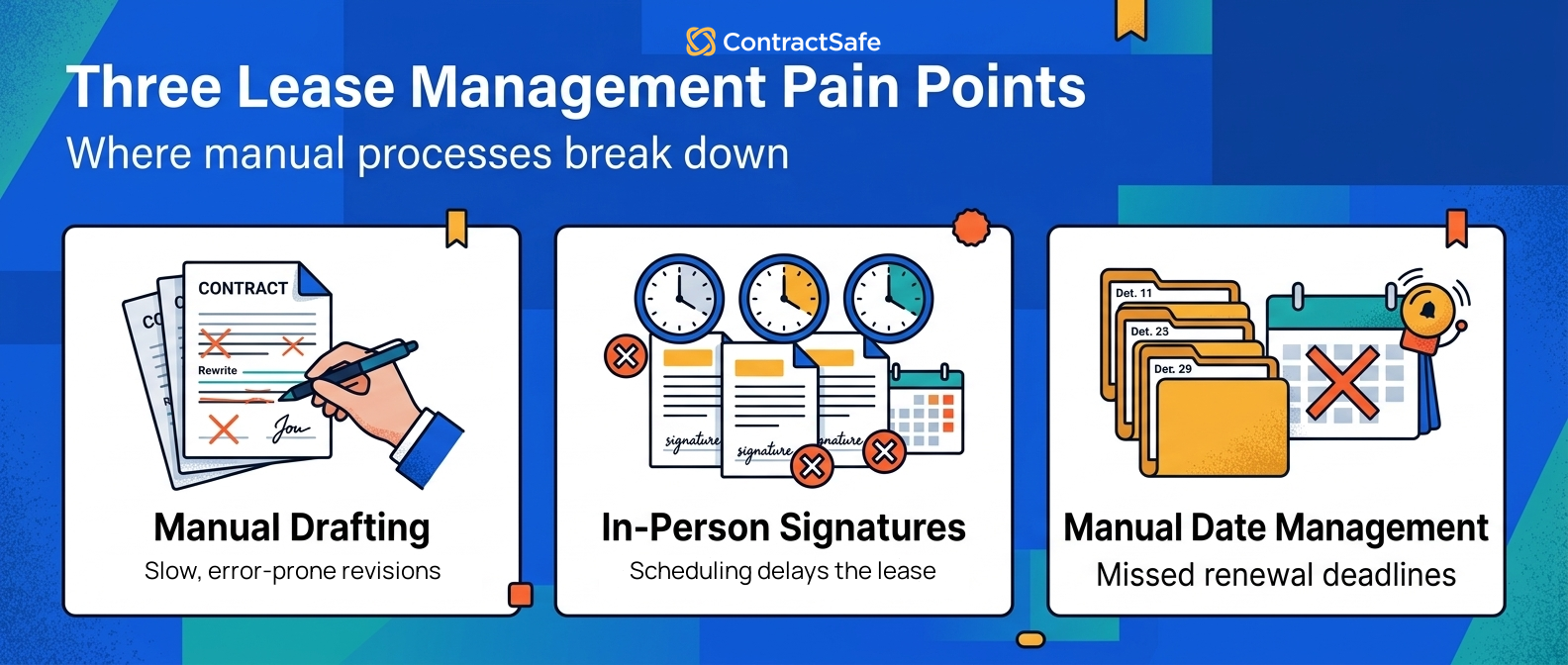
Manual Drafting
Creating lease agreements from scratch is time-consuming, tedious, and prone to errors. Contract template software solves that by keeping your approved lease language ready to reuse. Even modifying existing templates can be tricky, especially when dealing with complex clauses or unique situations.
And don't forget the legal review!
Ensuring compliance with local regulations is crucial, but the back-and-forth revisions can feel like an endless game of ping-pong.
Keeping Everyone in the Loop
When multiple parties are involved in a lease agreement, communication can become a tangled web. Landlords, tenants, property managers, lawyers — keeping everyone informed and on the same page can be difficult.
Miscommunication can lead to misunderstandings, delays, and unnecessary friction.
In-Person Signatures
Remember those old spy movies where agents had to meet in secret alleyways for a clandestine exchange? That's what coordinating in-person signatures can feel like.
Between scheduling conflicts, remote work, and unexpected delays, getting a simple signature can turn into a logistical nightmare, holding up the entire leasing process.
Physical Storage
Ever felt like your office was starting to resemble a library archive, overflowing with paper agreements?
Physical storage is cumbersome, takes up valuable space, and makes it difficult to find the right document when you need it.
And let's not even talk about the risk of misplacing or damaging those crucial papers.
Manual Date Management
Lease agreements are full of important dates…rent due dates, renewal deadlines, inspection schedules, and more.
Keeping track of all these dates manually can be rough. One slip-up, and you could miss a crucial deadline, leading to missed opportunities, financial losses, or even legal disputes.
The challenges associated with manual date management extend beyond just remembering dates. Here are some additional hurdles:
- Lease renewal and expiration dates: Missing these can mean lost chances to renegotiate or find new tenants, leading to vacancy and lost income.
- Insurance certificate renewals: Letting coverage lapse exposes you to big financial risks if there's an accident or damage.
- Payment due dates: Keeping track of recurring due dates for rent payments, whether they're monthly, quarterly, or another schedule, is essential for maintaining cash flow and avoiding late fees or disputes.
- End-of-lease return or purchase deadline: If there's an option to buy equipment at the end of the lease, there's a deadline for that decision.
- Renewal option deadline: If the lease can be renewed, tenants usually need to notify the landlord well in advance (e.g., 30, 60, 90 days) before it ends.
Manually managing all these dates and critical details within lease agreements is a major burden, increasing the risk of errors, missed opportunities, and potential legal headaches.
How ContractSafe Can Help You Manage Your Lease Agreement
ContractSafe is the ultimate solution for contract management. It’s designed to be simple yet powerful, packed with all the features you need to manage your lease agreements effectively:
- Customizable templates and automated workflows: Our user-friendly platform provides customizable templates and automated workflows, minimizing errors, expediting approvals, and reducing turnaround times. Automate key tasks like sending reminders and notifications, freeing up your time for more strategic activities. Improve accuracy and ensure consistency across all your lease agreements.
- Intuitive e-signature integration: Seamlessly integrate e-signatures into your lease agreements, eliminating the need for in-person meetings and physical paperwork. Speed up the signing process, enabling you to close deals faster and improve overall efficiency. Ensure the authenticity and integrity of signatures with advanced e-signature technology
- Cloud-based repository with bank-level security: Securely store all your lease agreements in a centralized cloud-based repository, accessible from anywhere, anytime. Easily locate any lease agreement with powerful search capabilities, eliminating the frustration of digging through physical files. Protect your sensitive lease data with bank-level security measures, including encryption and access controls
- Automated alerts and reminders: Receive timely alerts and reminders for crucial dates like rent increases, renewal deadlines, and option exercise dates. Avoid costly oversights, missed opportunities, and potential legal disputes. Stay organized and focused on critical tasks without the worry of manual tracking.
- Streamlined communication: Foster seamless communication by adding comments and notes directly to lease agreements. Keep all stakeholders informed and aligned, reducing miscommunication and potential conflicts. Enable multiple parties to review and contribute to lease agreements simultaneously, accelerating the negotiation and approval process.
ContractSafewill help you transform your lease agreement management processes, allowing you to supercharge efficiency, reduce risks, and make your contracts work for you.
Customize Your Lease Agreement
Leasing commercial property involves numerous legal and financial considerations. Our Commercial Lease Agreement template provides a comprehensive framework to establish the terms and conditions of the tenancy, protecting both landlords and tenants.
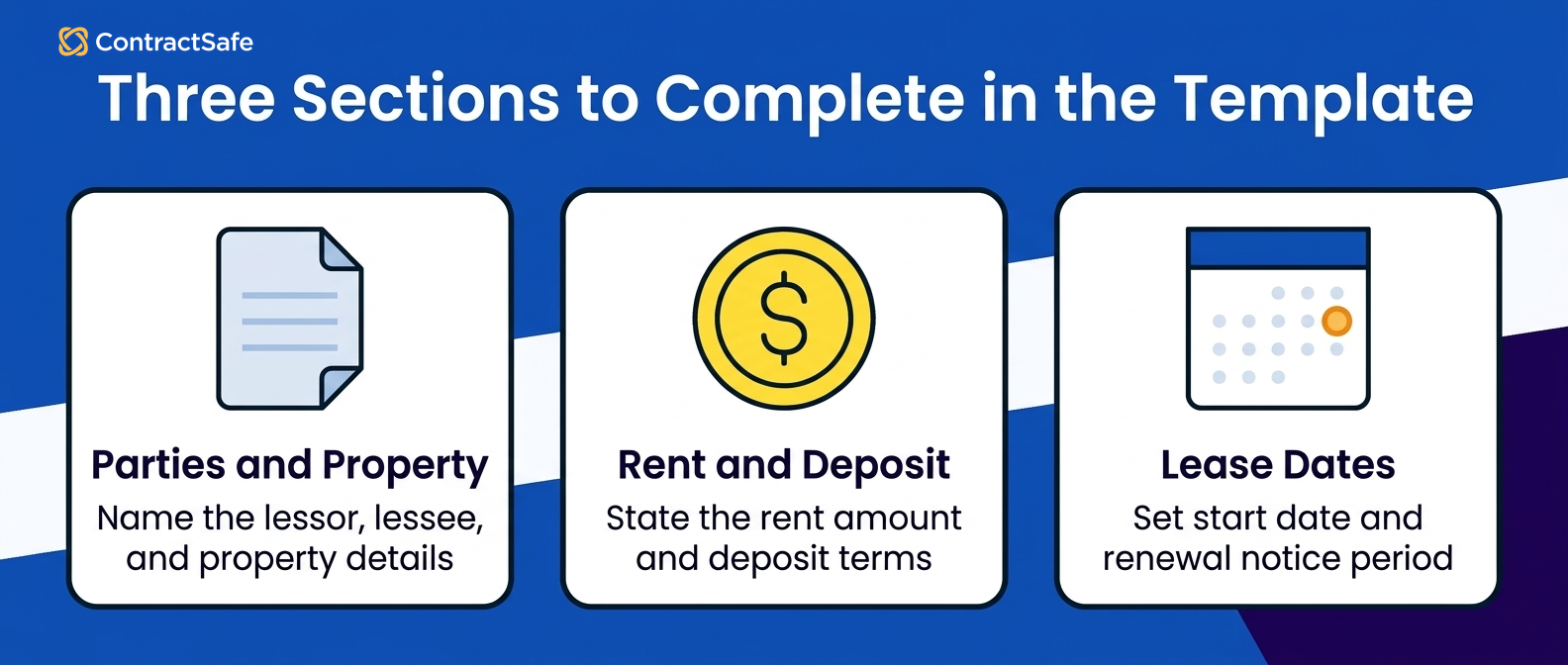
How to use the template:
- Download and open: Download the Commercial Lease Agreement template from a reliable source and open it.
- Date and parties: Fill in the current date at the beginning of the agreement. Then, input the full legal names and contact information (address, phone number, and email) for both the Lessor (landlord) and Lessee (tenant).
- Recitals: Ensure the "Recitals" section accurately reflects the situation, stating that the Lessor owns the property and the Lessee wishes to lease it.
- Property/equipment description: Provide a detailed and accurate description of the leased property, including its complete address, type, and any specific features, equipment, or fixtures included in the lease.
- Lease term: Specify the start date and duration of the initial lease term in months or years. If applicable, include the automatic renewal terms and the required notice period for termination.
- Rent: State the monthly rent amount in the specified currency, the due date for rent payments, and acceptable payment methods. You can also include provisions for late fees or rent escalation if desired.
- Security deposit: Specify the security deposit amount, how it will be held (e.g., in an interest-bearing account), and the conditions for its return, including any permissible deductions.
- Maintenance and repairs: Clearly define the responsibilities of both Lessor and Lessee for maintaining and repairing the property. List specific structural elements and common areas the Lessor is responsible for, and specific interior elements the Lessee is responsible for. State that the Lessee is liable for any damage caused by their negligence or misuse. Require the Lessee to obtain Lessor's prior written consent for any alterations or improvements, which become the Lessor's property upon lease termination.
- Insurance: Specify the types of insurance and minimum coverage amounts required for both the Lessor and Lessee. Ensure the Lessor is named as an additional insured on relevant Lessee policies.
- Rules and regulations: State that the Lessee must comply with all laws and regulations, cannot use the premises for illegal or hazardous purposes, and must not disturb other tenants. Add any additional property-specific rules.
- Termination: Specify the conditions for lease termination by either party, required notice periods, and any applicable penalties for early termination.
- Dispute resolution: Choose the desired dispute resolution method (arbitration, mediation, or litigation) and, if applicable, specify the administering organization and governing rules. For arbitration, include a clause for enforcing the arbitrator's award in court.
- Signatures: Both the Lessor and Lessee should print their names, sign, and date the agreement.
- Seek Legal Counsel: Before finalizing the agreement, have it reviewed by a qualified legal professional to ensure it is comprehensive, enforceable, and tailored to your specific needs and circumstances.
Remember: This template is designed to provide a helpful starting point, not a substitute for legal advice. Consulting with an attorney is essential to ensure your commercial lease agreement is tailored to your needs and provides the necessary legal protection for both landlord and tenant.
Lease Agreement FAQ
Still have questions about lease agreements? Here are answers to some frequently asked questions.
What is the Difference Between a Lease Agreement and a Lease Contract?
While the terms "lease agreement" and "lease contract" are often used interchangeably, there's a subtle but important distinction. A lease agreement is a broader term that encompasses any understanding between a landlord and tenant regarding the rental of a property. A lease contract, on the other hand, is a specific type of lease agreement that meets all the legal requirements to be enforceable in court. In essence, all contracts are agreements, but not all agreements are necessarily contracts.
What is the Purpose of a Lease?
A lease serves to establish a clear understanding between the landlord (lessor) and the tenant (lessee) regarding the use and occupancy of a property. It details everything from the rent amount and payment schedule to maintenance responsibilities and termination conditions, providing both parties with legal protection and a framework for a smooth rental experience.
Is the Lessee a Leaseholder?
Yes, the lessee and the leaseholder are the same. They are the person or entity renting the property from the landlord (lessor).
What is the Difference Between a Lease and a Lessor?
A lease is the actual contract or agreement itself, while the lessor is one of the parties involved – the property owner or landlord who is granting the right to use the property to the lessee (tenant) in exchange for rent.
Request a demo today and discover how ContractSafe can revolutionize your lease management process.







.svg)







.svg)