Quick answer: An agreement is a mutual understanding between two or more parties about what each will do. Legally, it means mutual assent: both sides accept the same terms. That assent is the core of every contract. A contract is an agreement that also has consideration, capable parties, a lawful purpose and definite terms, so every contract is an agreement, but not every agreement is a contract.
Say a cleaning vendor emails you on a Friday: "Confirming we'll start on the 1st at $4,000 a month." You're busy, so you reply "OK, sounds good." Nobody signs anything, and a month later you find a cheaper vendor. Can the first one hold you to that email? Quite possibly. Your reply accepted a definite price and start date for a service, and that's most of what a court looks for.
That's the line between an agreement and a contract: both start with two sides saying yes, but only a contract carries the extra elements that let a court enforce it, and a two-line email can cross that line before anyone notices. Once you can spot those elements, you can decide on purpose whether a reply should bind you, put that intent in writing, and keep track of what you've actually signed.
Choose your next step:
If you're checking whether a deal you've already made binds you, work through the elements of a contract one at a time.
If you're tracking signed term sheets, LOIs and contracts, start with our guide to contract risk management.
Key Takeaways
- Every contract is an agreement, but only agreements that meet the legal elements are enforceable.
- Those elements are mutual assent (offer and acceptance), consideration, capacity, a lawful purpose and terms definite enough to enforce.
- Documents labeled "non-binding," like letters of intent and term sheets, and quick replies by text or email can still bind you, so track them like contracts. If you don't mean to be bound, say so in writing and disclaim any duty to negotiate.
What Is an Agreement?
In everyday use, an agreement is a shared understanding between two or more people about what each will do. In law, the Restatement (Second) of Contracts §3 calls it a "manifestation of mutual assent on the part of two or more persons," shown by words, by conduct or, rarely, by silence when past dealings make silence a yes.
That makes agreement part of a contract, not a rival to it: mutual assent is a required element of every valid contract, so an agreement binds you once the other elements are present too.
For sales of goods, Uniform Commercial Code section 1-201 defines agreement as "the bargain of the parties in fact, as found in their language or inferred from other circumstances, including course of performance, course of dealing, or usage of trade." In plain English, an agreement doesn't have to be written or even spoken. A pattern of conduct can create one.
When it is written down, it can be one line: "I'll repaint the lobby by June 1 for $3,000" is the offer, "Agreed" is the acceptance, and paint for money is the consideration.
Acceptance can be even shorter than "Agreed." A grain buyer texted a farmer a photo of a flax contract, and the farmer replied with a thumbs-up emoji. In Achter Land & Cattle v. South West Terminal, the Saskatchewan Court of Appeal treated the emoji as both acceptance and a signature and upheld about CAD $82,000 in damages, as Eric Goldman's December 2024 case summary describes. The deciding factor was history: the two had closed earlier deals by texting a simple OK.
The Supreme Court of Canada docket shows leave to appeal was dismissed in July 2025. Canadian rulings are only persuasive in the US, but US courts are reaching the same place on their own: on October 1, 2026, a Massachusetts appeals court held that a three-sentence "settlement communication" email bound a developer to end a lawsuit, according to Law360's report on the ruling.
The same goes for spoken deals. A verbal agreement can be legally binding if it includes every element of a contract, though proving its terms in court can be difficult.
What Types of Agreements Are There?
You can group agreements two ways: by how they were formed, and by whether a court will enforce them. The cases above, from a texted OK to a three-sentence email, are examples of the formation types:
- Express: stated in words, like an NDA.
- Implied: shown by conduct, like the texted OKs above or paying a vendor after its contract ends.
- Bilateral: a promise for a promise.
- Unilateral: a promise for an act, like a referral fee paid only when a deal closes.
Grouped by whether a court will enforce them, they're:
- Binding: every element of a contract is present, and the document doesn't say it isn't binding.
- Non-binding: the document says plainly that it doesn't bind the parties. Most MOUs include that statement, which is why most MOUs aren't binding.
- Void: never enforceable, such as an agreement with an illegal purpose.
- Voidable: stands unless the wronged party undoes it, such as one signed under duress.
The implied type is the one that catches businesses out. If you're still paying a vendor whose contract expired, sign a renewal or send written notice ending it.
What Is a Contract?
A contract is an agreement a court will enforce. The agreement itself, an offer and an acceptance of it, is the base. A court then looks for four more things on top of it before it will step in: consideration, capacity, a lawful purpose and definite terms. A valid contract has all five:
- Offer and acceptance: A clear proposal by one party outlining specific terms, and an unequivocal agreement to those terms by the other. Together they show mutual assent and an intent to be bound.
- Consideration: Something of value exchanged between the parties, such as money, goods, services, or promises to act (or refrain from acting) in a certain way.
- Capacity: Each party is of legal age and mentally competent to enter the deal.
- Legality: The purpose of the contract must be lawful. A contract can't be formed to carry out an illegal act.
- Definite terms: The key terms (who, what, price and timing) are clear enough for a court to enforce.
In business deals, there's one more check: make sure the person signing has authority to bind the company. That's a separate question from capacity, and a common source of disputes.
None of this is exotic. Online purchases, phone plans and leases are all contracts. The Uniform Commercial Code puts the relationship neatly: a contract is "the total legal obligation that results from the parties' agreement."
Why Does the Difference Between a Contract and an Agreement Matter?
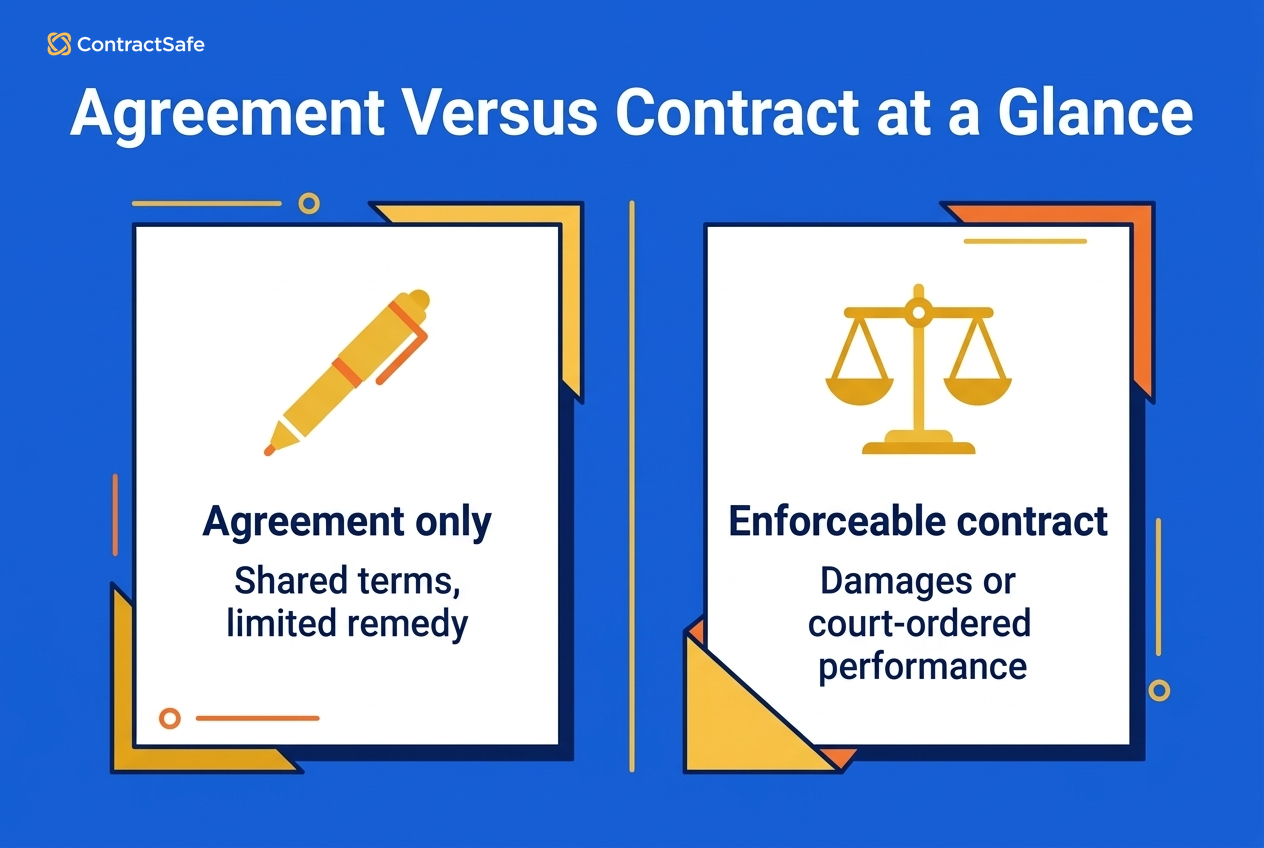
The difference decides what you can do if the other side walks away from the deal. If they break a contract, you can sue for damages or ask a court to make them perform; if all you have is an agreement, there's often nothing a court will enforce. Here's how the two compare:
| Criteria | Agreement | Contract |
|---|---|---|
| What it is | Mutual assent to the same terms | An agreement plus the elements the law needs to enforce it |
| Required elements | Offer and acceptance | Offer and acceptance, consideration, capacity, lawful purpose, definite terms |
| Form | Verbal, written or implied by conduct | Any of those; most needn't be written, but some (real estate, sales of goods of $500 or more) need a signed record |
| If it's broken | Often no legal remedy | Damages, or a court order to perform |
| Examples | Handshake plans, most MOUs | NDAs, MSAs, leases, signed service agreements |
Agreements, especially informal ones, are often harder to enforce in court, and they fail outright when an element is missing or one of the triggers that make an agreement unenforceable applies. Putting agreements in writing, even if they're not full-fledged contracts, reduces misunderstandings about the terms involved.
Common Agreements and Whether They Bind You
Most written business agreements bind you, and so do most signed personal ones. The exceptions are preliminary documents, and even those can bind you depending on the wording.
| Agreement | What it's for | Usually binding? |
|---|---|---|
| Non-disclosure agreement (NDA) | Protects sensitive information shared during talks or collaborations | Yes, typically structured as a contract |
| Master services agreement (MSA) | Sets the ground rules for an ongoing relationship | Yes |
| Statement of work (SOW) | Describes a specific project under an MSA | Yes, under its MSA |
| Letter of intent (LOI) or term sheet | Records initial commitments before the final contract | Depends on the wording |
| Memorandum of understanding (MOU) | Outlines the basis for collaboration between organizations | Usually not, unless its terms say otherwise |
| Lease | Grants use of property in exchange for rent | Yes |
| Separation or divorce settlement agreement | Divides property and sets support when a couple separates | Yes, once signed, and often approved by the court |
| Prenuptial agreement | Sets each spouse's property rights before marriage | Yes, if written, signed and voluntary, with fair financial disclosure |
| Settlement agreement | Ends a dispute, usually for payment or dismissal | Yes, and a short email can form one |
Because an SOW only binds you through its MSA, it helps to keep the two side by side. In ContractSafe's contract repository, you can connect related documents, so each SOW, amendment and signed LOI sits next to the agreement it depends on.
Letters of intent deserve extra care. In Givaudan v. Conagen, a federal appeals court held that a signed term sheet bound both sides to negotiate the open issues in good faith, even though the final deal never closed. Givaudan still lost because it couldn't prove damages, but the lesson holds: a document labeled preliminary can bind you unless its wording says otherwise.
The same question of intent decides personal agreements. Courts presume casual social promises aren't meant to bind, but formal ones like prenups and separation agreements are written to bind, and courts enforce them when they meet the same elements as any business contract.
What an Agreement Can Do That a Court Can't
A court can only order the remedies the law allows, but parties can agree to more. Separating parents can agree to cover college tuition, even though many states won’t order child support past high school, and companies can cap liability, set an installment schedule or pick an arbitration venue.
That freedom has limits. An agreement can't require anything illegal or bind people who never agreed, and it fails if one side was coerced or misled. If you want terms like these, write them into the signed document, because a court won't add them later.
What Makes an Agreement Unenforceable?
An agreement is unenforceable when something is wrong with how it was made, what it asks for, or the form it takes. A court won't enforce it if:
- Duress or misrepresentation: someone signed under pressure or was misled about key facts. That makes the agreement voidable.
- Illegal purpose: an agreement to do something unlawful is void from the start.
- Lack of capacity: a minor, or someone who isn't mentally competent, entered the deal.
- Vague terms: a court can't enforce what it can't pin down, which is what usually sinks an "agreement to agree."
- Binding non-signers: an agreement can't impose duties on people who never agreed to it.
- Missing formality: most contracts don't have to be in writing, but the statute of frauds requires writing for certain deals, such as real-estate sales and, under UCC 2-201, sales of goods for $500 or more.
That writing doesn't have to be paper. In states that have adopted the 2022 UCC amendments, an email or e-signed record can count. The amendments replace "writing" with "record" and accept electronic signatures, as the Oklahoma Bar Journal's January 2023 committee report explains. By December 2025, 33 jurisdictions had adopted them, Alston & Bird reported, and New York's version took effect in June 2026.
If any trigger applies, you don't have an enforceable contract, whatever the document's title says.
Agreements to Agree vs Final Agreements
A deal that leaves key terms open is an agreement to agree, and most courts won't enforce one. But states draw that line differently, and the Givaudan term sheet above was held binding because Delaware draws it more generously than most.
Delaware recognizes two kinds of preliminary agreement. In a Type I agreement, every term is settled and only the paperwork is left, so it binds like a finished contract. In a Type II agreement, terms are still open, but both sides are bound to negotiate them in good faith. The Delaware Supreme Court confirmed that rule in Cox Communications v. T-Mobile, a 2022 case, and the Second Circuit applied it in its February 13, 2025 decision, treating Givaudan's term sheet as Type II. The duty to negotiate held; Givaudan's claim failed only on damages.
New York is stricter. In Kassirer v. Gotlib, decided April 9, 2026, an oral real-estate venture deal failed because its terms weren't definite enough, even though one side had put in $1.6 million.
Whichever rule applies to you, the same wording protects you: "This term sheet is not binding and creates no obligation to negotiate until a definitive agreement is signed by both parties." Have counsel check it against your state's law before you rely on it. The sample contract agreement below ends the same way.
Sample Contract Agreement, Clause by Clause
A contract agreement is the written document that records a contract's terms. Most follow the same basic order, and each section answers a question a court might ask if the deal goes wrong. Once a deal is ready to bind, here's that order with fill-in wording:
- Parties and effective date: "Made on ___ between ___ ("Client") and ___ ("Contractor")."
- Scope of work: "Contractor will provide the services in Exhibit A by ___."
- Payment terms: "Client will pay each invoice within ___ days." Thirty is common.
- Term and termination: "Either party may end this Agreement on ___ days' written notice, or for breach not cured within ___ days." Typically 30 days' notice and 10 to 30 days to cure. These are the dates teams miss most, so we come back to them after signing.
- Insurance: "Contractor will carry commercial general liability insurance of at least $1,000,000 per occurrence, naming Client as additional insured."
- Work product: "Deliverables are works made for hire, assigned to Client."
- Independent contractor: "The parties are independent contractors."
- Confidentiality: "Each party will keep the other's Confidential Information private for ___ years."
- Limitation of liability: "Liability is capped at fees paid in the ___ months before the claim." Twelve is common.
- Assignment: "No assignment without consent, except in a merger."
- Notices: "Notices must be in writing, to the addresses below."
- Governing law: "Governed by the laws of ___."
- Severability: "An unenforceable provision is limited to the minimum extent necessary."
- Entire agreement and amendments: "This Agreement replaces earlier discussions, and changes must be made in writing."
- Not binding until signed: "Not binding until signed by both parties," the final version of the term-sheet line.
- Signature blocks: signed by someone with authority to bind each party.
Real-World Examples of an Agreement vs a Contract
Here's Lisa hiring the same painting company for the same job twice. Both times the company says yes. What separates the outcomes is whether the terms were pinned down in a signed document like the one above.
Scenario 1: A Legally Enforceable Contract
Lisa hires a painting company to paint her house. She signs a written service agreement, and its scope clause reads:
"Contractor will prepare and paint all exterior surfaces of the property using two coats of exterior latex, beginning no later than the Start Date and finishing within ten business days."
A payment clause sets the price and a deposit due at signing. Lisa pays the deposit. The painters never show up.
Because the scope clause pins down what, how and by when, and the other elements of a contract are in place, Lisa can pursue legal action for breach of contract.
Scenario 2: An Informal Agreement
This time Lisa calls the owner, and he agrees on the phone to paint her house "sometime next month." They never settle a price, which surfaces get painted or when the job starts and ends. Nothing is signed and no deposit changes hands. The painters never show up.
Lisa and the owner did agree, but the terms a court would need to enforce were never set, so Lisa likely has no legal claim for damages. That gap is why the agreement-or-contract decision matters.
When Should You Use an Agreement vs a Contract?
Choosing between an agreement and a contract comes down to risk. Before you settle for a handshake, ask whether you'd be out of pocket or stuck if the other side walked away:
Agreements Work Best When
- the stakes are low
- parties have an established relationship
- the interaction is exploratory
- discussions are still preliminary, and the document says plainly that it's non-binding
Contracts Make Sense When
- significant money is involved
- obligations must be clearly enforceable
- deals are complex or multi-party
- legal protection is necessary
When risk increases, relying on a legally binding contract becomes critical. If one item in the second list fits, sign a contract before work or a deposit starts.
How To Turn an Agreement Into a Contract
Before that signature, and before any work or deposit, go through the deal step by step:
- defining a specific offer
- ensuring clear acceptance of the terms
- documenting the exchange of value (consideration)
- confirming each party has legal capacity
- separately, confirming the signer has authority to bind the company
- ensuring the purpose of the contract is lawful
- making key terms (price, scope, dates) definite enough to enforce, and capturing them in a signed record
- stating in writing that you intend to be bound, or that you don't yet
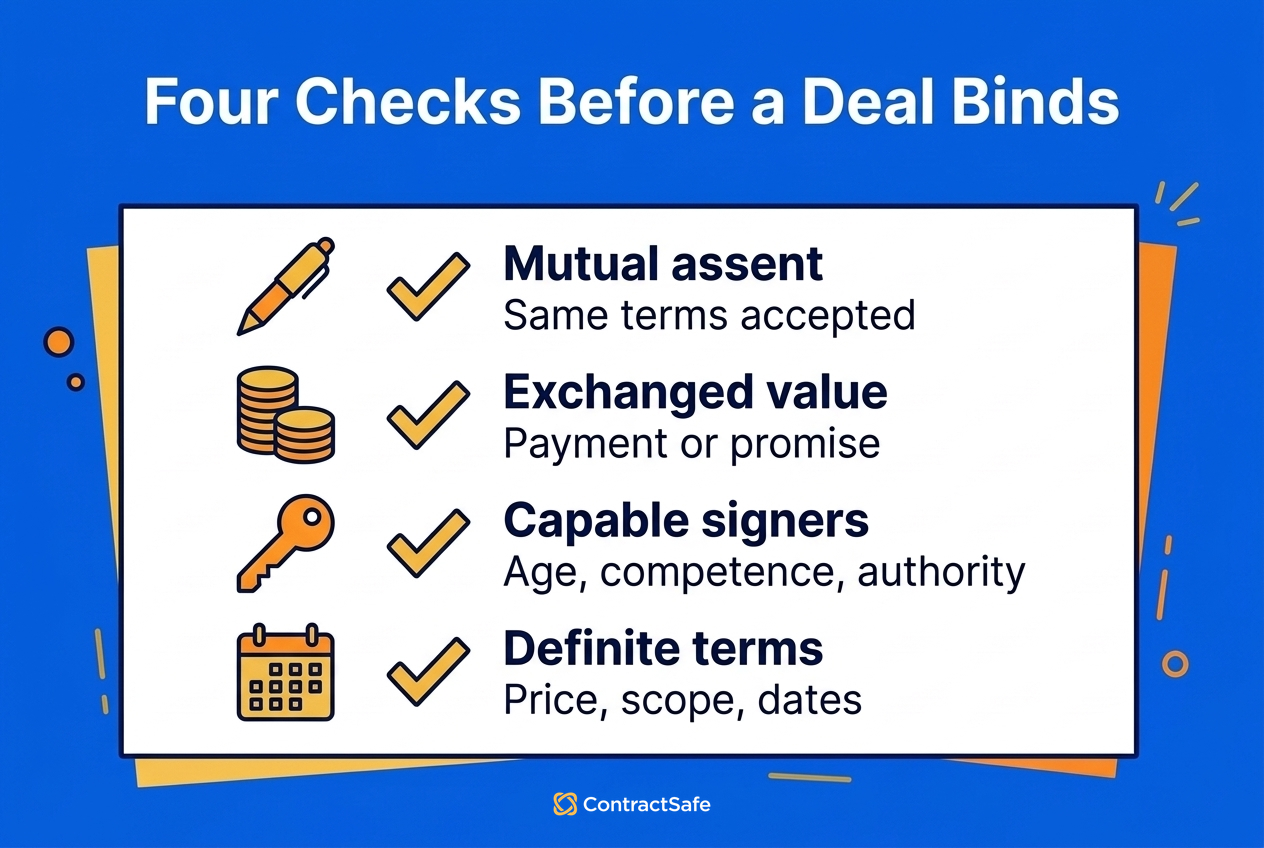
Most of those steps come down to four checks you can make by reading the document itself. The offer, the acceptance and your stated intent to be bound together show mutual assent. Consideration is the exchange of value. Capacity and authority are both about who signs. And the terms are either definite on the page or they aren't. Lawful purpose is the one step left off, because no wording settles it: whether a deal is legal depends on what it actually does.
That judgment, along with the drafting, is where your legal team comes in on complex or high-value deals. They can write a contract that reflects your agreement, protects your interests and complies with relevant laws.
Common Mistakes Businesses Make With Agreements and Contracts
Even experienced teams that follow those steps run into issues when agreements and contracts aren't clearly managed. Common problems include:
Assuming an agreement is legally binding
Many business conversations create expectations without creating enforceable obligations. Check it against the five elements first.
Treating a "non-binding" document as harmless
A signed term sheet, a short settlement email or a quick OK by text can bind you, as the cases above show. Add an express non-binding line before you sign or reply.
Losing track of contract versions
Without centralized tracking, teams may rely on outdated versions of contracts. Keep every amendment with the signed copy.
Missing renewal deadlines
Auto-renew clauses can create unwanted obligations if deadlines are missed. Set reminders on the notice deadline, not the end date.
Scattered storage across departments
Different teams may store contracts in separate systems, making oversight difficult. Pick one place to file signed documents.
The last three start after signing, and they're the problems contract management software is built to solve.
Related Reading
- Seven Common Mistakes in Contract Management and How to Avoid Them
- ContractSafe: Contract Management Software Implementation Made Easy
How ContractSafe Helps You Track Renewal and Notice Dates After Signing
Once a contract is signed, the renewal date and the termination notice window are what catch teams out. ContractSafe keeps signed contracts searchable in one place and sends reminders before those dates arrive, on every plan, including Organize.
In its August 2025 whitepaper, World Commerce & Contracting found that the average business loses almost 9% of value annually through poor contract management, while the best performers lose about 3% and the worst 15% or more. Much of that gap is decided after signing.
ContractSafe is contract management software built for that job:
- A cloud-based contract repository with version tracking and a full audit trail, so you're always working from the latest version.
- Search across every document, including scanned PDFs, thanks to optical character recognition (OCR).
- ContractSafe's [AI]ssistant suggests key data such as renewal and notice dates, and a person accepts, corrects or skips each value before it's saved.
- Automated reminders for renewals, expirations and deadlines to non-renew, including recurring reminders and alerts to any email address, such as outside counsel.
Signed term sheets, LOIs and email confirmations that may bind you belong there too. They go in alongside your contracts, connected to their MSA, with reminders on their dates.
"ContractSafe helps us stay ahead of renewals and saves me at least a few hours every week. Instead of rebuilding information from SharePoint, I can pull the contract report I need and keep the process moving," says Carrie McClain, Procurement Specialist at Vitality Living.
ContractSafe is designed to be simple to implement, with no implementation fee. ContractSafe pricing starts at $450/month (Organize plan, billed annually; $540 month-to-month), with unlimited users on every plan.






.svg)







.svg)