
Contract volume means handling lots of similar agreements, while complexity means dealing with fewer, but tougher, contracts.
Think of volume like a mailroom and complexity like a control panel. Both can break, but they break differently.
Buying for the wrong problem leaves your team with software that solves yesterday's bottleneck.
TL;DR
- Scaling isn't just about more documents. As you grow, you'll hit two different kinds of snags: dealing with more contracts, and dealing with more complicated clauses.
- If you misdiagnose the problem, you'll end up with 'shelfware.' For example, buying a huge enterprise system for a simple volume issue means your team will probably find it too clunky to use.
- Success requires the right tool for the job. High-volume work needs to be fast and automated, while complex work requires deep searchability and a clear understanding of what was actually agreed upon.
- You don't need a six-figure budget to stay organized. ContractSafe is designed to fit just right, helping you get a clear view of your contracts as you grow, without the long implementation headache.
The CLM Buying Mistake Most Growing Companies Make
It's easy to make CLM buying mistakes as you grow. Your contract portfolio needs a clear record, owner, date, and next action before your team can rely on it.
Treating all contract growth as a single problem often leads teams to purchase a more expensive piece of software than they actually need.
Most organizations assume that if they are growing, they automatically need a super powerful contract management system with all the bells and whistles.
If you’re moving, your stuff not fitting in your trunk doesn’t mean your only option is a cargo plane. You might be moving long-distance over a longer time period, which means shipping can make sense.
Or if it’s a cross-town trip made in an afternoon, a daily box truck rental works. There’s usually a more nuanced and better solution than just throwing money at the problem.
When it comes to your contracts, volume and complexity are like the distance requirements in a move. Both pose a new challenge but stress different parts of a system.
High volume means manual processes get swamped by documents. Complexity makes it impossible for teams to track specific obligations across different versions.
If you don't get the problem right, you might build a complicated system for something simple, or not give enough support to what really matters.
What High-Volume Contract Management Actually Looks Like
If you’re processing lower-stakes agreements like NDAs, standard vendor renewals or SOWs day in and day out, you’re battling high-volume contract management. sending a large number of simple contracts to Legal every day gets expensive quickly
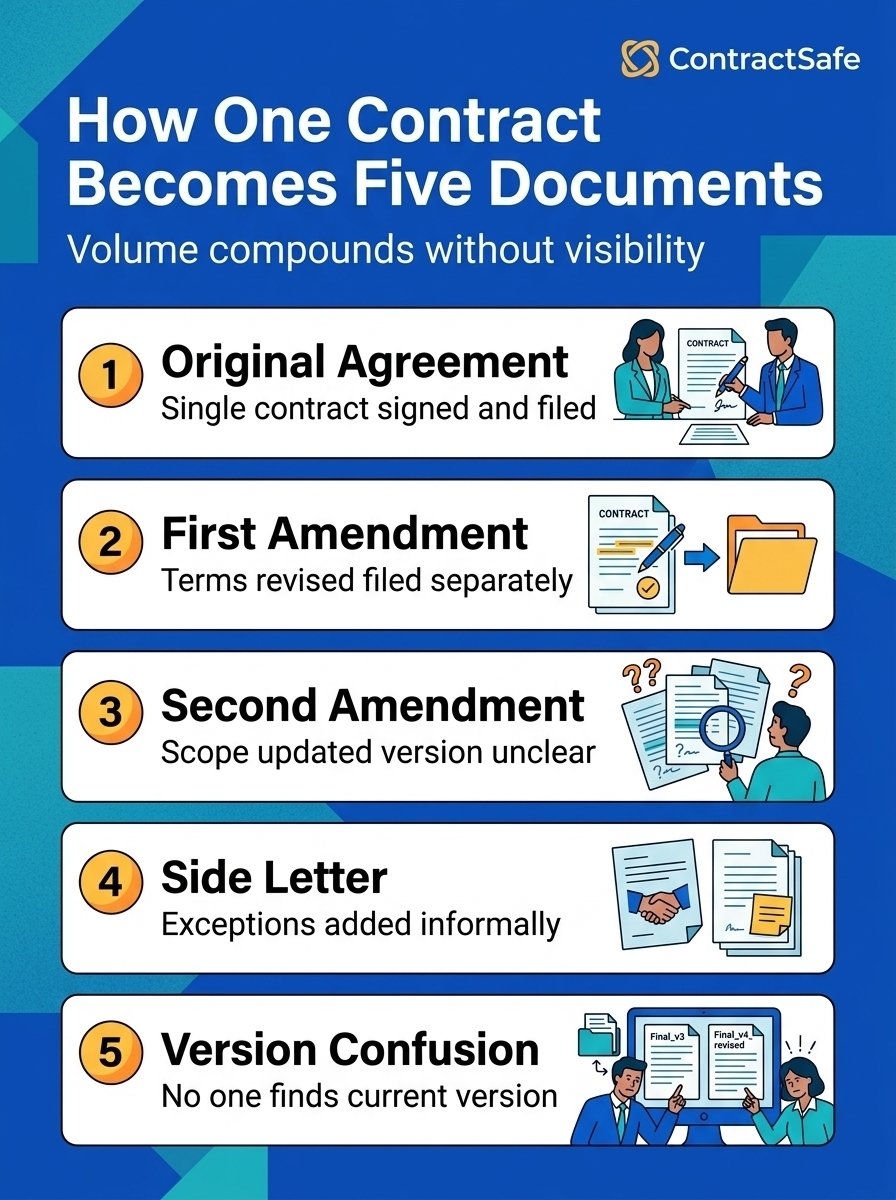
In high-volume environments, risk lives in the aggregate. poor contracting practices lose an average of 9% of annual revenue
If you’re looking to cut down on errors caused by volume, the solution is standardization. AI can help scale pre-signature review
The Reality of High-Complexity Contract Management Looks Like
For high-complexity contract management, your contract portfolio needs a clear record, owner, date, and next action before your team can truly rely on it.
Sometimes growing companies aren’t handling dozens of contracts a day. Instead, they’re managing major contracts like cross-border agreements or enterprise deals that require extreme attention to detail.
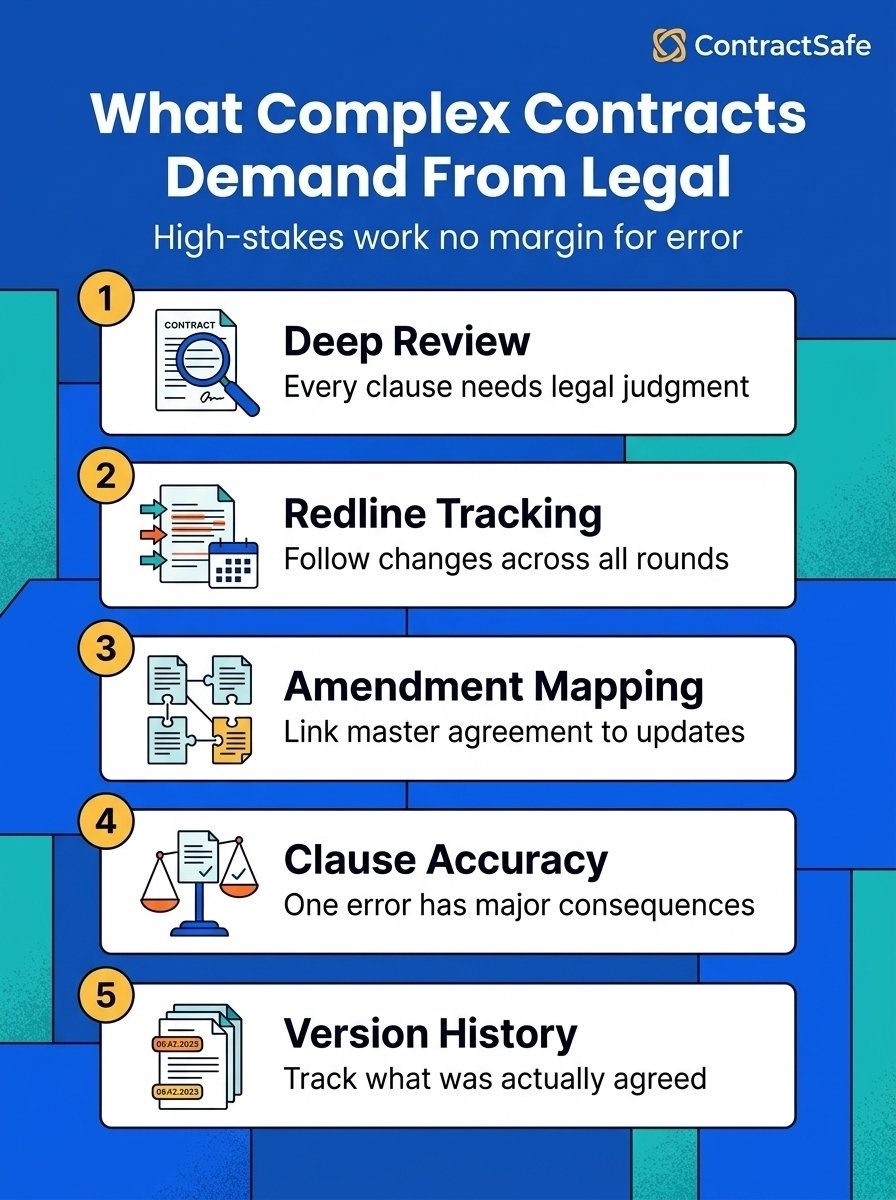
Each of these high-stakes contracts needs careful legal review because a single mistake can have huge consequences. One bad clause in an enterprise deal can have outsized consequences for the entire business.
The University of Texas San Antonio fell victim to a contract error in June 2025 that almost cost them their most winningest baseball coach to a clerical error . almost cost them their most winningest baseball coach to a clerical error
In complex situations, contract management falls apart when you lose track of versions and negotiation history. Legal teams
At-a-glance: High Contract Volume vs. High Contract Complexity
To get a quick overview of high contract volume versus high contract complexity, remember that your contract portfolio needs a clear record, owner, date, and next action before your team can truly rely on it.
|
High-Volume Contract Management |
High-Complexity Contract Management |
|
|
What it looks like |
A large number of low-stakes agreements like NDAs or renewals that flood your Legal team’s to-do list |
High-stakes enterprise deals or cross-border arrangements that require careful consideration and concentration |
|
The problem |
The sheer amount of contracts processed daily becomes expensive and slow |
Each contract requires specialized attention and oversight over just processing |
|
What breaks first |
Throughput: Manual processes can’t keep up even with large teams |
Clear view: Specific obligations or negotiation history gets lost across multiple versions and redlines |
|
Biggest risk |
Individual minor issues stack up across dozens or hundreds of contracts to create big financial losses |
One bad clause in a single enterprise deal can have major consequences for the entire business |
|
The solution |
Using a CLM to support standardization and automation to keep consistent quality across contracts |
Using a CLM that makes it easy to track the latest version and understand the relationship between master agreements and amendments |
How Scaling Companies Face Both Volume and Complexity at Once
When scaling companies face both volume and complexity at once, your contract portfolio needs a clear record, owner, date, and next action before your team can rely on it.
Companies can experience growing pains when they must suddenly handle high-volume vendor onboarding and high-complexity enterprise sales at the same time. This often happens when a company hires more people and moves upmarket.
Sales teams may be closing bigger, more complex deals while procurement is onboarding a record number of new vendors.
Legal departments get squeezed from both sides, needing to quickly process routine paperwork while also carefully reviewing complex enterprise contracts.
This is where teams most often reach for the wrong solution. They might buy a heavyweight system to solve the complexity, only to find it is so cumbersome that nobody uses it for the high-volume routine stuff.
If your legal team feels like a black hole where documents go in but never come out, you are likely facing both problems at once.
Why Solving the Wrong Contract Problem Leads to Software Nobody Uses
When you solve the wrong contract problem, you end up with software nobody uses. That's because your contract portfolio needs a clear record, owner, date, and next action before your team can rely on it.
Choosing a CLM based on complexity when you only have a volume problem results in “shelfware,” expensive software that your team finds too difficult to use and sits collecting dust. Choosing a CLM
Lightweight tools might handle volume, but they'll fall short if they can't track terms across amendments. Instead, you need something that's easy to search, yet also smart enough for all those tricky negotiated terms.
If teams think complexity is just a volume problem, they'll miss big risks.
The Contract Management Mistakes We See Most Often at Scale
Let's look at the contract management mistakes we see most often at scale. Your contract portfolio needs a clear record, owner, date, and next action before your team can rely on it.
When contract management breaks at scale, it isn't usually a single catastrophic event. It’s a series of small, quiet failures that add up to major risk.
- Amendment Drift: You act on a Master Service Agreement (MSA) but don't realize an amendment changed the payment terms or liability cap.
- Signature Silos: You find a 'final' PDF, only to realize it's not signed, and the actual executed copy is stuck in a former employee's inbox.
- Evergreen Masking: You miss a cancellation window because the 'auto-renew' clause was hidden deep in the fine print of a scanned document.
- Template Decay: Your team keeps using an old, outdated contract template because no one can find the approved version.
- The Search Shrug: Someone asks, 'Do any of our other contracts have this clause?' and the only way to find out is to manually check every PDF in the drive.
How ContractSafe Handles Volume and Complexity Without the Enterprise Overhead
Here's how ContractSafe handles volume and complexity without the enterprise overhead: for your team to truly rely on a contract, it needs a clear record, owner, date, and a plan for what happens next.
ContractSafe tackles both high contract volume and complex agreements, all while keeping things simple to use. Our advanced search helps you find terms in any document, and our [AI]ssistant uses AI to simplify things for everyone, no matter their department.
- Find any term in seconds: Our OCR and full-text search look inside any document, including scans, across your entire database so you never have to guess what’s in a file.
- Search like you speak: Natural language search means you can type a plain-English question and get a filtered list of matching contracts.
- Ask your contract questions: Users can use the AI chat feature to ask questions directly about a specific contract and get answers from the document itself.
- Eliminate manual data entry: ContractSafe extracts the key details out of every contract (parties, dates, renewal terms, and amendment status) so your team can easily find what they need.
- Stop risky language before it’s signed: Our [AI] Contract Review checks contract language against your standards, flagging issues and suggesting approved language instead.
- Maintain consistency with standard templates: Centralize your approved versions so the rest of the business can move fast without creating new legal risks.
- Start off strong: Use standard intake forms to make sure every contract starts with the same data points.
- Keep an eye on changes: Version history logs content changes across users to keep track of who last touched a document, while audit trails provide a complete activity log for more complex contracts.
You don't need a six-figure budget to get control of your contracts. best contract management practices
How to Scale Without the Stress
The first step to identifying your problem is admitting there might be one. The second is to look at the data.
Look at your agreements from the last quarter to see how many needed significant redlining versus those signed using a standard template.
- If the audit shows your biggest pains are "we can't find things," "we keep missing renewals," and "nobody knows who owns this," you’re struggling with volume.
- If your biggest pains are "we don't know what we agreed to," "we are redlining the same clause for the sixth time," and "we can't track what changed between versions," you are running into complexity problems.
- If your audit shows a mix of all of the above, you’re struggling with a poor overall solution.
By identifying whether you're solving for volume, complexity, or both, you can choose a system that actually reduces your workload instead of adding to it. Ready to see how simple contract management can be? Schedule a demo with ContractSafe today.
For your contract portfolio to truly work, it needs to be linked to your contract repository, your contract metadata, and how you handle contract obligations.
If missing dates is a common problem, always double-check your renewal checklist and effective date rules before you consider a contract finished.
Use the contract portfolio record like a map, then check it again when the project, vendor, owner, or deadline changes.
For outside context on contract volume vs contract complexity, compare the article against WorldCC contract resources and the NIST contract management body of knowledge.
Your team should be able to answer any questions about contract volume or complexity without waiting for the one person who knows where the file is.
That means you need to clearly know who owns the contract, all the important dates, any related files, what you're obligated to do, and how to renew it before you can consider it finished.
You should know what you signed, where you stored it, who you assigned it to, and what you need to do next.
Always start with the final signed contract, its owner, key dates, and any related documents. 








.svg)







.svg)