Contract review is one of the most time-consuming parts of the legal workflow, and one of the easiest places for risk to hide. As contract volumes increase and timelines shrink, legal teams are rethinking how review happens before a contract is signed. In 2026, AI-powered contract review is becoming less about speed alone and more about consistency, clarity, and control.
What AI contract review is:
AI contract review helps legal teams scale pre-signature review by applying consistent standards, surfacing risky or missing clauses, and keeping approvals moving.
Does it replace legal judgment?
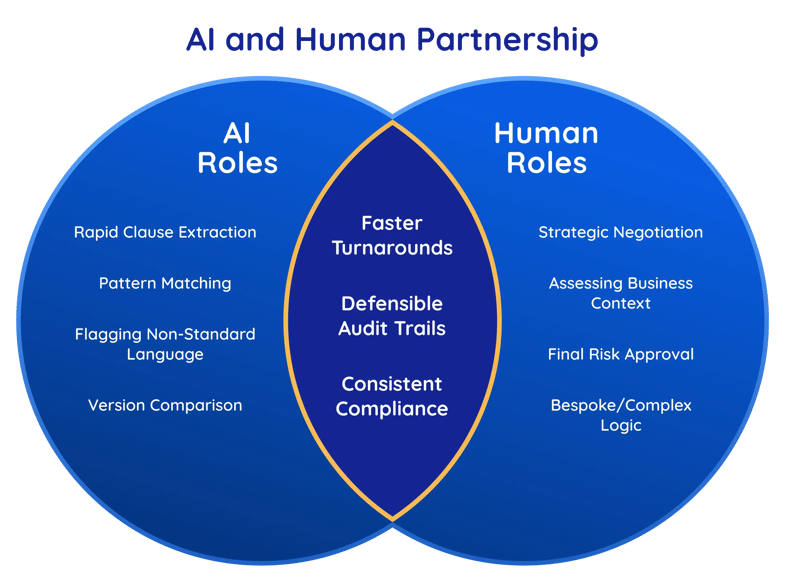
No. Modern AI does not replace lawyers. It supports reviewers by comparing contracts against playbooks, extracting key terms, and flagging deviations so that teams can focus on decisions, not document hunting.
What’s different in 2026:
In 2026, the most effective AI contract review tools are built into workflows that preserve approvals, accountability, and a clear record of who approved what and why.
Why Manual Contract Review Is No Longer Sustainable
Traditional, manual contract review workflows are struggling to keep up with modern contract volume, complexity, and expectations for speed. When you’re forced to choose between thoroughness and meeting a “sign by EOD” deadline, risk is usually what ends up hiding in the shadows. Manual contract review starts to break down when your inbox begins to look like a disorganized shared drive. It's not just about working harder; it's about the fact that manual processes aren't built to scale.
At scale, manual contract review breaks down in three predictable ways:
-
Inconsistency in how contracts are reviewed
-
Lost context between drafts, approvals, and decisions
-
Bottlenecks that slow approvals and hide risk
The faster contracts move, the more risk hides in the gaps between drafts, approvals, and memory.
The Risks of Manual Contract Review
Inconsistency and lost context are the quiet failures of manual contract review at scale. When reviews rely heavily on individual memory, personal templates, or experience, the same contract can be evaluated very differently depending on who happens to review it.
Instead of a shared company standard, reviewers can be influenced by their own personal templates or past experiences, leading to a choose-your-own-adventure style of legal review, where two nearly identical contracts might end up with different terms simply because two different people reviewed them.
This inconsistency creates a breeding ground for risk. When you’re under the gun to get a contract signed by the end of the day, it’s natural to start scanning for known issues rather than reading every single clause with a fine-toothed comb. That’s exactly when risky language—the kind that's just close enough to look okay—slips through the cracks. Because risk tolerance varies from person to person—and from day to day—acceptable fallback language can shift without anyone realizing it. Under deadline pressure, reviewers scan for familiar issues rather than evaluating each clause in context. That’s when “almost acceptable” language slips through.
To make matters worse, the "why" behind your edits often disappears the moment the document is saved. The context of a negotiation and the specific reasoning that led you to accept a compromise usually lives in a buried email thread or a deleted document comment rather than in a clean, accessible record.
As an example, manual contract edits and clause review in Word work perfectly fine when you’re handling a couple of agreements a week. It’s familiar, it’s comfortable, and you actually have the time to be meticulous. But as your workload grows and you’re moving quickly across dozens of similar agreements, that manual process starts to show its cracks.
This makes it hard to explain or defend down the road. If an auditor or an executive asks why a specific clause was accepted six months from now, you’re left hunting through a digital paper trail that has long since gone cold. These risks don't just stay at a simmer; they compound and multiply as contracts move faster and faster through your review queue.
Slow Review Cycles and Approval Bottlenecks
Bottlenecks are the third way manual contract review fails at scale. Contracts don’t stall because people don’t care—they stall because ownership is unclear, context is missing, and reviewers don’t know exactly what decision they’re being asked to make.
The contract isn't moving, no one is talking about it, and yet the deadline is coming up fast. This happens because review cycles naturally slow to a crawl when there’s no clear visibility into who actually owns the next step or what specific decision is needed to move the needle.
This bottleneck is often made worse because the people expected to give the "okay" aren't given the context they need to do their jobs quickly. Approvals stall because stakeholders are handed a raw document without any signals as to what changed or what specific risks they’re being asked to evaluate.
Imagine being a busy executive and receiving a 50-page vendor agreement with a note that just says, "Please approve." You’re going to set that aside until you have a spare hour to dig in, whereas if you knew exactly which three sentences were modified, you’d be done in minutes. This lack of transparency means Legal can become a bottleneck, as every tiny question or exception funnels into a small group that has no way to prioritize the must-reads from the routine-checks.
When delays pile up early in the review process, they compress the business timelines later on. This crunch forces teams into rushed, last-minute decisions where the likelihood of missing a critical issue skyrockets. To break this cycle, teams need earlier, more consistent support throughout the review process so that contracts don't stall out and lose momentum long before they ever reach the final approval stage.
RELATED READ: How To Simplify Your Contract Workflow With Contract Management Software
What Can AI Contract Review Do
What AI Handles Well
Modern AI is well-suited for the heavy lifting—scanning contracts to find the clauses legal teams care about. It can scan contracts quickly, find key clauses (like indemnity, termination, and limitation of liability), and compare the language to your predefined standards. It’s also great at spotting what isn’t there, such as a missing data privacy addendum or a forgotten force majeure clause.
However, if you’re worried that AI is here to replace your legal judgment, take a deep breath. The best legal teams aren't handing the keys over to a robot; they’re using what we call “practical AI.” The best teams use practical AI that applies your standards to surface issues and inconsistencies, then routes the decisions to a human reviewer.
Where Human Judgment Still Leads
Where legal judgment remains essential is in the nuance. AI can tell you what a clause says, but it can’t understand the specific history of your relationship with a vendor or the strategic "why" behind a risky trade-off. You keep the final say; the AI just makes sure you have all the facts in front of you before you say it.
Why Playbooks Make AI Review Practical
To make this possible, teams are using "Contract Review Playbooks," digitized guides that define your company’s acceptable positions and provide approved fallback language. AI uses these playbooks as a reference point, instantly comparing a new draft to your gold standard and highlighting where things have gone off-script.
AI-Powered Clause Extraction and Risk Identification
Think of AI as your high-speed assistant that highlights the key parts of a contract before you even open the file. When you’re in a rush, your eyes naturally glaze over boilerplate—exactly when an easy-to-miss auto-renewal or a one-sided indemnity can slip by.
That’s where clause extraction earns its keep. Instead of scrolling and searching, AI pulls up the provisions legal teams look for most (indemnity, termination, limitation of liability) and flags what’s different: nonstandard wording, missing clauses, or terms that drift from your preferred language.
And it doesn’t “approve” anything. It just makes sure the right issues are on your radar early, so humans can spend their time on the judgment calls and negotiation strategy that actually move the deal forward.
RELATED READ: How AI Is Transforming Contract Review: Faster, Smarter, and More Accurate
Reducing Legal Bottlenecks with AI-Supported Review Workflows
AI can spot issues fast. But without a clear next step, those insights just pile up.
Think of AI as the check engine light for your contracts: it tells you something needs attention, but it doesn’t schedule the mechanic or assign the work. That’s what structured workflows do. They turn “here’s what looks off” into routing, approvals, and accountability, so risks don’t just get identified, they get handled.
Instead of every document landing in a generic “Legal Review” inbox, workflows route contracts based on what the AI found. A standard NDA with no deviations can move forward quickly. A limitation of liability clause that’s outside your preferred terms can automatically pull in the right stakeholder—CFO, GC, or whoever owns that decision. Legal stops being the air traffic controller for every routine agreement and gets involved where judgment actually matters.
As review volume increases, you also need the process to hold up later. Workflows keep the “why” attached to each decision by capturing comments, version changes, and approvals in one place, with timestamps, so you have an audit-ready trail without slowing anyone down.
Faster Intake and Review Prioritization
Once routing is in place, the next bottleneck is the queue.
If everything is treated the same, routine contracts get stuck behind higher-risk ones, and reviewers feel pressure to rush just to keep up. Intake gets a lot smoother when you can triage based on what the AI actually surfaced:
-
Which clause changed
-
What’s missing
-
Where the language falls outside your standards
Low-risk agreements—like standard NDAs that match your playbook—can move through a lighter review path, while higher-risk contracts get the deeper scrutiny they require. That keeps routine work from clogging the queue and helps reviewers focus their time where judgment actually matters.
The result is faster turnaround without cutting corners. Business teams get quicker answers, Legal avoids last-minute fire drills, and decisions are driven by real risk—not by who happened to email first.
Structured Approvals and Review Accountability
One of the biggest misconceptions in contract management is that you have to choose between speed and safety. In reality, structured workflows help approvals move faster, specifically because they preserve accountability. It’s much easier for a stakeholder to hit "approve" when they can see a clear trail of who has already weighed in and what risks were identified. This isn't just about efficiency; it’s about a clear record of who approved what and when. When questions come up months or years later, you want a single, standardized record that shows exactly how the contract moved from draft to signature.
Version history plays an important role here as well. It’s not just about seeing the "Final_v4" file; it’s about seeing the evolution of the negotiation to ensure that every flagged issue was either resolved through drafting or intentionally accepted as a business risk. When your review and approval records create this kind of repeatable evidence of control, your entire compliance posture strengthens.
Ultimately, speed and defensibility aren’t tradeoffs. Structured workflows help teams move faster while maintaining clear records of every review and approval decision made along the way.
RELATED READ: How To Use AI To Simplify Contract Review
Who Should Use AI Contract Review, and When Human Review Should Lead
AI contract review is most valuable in high-volume or high-risk environments where consistency and speed are non-negotiable. The goal isn’t to use AI for every single comma, but to deploy it where volume, repetition, and human fatigue create the most risk. It’s about knowing when to let the technology do the heavy lifting so that your team can focus on the nuances that actually require a law degree or years of business experience.
Who Benefits Most from AI Contract Review
AI contract review helps different teams in different ways:
-
In-house counsel: spend less time on repetitive review work and more time on high-impact legal judgment and strategy.
-
Legal ops and contract managers: get real visibility into the pipeline—what’s in review, what’s blocked, and where cycle time is slipping—so they can improve the process.
-
Procurement and Sales: get more predictable turnaround times, which makes deal cycles easier to plan around.
-
Compliance: gets an audit-ready trail of what was reviewed, what changed, and who approved it, without a manual paper chase.
When AI Review Helps Most and When Human Review Should Lead
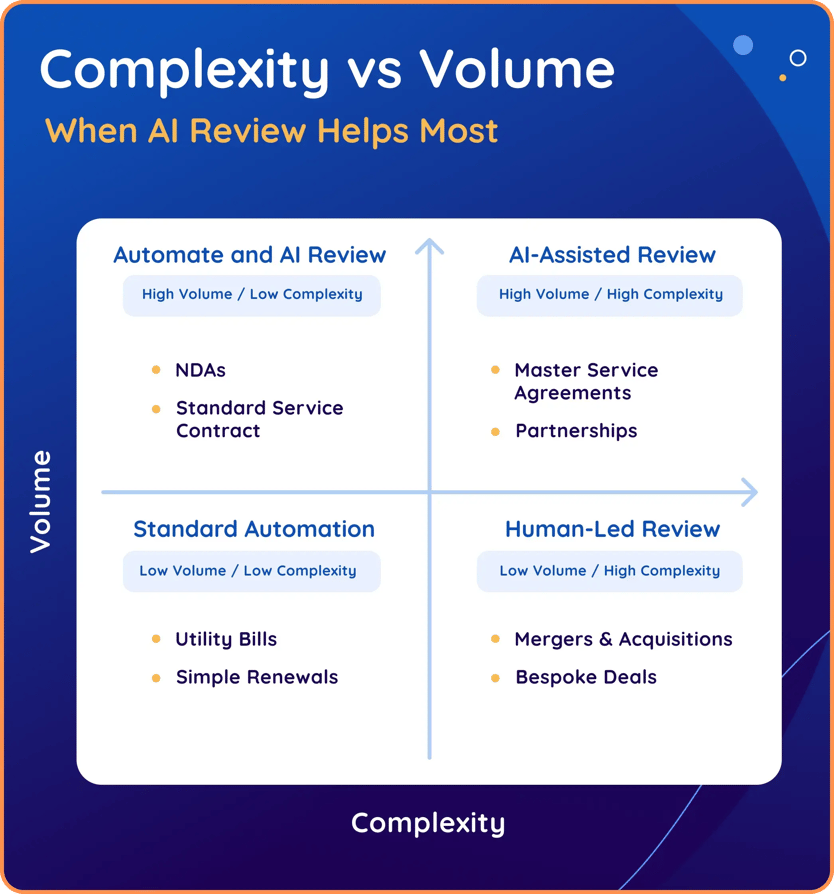
AI shines when it can apply a consistent standard to high-volume, standardized contracts like NDAs, vendor agreements, and routine leases. It is perfect for detecting patterns and deviations across hundreds of similar documents that would otherwise overwhelm a human reviewer. It is also a lifesaver for legacy cleanup tasks, such as finding every contract with a specific change-of-control clause during an acquisition.
However, human review should still lead the way for bespoke, high-risk deals like mergers and acquisitions (M&A) or complex partnership agreements. These situations involve nuances in relationship management and long-term strategy that AI simply cannot predict. Sometimes the "correct" legal move isn't the "right" business move for a specific relationship, and that’s where human judgment is irreplaceable. AI works best as a disciplined support for review, not as a total replacement for legal oversight.
RELATED READ: Let's Be Real About Legal AI
Bringing Clarity and Control Back to Pre-Signature Review
Pre-signature review isn’t only about moving faster. It’s about making the process feel controlled instead of reactive. When reviewers follow consistent standards and approvals are routed to the right owner, contracts stop bouncing around and stalling at the finish line.
When routine review work follows a clear, consistent process, legal teams can spend their time on the judgment calls that actually matter. Reviews move faster, risk stays visible, and decisions don’t disappear into inboxes. Contracts stop piling up, and legal stops being the place deals get stuck.
When your process is clear, your risk is controlled, and your team isn’t buried in manual review, Legal can focus on what it was hired to do: apply judgment where it actually matters.
ContractSafe supports this kind of controlled review by combining AI-powered contract analysis with structured workflows and digital playbooks—without adding complexity or slowing teams down. Teams can surface risk early, route approvals to the right owners, and maintain a clear audit trail without adding complexity or slowing reviews down.
See how ContractSafe’s AI Contract Review helps teams review contracts faster without losing control. Request a demo today.

Key Takeaways
-
Manual review doesn't scale: As contract volume grows, inconsistency and risk inevitably follow if you're relying on human memory alone.
-
AI is an assistant, not a replacement: Practical AI surfaces risks and extracts clauses so you can make faster, more informed decisions while remaining in control.
-
Playbooks are your superpower: Digital playbooks allow you to compare incoming language against your standards in seconds, saving hours of manual "spot the difference" work.
-
Structured workflows turn AI insights into actions by clearly routing risks to the right people, ensuring contracts move toward signature without getting lost.
-
Accountability is built-in: Modern systems provide a clear, time-stamped record of every decision, making your process defensible for audits and compliance.
-
Transparency builds trust: When Sales, Procurement, and Legal can all see exactly where a contract stands, the friction in your organization disappears.
See how ContractSafe’s AI Contract Review helps teams review contracts faster without losing control. Schedule a quick demo today!





.svg)







.svg)