Quick answer: Contract data extraction reads contract text and turns the details inside it, such as parties, dates, contract value, renewal terms and key clauses, into fields you can search, report on and get alerts from. ContractSafe's AI can extract up to 29 fields, and all 29 are available on every plan.
Picture finance asking which vendor agreements auto-renew next quarter and what they're worth. If the answer lives in PDFs, someone opens every one of them. If it lives in extracted fields, it's a filtered report you can run before the meeting starts. That report is only as good as the review behind it, though, because extraction gets some fields right almost every time and stumbles on others.
Choose your next step:
For general counsel and contracts managers: This page covers what extracted data is good for. Our companion guide goes deeper on checking AI output field by field.
For finance and operations leads: See how the team at Metro MLS searches, filters and runs a report whenever its COO needs a list of contracts.
Key Takeaways
Contract data extraction turns contract text into fields you can search, filter, report on and get reminders from.
Most fields fall into five groups: parties, dates, money and payment terms, renewal and termination terms, and clauses such as governing law and liability caps.
Single-value fields like parties and governing law extract reliably. Financial and conditional fields, such as contract value and renewal term, need a person to check each value against the source.
Validated fields belong inside the CLM that runs the contract, so they drive alerts and let you analyze your whole history of contracts instead of a spreadsheet nobody updates.
ContractSafe extracts up to 29 fields on every plan, and because every plan includes unlimited users, the people who know each deal can review its values.
How Contract Data Extraction Works
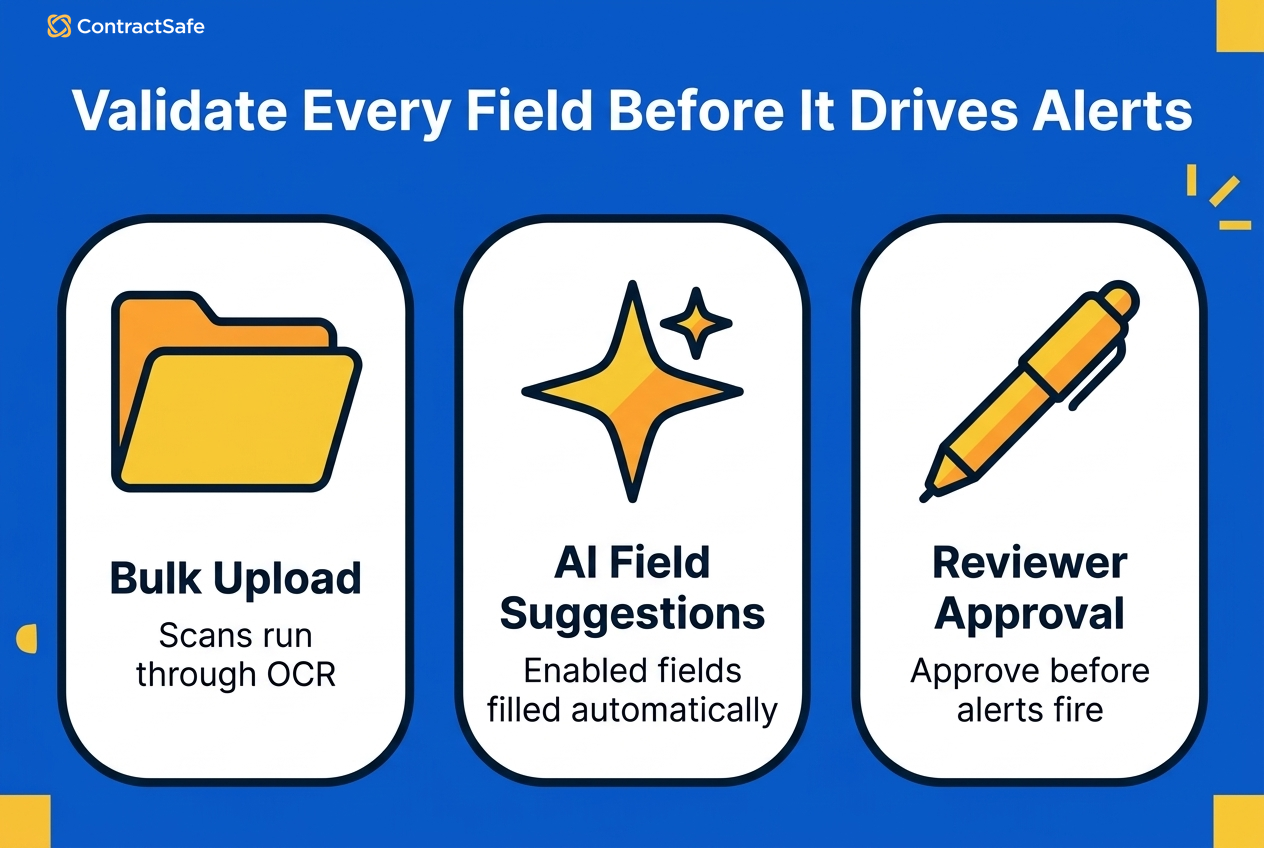
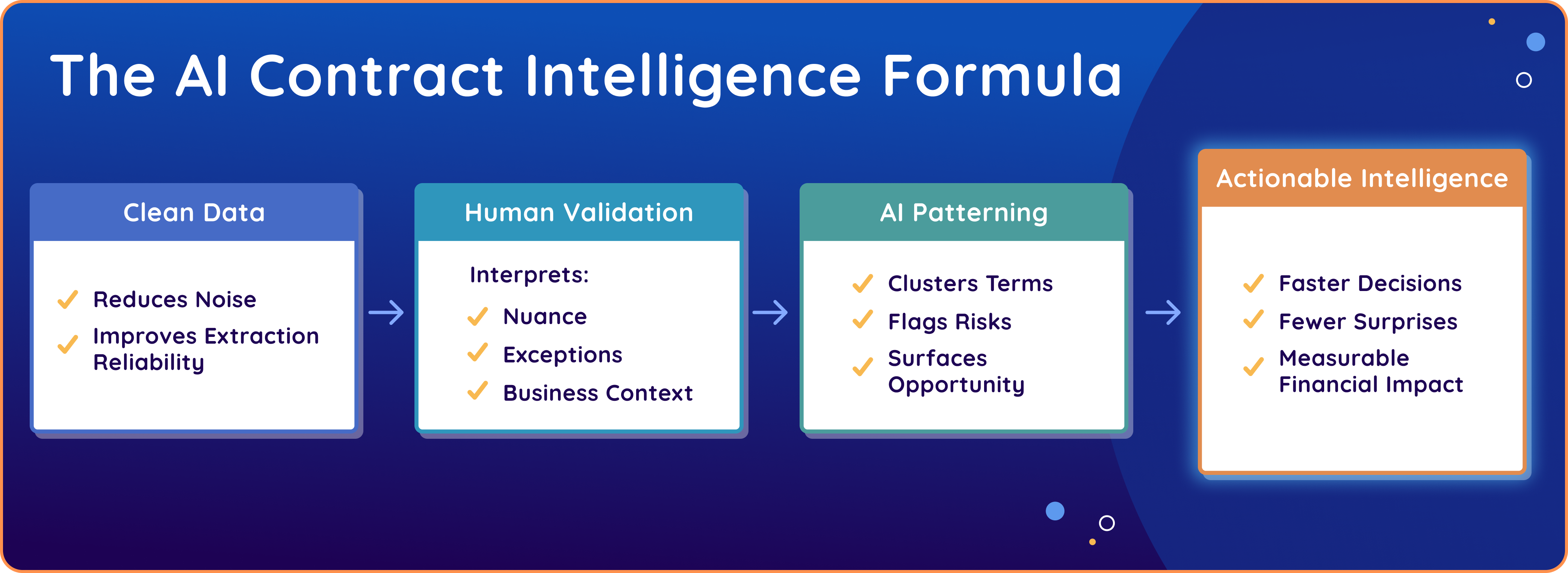
Between upload and a field you can rely on, extraction runs in four steps: the system reads the text, AI finds a value for each field you've turned on, a person confirms or corrects it, and the confirmed value feeds search, alerts and reports.
In ContractSafe, the first two steps happen on upload. Optical character recognition makes any file keyword searchable, scans included, and the AI then looks for the fields your admins have chosen, including key dates such as renewals, terminations, notice periods and expirations. Each suggestion waits for a person before it reaches the record. Extraction is built for English-language contracts. It may also work on Spanish, French or German contracts, where each value stays in the contract's own language, so check those more closely.
Which Fields Contract Data Extraction Can Pull
Most extraction covers five groups of fields:
Parties: party names, signers and notice recipients.
Dates: effective, executed, expiration and renewal dates, plus notice deadlines.
Money: total and annual contract value, payment terms, invoice frequency and price escalators.
Renewal and termination: auto-renewal, renewal term and termination rights.
Clauses and compliance: governing law, liability caps, indemnity, SLA obligations and data privacy terms such as GDPR or BAA requirements.
Start with the fields someone will act on. If no one will get a reminder, run a report or answer a question from a field, leave it off for now. If the built-in fields don't cover something you act on, add your own. Most teams do: 83% of paying ContractSafe accounts have added custom fields, a median of 12 each.
Why Teams Are Turning to Extraction Now
Interest in AI is running ahead of where contracts and their data actually live. The CCM Institute and WorldCC 2026 survey found enthusiasm for AI rose from 36% in 2025 to 56% in 2026, but only one in four practitioners access AI through their CLM. The contracts themselves are scattered too: a May 2026 Sirion and WorldCC study found only 27% of organizations keep all executed contracts exclusively in CLM.
Extraction is what makes pulling contracts into one system pay off. Once a renewal date or reporting deadline is a field, obligation monitoring stops depending on someone remembering which PDF to open. The same shift is changing how teams read new agreements, which we cover in how AI is transforming contract review.
How Accurate Is Contract Data Extraction?
Accuracy depends on the field. In current tests, single-value fields such as parties and governing law extract almost perfectly, while money and conditional fields such as annual contract value and renewal term go wrong often enough that a person should check every one.
The most useful evidence so far is A Few Good Clauses, a May 2026 benchmark from Onit AI Labs, a contract software vendor. It tested 26 contract fields on 24 held-out SEC EDGAR contracts using 508 field instances labelled by lawyers, and the vendor's own model, Olava Extract, scored 0.842 micro F1 and 0.812 macro F1.
The field-level spread in the benchmark results is what matters for review:
Near perfect: Renewal Notice Period (1.000), Parties (0.990) and Governing Law (0.977).
Weakest: annual contract value, payment period frequency, renewal term, executed date and total contract value.
Treat those results as indicative. The study's authors were testing their own employer's model, the test set is 24 contracts, and they state that no statistical significance testing or confidence intervals are computed.
Where People Still Need to Check the Work
AI doesn't replace legal review or business judgment. It can find a liability cap, but it can't tell you whether that cap is acceptable for this vendor, so don't let extracted values drive contract approval, risk acceptance or regulatory calls until a person has confirmed them. Human oversight matters beyond contracts, too, which is why teams expanding their use of AI also invest in agentic AI security around their AI-powered workflows.
Before a field drives an alert or a report, put it in one of these review tiers:
Spot-check a sample: parties, governing law and notice periods.
Check every value against its clause: contract value, payment frequency, renewal term and executed date.
Check against the whole file: anything an amendment, exhibit or schedule could change, such as pricing or term length.
If you're turning these tiers into vendor requirements, compare the leading AI contract review software on how each tool lets you review and correct extracted values.
How Extracted Data Becomes Strategic Intelligence
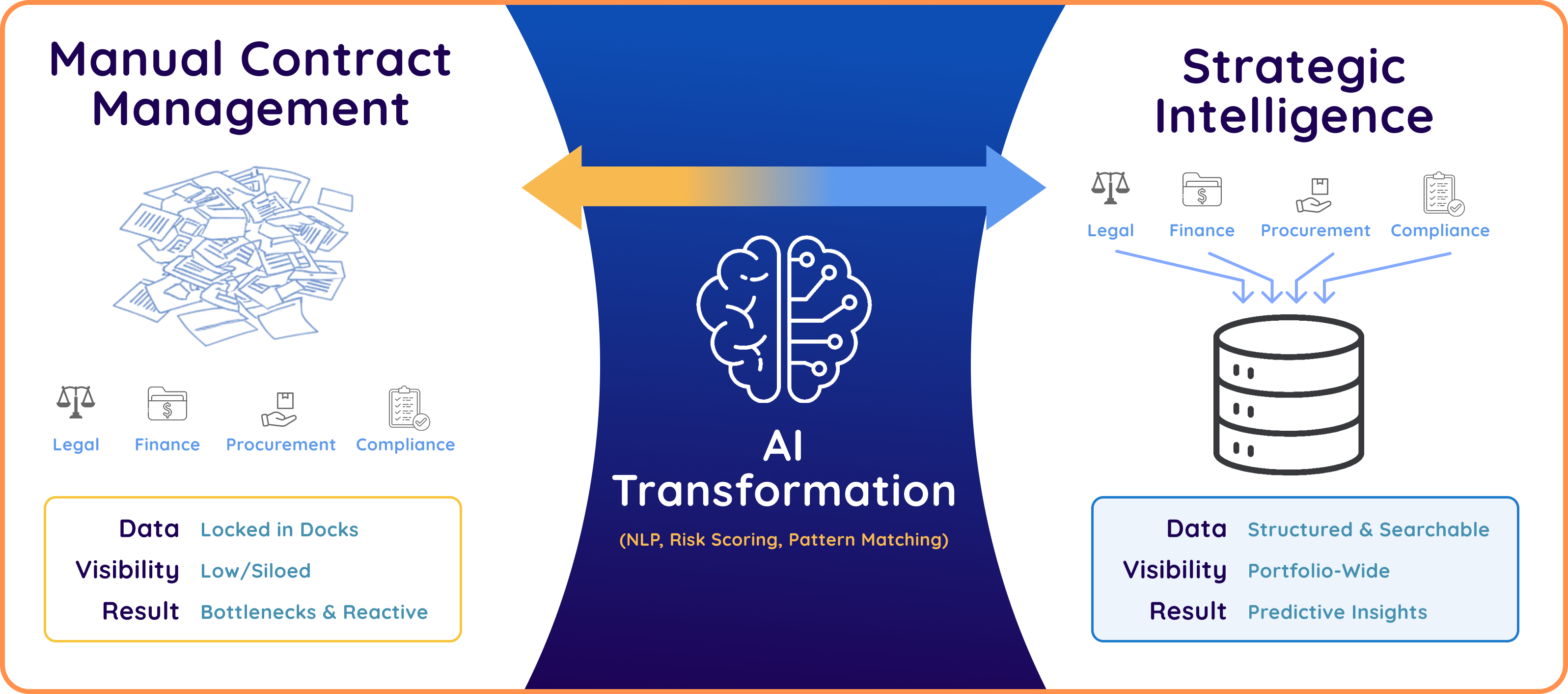
Extracted data becomes strategic intelligence when validated fields cover the whole portfolio, so you can filter and compare hundreds of contracts at once. Recurring risks and cost overlaps only show up at that level, because nobody spots a pattern by reading one contract.
What Risks Show Up Across Contracts
Portfolio data shows where you've accepted terms that drift from your standards and where expected protections, like liability caps, data privacy language or insurance requirements, are missing. Extraction shows you that drift in contracts you've already signed. To catch it before signing, ContractSafe's AI Contract Review, on the Maximize plan, checks incoming contracts against rules your team defines, reports passes and failures, links to the relevant clauses and can suggest wording. Rules the AI creates need a person to review and accept them, and playbooks are English-only.
How Extracted Dates Keep Obligations on Track
A date field earns its place when it becomes a reminder, and 86% of paying ContractSafe accounts have date reminders set. Reminders can cover payment dates, milestones, renewals, expirations and deadlines to non-renew. Each one belongs to the contract and its recipient list rather than one person's inbox, so it keeps firing when someone changes roles, and recipients don't have to be ContractSafe users.
Auto-renewals stop being a yearly scramble, too. Turn on Autorenew for an auto-renewing contract and ContractSafe rolls the renewal date and the deadline to renew forward each cycle, with reminders resetting on their own.
For compliance questions, search does the digging. You can look for every agreement that mentions HIPAA or GDPR, scans included. Smart Search is optimized for English-language contracts.
Where the Money Is Hiding
Once vendor names and service types are fields, overlapping subscriptions and separate consulting deals that could be combined show up in one filtered list. Financial fields also surface volume tiers, rebates, credits and price escalators that go unclaimed because no one remembers they're there. On the revenue side, they point to payments, royalties or escalations you're owed but haven't enforced.
Check those financial fields before anyone forecasts from them. They're the fields the vendor-authored May 2026 benchmark found weakest, with the vendor's own model scoring 0.333 F1 on annual contract value across 24 test contracts.

How Contract Data Extraction Works on Messy Files
Messy files extract well once the text is readable and you know which version is final. After that, the people who know each deal need access to confirm the values, because a correction fixes the record that search, reports and alerts all run on.
How Scanned Contracts Become Readable
Old scans look like documents to you and like pictures to a computer. ContractSafe runs optical character recognition (OCR) on them so their text becomes keyword searchable and available for extraction. Expect native digital files to extract more cleanly than blurry, low-resolution scans or pages with handwritten margin notes, so review values from older paper more closely.
How to Make Sure You're Extracting from the Right Version
Extract from executed agreements, and keep amendments, exhibits and schedules with the contract they change, or the fields will describe a deal that no longer exists. ContractSafe records contract views, downloads and changes, and general audit trails are included on every plan. Signing through ContractSafe, on the Finalize or Maximize plan, settles the version question for you: the signed copy replaces the draft, the draft stays attached, and the signature audit trail is attached to the final document.
Who Should Review the Extracted Values
The best reviewer is whoever knows the deal: the finance lead for payment terms, the procurement manager for vendor renewals. Per-seat pricing pushes companies to limit logins, which leaves those people unable to check the fields they know best. ContractSafe pricing starts at $450/month (Organize plan, billed annually; $540 month-to-month), with unlimited users on every plan.
In practice, the people reviewing fields often aren't lawyers. Fewer than 1 in 4 primary ContractSafe account admins have a legal job title, and among users with a known job title, finance (23%), operations (21%) and executives (20%) each outnumber legal (17%). So plan your review around the people who own the deals.
A Parser or Extraction Inside a CLM
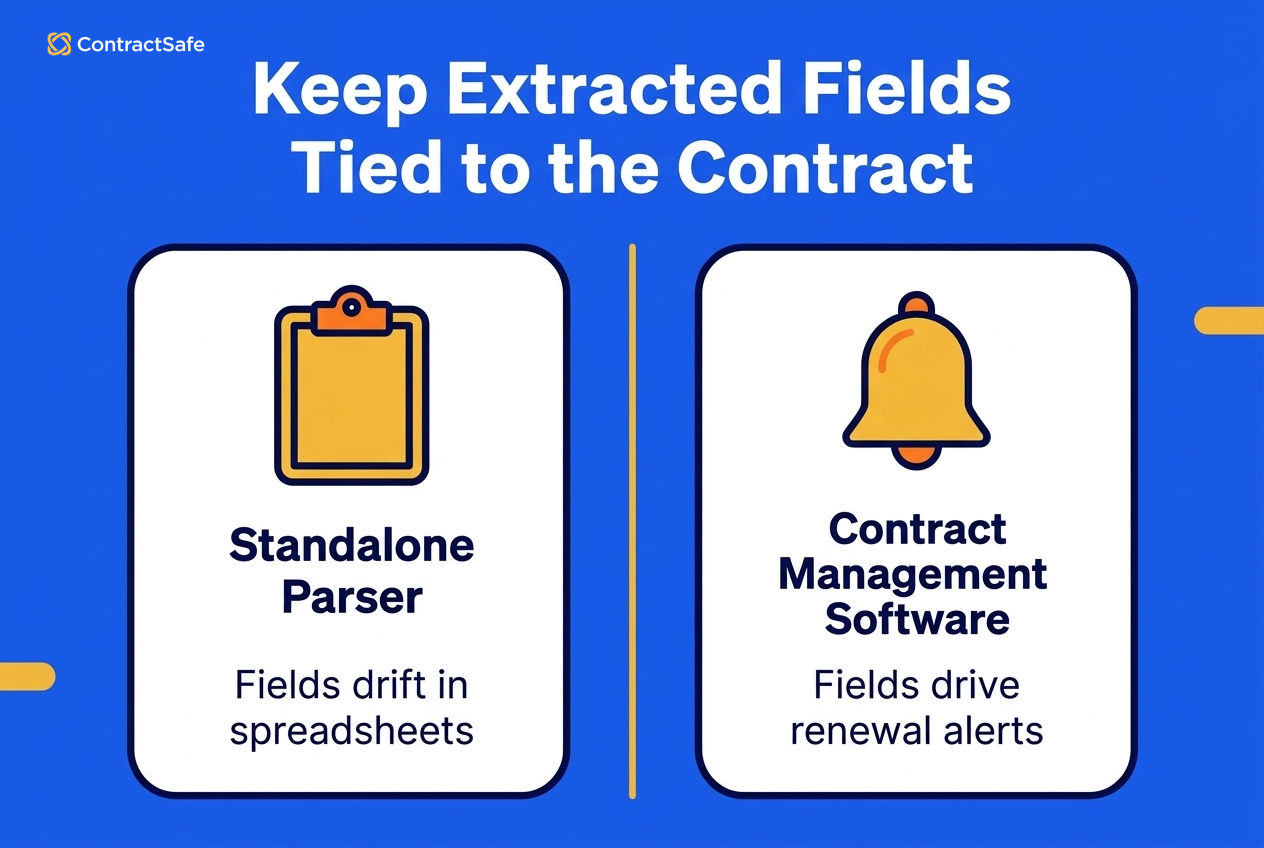
A standalone parser exports fields to a spreadsheet. That can work for a one-time cleanup, but the sheet goes stale the day a contract is amended, and no reminder fires from a cell nobody opens. Extraction inside the CLM keeps each value attached to its contract, so a confirmed renewal date becomes a reminder and a confirmed value shows up in reports.
That difference decides it once you own more than a handful of contracts. The median ContractSafe account holds about 700, far too many to keep a spreadsheet current by hand.
How Legal, Finance, Procurement and Compliance Use Extracted Data
Each team asks different questions of the same validated fields. Legal checks terms against its standards, finance forecasts renewals and escalators, procurement finds overlapping vendors, and compliance shows which contracts carry which obligations.
Extraction is only as strong as the review behind it, and that's where ContractSafe provides a critical advantage: with unlimited users on every plan, the people closest to each deal can check suggested values across contracts before they're added.
Legal: Find the Same Deviation Everywhere
Legal can stop hunting for risky terms one file at a time. At the portfolio level, recurring indemnity carve-outs or unusual liability caps show up across agreements. Finding the same carve-out in 14 MSAs, for example, tells Legal it's time to update fallback language and the standard template, which shortens the next round of review.
Finance: See Renewals and Escalators Coming
Auto-renewals and price escalators hide in vendor agreements. With those terms in fields, finance gets a forward view of spend, fewer surprise invoices and time to renegotiate before a renewal deadline passes. For the wider business case, see how contract management software directly impacts your bottom line.
Procurement: Stop Paying Twice
If three departments pay for similar software, a filtered list of vendor and service fields shows it. A clear vendor contract management framework turns that list into consolidation and better volume pricing, and unmet service obligations give procurement grounds to enforce terms or escalate performance issues.
"ContractSafe gives us the complete picture on our full contract lifecycle. Our contracts are current, active, and organized in one place, while alerts, permissions, review routing, and reporting help us manage the work around them."
Carrie McClain, Procurement Specialist, Vitality Living
Compliance: Stay Ready for the Audit
When an audit is announced, compliance shouldn't have to rebuild the record. Searching extracted privacy and reporting fields shows which contracts include GDPR or PII provisions and which don't. On the Maximize plan, AI Contract Review can also check new agreements against your required privacy clauses and flag the ones that fail.
Related Reading
Before you rely on AI output, read our companion guide to checking extracted values field by field.
The same review habits apply to new agreements coming in, which we cover in using AI to simplify contract review.
How ContractSafe Helps With Contract Data Extraction
ContractSafe extracts contract data inside the same system that runs the contract, so confirmed fields feed search, reminders and reports as soon as someone accepts them. Search then covers your entire repository, scans included.
Admins pick which of the 29 available fields the AI looks for in new uploads. Users accept, correct or skip each suggested value before it's added, and they can review suggested values across contracts.
Confirmed dates become email reminders for payment dates, milestones, renewals, expirations and deadlines to non-renew, and the relevant contract is attached to each notification. ContractSafe supports contract creation, review, approval, signature, storage, date management and reporting, and the complete feature set requires the Maximize plan.
Every plan includes general audit trails. No annual commitment is required, and the median new customer has its first contract in the system within a week of buying.