Most teams don’t lose visibility into contracts all at once; it happens gradually. A contract sits in review longer than expected. Ownership becomes unclear. Business teams start asking, “Where is this contract?” and no one has a clear answer.
ContractSafe Lifecycle Tracking is designed to solve that problem by giving teams real-time visibility into where contracts are in the pipeline, how long they’ve been in each stage, and who is responsible for moving them forward, especially between drafting, review, approval, and signature.
Key TakeawaysContractSafe Lifecycle Tracking gives teams a clear, shared view of where contracts stand across their lifecycles, including current stage, ownership, and time spent in each step. Instead of relying on email check-ins or manual status updates, legal and business teams can see what’s moving, what’s stuck, and what needs attention to keep contracts progressing and properly managed over time.
Why Teams Lose Visibility Into Contract Progress
Most teams care deeply about moving contracts forward, but visibility often breaks down along the way. It’s important to understand that this breakdown doesn't happen because teams are careless or disengaged; it happens because contracts move without a structured tracking system.
When contracts move through drafting, review, approval, and signature, status often lives in inbox silos, email threads, or Slack messages that only one or two people can see. Without a shared system, there is no single source of truth.
-
A contract might be stuck in legal review for two weeks, but no one knows why.
-
Another might be waiting on a signature, and no one realizes it’s overdue.
-
When Sales asks, “Where’s the contract?”, legal ends up digging through messages instead of seeing the answer immediately.
This lack of contract status tracking creates a ripple effect of status chasing, late escalations, and stalled work. You find out a deal is dead on the last day of the quarter simply because a redline was never addressed in a buried email chain.
Why Visibility Breaks Down Between Contract Review, Approval, and Signature
The most dangerous phase for any contract is the gauntlet between review and signing. This is where visibility breaks down because contracts move between different departments, legal, finance, and business stakeholders, without a shared view of status or ownership.
-
Manual Check-ins: Status updates rely on manual pings instead of a system view.
-
The "Invisible" Wait: There is no visibility into how long a contract has been sitting in a specific person's queue.
-
Unclear Ownership: As contracts move between reviewers and approvers, the "ball" is often dropped because everyone assumes someone else has it.
This loss of visibility happens gradually and often goes unnoticed until a crisis arises.
RELATED READ: How Contract Management Software Affects the Bottom Line
How Contract Lifecycle Tracking Helps Legal Teams
Contract lifecycle tracking is about shifting from reactive firefighting to proactive contract management. It allows legal teams to spend less time answering status questions and more time actually moving contracts forward.
-
Answer status questions instantly: Legal teams can see where a contract is without searching email or chat threads. When Sales asks, “Where’s the contract?” the answer is immediately visible.
-
Spot bottlenecks before they become problems: You can see which contracts have been sitting in the same stage the longest.
-
Prioritize work with context: Instead of just responding to the person who is shouting the loudest in your inbox, you can prioritize tasks based on urgency, deadline, or the time spent in a particular stage.
-
Report on throughput and trends: You can finally answer operational questions like: "What’s the average time from review to signature?" or "Where do contracts tend to slow down most often?".
-
Stay informed as work moves: Automatic updates notify teams when contracts change stages, so reviewers know when something lands in their queue without constant checking.
RELATED READ: How To Simplify Your Contract Workflow With Contract Management Software
What “Contract Lifecycle Tracking” Actually Means (Stage-by-Stage)
In plain English, contract lifecycle tracking is the practice of monitoring where contracts are in your workflow using defined contract lifecycle stages. This transforms management from reactive status chasing ("Where did this go?") into proactive visibility ("I can see exactly where everything stands").
The Standardized Lifecycle Stages
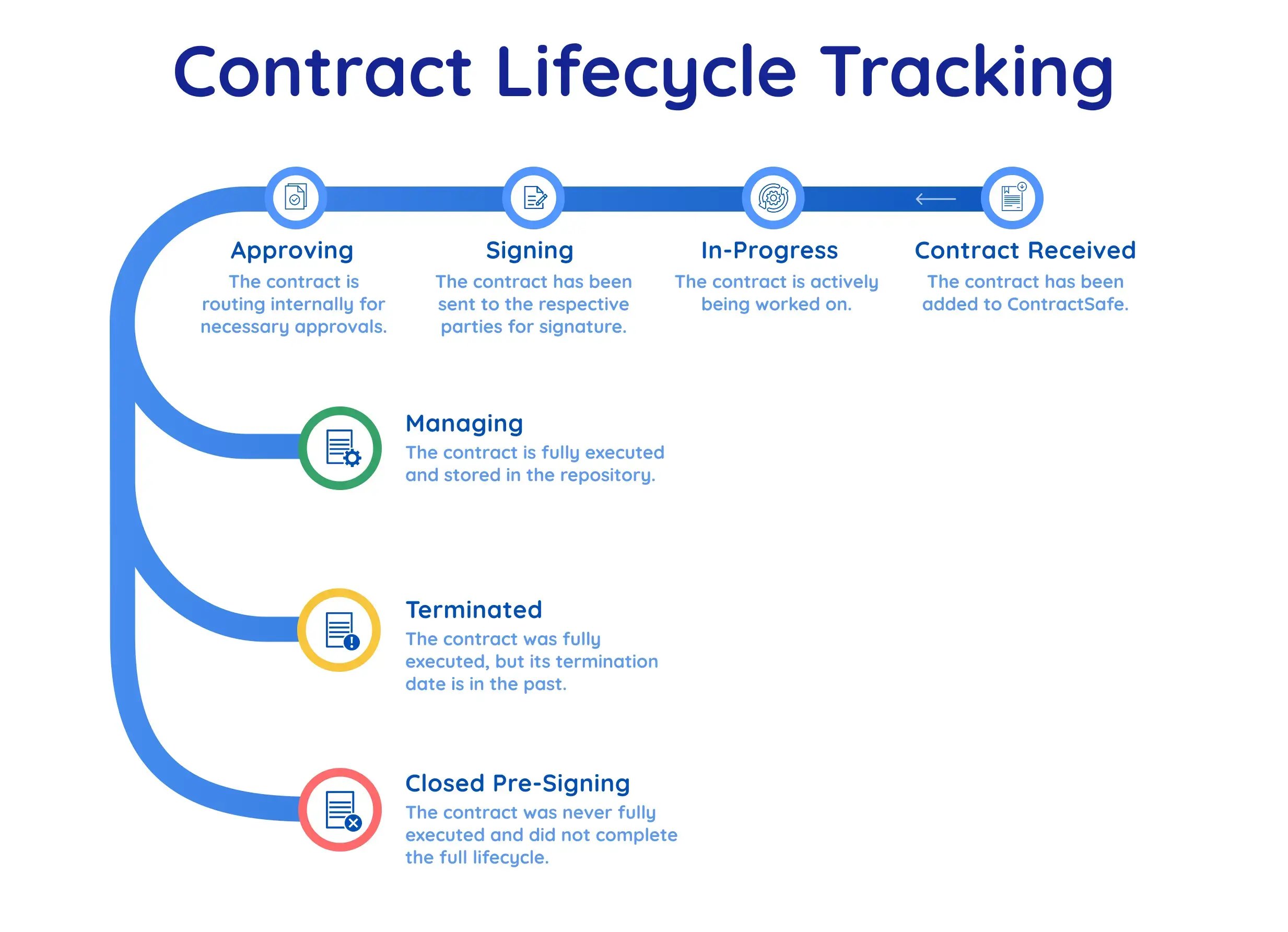
To have a shared language across teams, you need clear stages:
-
Contract Received: The intake phase where the request is first logged.
-
In-Progress: The drafting and active negotiation phase.
-
Approving: The internal stage where stakeholders (Finance, IT, etc.) sign off.
-
Signing: The contract is out for execution.
-
Managing: The post-signature phase where you track obligations.
-
Closed Pre-Signing: Deals that didn't make it to the finish line.
RELATED READ: Contract Lifecycle Management Process Best Practices: The Ultimate Guide
How Lifecycle Tracking Improves Contract Pipeline Management
When status is visible across every stage, you’re gaining real power over your entire contract workflow. Instead of guessing why a deal is stalled, you can see exactly where the bottlenecks are hiding. If contracts are piling up in the review stage, you might have a negotiation snag on your hands.
If the approval stage is the culprit, it’s usually a sign of capacity constraints or someone simply missing the context they need to hit Sign. This kind of visibility turns "I think we're busy" into "I know exactly where we need to jump in."
This isn't just about spotting trouble; it’s about making sure your team stays sane. Operations can see the total volume of contracts in progress at a glance, making it easy to shuffle the deck and distribute work more effectively.
Plus, when you have this level of transparency, contracts that have been sitting in one spot for too long stick out like a sore thumb. You can prioritize those aging agreements and get things moving again before a minor delay turns into a major headache for your stakeholders.
Measuring Contract Turnaround Time and Pipeline Trends
Once your stages are visible, you’re moving from "I think it’s stuck" to "I know exactly what’s happening." It’s about trading guesswork for real, actionable data that tells the full story of your contract’s journey. You get to see the big picture, like the average time it takes for an agreement to travel from received to signed, but the real magic is in the stage-level details.
You might find that while your team is drafting at lightning speed (go team!), things are sitting in the signing queue for ten days. Identifying that specific gap is the first step toward actually fixing it, rather than just wondering where the time went.
This level of insight is also a total game-changer for managing expectations across the business. Instead of relying on vibes or anecdotes, you can use hard data to set realistic timelines with your stakeholders, making you the hero who always delivers on time. Plus, it gives leadership a much clearer view of the why behind any delays.
They can finally distinguish between a temporary slowdown caused by a sudden spike in volume and a genuine process snag that needs a little grease. It’s not just about tracking numbers; it’s about having the visibility you need to keep the whole operation moving smoothly.
Who Owns Each Stage of the Contract Lifecycle
Even if you can spot a contract sitting in the approving stage, things will still stall out if nobody knows who’s actually at bat. It’s not enough to just see the status; ownership has to be an intentional handoff as responsibility shifts between your legal, finance, and business stakeholders.
Think of it as a relay race where the baton needs a clear recipient. By using automatic notifications, the relevant team members get a heads-up the second a contract hits their queue, so they know exactly when it’s their turn to move the needle. This kind of visibility is a total lifesaver; it cuts down on those” just checking in" pings and ensures no handoffs get missed in the shuffle.
RELATED READ: 6 Stages of Contract Lifecycle Management (CLM)
How ContractSafe Tracks Lifecycle Progress in One Dashboard
The real challenge for most teams is having a single place to see all of this without relying on scattered tools or manual check-ins. ContractSafe provides a centralized contract lifecycle management software experience that keeps things refreshingly simple.
Centralized Contract Lifecycle Status Visibility
Our dashboard puts contract stages in one place so teams can see progress across drafting, execution, active management, and renewal.
-
No More Chasing: Status visibility reduces manual follow-ups because you don't need to hunt for updates in meetings.
-
Prevent Stalling: Overlooked or inactive agreements are easy to spot before they quietly stall.
Contract Ownership and Accountability Visibility
Lifecycle tracking is only actionable if you know who to talk to.
-
Visible Accountability: Responsibility is clear at each stage of the lifecycle.
-
Faster Issue Routing: Questions and issues are routed to the right person faster because ownership is visible alongside status.
Contract Alerts, Integrations, and Lifecycle Support Tools
Alerts work best when they reinforce the lifecycle, rather than acting as disconnected reminders.
-
Stage-Change Alerts: Get notified the moment a contract moves into your queue.
-
Time-in-Stage Alerts: Surface contracts that have stalled in review or approval before they turn into late-quarter emergencies.
-
Integrations: ContractSafe slides into your existing workflows with a two-way DocuSign integration, Salesforce sync, and Microsoft Word integration.
What Contract Deadline Tracking Covers and What It Misses
It’s a common mix-up: mistaking a calendar full of deadline alerts for actual contract lifecycle tracking. While tracking signature dates and approval SLAs is great for keeping time, it only gives you a tiny slice of the pie.
The danger here is a false sense of security. You might think everything is under control because the dates look fine, but without seeing where a contract is sitting or who is currently at bat, you’re missing the bigger picture of your pipeline’s health.
If you only see the when and not the who or where, you’re essentially flying blind through potential bottlenecks. Real tracking shouldn't just tell you that you're late; it should show you exactly where the progress stalled so you can move the needle before a minor delay turns into a major backup.
Why Contract Lifecycle Tracking Goes Beyond Deadline Alerts
Lifecycle tracking is the secret sauce that turns a messy list of dates into a structured, manageable pipeline. By connecting specific deadlines to actual stages and ownership, you finally get the full story of what needs to happen both before and after a date hits the calendar. This means you can spot stalls and handoffs in real-time, no more waiting until a deadline has already zipped past to realize things are stuck.
It’s the difference between constantly reacting to what’s due this second and having the foresight to see exactly what’s coming down the pipe, so you can plan your week (and protect your sanity) accordingly.
RELATED READ: How to Simplify Tracking Contract Deadlines
Why Lifecycle Tracking Improves Forecasting and Operational Planning
When your reporting is fueled by real-time pipeline data, you finally get to trade gut feelings for actual strategic planning. Instead of guessing how long a deal might take, you have clear visibility into cycle times, making it easy to set realistic expectations with the business (and look like a total pro while doing it).
You’ll be able to see exactly how many contracts are active at each stage, spotting capacity constraints before your team feels like they’re totally underwater. Best of all, it completely changes the conversation with leadership.
Instead of the dreaded "Legal is a black hole" narrative, you can walk into the room with data that shows exactly where the process is backing up. Whether it’s negotiation drag or an approval bottleneck, you’re moving from defense to offense with the facts to back you up.
How ContractSafe’s Contract Lifecycle Tracking Works
At ContractSafe, our focus is on responsible and practical AI and high-value features that your entire organization can adopt immediately.
-
Centralized Lifecycle Dashboard: See all contracts in one view, including current stage, owner, priority, and time in stage.
-
Time-in-Stage Visibility: Spot stalled agreements and bottlenecks early with clear timing data.
-
Turnaround Time Metrics: Data that supports cycle time and throughput reporting, making forecasting a breeze.
-
Automated Stage-Change Notifications: Automated emails notify relevant team members when a contract moves, so ownership is always clear without manual follow-ups.
Unlike complex enterprise systems that can take 6-12 months to set up, most of our customers are up and running in a single day. We handle the full import and onboarding for you as part of our partnership, at no extra cost.
Bringing Clarity to the Contract Lifecycle
Contract lifecycle tracking isn't about adding more B.S. (bells and whistles) or heavy process; it’s about maintaining clarity while contracts are moving. By making visibility, ownership, and time-in-stage the center of your strategy, you can reduce status chasing, avoid stalled deals, and keep work moving predictably from the first draft to the final signature.
It’s time to move from a reactive queue to a proactive pipeline.
Ready to see how refreshingly simple contract management can be? Schedule your demo today.

Key Takeaways
-
Visibility Breakdown: Contract visibility often fails during drafting, review, and approval because status is hidden in emails.
-
Stages Matter: Lifecycle tracking focuses on stages, ownership, and time-in-stage—not just storage or dates.
-
Clear Ownership: Knowing who is responsible at each stage reduces handoff confusion and keeps deals moving.
-
Spot Bottlenecks: Pipeline visibility helps legal teams identify and fix delays before they become crises.
-
Clarity Over Complexity: Lifecycle tracking replaces reactive status chasing with shared, predictable visibility.




.svg)







.svg)