
Contract lifecycle management (CLM) is the process of managing contracts from creation through negotiation, approval, execution, ongoing management, renewal, and reporting. A well-defined contract lifecycle management process ensures contracts move predictably through each stage, with clear ownership and accountability.
When that process isn’t clearly defined or consistently followed, problems emerge. Contracts get delayed. Approvals stall. Renewals sneak up. Obligations get missed—not because teams don’t care, but because the CLM process breaks down as work moves between people and departments.
At its core, contract lifecycle management is about how work moves: who initiates contracts, how they’re reviewed, how decisions get made, and what happens after an agreement is signed.
This guide breaks the contract lifecycle management process down into a practical, repeatable operating model you can actually run—whether you’re managing 50 contracts or 50,000. It’s process-first (not software-first) and focused on execution, not theory.
Industry research from World Commerce & Contracting has repeatedly shown that weak contract management contributes to significant value leakage over the life of agreements—making process discipline just as important as legal language.
RELATED READ: What is the Contract Management Process?
Key Takeaways
-
Contract lifecycle management (CLM) is the end-to-end process of managing contracts from creation through execution, renewal, and reporting.
-
Strong contract lifecycle management processes reduce delays, improve compliance, and limit value leakage.
-
Effective CLM programs rely on clear stages, defined ownership, standardized artifacts, and measurable controls.
-
CLM maturity isn’t about adding complexity—it’s about standardization, visibility, and accountability.
What Is Contract Lifecycle Management (CLM)?
Contract lifecycle management (CLM) refers to the process of managing contracts throughout their entire lifecycle—from initial creation through negotiation, approval, execution, ongoing management, renewal, and reporting.
While CLM is often associated with software, at its core it’s a process discipline. It defines how contracts move through an organization and how responsibility is assigned at each point in the lifecycle.
CLM goes beyond simply storing contracts. It introduces structure, accountability, and visibility into how agreements are created, approved, executed, and managed over time.
Once CLM is understood as a process—not just a tool—the next step is clarifying how contracts move through that lifecycle in practice.
The Contract Lifecycle Management Process (High-Level Overview)
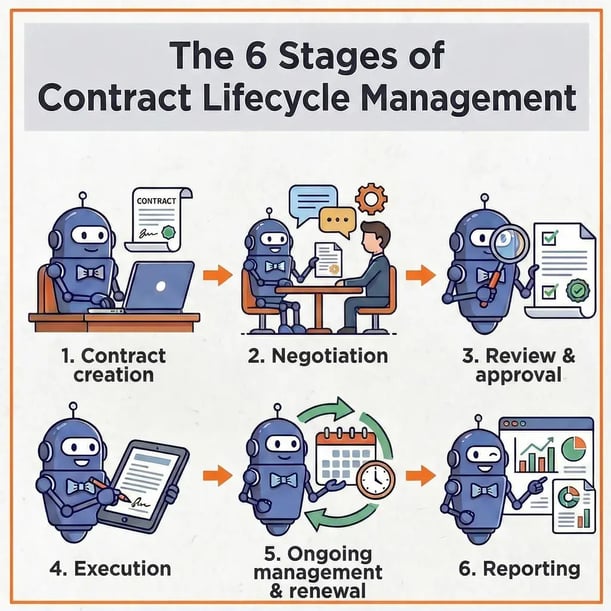
Contract lifecycle management is a cross-functional process. While ownership shifts as contracts move through the lifecycle, several core roles consistently contribute to how contracts are created, reviewed, managed, and reported.
Every contract follows a lifecycle, whether it’s formally documented or not. What separates high-performing teams from struggling ones is their ability to make that lifecycle visible, consistent, and measurable. A well-defined contract lifecycle management process ensures contracts are not only executed efficiently but actively managed throughout their lifespan.
Most organizations use a common set of lifecycle stages to structure their contract workflows. These stages explain what happens to a contract over time—not how complex each step needs to be.
RELATED READ: How Contract Management Software Streamlines Processes
Roles Involved in Contract Lifecycle Management at Each Stage:
While ownership changes as contracts move through the lifecycle, a small set of core roles consistently participate in contract lifecycle management:
-
Business Owners are responsible for contract performance and ongoing obligations.
-
Legal / Contracts manages contract terms, negotiation, and legal risk.
-
Legal Ops governs the CLM process, systems, and reporting.
-
Finance focuses on spend visibility, renewals, and financial impact.
-
Executives / Leadership provide oversight and approval for material agreements.
These roles collaborate throughout the lifecycle, but accountability shifts depending on the stage of the contract.
Ownership by Stage in the Contract Lifecycle
While multiple roles participate in contract management, ownership changes as a contract moves through the lifecycle. The table below shows primary ownership and supporting roles at each stage.
How to think about these stages
These stages are process checkpoints, not departments.
Every contract passes through all of them—even if informally.
Most CLM failures don’t come from missing stages. They come from:
-
unclear ownership
-
inconsistent handoffs
-
lack of visibility after execution
If you already “have the stages,” but contracts still stall, disappear after signing, catch teams off guard at renewal, or fail audits, the issue isn’t the framework—it’s process execution.
That’s what the rest of this guide focuses on.
RELATED READ: 6 Stages of Contract Lifecycle Management (CLM)
Contract Lifecycle Management Best Practices
Contract lifecycle management best practices focus on reducing friction, clarifying ownership, and maintaining visibility across every stage of the contract lifecycle.
High-impact CLM best practices include:
-
Standardizing intake and contract templates
-
Defining ownership at every stage
-
Controlling versions and approvals
-
Tracking obligations like tasks
-
Reviewing renewal decisions early
-
Measuring performance consistently
Together, these practices turn the contract lifecycle from a series of one-off actions into a repeatable operating model.audit your contract management process
RELATED READ: 5 Proven Tips for Better Contract Tracking (Do’s and Don’ts)
Roles & Ownership Across the Contract Lifecycle
Contract lifecycle management is a cross-functional process. While ownership shifts as contracts move through the lifecycle, several core roles consistently contribute to how contracts are created, reviewed, managed, and reported.
• Business Owners are responsible for contract performance and obligations.
• Legal / Contracts manages terms, negotiation, and legal risk.
• Legal Ops governs the CLM process, systems, and reporting.
• Finance focuses on spend visibility, renewals, and financial impact.
• Executives provide oversight and approval for material agreements.
Unclear ownership is one of the most common causes of CLM breakdowns. When responsibility shifts—or disappears entirely—contracts slow down and risk accumulates quietly.
Effective CLM programs define who owns each part of the lifecycle, from request through renewal.
Key CLM Artifacts
A contract lifecycle management process isn’t enforced by good intentions or tribal knowledge. It’s enforced by shared, repeatable tools that guide how work gets done.
In CLM, these tools are often referred to as artifacts. Artifacts are the documents, templates, trackers, and reports teams use to run the contract lifecycle consistently—regardless of who is involved.
Key CLM artifacts include:
• Intake forms that standardize how contract requests are submitted
• Templates and clause libraries that reduce drafting and negotiation time
• Approval matrices that define who must review and approve contracts
• Obligation trackers that capture post-signature responsibilities
• Renewal calendars that surface upcoming notice periods and decisions
• KPI dashboards that show contract volume, risk, and performance
These artifacts provide structure across the contract lifecycle and reduce reliance on institutional knowledge. Once they’re in place, organizations can move from reactive contract handling to measurable, repeatable process performance.
Measuring CLM Performance
If you can’t measure your contract lifecycle, you can’t manage it. These CLM metrics help teams identify where contracts slow down, where risk concentrates, and where accountability breaks across the lifecycle.
Focus on KPIs that reflect process health, such as:
-
Contract cycle time
-
Exception rate
-
Approval turnaround time
-
Metadata completeness
-
Renewal accuracy
-
Obligation completion
The goal isn’t to track everything—it’s to track what reflects decision quality and operational control.
RELATED READ: How to audit your Contract Management Process
Common CLM Process Failures (and Fixes)
Most contract issues follow predictable patterns. The same breakdowns appear across organizations and industries.
Common failures include:
-
“Contracts live in email” → Centralize storage
-
“We don’t know who approved this” → Enforce approval records
-
“We forgot about the renewal” → Track dates and automate reminders
-
“We can’t report on contracts” → Standardize metadata
Identifying these failure points makes them far easier to prevent.
RELATED READ: How To Build Effective Contract Management Processes
CLM Reality Check
Use the questions below to quickly assess how effective your current contract lifecycle management process really is.
- Can you identify the current owner of any active contract in seconds?
- Do renewal decisions happen before notice periods expire?
- Can leadership trust contract reports without manual cleanup?
If any of these are difficult to answer, the issue isn’t effort—it’s process visibility.
How CLM Evolves as You Scale
A CLM process that works for a small team won’t hold up as contract volume, stakeholders, and risk increase. As organizations grow, contract lifecycle management challenges change—but the underlying lifecycle structure remains the same.
-
Startups need simplicity and consistency to avoid ownership gaps and ad-hoc approvals.
-
Mid-market teams need visibility and standardization as contract volume increases and renewals become harder to track.
-
Enterprises need governance, reporting, and audit readiness to manage risk across complex portfolios.
Scaling CLM processes isn’t about adding complexity. It’s about maintaining clarity as contract volume, stakeholders, and risk increase.
RELATED READ: How To Scale Your Contract Management Processes
Turning CLM Process Into Practice With ContractSafe
Defining a strong contract lifecycle management process is only half the equation. The harder part is running that process consistently as contract volume, stakeholders, and risk increase—without creating new bottlenecks or relying on manual workarounds.
ContractSafe is designed to support CLM processes in practice by reinforcing the fundamentals teams rely on to stay in control:
• Centralizing contracts so agreements don’t disappear after execution
• Maintaining visibility across the full lifecycle, not just pre-signature
• Tracking key dates and obligations so renewals and commitments aren’t missed
• Supporting reporting teams can trust without manual cleanup
When contracts are easy to find, ownership is clear, and obligations are tracked as part of daily work, the contract lifecycle stops being reactive. It becomes a reliable system teams can run with confidence.
Conclusion
A strong contract lifecycle management process isn’t about adding steps or tools—it’s about creating clarity. When ownership is defined, handoffs are consistent, and contracts remain visible after execution, teams spend less time reacting and more time making confident decisions.
Most contract breakdowns don’t come from missing stages. They come from process gaps: unclear accountability, inconsistent execution, and limited visibility once a contract is signed. Fixing those issues doesn’t require complexity—it requires a repeatable operating model that scales as contract volume grows.
If your CLM process is documented but difficult to run day to day, the next step is supporting it with systems that reinforce visibility, ownership, and accountability—without introducing new friction.
Contracts don’t stop needing attention once they’re signed. See how ContractSafe helps teams manage the full contract lifecycle—from execution through renewal—without added complexity.







.svg)







.svg)