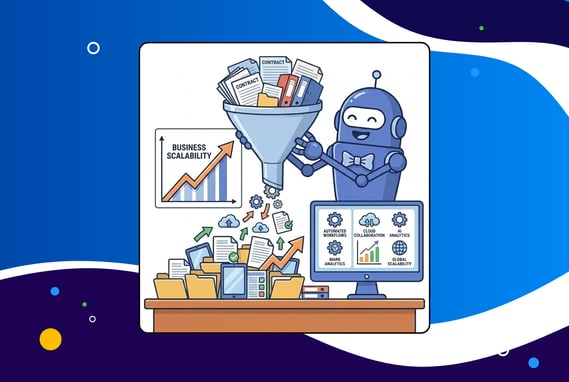
Scaling contract management processes means your contract approach works as volume and complexity grow — without manual bottlenecks or risk. It depends on centralized visibility, clear ownership, process consistency, and tracking obligations so growth doesn’t break your workflows.
As your small business grows, you may find yourself struggling to keep up with the new influx of contracts. What was once a manageable stack of paperwork is now a mountain, and your trusty old spreadsheet system just isn't cutting it anymore.
In this post, we’ll walk through how to scale your contract management processes effectively, transforming what feels like an administrative nightmare into a streamlined, efficient part of your business.
From understanding the significance of adaptability in your contract management to auditing your current processes, and, finally, implementing the right tools and strategies for growth — we've got you covered.
Key Takeaways
- A flexible contract management process can help your business grapple with an influx of new agreements.
- Conducting an audit of your current approach will uncover areas for improvement and help you create a process that will grow with your business.
- Structure before automation: centralization reduces missed deadlines and standardization supports repeatable processes.
- ContractSafe can help your business scale with flexible pricing, AI data extraction, and seamless system integrations.
Why do contract management processes break as companies grow?
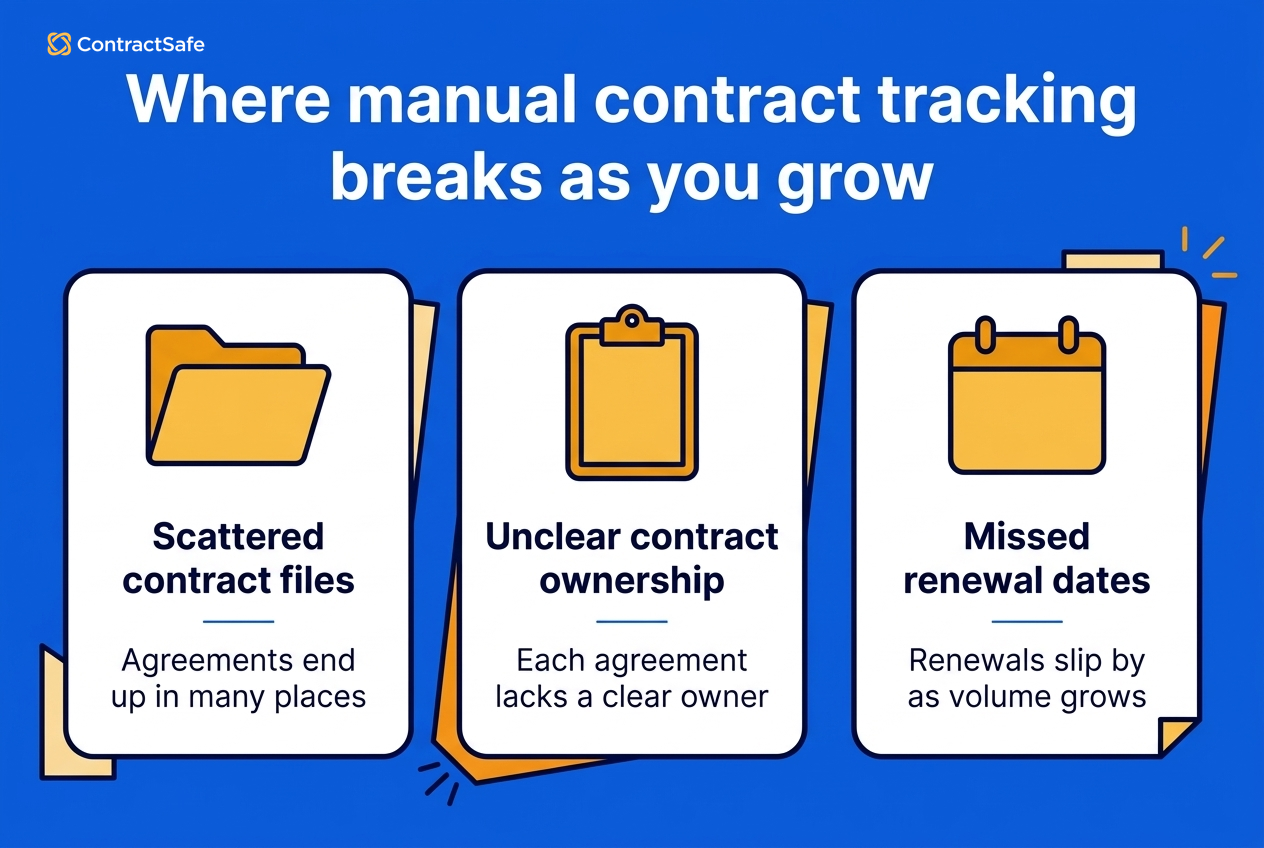
As organizations expand, informal workflows and manual tracking stop working. What was manageable at low volume becomes fragmented: contracts are scattered, ownership is unclear, and renewals get missed — which increases risk and inefficiency.
Keep:
For small businesses, growth can mean a lot of things: increasing sales, expanding your customer base, or even getting a cash injection from a big investor.
But no matter how you’re growing, there’s always one constant… As you scale, so too will the volume and complexity of your agreements.
And that’s exactly why your contract management process needs to be adaptable. If your team is still defining the discipline, our contract management overview is the place to start.
When the foundation of your business dealings (your contracts) starts to become a bottleneck, it's a clear sign that your current system isn't built to scale with your business's growth.
Adaptable contract processes will lead to:
- Streamlined operations and efficiency: By making your contract management process more adaptable, you can manage an increasing volume and variety of contracts without proportionally increasing the resources dedicated to managing them.
- Regulatory agility: The regulatory landscape is always changing, and businesses need to be able to pivot quickly. An adaptable system allows for rapid adjustments to comply with new laws and regulations, reducing legal risks and ensuring your business operations continue to run smoothly.
- Faster turnaround times: A flexible process can drastically reduce the time it takes to review, approve, and finalize contracts. This accelerated turnaround frees up resources, allowing your team to focus on core activities that drive growth rather than getting bogged down in administrative tasks.
In essence, adaptable contract management processes will grow with your business and help you manage your agreements effectively, whether you’re dealing with 50 or 500.
RELATED READ: What is the contract management process?
How Do You Audit Your Current Contract Management Process?
Auditing your current contract process means evaluating how contracts are stored, tracked, and tracked for obligations. A thorough audit reveals bottlenecks and inconsistencies so you can fix gaps before you scale.
Before you can scale your contract management processes, you need to know where they currently stand.
A thorough audit will enable you to identify areas for improvement and simplification in your contract management process, helping you build a foundation for your business's continued growth.
In other words, you want to nail your process before you try to scale your process.
Here’s how to do it:
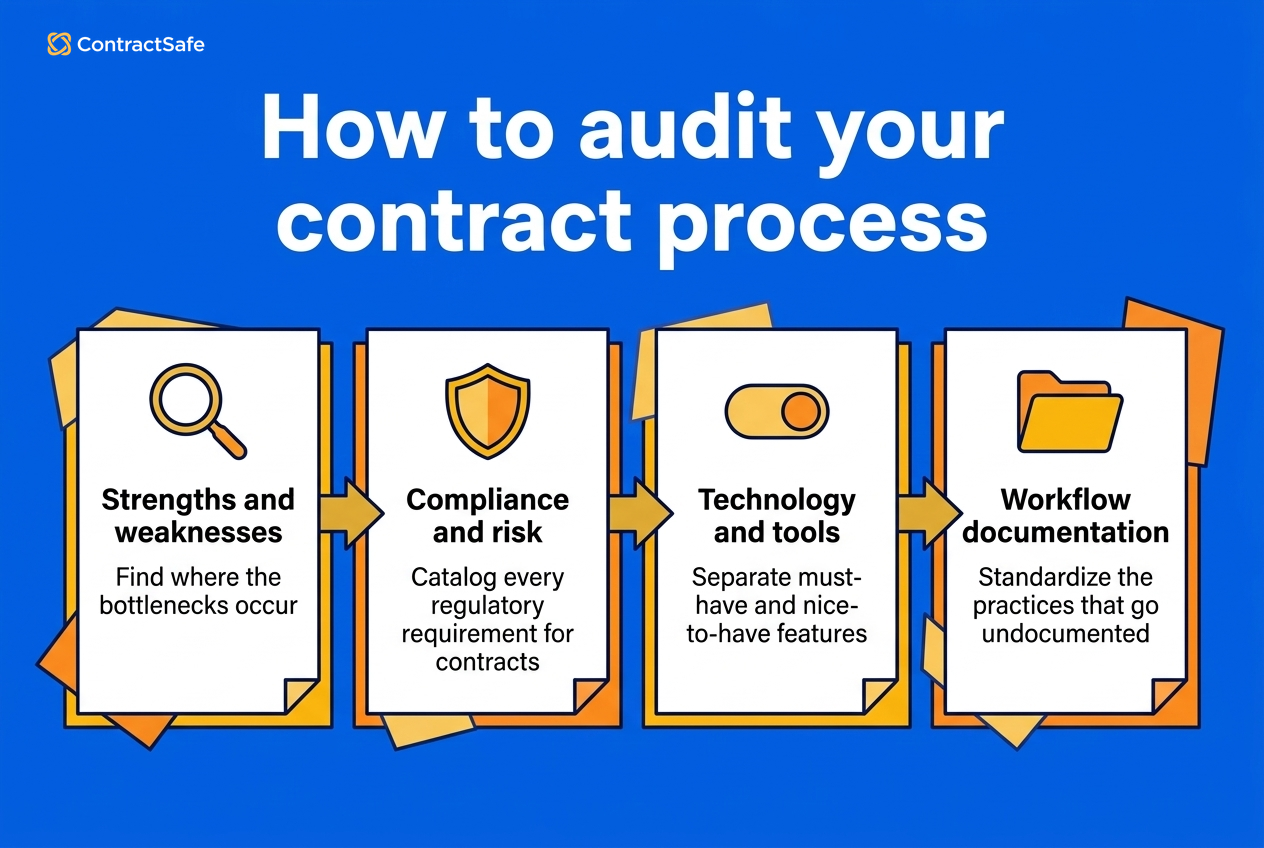
- Identify strengths and weaknesses: What’s the average time for a contract to go from initiation to completion, and where do bottlenecks occur? Gather feedback from daily users about the process's challenges and successes. Compare your processes with industry standards to see where you stand. Evaluate the success rate of your contract renewals and negotiations to measure the effectiveness of your management.
- Evaluate compliance and risk management: Have you cataloged all regulatory requirements affecting your contracts? Review how past compliance issues were resolved and conduct risk assessments on your critical contracts. Understanding your compliance posture and potential risks is crucial for a solid contract management foundation.
- Assess your technology and tools: What tools are you currently using for contract management, and how well do they meet your needs? Identify essential features by considering their direct impact on your process. Maybe automated alerts for renewals are a “must-have” feature, but advanced analytics is only “nice-to-have” Selecting the right technology hinges on understanding these distinctions and ensuring seamless integration with your existing systems.
- Highlight gaps in documentation and standardization: Are your contract management workflows thoroughly documented and standardized? Identifying undocumented practices or automatable processes can lead to significant efficiencies. Standardizing these processes ensures consistency and reliability in your contract management.
RELATED READ: How to audit your Contract Management Process
What changes when you scale contract management processes?
Scaling contracts isn’t just about tooling — it’s about making your workflows repeatable and reliable as demand increases. Centralizing storage, automating notifications, and establishing performance KPIs are key steps toward a scalable process.
Scaling your contract management processes effectively requires some heavy lifting, but the best contract management software can make it much easier.
Here's how to leverage this technology for maximum impact.
1. Enhance Contract Visibility and Accessibility
Begin by centralizing all your contracts in a digital repository.
This change alone can make managing your contracts much simpler and more efficient.
To further enhance visibility and accessibility, organize your contracts with tags and custom fields, making it easy to search and retrieve documents as needed.
Finally, implement customizable dashboards for a clear overview of contract statuses and metrics and set up automatic alerts to keep track of key milestones and deadlines. This setup ensures you never overlook important actions.
2. Develop a Framework for Continuous Improvement
Creating a culture of continuous improvement is vital for enhancing your contract management process.
But how do you improve?
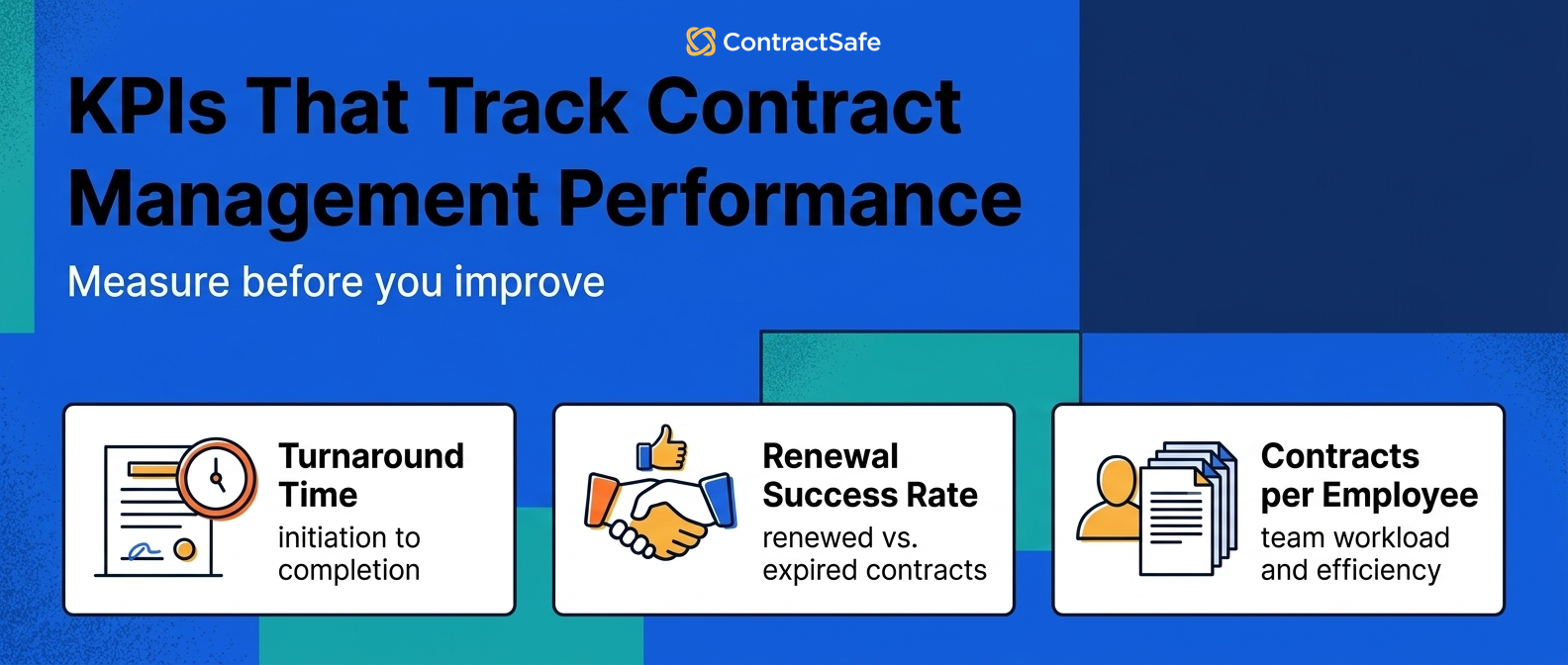
Well, the first step is to set clear key performance indicators (KPIs) to measure your contract management performance.
Here are some examples to get you started:
- Contract turnaround times: Measure the average time it takes for a contract to move from initiation to completion.
- Compliance rates: Track how well contracts adhere to internal policies and external regulations.
- Renewal success rates: Assess the percentage of contracts successfully renewed versus those that expire or terminate.
- Number of contracts managed per employee: Understand the workload and efficiency of your contract management team.
- Average time to resolve contract disputes: Evaluate the efficiency of your dispute resolution process.
Armed with your KPIs, the next step is to regularly review the effectiveness of your contract management system. This process of continuous evaluation and adjustment is invaluable. It will ensure your contract management system meets current needs and is scalable and adaptable as your business grows.
Consider also establishing a feedback loop within your organization.
Encourage team members to provide insights and suggestions on refining the contract management process. This collaborative approach fosters a sense of ownership and engagement among your team while giving you strategic, on-the-ground insights into how your operation is running.
3. Train and Empower Your Team
Your team needs to be fully on board for a truly effective contract management system.
Provide comprehensive training on new tools and processes to ensure everyone is confident using the system.
Encourage your team to contribute ideas for improving contract management strategies, fostering a sense of ownership and collaboration across the organization.
4. Streamline Processes With Automation
Automation may be the most important thing any business can use to scale. Why? Because it’s essentially taking what used to be time-consuming, manual processes and making them go all on their own.
And, of course, contract management is no different.Here are a few things you can automate with contract management software:
- Employ artificial intelligence to extract key data from contracts, enhancing management and categorization.
- Use templates for common contract types to ensure consistency and speed up the drafting process.
- Implement review and approval workflows to streamline decision-making.
- Set up automatic alerts and reminders to inform you when a key date, renewal, or obligation is approaching.
By automating some of these tasks with contract management software, you can free up your team to focus on the big picture, like strategy and negotiations.

5. Integrate With Other Business Systems
Contract management software is probably not the only tech tool in your stack, which means you’ll want to make sure it plays nice with other business systems.
These can be things like your customer relationship management (CRM) software or your favorite e-signature tool.
When you have a cohesive tech ecosystem that supports all aspects of your business, you can guarantee that your business is running on all cylinders. And when you don’t, you may find yourself scrambling for IT more often than you’d like.
Tools like Zapier can make this much easier, opening the contract management software up to thousands of potential integrations.
6. Leverage Analytics for Strategic Insights
Contracts come with a ton of data you can use to identify trends, pinpoint risks, gain insights into contract performance, or even inform your next negotiation.
And contract management software can help you do it.
Using AI, contract management software can pull and compile key data and package it into a custom report, allowing you to analyze different aspects of your contract portfolio.
These insights can include:
- Contract performance
- Time to execution
- Number of contracts executed
- Renewals
- Compliance
- Value of contracts
- Type of contract
These insights can help you make better, more informed decisions and even uncover exciting opportunities you may have overlooked otherwise!
RELATED READ: How Contract Management Software Streamlines Processes
How teams apply scalable contract management in practice
Scaling contract management isn’t about doing more work faster—it’s about reducing the number of decisions and follow-ups required to keep contracts under control. Teams that scale successfully apply structure in a few consistent ways.
They start by centralizing contracts.
All agreements live in one system, regardless of department or contract type. This eliminates version confusion and ensures teams can find the most current contract without relying on individual knowledge.
They define ownership beyond legal.
Legal may govern standards, but operations, finance, and procurement often own renewals, obligations, and vendor performance. Scalable processes make ownership visible and shared—not assumed.
They treat post-signature work as part of the process.
Renewals, notice periods, and ongoing obligations are tracked automatically instead of manually. This prevents contracts from going dormant after signing and surfacing only when something goes wrong.
They standardize before automating.
Teams align on how contracts should move—from intake through renewal—before introducing automation. This ensures technology reinforces consistency instead of locking in bad habits.
Together, these practices allow teams to manage more contracts without adding headcount, increasing risk, or relying on memory to keep critical work on track.
RELATED READ: How Important is Digitalization of the Contracting Process?
How does ContractSafe support scalable contract management?
ContractSafe supports scalable contract management by centralizing contracts, tracking key dates and obligations, and maintaining visibility as contract volume and complexity increase. This allows teams to manage growth without relying on manual tracking or individual memory.
When contract processes scale successfully, teams gain visibility into obligations, deadlines, and performance. Centralization and clarity reduce compliance gaps and operational friction—enabling more predictable business outcomes.
But process discipline alone can only go so far. As contract volume increases, relying on shared drives, spreadsheets, or manual reminders makes it harder to maintain consistency, accountability, and visibility across teams. That’s where purpose-built contract management systems become essential—not as replacements for good processes, but as reinforcements for them.
ContractSafe isn’t just another tool in your tech stack; it’s designed to support contract management as your business grows.
With features tailored for small businesses looking to scale, ContractSafe helps centralize contracts, track key dates and obligations, and maintain visibility—so teams spend less time chasing contracts and more time moving the business forward.
Here’s a snapshot of what sets us apart:
- Scalable pricing that fits your needs
- Dedicated support to ensure you always have the help you need, no matter your team size
- AI data extraction to effortlessly turn contracts into actionable data
- Automated alerts to streamline your review and approvals
- Powerful analytics and reporting to provide insights that drive decisions
- Custom dashboards to keep the metrics that matter most at your fingertips
- Comprehensive training to empower your team with the knowledge they need
- Centralized repository for quick, secure access to all your contracts in one place
Ready to get back to growing? Try ContractSafe today and see the difference for yourself.
Common mistakes teams make when scaling contract management
Many teams try to scale contract management by adding tools before their processes are ready. Without clear standards for ownership, review, and post-signature tracking, technology simply accelerates existing gaps instead of fixing them.
Common mistakes include:
-
Treating contract management as a legal-only responsibility
-
Relying on spreadsheets or manual reminders for renewals
-
Failing to track obligations after contracts are signed
- Scaling volume without scaling ownership or visibility
These issues often remain hidden at low volume, but surface quickly as the organization grows.
Conclusion
Scaling contract management isn’t just about handling more contracts. It’s about making sure growth doesn’t introduce blind spots. As volume increases, informal systems and manual tracking quietly break down, turning contracts into hidden risk instead of operational assets.
Teams that invest in scalable processes early, including centralization, clear ownership, and structured post-signature management, are better positioned to grow with confidence. When contracts remain visible and actionable, they continue to support the business long after they’re signed.
Growth shouldn’t break your contract process.
See how ContractSafe helps teams scale. Book a demo.








.svg)







.svg)