_Blog%20Post_1550x1040.png?width=572&height=382&name=How%20to%20Organize%20Digital%20Contracts%20Securely%20(Best%20Practices%20That%20Actually%20Hold%20Up)_Blog%20Post_1550x1040.png)
The best single security control for a contract repository is role-based access with least privilege. Each person sees and edits only the contracts their job requires, and nothing else. Most contract exposure isn't a hack. It's the wrong person opening a pay agreement or a customer's pricing because the folder was open to everyone.
Access control only holds up if the login behind it is strong and someone reviews it. That's why the next three controls are part of the answer: MFA or SSO on every account, an audit log you can't edit, and encryption at rest and in transit.
Organizing digital contracts securely isn’t about better folders or stronger passwords. It’s about creating structure, control, and accountability across the contract lifecycle, so contracts remain trustworthy long after execution.
That's also the honest test of where your own contracts stand. Not whether they're scanned and in a folder, but whether you can say who owns each one, who can see it, and which obligations are still live. If any of those answers is "it depends who you ask," the assessment below will show you where the structure is missing. It scores storage, findability, key dates, workflow, and risk controls, so you can see which of the controls ranked below your team still lacks.
Key Takeaways
Secure digital contract organization requires centralized storage, controlled access, version history, and clear ownership—embedded into the contract lifecycle so contracts remain visible, defensible, and auditable after signing.
How Does Secure Digital Contract Organization Fit into the Contract Management Process?
Secure organization is not a standalone task. It’s a core outcome of the contract management process, particularly in the post-signature stages where risk tends to accumulate.
Across the seven stages of the contract lifecycle (request and intake, drafting, negotiation, review and approval, signature and execution, obligation and compliance tracking, and renewal or closeout), security becomes most visible after execution. This is when contracts must be protected, monitored, and accessed by the right people without introducing risk or friction.
If digital contracts are not securely organized at this stage, downstream processes like audits, renewals, and compliance reviews become reactive instead of controlled. This is why secure organization is foundational to effective contract lifecycle management, not a separate IT concern.
RELATED READ: What Is the Contract Management Process?
What Does It Mean to Organize Digital Contracts Securely?
Secure digital contract organization means contracts are stored, accessed, and maintained in a way that protects sensitive information while supporting ongoing contract work.
Secure digital contract organization typically relies on a centralized contract repository that serves as the system of record for executed agreements, associated metadata, and lifecycle activity.
It combines:
-
centralized digital storage (not scattered files),
-
role-based access control,
-
version tracking and audit history,
-
and defined ownership for every contract.
The goal is not just to prevent unauthorized access, but to ensure contracts remain accurate, traceable, and usable throughout their lifecycle.
This approach is sometimes referred to as secure contract storage, digital contract organization, or secure contract management—all describing the same underlying need: control without chaos.
RELATED READ: What is a Digital Contract Repository?
Why Are Shared Drives and Spreadsheets Risky for Digital Contracts?
A shared drive can encrypt files and require MFA. What it can't easily do is limit access by contract type, show you who opened a specific agreement last quarter, or stop someone from quietly replacing the signed version.
Those gaps are the access and audit controls ranked first and third below, and they're why contracts outgrow the shared drive.
RELATED ON-DEMAND WEBINAR: Level-Up Your Contract Management From Spreadsheets
What Security Controls Matter Most for Digital Contract Storage?
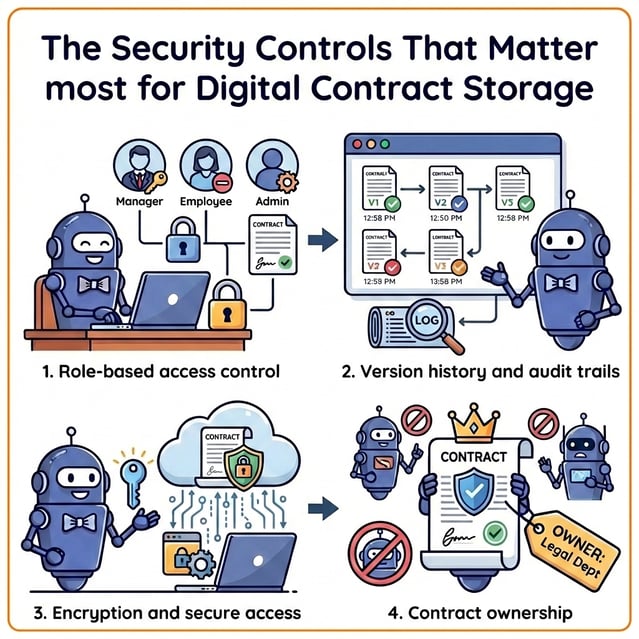
Least-privilege, role-based access is the most important control, because most contract exposure comes from people seeing contracts they shouldn't. Back it with MFA or SSO on every account, a tamper-proof audit log you can export, encryption at rest and in transit, and quarterly access reviews.
When contracts are stored in a single, governed contract repository rather than scattered across shared drives and inboxes, access controls, version history, and audit trails can be applied consistently. But not all security controls carry equal weight. Here's how they rank, what to require from each, and how to test it:
| Rank | Control | What to require | How to test it |
|---|---|---|---|
| 1 | Least-privilege, role-based access | Permissions set by contract type and department, not by folder | Log in as a finance user and try to open an employment agreement. You shouldn't be able to. |
| 2 | MFA or SSO on every account | Admins can require MFA for everyone, plus for high-risk actions like bulk export or deletion | Ask whether MFA can be enforced for all users and for bulk export or deletion. A strong permission model does nothing if a phished password opens it. |
| 3 | An audit log you can't edit or delete | Every view, download, edit and permission change recorded with a name and a timestamp | Export the full history for one contract. If it only lives on screen, it won't help you in an audit. |
| 4 | Encryption at rest and in transit | AES-256 for stored files and TLS 1.2 or higher in transit is the baseline | Ask for the standard by name. If the vendor can't answer in one sentence, that's your answer. |
| 5 | Scheduled access reviews | Review who can see sensitive contracts every quarter, and whenever someone changes teams or leaves | Least privilege erodes as people change roles. Ask who owns the review and what record it leaves. |
Contract ownership isn't a security control, it's governance, but it holds the controls above together. Each contract should have a clearly assigned owner responsible for accuracy, access, and lifecycle actions. Contracts without owners are a leading cause of missed renewals and compliance gaps.
These controls turn contract storage into an active part of the contract management process, not a passive archive.
How to Check a Vendor's Security Claims
Ask for a current SOC 2 Type II report, not a marketing badge. A Type II report shows the controls worked over months, not just on the day of the audit.
Then ask four questions:
- Can we limit access by contract type, not just by folder?
- Can we require MFA or SSO for every user?
- Can we export a contract's full access-and-change history as a file?
- Who can see our data on your side, and is that access logged too?
A vague answer to any of these tells you more than the feature page does.
How Does Secure Organization Improve Contract Workflows?
Security is often framed as a constraint, but in contract management, it enables smoother workflows.
When contracts are securely organized:
-
Teams spend less time searching for information,
-
Reviews and audits move faster,
-
Renewal decisions are based on accurate data,
-
Ownership is clear across departments.
Secure organization also sets the foundation for responsible use of AI in contract management. AI tools rely on accurate, centralized contracts with consistent metadata and access controls. Without secure organization in place, AI outputs become unreliable, incomplete, or difficult to validate—introducing new risk instead of reducing it.
This is why modern contract management software is increasingly evaluated on process outcomes, not just features. Secure organization supports visibility, accountability, and continuity across the lifecycle—especially as contract volume scales.
RELATED READ: How to Scale Contract Management Processes
Common Mistakes Teams Make When Organizing Digital Contracts
Most issues don’t come from neglect—they come from assumptions.
Common missteps include:
-
assuming “digitized” means “secure,”
-
granting broad access for convenience and never revisiting it,
-
storing executed contracts without lifecycle context,
-
and treating contract storage as a one-time setup instead of an ongoing process.
These mistakes surface later as missed obligations, audit scrambles, or security concerns that feel sudden but were quietly building over time.
How to Apply Secure Contract Organization in Practice
Start with the post-signature stage, where risk tends to hide.
Ask:
-
Where do executed contracts live today?
-
Who can access them—and why?
-
Can we see version history and ownership?
-
Could we respond quickly to an audit or renewal request?
If the answers aren’t clear, secure organization should be addressed as part of your broader contract management process—not as a side project.
How Secure Contract Organization Supports the Contract Lifecycle
Securely organizing digital contracts isn’t about locking files away—it’s about making contracts reliable throughout their lifecycle.
When contracts are centralized, access is controlled, ownership is clear, and changes are traceable, teams can actually trust the information they’re working with. That trust shows up downstream: faster audits, fewer missed renewals, clearer accountability, and less operational risk after contracts are signed.
This is why modern contract management platforms focus on process outcomes, not just storage. Secure organization supports every post-signature stage of the contract lifecycle by keeping contracts visible, defensible, and usable—long after execution.
ContractSafe was built around this reality. By combining centralized contract storage with role-based access, audit trails, and lifecycle visibility, it helps teams organize digital contracts securely without adding friction or complexity to how they work.
If your contracts are digital but still hard to trust, secure organization isn’t an upgrade—it’s the foundation.
Key Takeaways
-
Secure digital contract organization is a lifecycle outcome, not just a storage decision.
-
Centralization, access control, version history, and ownership are essential foundations.
-
Shared drives and spreadsheets create long-term risk as contract volume grows.
-
Security supports contract workflows by improving visibility, accountability, and audit readiness.
-
The most effective approaches embed security directly into the contract management process.
Secure Organization Makes Contracts Reliable, Defensible, and Usable
Secure digital contract organization is not about locking contracts away. It’s about making them reliable, defensible, and usable throughout their lifecycle. When security is built into how contracts are stored and managed, teams reduce risk without slowing work—and contracts finally start working the way they’re supposed to.






.svg)







.svg)