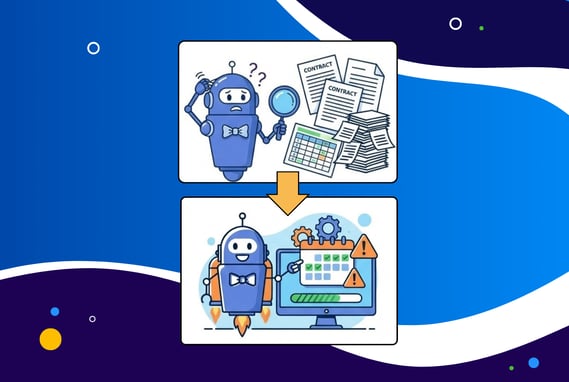
Contracts don’t usually fail because of bad drafting. They fail because no one knows what happens next.
As organizations grow, contracts start living everywhere—email threads, shared drives, spreadsheets, and inboxes. Ownership becomes unclear, versions multiply, and critical dates slip by unnoticed. The result isn’t just inefficiency. It’s risk.
The contract management process defines the work required to manage contracts effectively—from request through renewal or termination. Contract management software doesn’t replace that process. It supports it by reinforcing visibility, consistency, and accountability at every step.
TL;DR
Contract management software streamlines processes by supporting the contract management process end to end.
It improves collaboration, security, and renewal control by centralizing contracts, reducing manual tracking, and keeping post-signature work visible.
What processes does contract management software streamline?
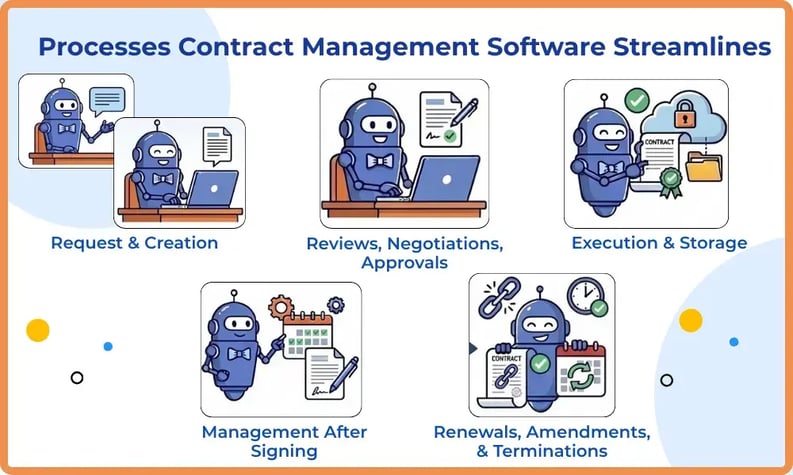
Contract management software streamlines the processes teams use to create, review, approve, store, manage, and renew contracts.
Instead of relying on email, spreadsheets, or shared drives, teams manage contracts in a single system that keeps each step connected.
This reduces manual tracking, version confusion, and missed deadlines—especially after contracts are signed, when visib.
At a high level, contract management software supports how contracts are:
-
Requested and created
-
Reviewed, negotiated, and approved
-
Executed and stored
-
Managed after signing
-
Renewed, amended, or terminated
RELATED READ: What is the Contract Management Process?
How does contract management software enable collaboration?
Contract management software enables collaboration by giving all stakeholders access to the same contract record and current version.
Contracts require input from legal, finance, procurement, operations, and leadership. Collaboration breaks down when versions are shared over email or stored in multiple locations.
-
Shared access to the latest version: Teams can review, comment on, and approve contracts without guessing which version is final.
-
Clear handoffs between teams: Ownership and responsibility move with the contract instead of being lost in inboxes.
This allows teams to manage growing contract volume without adding manual work or risk.
How does contract management software provide security?
Contract management software provides security by controlling who can access, edit, and manage contracts.
Instead of open shared folders or email attachments, contracts are stored in a secure system with defined permissions. This reduces unauthorized access and preserves a clear audit trail of changes and approvals.
Key security benefits include:
-
Permission-based access
Teams can access only the contracts and actions relevant to their role. -
Secure storage and auditability
Contracts are stored centrally with version history and activity tracking.
This allows teams to share contracts confidently without losing control or increasing risk.
RELATED READ: How To Scale Your Contract Management Processes: Key Considerations for Small Businesses
How does contract management software facilitate the renewal process?
Contract management software facilitates renewals by tracking key dates and making renewal decisions visible before deadlines arrive.
Renewals are one of the most common failure points in contract management. When contracts renew automatically without review, outdated terms and unnecessary costs persist.
-
Automated renewal tracking: Notice periods, expiration dates, and renewal terms are monitored automatically.
-
Renewal as a decision point: Teams have time to evaluate whether to renew, renegotiate, or terminate—rather than reacting after the fact.
This shifts renewals from last-minute reactions into planned, intentional decisions.
How does contract management software support other business processes?
Contract management software supports other business processes by making contract data accessible beyond the legal team.
Finance, procurement, operations, and leadership can view contract terms, obligations, and timelines without chasing updates. This improves planning and decision-making across the organization.
Examples include:
-
Finance and accounting
Visibility into payment terms, obligations, and renewals supports better forecasting and budgeting. -
Procurement and vendor management
Centralized vendor contracts reduce duplication and improve leverage. -
Operations and leadership
Leadership gains insight into commitments and risk without relying on ad-hoc updates.
As a result, contract information becomes usable in day-to-day operations instead of locked away in legal files.
How does contract management software support the contract management process?
The contract management process defines the work. Contract management software supports its execution.
Software keeps each step—from request through renewal—connected and visible, especially after signing, when manual processes tend to fail.
Across the contract management process, software helps teams:
-
Centralize requests, drafts, and executed agreements
-
Maintain version control during negotiation and approval
-
Keep amendments, obligations, and related documents tied together
-
Track renewal decisions instead of relying on calendar reminders
For a step-by-step breakdown of the contract management process and responsibilities involved, see What Is the Contract Management Process.
So what? Common mistakes teams make without contract management software
Most contract problems aren’t caused by missing steps in the process. They’re caused by trying to manage that process without the structure or visibility to support it.
Common mistakes include:
-
Treating contract management as a filing task after signing
-
Tracking renewals and obligations in spreadsheets
-
Assuming one team owns contracts end to end
-
Letting contracts auto-renew without review
These issues tend to surface after contracts are signed—when visibility and ownership matter most.
Once teams recognize this gap, they often look for software that can support the contract management process consistently as volume grows.
RELATED READ: How to Audit Your Contract Management Process
Why teams use ContractSafe to support their contract management process
ContractSafe is designed to support the entire contract management process, from pre-signature work through post-signature management—without forcing teams into rigid workflows or enterprise complexity.
Rather than redefining how contracts should work, ContractSafe reinforces the process teams already follow—especially after contracts are signed, when visibility and ownership often break down.
Teams use ContractSafe to:
Support pre-signature collaboration and consistency
Before contracts are signed, teams need clarity, coordination, and control.
ContractSafe helps by:
-
Centralizing drafts and related documents
-
Reducing version confusion during review and negotiation
-
Supporting collaboration across legal, finance, procurement, and operations
-
Maintaining a clear record of what was reviewed and approved
This keeps pre-signature work organized as deal volume increases—without changing how teams already negotiate and approve contracts.
Centralize executed contracts in a single system of record
Once contracts are signed, they’re stored together with amendments and supporting documents.
-
Eliminate scattered storage across inboxes and shared drives
-
Reduce time spent searching for agreements
-
Preserve context across the full life of the contract
Keep post-signature work visible and manageable
After execution, contracts don’t disappear.
-
Track obligations, milestones, and key dates
-
Keep amendments and addenda tied to the original agreement
-
Maintain continuity through renewal or termination
Reduce manual tracking and version confusion
As contract volume grows, spreadsheets and calendar reminders stop scaling.
-
Maintain clear version history
-
Track renewal decisions instead of relying on ad-hoc reminders
-
Ensure teams work from a single source of truth
Support cross-functional access without losing control
Contracts touch more than the legal team.
-
Role-based permissions keep access appropriate
-
Clear ownership and accountability reduce confusion
-
Teams can share contracts confidently without increasing risk
By supporting both pre-signature collaboration and post-signature management, ContractSafe strengthens the contract management process end to end—helping teams scale without adding manual effort or risk.
Key Takeaways
-
Contract management software supports execution of the contract management process
-
Collaboration improves when teams share one source of truth
-
Security and access controls reduce risk
-
Renewals work best when treated as decisions, not reminders
-
Contract data supports broader business operations
Conclusion
Contract management software doesn’t replace the contract management process—it strengthens it.
By improving collaboration, security, renewal control, and cross-team visibility, software helps organizations manage contracts consistently as volume grows. When the process is clear, software becomes a force multiplier rather than a workaround.







.svg)







.svg)