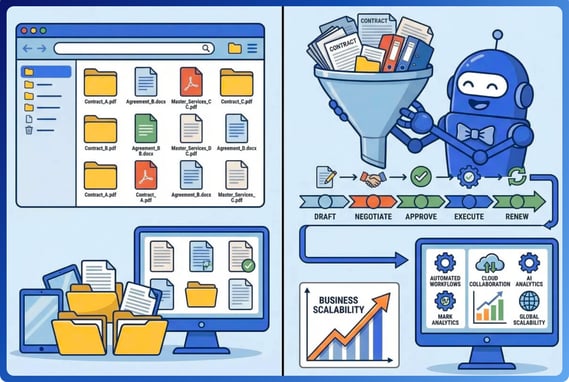
The start of a new year often comes with a familiar task: cleaning up contracts. Files are reorganized, folders renamed, and gaps become harder to ignore. For many legal teams, that moment reveals a deeper issue: not just disorganized files, but a system that can’t support how contracts are actually created, reviewed, and approved anymore.
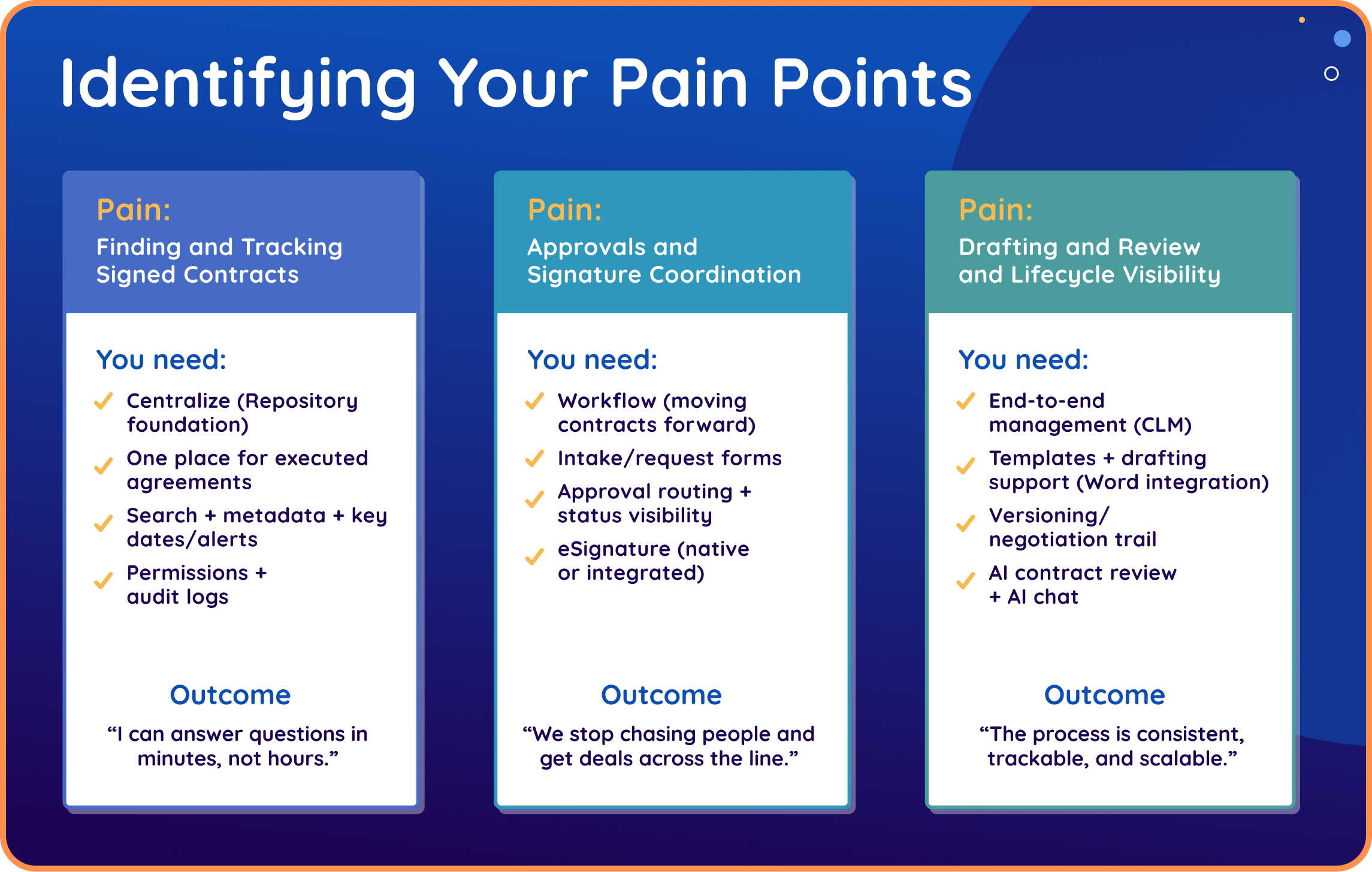
Contract repositories centralize executed contracts and support post-signature visibility through search, metadata, date tracking, alerts, permissions, and audit trails.
Contract lifecycle management (CLM) builds on that foundation by adding end-to-end workflows for intake, drafting, review, approvals, negotiation, execution, and ongoing obligations.
Rule of thumb: If your pain is finding and tracking signed contracts, start with a repository. If your pain is intake, approvals, negotiation, and accountability, you’re in CLM territory
What Is a Contract Repository?
A contract repository is, at its heart, the single source of truth for your organization’s executed agreements. A dedicated software designed to house every signed document in one secure, searchable, and organized place.
Imagine a world where you never have to search through Janet from Finance’s desktop folders or hunt through a shared drive that looks more like a digital junk drawer than a professional filing system.
For legal teams, a repository is the first line of defense against disorganization and blind spots. When a stakeholder asks, "Do we have an active NDA with this vendor?" or "When does our lease for the Chicago office expire?" the repository provides the answer in seconds. This includes:
-
Search across contracts and clauses: Quickly find specific words or phrases across your entire contract library without opening dozens of files. For scanned PDFs or image-based documents, OCR converts them into searchable text, so nothing gets missed.
-
Key date tracking: You can set automated reminders for renewals, expirations, and notice periods. This shifts the team from being reactive (finding out a contract expired after the fact) to proactive (planning for a renewal three months in advance).
-
Metadata and custom fields: You can tag documents with specific data points like "Contract Value," "Department," or "Internal Owner," making reporting a breeze.
-
Permissions and access control: Not everyone needs to see the executive employment agreements. A repository allows you to lock down sensitive folders while keeping standard vendor agreements accessible to the teams that need them.
-
Version history and audit trails: You can see exactly who accessed a document and when, providing a clear record for compliance.
A repository is often the right starting point for teams moving away from shared drives, inboxes, or spreadsheets. It provides the visibility and control needed to stop the bleeding of lost information and missed deadlines, setting the foundation for more advanced management as the organization matures.
RELATED READ: The Ultimate Contract Repository Guide: How to Build, Automate, and Prove ROI
What Is Contract Lifecycle Management (CLM)?
Think of Contract Lifecycle Management (CLM) not as a replacement for your repository, but as a powerful extension of it. If a repository is the library where the finished books are kept, CLM is the publishing house that manages the story from the very first draft until it’s ready for the shelf.
CLM builds on those repository foundations by supporting the entire journey of a contract. It recognizes that a contract’s life doesn’t start when the ink is dry; it starts the moment someone in sales or procurement says, "We need a new agreement."
A full CLM process includes pre-signature workflows that bring order to the drafting and negotiation phase:
-
Intake and request forms: Instead of receiving "Hey, can you look at this?" messages via Slack or email, requests come through a structured form that captures all the necessary data upfront.
-
Contract drafting and templates: Legal teams can create a library of pre-approved templates and clauses. This allows the business to move faster while ensuring that everyone is starting from the same safe legal language.
-
Review and approval workflows: Documents are automatically routed to the right people (whether it’s Finance, IT Security, or the VP of Sales) based on the contract type or value.
-
Redlining and negotiation: The system tracks changes and comments, keeping the negotiation history in one place rather than scattered across twenty different versions of a Word document.
-
Execution and eSignature: Once the deal is done, CLM bridges the gap directly into the signature process, often through integrated tools like DocuSign or its own native signature features.
Together, these workflows ensure contracts are not only stored correctly, but created, reviewed, approved, and renewed with clear ownership and accountability at every stage.
The true value of CLM becomes clearer as contract work expands across more stakeholders and cross-functional teams. It ensures that contracts remain visible and accountable from the initial request through to the final renewal.
By adding structure to the pre-signature side, CLM helps legal teams move away from being a bottleneck and toward being a strategic partner that enables the business to scale safely.
RELATED READ: Contract Lifecycle Management - 12 Common Questions Answered
How Contract Management Needs Change as Teams Grow
As an organization grows, so does the complexity of its contractual obligations. In the early days, a contract repository is a lifesaver; it provides that much-needed centralized access and post-signature oversight.
However, as the team expands from five people to fifty or five hundred, the pain points shift. It’s no longer just about finding the signed document; it’s about managing the sheer volume of work that happens before the document is ever signed.
The need for CLM typically arises when the process of getting a contract through the door starts to feel like a game of telephone. As more stakeholders participate earlier in the process, coordination, ownership, and accountability become harder to manage without a dedicated workflow. You start to feel the struggle not just in where the signed agreements live, but in how they move through the organization.
Lifecycle management layers structure onto this pre-signature and cross-functional work, continuing to rely on the repository’s strengths for post-signature oversight rather than replacing them.
The shift from repository to lifecycle management is all about how much coordination, accountability, and documentation your contract process requires.
Why Centralized Contract Repositories Work Well at First
Once a repository is in place, most early-stage legal teams experience an immediate shift in control. The focus is primarily post-signature: knowing what’s signed, when it expires, and who owns it.
When the number of stakeholders is limited and agreements are relatively standardized, repository features like search, metadata, and automated reminders provide enough structure to stay organized and audit-ready without introducing unnecessary workflow complexity.
What Changes as Contract Work Expands Beyond Post-Signature Oversight
As the organization matures, the limitations of relying on post-signature tools alone become more visible. Growth introduces new stakeholders (like Procurement, HR, and dedicated Ops teams) and more complex pre-signature coordination. Suddenly, the how and why of a contract become just as important as the where.
Risk increases when decisions, approvals, and changes happen outside a structured system, in private emails or side conversations. It becomes difficult to demonstrate why a specific term was accepted or who authorized a deviation from the standard template. While your repository provides excellent version history, it isn’t designed to orchestrate the drafting and redlining dance.
This is where teams feel the need to layer lifecycle management on top of their repository capabilities, ensuring that every stage of the contract, from the first request to the final signature, is documented and defensible.
RELATED READ: How to Audit Your Contract Management Process
What Contract Repositories Are Designed to Handle
It is important to remember that contract repositories are the workhorses of the legal department. They are intentionally designed to support robust post-signature management. They focus on the executed contract—the final, binding agreement—and ensure it is never lost or forgotten.
A modern repository is built to handle:
-
Centralization: Bringing every signed document into a unified hub so you can retrieve and review agreements in seconds.
-
Milestone Management: Using metadata and date tracking to stay ahead of renewals and notice periods. Automated alerts ensure that a $50,000 SaaS contract doesn't auto-renew simply because someone forgot to check the calendar.
-
Search and Data Extraction: Allowing teams to locate specific language (like Force Majeure or Non-Compete) across the entire library of contracts instantly.
-
Relationship Management: Supporting parent-child relationships so you can see how an original Master Service Agreement (MSA) relates to its subsequent Statements of Work (SOWs) and Amendments.
-
Audit Readiness: Providing an immutable record of document access and version control, which is essential for SOC2 audits or healthcare compliance.
Repository tools typically stop at the point of execution. They are the guardians of the final record, providing ownership and oversight, but they aren't the tool you use to build the contract.
Search across those records works automatically for native digital documents, with OCR used only when needed to make scanned or image-based files searchable. That’s the point where CLM functionality takes the lead.
RELATED READ: Contract Lifecycle Management Process Best Practices: The Ultimate Guide
What Contract Lifecycle Management Is Built to Do
CLM systems treat contracts as active, living records that require attention throughout their entire lifespan. They don't just house the contract; they manage it. In a CLM, a contract is an evolving entity that moves through defined stages: intake, drafting, review, negotiation, approvals, execution, and ongoing obligation management.
The goal of a CLM is to ensure that status and ownership remain visible at every step of the way.
-
Workflow Orchestration: Instead of a document sitting in an unseen inbox, the system automatically pushes it to the next person in line for review.
-
Capture of Intent: CLM captures the why behind the contract. When a redline is accepted, the system stores the discussion around that change. This creates a defensible record of how contract decisions were made, which is invaluable during disputes or leadership reviews.
-
Consistency and Scalability: By using pre-approved templates and automated workflows, legal teams can maintain consistency even as contract volume triples. It ensures that the right language is used every time, reducing the risk of rogue agreements.
As contract volume and regulatory expectations increase, CLM provides the workflow automation and lifecycle tracking needed to maintain accountability across the entire organization.
RELATED READ: How Contract Management Software Streamlines Processes
Where Contract Repositories Stop, and Where CLM Extends Further
The distinction between these two tools is not about one being better than the other; it’s about a natural boundary. Contract repositories are optimized for post-signature visibility. They answer the question: “What did we sign, and where is it?”
However, as contract work expands, legal teams are often asked questions that a repository simply isn't built to answer. These are contextual questions, such as:
-
How long did it take for Finance to review this request?
-
Who approved the deviation from our standard indemnity clause?
-
What changes were made during the third round of negotiations with this vendor?
-
Which related contracts create shared obligations that we need to track collectively?
Without structured lifecycle workflows, this information is often captured off-system, in emails, meetings, or spreadsheets. This makes it incredibly difficult to reconstruct a complete record later. Gaps in decision context often surface at the worst possible times: during a surprise audit, a contentious renewal, or a leadership review.
The challenge is no longer missing documents—it’s missing context. CLM extends the value of a repository by connecting those pre-signature decisions with the post-signature records. It ensures that the story of the contract is complete from start to finish.
When Legal Teams Outgrow Post-Signature-Only Processes
While we can talk about maturity models all day, most legal teams realize they’ve outgrown relying on post-signature tracking alone during a trigger moment. This is often a missed renewal that costs the company thousands, or a grueling two-week audit prep that involves three people working late every night just to locate files.
These signals don’t mean your repository has failed. In fact, the repository is often doing its job well: you can find the signed documents, see key dates, and confirm ownership.
What’s changed is the work happening before signature. Teams begin to realize that while post-signature tracking is under control, they now need more structure around how contracts are requested, reviewed, approved, and negotiated in the first place. At that point, what’s essential is coordinated workflows across Legal, Finance, Procurement, and Sales.
Common Signs Teams Are Ready for Lifecycle Management
-
Clarification Requests: You find yourself spending hours every week just answering, “Where is this contract?” Or, “Who is supposed to sign this?” because ownership isn't clear.
-
Decision Gaps: You have the signed PDF, but when a leader asks why we agreed to a specific term, no one can find the email thread where that decision was made.
-
Manual Follow-ups: Renewals and amendments require an exhausting amount of manual email coordination. You’re essentially acting as a human reminder bot.
-
Cross-Contract Questions: Leadership asks for a report on Total exposure across all vendor contracts, and it takes you three days of manual data entry to figure it out.
-
Shadow Processes: Teams start building their own intake trackers or approval spreadsheets because the “official” process can’t keep up.
These signals don't mean your repository has failed; they mean your team has succeeded in growing to a point where you need more structure to support how contract work actually happens.
RELATED READ: Contract Lifecycle Management Process Best Practices: The Ultimate Guide
Why Lifecycle Tracking Improves Forecasting and Operational Planning
When your reporting is fueled by real-time pipeline data, you finally get to trade gut feelings for actual strategic planning. Instead of guessing how long a deal might take, you have clear visibility into cycle times, making it easy to set realistic expectations with the business (and look like a total pro while doing it).
You’ll be able to see exactly how many contracts are active at each stage, spotting capacity constraints before your team feels like they’re totally underwater. Best of all, it completely changes the conversation with leadership.
Instead of the dreaded "Legal is a black hole" narrative, you can walk into the room with data that shows exactly where the process is backing up. Whether it’s negotiation drag or an approval bottleneck, you’re moving from defense to offense with the facts to back you up.
A Practical Contract Lifecycle Management Maturity Model
Adopting a CLM system isn’t an all-or-nothing event. It doesn't happen overnight. Most legal teams progress through a recognizable set of stages as their work becomes more complex. This maturity model helps teams understand where they are today and what capabilities they need to support their next level of growth.
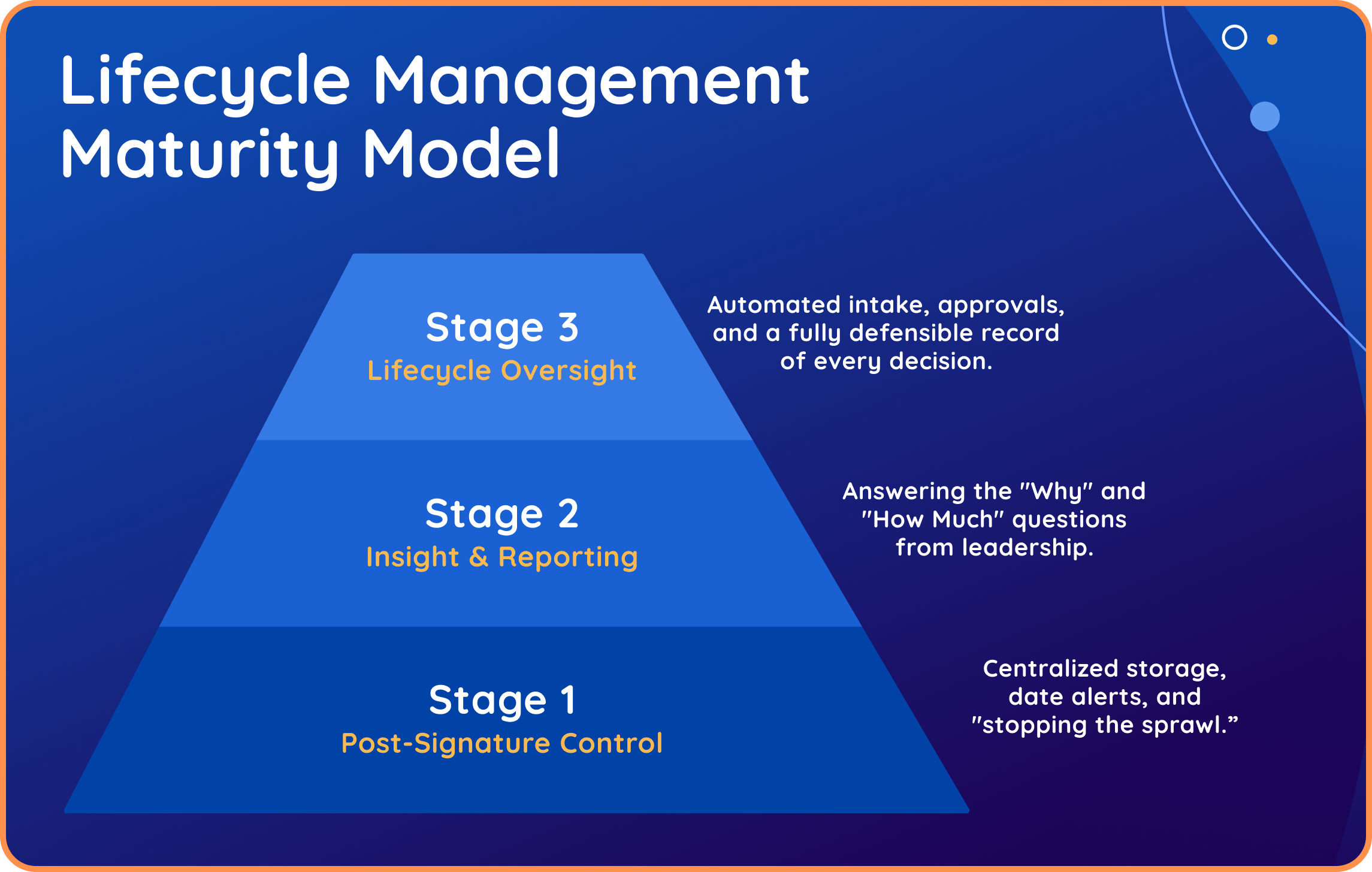
The progression is typically driven by operational and compliance pressure. It’s not just about how many contracts you have; it’s about how much scrutiny those contracts are under.
-
Stage 1: Repository-First (Post-Signature Control)
This is the foundation. The focus is on visibility, organization, and audit readiness. You centralize your contracts to stop them from being scattered across folders and inboxes. You use key dates and ownership fields to support basic oversight. At this stage, ContractSafe helps teams establish reliable post-signature visibility without adding unnecessary process overhead. -
Stage 2: Insight-Driven (Analysis & Reporting)
At this stage, the team starts using contract data to answer recurring questions from leadership and Finance. You aren't just looking for one contract; you're looking for trends. You need reporting and analysis to manage obligations and understand vendor exposure. This is the inflection point where teams begin to feel the pressure for more structure in how data is collected. This is often where teams realize that inconsistent intake and manual data entry are quietly undermining the quality of their reporting. As more teams need visibility, ContractSafe helps make contract data easier to find, review, and explain without changing how work already flows. -
Stage 3: Lifecycle-Managed (End-to-End Oversight)
This is the gold standard where intake, drafting, negotiation, and execution follow defined, auditable workflows. Ownership and decision history are captured as part of the process, not reconstructed after the fact. This stage supports consistent compliance and high-level scalability. When teams are ready for more structure, ContractSafe lets them add lifecycle workflows without starting over.
From Centralized Visibility to Active Management
Early maturity is all about knowing where contracts are and what stage they’re in. You replace guesswork with lifecycle status. Instead of saying “I think that’s being reviewed," you can look at a dashboard and see Active, Pending, or Expiring. This clarity reduces the reliance on individual memory and gives the whole team confidence that nothing is slipping through the cracks.
From Visibility to Analysis, Reporting, and Compliance Readiness
Later maturity focuses on insight and defensibility. You move from being reactive to being proactive. You use clause analysis to find variations across agreements and structured reporting to answer audit questions instantly. This is the shift where contract management becomes a strategic asset rather than an administrative burden.
RELATED READ: Do you need Contract Lifecycle Management? A Practical Guide to CLM Features
How ContractSafe Helps as Your Contract Process Evolves
Contract needs don’t change all at once. Sometimes the priority is simple: find the signed agreement, track key dates, and stay audit-ready.
Other times, the bottleneck shows up earlier: requests, reviews, approvals, and negotiations spread across inboxes and documents.
ContractSafe is built to support both, so teams can add structure where it’s needed without forcing complexity everywhere else.
Post-signature visibility when that’s enough
ContractSafe centralizes executed agreements with fast search, key dates, alerts, and role-based access, so teams can quickly answer what’s signed, who owns it, and what’s coming up.
Lifecycle structure when coordination becomes the problem
As more people get involved, teams can manage intake, drafting, approvals, negotiation, execution, and renewals in one place, with clear ownership and status at every stage.
Choosing the Right Contract Management Approach as You Grow
Choosing between a contract repository and a full CLM isn't a once-and-for-all decision; it’s a journey of alignment. Contract repositories play a critical role in providing the visibility and tracking that early and mid-stage teams need to stay organized.
As your organization grows and more stakeholders get involved, adding lifecycle structure ensures that your consistency and defensibility grow alongside your contract volume.
The shift is not about replacing your repository, but about ensuring your tools match how your contracts are actually being managed. ContractSafe is built to support this progression, offering a flexible, powerful platform that starts with repository visibility and allows you to add lifecycle capabilities when they make sense for your team.
Take a moment to assess where your team sits in the maturity model. Does your current setup support your workflows today, or are you starting to see those trigger signs?
If you're ready for the next step, schedule a demo today to see how ContractSafe can support your team as your needs grow, without adding complexity.

Key Takeaways
-
Contract repositories are the "System of Record": They are essential for post-signature visibility, organization, and ensuring your team is always audit-ready. Without a repository, you're essentially flying blind after a contract is signed.
-
CLM adds the "Pre-Signature" Story: Contract lifecycle management extends the value of your repository by adding structure to intake, drafting, and approvals. It ensures that the context of a contract—not just the final PDF—is preserved.
-
Workflow over Volume: The need for CLM is usually driven by the complexity of your coordination and oversight needs, not just by having "a lot of contracts." If you're struggling to track who approved what, you're ready for lifecycle structure.
-
Maturity is a Journey: You don't have to adopt every feature at once. Start with centralized visibility, move to insight-driven reporting, and eventually reach full workflow-driven accountability.
-
Choose a Tool that Grows with You: Your software should solve today’s problems without creating tomorrow’s headaches. ContractSafe provides the powerful foundation of a repository with the flexibility to add lifecycle features as you scale.







.svg)







.svg)