If you've ever had that sinking feeling when you realize a critical contract renewal deadline just passed, you know why contract compliance management matters. That missed deadline? It could cost your company thousands and maybe put you in legal hot water.
Here's the uncomfortable truth: non-compliance costs businesses an average of $15 million annually. Companies lose between 8-9% of their annual revenue to poor contract practices, while top performers keep that number closer to 3%. The difference between success and failure? A solid approach to managing contract compliance.
In this guide, we’ll walk you through what compliance means, the most common mistakes that trip up even the most experienced teams, and how to build a fool-proof contract compliance system.
Key Takeaways
- Contract compliance means ensuring that all parties involved fulfill their obligations according to the agreement.
- You must track contractual obligations (what you promised), regulator requirements (what the law says), and operational execution (delivery)
- Contract management software can help streamline compliance by centralizing every document in a searchable repository, automating tasks like deadline notifications.
What Is Contract Compliance?
Contract compliance means ensuring that all parties meet their agreed-upon obligations, terms, and regulatory requirements.
When you sign on the dotted line, you accept specific responsibilities and liabilities for your part of the agreement. Simple enough, right? Not quite.
Contract compliance actually operates on three levels: contractual obligations (what you promised to do), regulatory compliance (what the laws require), and operational compliance (actually delivering on those promises). Miss any of these, and you've got a problem.
The Rising Stakes of Non-Compliance in 2025
The compliance landscape has gotten significantly more complicated. According to a EY's 2025 Global Third-Party Risk Management survey of 500 executives, 57% now cite operational risk as their top concern when monitoring third parties, a jump of 40% from just two years ago. Regulatory and contractual risk follows close behind at 53%.
Why the increase? Companies are juggling more contracts with more complex terms than ever before. The average company now sends 55 different questionnaires to third parties just for control assessments. Add shifting regulations, supply chain disruptions, and cybersecurity threats into the mix, and you can see why 85% of organizations report that compliance has become more complex.
Understanding where compliance breaks down helps you prevent it. Let's look at the most common mistakes across all three levels of compliance,
The 8 Most Common Contract Compliance Mistakes (And How To Avoid Them)
These are the contract compliance mistakes we see most often, along with straightforward fixes you can implement today.
Mistake #1: Relying on Manual Tracking and Spreadsheets
Here's a startling stat: 71% of companies can't find at least 10% of their contracts. When your compliance tracking lives in scattered spreadsheets, shared drives and email chains, critical documents disappear into the void.
The problem compounds over time. You end up with multiple versions floating around, no version control or audit trails and zero visibility into upcoming obligations. Human contract review takes an average of 92 minutes per agreement. That time adds up fast when you're managing hundreds of contracts.
The fix: Centralize everything (including drafts, attachments and addendums) in a contract repository with advanced search functionality. A proper repository isn't just a place to store your contracts, it's your single source of truth with version control and audit trails built in.
Mistake #2: Missing Critical Deadlines and Renewal Dates
Getting locked into an unfavorable automatic renewal because you missed the notification window? It happens more than you think. Without automated alerts, your team is playing a dangerous game of calendar roulette.
The fix: Set up automated reminders with enough lead time to actually do something about it. Good contract tracking means getting alerts 90 days, 60 days, and 30 days before critical dates, giving you time to review, renegotiate or plan your exist strategy.
Mistake #3: Poor Version Control
When three people are working from three different versions of the same contract, compliance becomes nearly impossible.
This confusion leads to disputes, missed milestones, and embarrassing moments when you discover what you thought was your "final" contract isn't actually final. The lack of clear audit trail makes it nearly impossible to provide compliance during reviews.
The fix: Implement strict version control with clear approval workflows. Every change should be tracked, every editor identified, and every version accessible.
Mistake #4: Unclear or Inconsistent Contract Language
Ninety percent of professionals find contracts difficult to understand? When language is vague or inconsistent, compliance becomes a guessing game. What does "reasonable efforts" actually mean? How do you measure "timely delivery"?
Ambiguous language doesn't just confuse your team, it creates compliance risks when parties interpret the same clause differently. That's how misunderstandings turn into disputes.
The fix: Standardize your contract language with pre-approved templates and clause libraries. Create a playbook that defines key terms consistently across all agreements.
Mistake #5: Failing to Assign Clear Ownership of Obligations
Here's a recipe for disaster: important obligations with no clear owner. When nobody knows who's responsible for what, things fall through the cracks. Deadlines gets missed and deliverables don't get . . . well. .. . delivered.
The fix: Assign a specific owner to every contractual obligation. Use your contract management system to surface obligations to the right people at the right time, with clear escalation paths when issues arise. Accountability prevents problems.
Mistake #6: Inadequate Stakeholder Collaboration
Legal, finance, operations, procurement need to be involved in compliance management. When teams operate in silos, compliance gaps crop up. Legal might miss financial red flags while Finance might overlook operational risks.
The fix: Build collaborative workflows with clear approval chains. Make sure every relevant stakeholder can review and comment on contracts before they're signed. The few extra days spent on proper review will save months of cleanup later.
Mistake #7: Failing to Track Changing Regulations
Regulations don't stand still. Data privacy laws, industry standards evolve constantly. According to EY's 2025 survey, 53% of companies cite regulatory and compliance risks as a top concern, yet many contracts include no mechanism for updating terms when laws change.
Whether you're dealing with HIPAA in healthcare, SOX in finance, or OSHA in manufacturing, a contract that was compliant six months ago might violate current law today. This is especially critical for third-party contracts where your vendor's non-compliance becomes your problem.
The fix: Schedule quarterly compliance reviews specifically focused on regulatory alignment. Include clauses in new contracts that require updates when regulations change. When regulations like GDPR, CCPA, or industry-specific rules shift, you need a process to identify affected contracts and take action.
Mistake #8: Ignoring Third-Party Regulatory Compliance
Here's a dangerous assumption: believing your vendors are handling their compliance obligations without verification. The EY study found that 64% of organizations now validate their third parties' compliance programs and also assess subcontractors because they've learned this lesson the hard way.
When your vendor violates requirements, you can still face penalties, lawsuits, and reputational damage even if you weren't directly responsible. This is particularly critical for data handling, cybersecurity, and industry-specific regulations.
The fix: Include specific regulatory compliance requirements in all vendor contracts. Require regular compliance attestations and audit rights. Build a system to track which third parties handle regulated data or activities, and monitor their compliance status continuously rather than assuming they're handling it.
Understanding the Four Categories of Contract Risk
Every compliance mistake we just covered creates risk exposure. Understanding how these risk interconnect helps you build a more comprehensive compliance strategy. According to EY's 2025 research, successful contract risk management addresses four key areas.
- Financial Risks are exactly what they sound like: losing money. This includes missed penalties, accidental overpayments, cost overruns and revenue leakage where value quietly drips away because terms weren't enforced.
- Regulatory Risks cover legal compliance, data privacy requirements, industry standards and changing legislation. With over half of companies citing this as a top concern, regulatory compliance mistakes directly translate to legal exposure and potential fines.
- Operational Risks encompass service delivery, performance standards, business continuity, and vendor reliability. This has jumped to the #1 concern for 57% of organizations, making the operational compliance mistakes particularly costly.
- Security Risks involve cybersecurity vulnerabilities, third-party breaches, and unauthorized access. In our interconnected world, your vendors' security problems become your problems, which is why third-party regulatory compliance is so critical.
The key insight? Compliance and risk management aren't separate functions. They're the same work viewed from different angles. Every compliance process should consider all four risk categories, and every risk mitigation strategy should include compliance checks.
Managing Compliance in AI Vendor Contracts
Your company is likely adopting new AI tools to boost productivity. But as the one responsible for managing contract compliance, you need to be the voice of reason. Why? Because, a March 2025 study from Stanford Law School found some alarming trends with AI vendor contracts, such as:
- Missing Compliance Commitments: Only 17% of AI vendors explicitly commit to regulatory compliance in their contracts (compared to 36% in SaaS agreements).
- Data Grabs: A staggering 92% of AI vendors claim broad data usage rights that go far beyond what is needed to deliver their service.
- Weak Protections. Just 33% offer indemnification if their tool accidentally infringes on third-party IP.
What this means for your compliance strategy:
If teams are signing these agreements without review, your organizations are taking on risk. This is where your contract management process shines.
How to Build Your Contract Compliance System: 7-Step Implementation Plan
Ready to put all this into practice? Here's your implementation roadmap to contract compliance.
Step 1: Audit your Contract Portfolio and Assess Risk
Take inventory of where contracts live, what format they're in, and which ones carry the highest risk. Document your current process and identify the biggest pain points. This assessment typically reveals that critical contracts are scattered across multiple systems and stakeholders.
Step 2: Centralize Your Contracts
Create your single source of truth by implementing a searchable repository with proper access controls. Digitize any remaining paper contracts. Many contract management systems like ContractSafe offer Optical Character Recognition (OCR) that converts scanned documents or images into machine-readable text. This is your foundation; everything else builds on this. Make sure the system includes version control from day one.
Step 3: Define Compliance Requirements
Map out what compliance means for your organization. Document which regulations apply to which contracts and create compliance checklists for different contract types. Develop standardized templates for different contract types. That way you can bake compliance into every agreement from the start.
Step 4. Establish Clear Roles, Approval Workflows and Escalation Paths
Assign contract owners for each agreement. Define approval workflows that include all relevant stakeholders. Create escalation procedures for issues. Train stakeholders on their obligations Make sure everyone understand not just what they're responsible for, but who to contact when problems arise,
Step 5: Implement Date Tracking and Monitoring
Tracking contract obligations and important dates is essential to contract management, as it helps ensure contract compliance. Here are a few simple steps to stay ahead of all your obligations:
- Identify important clauses, deadlines, and obligations that must be fulfilled.
- Configure compliance notifications for regulatory changes
- Set up a monitoring process with designated team members.
- Record all changes to the contract in an amendment or addendum
- Create renewal reminders with sufficient lead time to analyze and make changes
- Review the contract regularly.
Following these steps, you can fulfill your commitments and maintain healthy relationships with your business partners.
Step 6: Break Down Data Silos
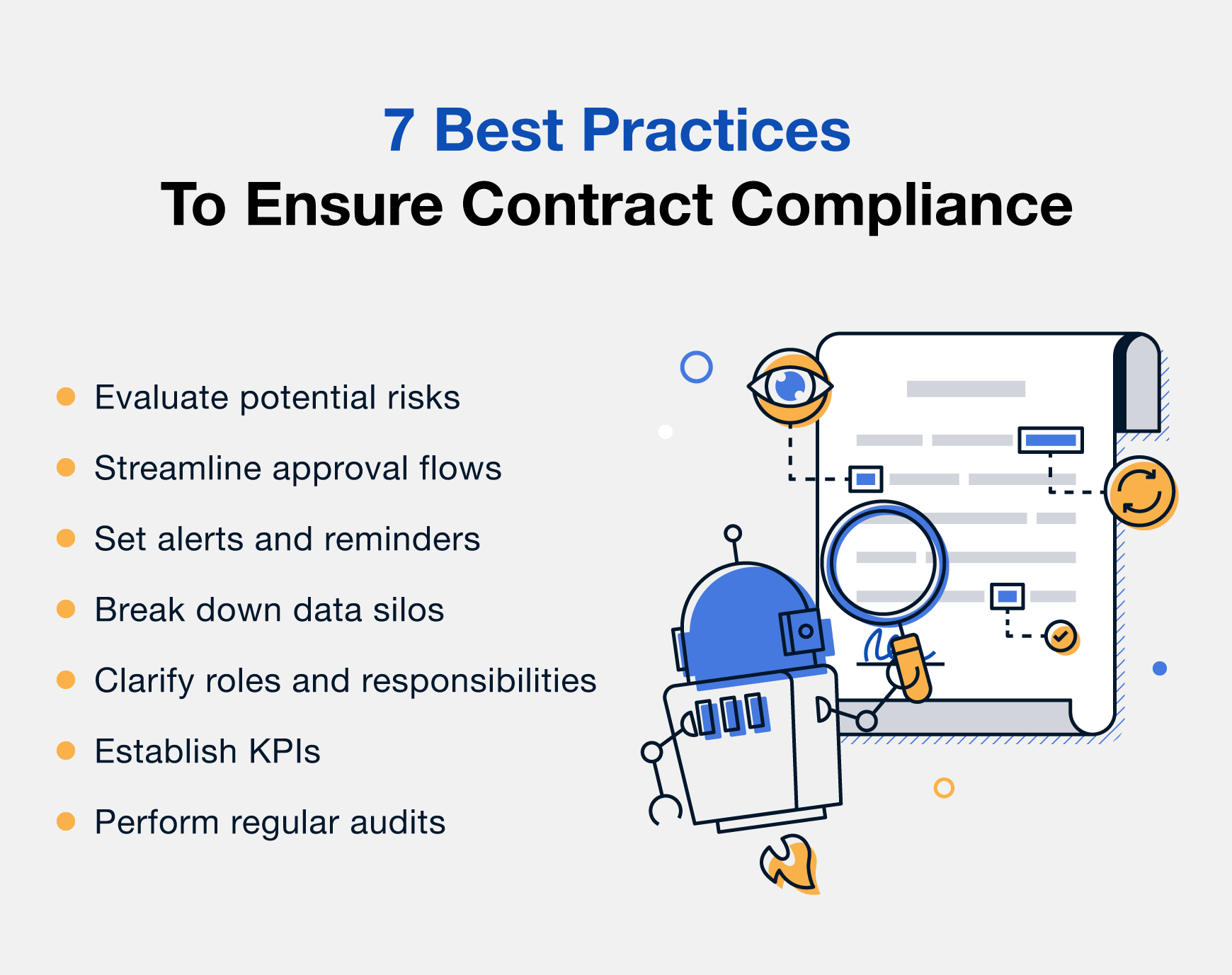
Breaking down data silos involves integrating information from various departments, systems, or software applications within an organization to improve collaboration, decision making, and data accuracy.
To break down data silos and improve contract compliance, your organization can:
- Implement a comprehensive contract management system that facilitates collaboration and data integration among the departments involved.
- Establish clear guidelines and processes for storing and sharing contract-related information.
- Invest in training and resources to ensure proper use and management of your data management systems.
Step 7: Schedule Regular Reviews, Audits and Updates
Conduct periodic compliance reviews across all three levels: perform risk assessment quarterly, update contract as regulation changes. Document all. changes as amendments. Make compliance reviews a habit, not an event. Schedule specific review for regulatory alignment separate from operational performance review.
Making Contract Compliance Easy
Contract compliance doesn't have to be overwhelming. Yes, the stakes are high and yes, you need to manage contractual, regulatory and operational requirements. But the solution doesn't require enterprise-level software with enterprise-level complexity.
With ContractSafe's contract management software, you can store all of your legal documents in one secure, centralized location, making it easy to keep track of important dates and deadlines throughout each stage of the contract’s lifecycle, so you’re always on beat.
Additionally, ContractSafe's powerful search and AI chat features allow you to quickly find and extract specific information from your contracts. Need to find limitation of liability caps? Just ask "What is the total Limitation of Liability cap in this agreement? Are claims related to 'data breaches,' excluded from this cap?"
By using ContractSafe, companies can streamline their legal operations and protect themselves from potential legal risks associated with noncompliance.
Want to see it in action? Sign up for a free demo today.







.svg)







.svg)