Quick answer: Evisort vs SpotDraft is a choice between two capable enterprise contract lifecycle management platforms: Evisort is an AI-first CLM now sold through Workday, and SpotDraft is a CLM built around the way in-house lawyers draft and review. Neither is the kind of thing you buy on a whim between meetings.
Both vendors give a good demo, which is exactly why a demo can't settle the choice. The test that matters comes after the rep logs off: whether your contract repository holds up in daily use and whether people outside legal will open it. If you need a system the whole organization will use without enterprise rollout weight, a full-lifecycle CLM like ContractSafe might fit better than either one.
Either way, the tour is where most buyers make up their minds, so it's worth knowing what a staged tour leaves out.
Choose your next step:
Worried about the Workday change? Start with what Evisort does best, just below.
Nervous about cost? Skip ahead to pricing and contract terms.
Suspect you don’t need an enterprise CLM at all? Jump to when neither one fits, and our contract management software buyer’s guide covers the wider field.
Key Takeaways
- Evisort’s real strength is AI extraction and document intelligence, and it’s now sold through Workday, which reshapes both its packaging and its roadmap.
- SpotDraft is organized around legal drafting and review, which is lovely for in-house lawyers and can quietly box in procurement, finance, and operations.
- Both are enterprise CLM rollouts, so the implementation effort matters just as much as the license line on the quote.
- Test real capability during the demo instead of trusting the feature list, and keep a contract management requirements checklist next to you while you do it.
- If your whole team needs a CLM they’ll use, contract management software like ContractSafe runs on unlimited users and published flat pricing.
Buying contract software is a lot like apartment hunting in a city where every unit has been staged before you get there. The couch is angled just so.
There’s a bowl of lemons on the counter that nobody in the history of the building has ever actually eaten. You walk in, and for about four glorious minutes you can picture your entire life happening in that space.
A vendor demo is that staging. Evisort shows beautifully, all clean extraction and confident dashboards. SpotDraft shows beautifully too, with drafting flows that make a lawyer’s shoulders drop a full inch.
The trouble starts later, on an ordinary Tuesday, when you’re standing in the middle of the place wondering where the boxes are supposed to go. The real question is where your contract repository lives when nobody’s performing, whether you can find the master services agreement at 11pm, and who gets a key.
Evisort vs SpotDraft Decision Table
So once the tour ends, compare any system, Evisort and SpotDraft included, on the work the system has to support every ordinary Tuesday: clean records, trusted answers, clear ownership, and next actions the team can actually take.
| Scenario | Better fit | Reason |
|---|---|---|
| Signed agreements are scattered across folders | Contract repository | The team needs searchable records, metadata, and renewal alerts |
| The team only needs static file storage | Shared drive or document management | A generic file tool may be enough when dates, owners, and alerts don’t matter |
| Legal needs intake, drafting, approvals, and signature | Full CLM | The pain is broader than post-signature control |
| Finance or procurement needs renewal reports | Contract repository | Structured fields and alerts matter more than folder structure |
| Sensitive contracts need controlled access | Contract repository | Permissions must apply to documents and contract data |
Evidence Checklist
| Decision signal | Evidence to request |
|---|---|
| A shared drive is enough | Confirm no one needs renewal alerts, owner fields, restricted access, or portfolio reports |
| A repository is needed | Show contract-specific metadata, search, permissions, alerts, and reports |
| Full CLM is needed | Show intake, drafting, approvals, redlining, signature, storage, and renewals in one workflow |
The 10 Comparisons That Decide Evisort vs SpotDraft
Ten dimensions decide this comparison, and every one of them is testable before you sign, with your own contracts in the room.
Here’s what is actually different across each area of daily contract work, why it matters, and where each deal tends to slip.
1. Repository Search and Findability
Both platforms store and search contracts, but Evisort’s search rides inside a larger enterprise CLM while SpotDraft’s is tuned to legal workflows. When you want everyone filing into one system, findability is the whole job, not a side feature.
Signed agreements scattered across folders are the usual starting pain, and the fix is searchable records with real metadata, not a tidier shared drive.
Ask each vendor to load a batch of your messiest signed PDFs and find the master services agreement by counterparty, value, and renewal window while you watch. Then run it again at the granularity your team actually uses.
The risk is a search that dazzles on curated demo data and stalls on your real folder sprawl, which you won’t discover until go-live, when the whole team is depending on it.
Can users find an agreement by owner, date, value, and clause, not just filename?
Does full-text search reach scanned and image-based PDFs?
Who can search the whole portfolio versus only their own workspace?

2. AI Extraction You Can Audit
Evisort was built to read contracts at scale, and its extraction earns the applause on the tour. SpotDraft extracts too, but tuned to legal review rather than portfolio-wide intelligence.
Evisort was founded by legal technologists as one of the early companies pointing AI and machine learning at documents, and it sits at the ambitious end of legal AI tools.
Run a stack of tens of thousands of sample agreements and ask the vendor to pull every contract that auto-renews in Q3, then trace each answer back to the exact source clause. Do the same for a handful of messy scanned PDFs.
Watch for extraction you can’t audit, because a number with no source link isn’t data, it’s a guess you’ll end up defending to finance later.
Does every extracted field link to the clause it came from?
Can a human correct a bad read, and does the model keep the fix?
3. Drafting and Review Workflows
Drafting is SpotDraft’s home turf, with workflows shaped around how in-house legal teams create, negotiate, and approve agreements. Evisort drafts too, but it’s capable rather than native, sitting inside a broader extraction-led platform.
For an in-house legal team that lives in redlines and approvals, SpotDraft feels like a place designed by someone who’s actually lived there.
Ask each vendor to walk one of your real contracts from first draft through redlines, approvals, and signature without leaving the tool, and time every handoff.
The risk is a review loop built for legal that turns procurement and finance into guests who have to ask the legal team for a key every time they want to run their own intake.
Legal-led drafting: SpotDraft is the stronger instrument when legal owns the process end to end.
Everyone else: confirm non-legal users can run intake without hand-holding.
4. Permissions and Access Control
Both Evisort and SpotDraft offer role-based permissions, so the real difference isn’t whether they restrict access but how granular it gets, down to individual documents and specific contract fields.
Permissions have to apply to the document and to the contract data attached to it, not just the folder it lives in. Test a real scenario during the demo.
Lock an executive-compensation agreement so finance can see renewal dates but not the numbers, and confirm the tool actually enforces it when a finance user logs in.
Permissions are where deals slip, because checks that look fine on a slide often can’t separate document access from data access once you get specific.
Can you restrict by document, folder, and individual field?
Do permissions cover both the file and its extracted data?
Is there an access audit trail showing who viewed what and when?
5. Alerts, Renewals, and Deadlines
Missed renewals are the most expensive boring problem in contract management, and both Evisort and SpotDraft send alerts. What differs is how much you can configure and which team’s calendar the reminders are built around.
Finance and procurement need renewal reports and warnings as much as legal does, so structured fields and alerts matter more here than folder structure.
Ask the vendor to set a renewal alert on your own agreement during the demo, with the owner, notice period, and escalation path you actually use, then let it fire to a non-legal owner.
Watch for alerts that fire into a void, because a reminder nobody owns is just a missed renewal with a paper trail attached.
Can non-legal owners receive and act on their own alerts?
Do reminders carry notice periods and escalation, not just a date?
Can you report on every renewal window across the portfolio?
Ask who maintains owner fields when people change roles, and test the reassignment flow.
6. Reporting and Dashboards
Evisort leans on portfolio-level analytics, while SpotDraft’s dashboards are legal-centric. For finance or procurement pulling a renewal report the moment the CFO asks, the question is whether reporting reaches beyond the legal team’s view.
Structured fields are what make this work, so users can report on dates, values, owners, and renewal windows instead of eyeballing folders.
Ask each vendor to build a live report across your sample set, covering dates, values, owners, and renewal windows, then export it to the format your finance team already uses.
The risk is dashboards that answer legal’s questions cleanly and leave every other department exporting to a spreadsheet anyway, which quietly recreates the problem you bought the tool to fix.
Can users report on dates, values, owners, and renewal windows without help?
Are reports self-serve, or do they route through an admin every time?
7. Integrations and Tools Architecture
Architecture is where Evisort’s Workday ownership shows. Its integration priorities and packaging now live inside Workday’s catalog, while SpotDraft integrates as an independent CLM, and that shapes what will connect cleanly to your stack.
Map your real integrations first, your CRM, e-signature, storage, and any system of record, then ask each vendor to prove the connectors you depend on rather than the ones on the slide.
Run a live test against one of them with your own data. Watch for a roadmap that answers to a parent company’s priorities, because the connector you need most may sit behind a boardroom decision you’ll never be in the room for.
Which integrations are native versus built on request at extra cost?
Does the extraction and search architecture reach scanned PDFs and email intake?
Will your integration priorities survive the next parent-company roadmap?
Ask for API rate limits, export formats, and sandbox access in writing before you sign.
8. Implementation and Migration Lift
You’ll still map integrations, migrate a repository, configure workflows, and train people who never asked for a new tool.
Thomson Reuters implementation guidance makes the case bluntly, that implementation belongs inside the buying decision, not after it, because teams who skip that step tend to discover their real requirements halfway through the build.
Ask each vendor for a written migration plan with dates, an owner, and a rollback, then run a sample migration of a few hundred agreements before you commit.
The risk is a legal-first rollout that squeezes every other department into a model drawn for legal and bills the hours nobody budgeted.
Legal side: SpotDraft’s design can make the legal rollout smoother.
Everyone else: budget the hours to fit procurement, finance, and ops in.
9. Pricing and Contract Terms
Neither Evisort nor SpotDraft hangs a price in the window, but only Evisort’s contract terms and packaging shifted when Workday acquired the company. You get a quote after a discovery call, and the number rides on seats, modules, and volume.
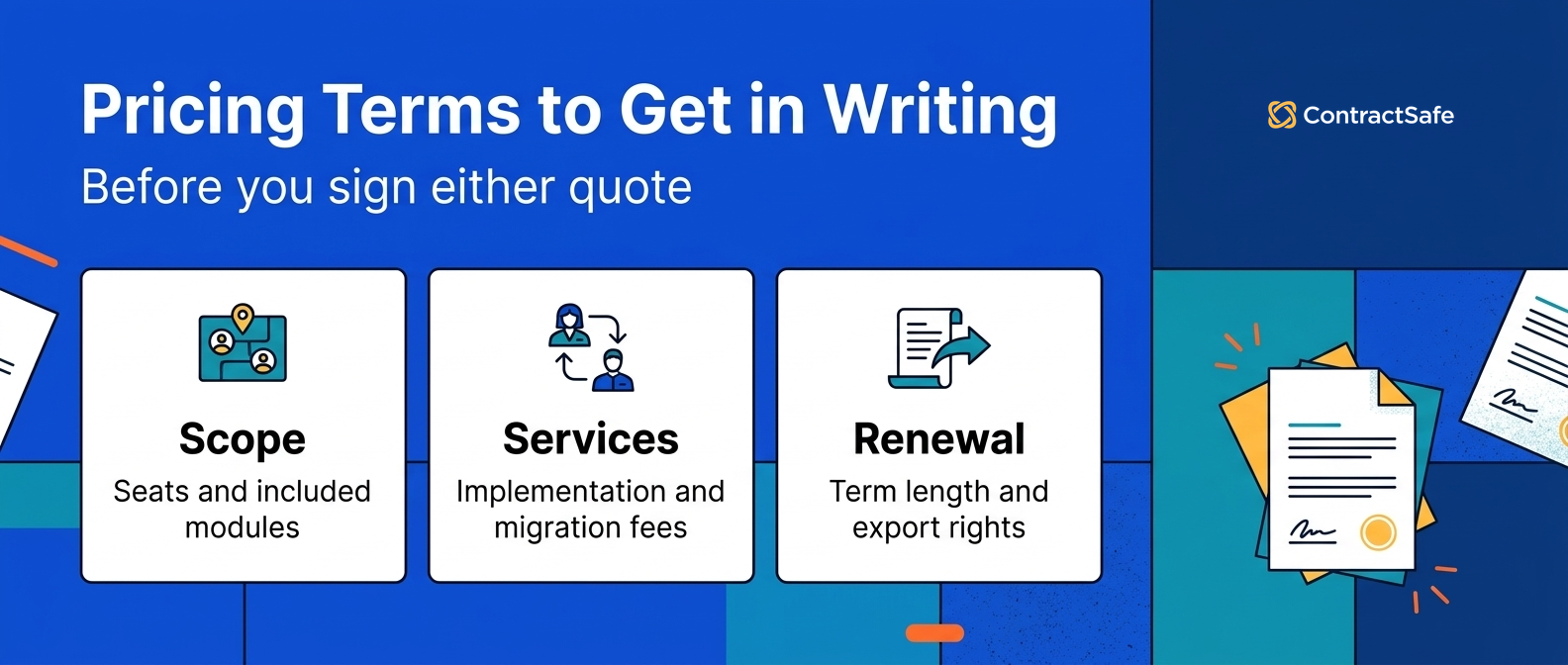
Thomson Reuters contract management criteria argues you should test concrete capabilities, so ask each vendor to price and prove the seat model, which modules sit in the base price, implementation fees, term length and auto-renewal, and clean data export.
The risk is per-user pricing that rewards you for keeping people out of the exact system a shared repository exists to open up.
MGI Research estimates Evisort’s run rate sat near $30 million on a 25% growth trajectory with a negative EBITDA margin. MGI Research’s acquisition analysis traces what that kind of absorption does to your contract terms, renewal pricing, and exit rights.
Base vs add-on: which modules reappear as line items at renewal?
Exit: can you export every contract cleanly the day you leave?
10. Support and Customer Success
Support diverges on ownership, not just service levels. SpotDraft answers to its own roadmap, while Evisort’s renewal, integration priorities, and account owner now sit downstream of Workday, and the demo won’t surface that shift.
None of that makes Evisort a bad tool.
Ask each vendor who owns your account after signing, what the escalation path looks like, and whether implementation, migration, and customer success are included or billed as separate lines.
Watch for support that’s warm in the pitch and invoiced later, because that’s where a friendly demo turns into a ticket queue.
Is customer success folded into the deal or a separate line item?
Who is your named contact, and can Workday’s catalog reassign it?
Get the support SLA, response times, and escalation owners written into the contract as exhibits.
When Neither Evisort Nor SpotDraft Fits Your Team
Sometimes the honest answer is neither. A lot of buyers comparing Evisort vs SpotDraft want fast search, dependable reminders, and clean permissions, not an enterprise CLM rollout that reorganizes how three departments work. If that’s you, the head-to-head is almost a distraction.
Come back to the apartment. Sometimes you tour two gorgeous places, and the quiet truth is that you don’t need four bedrooms and a chef’s kitchen. You need a good closet, a front door that locks, and to stop losing your keys.
A generic file tool might be enough when dates, owners, and alerts genuinely don’t matter, but the moment contract data has to trigger an action, plain storage stops being enough.
The cost of getting this wrong isn’t abstract.
WorldCC contract management research from 2025 found that the average business loses almost 9% of its value every year to poor contract management, and most of that leak is deeply boring: missed renewals, forgotten obligations, agreements nobody could find in time.
You don’t plug boring leaks with the most ambitious tool in the room. You plug them with something people will actually open on a Tuesday.
That’s the case for a full-lifecycle CLM the whole organization will actually use. A searchable repository, automatic alerts, plain reporting, role-based permissions, and AI extraction cover the day-to-day for most teams without a months-long deployment.
decision check: before you decide, ask the people who’ll actually use it. Are colleagues asking where the current agreement lives? Do renewal dates, owners, values, or restricted access drive the decision, or would a tidy folder answer the question?
If the honest answers point at find-and-track work that everyone shares, the enterprise head-to-head is a distraction.
The next move is to shortlist tools your whole team will use and write down your real requirements before the first call, so you’re testing platforms against your list instead of theirs.
How ContractSafe Compares to Evisort and SpotDraft
A large share of teams running this comparison don’t need either enterprise system. They need to find a contract in ten seconds, get warned before an auto-renewal fires, control who sees what, and pull a clean report when the CFO asks.
That’s a job for a full-lifecycle CLM everyone actually uses.
Paying for an enterprise rollout when you need a CLM the whole team will actually use is how good budgets go quietly sideways. The value that leaks out comes from missed renewals, buried obligations, and agreements nobody could locate in time.
Those are search-and-alert problems, and you don’t need to gut the kitchen to solve them. The tell is simple.
If your open tickets are people hunting for a signed copy or asking which version is current, you have a findability problem, and an enterprise CLM answers a question you didn’t ask while the real one stays open.
ContractSafe is built for that middle. It gives legal, finance, procurement, and operations one shared system: a searchable repository, AI extraction on every plan, alerts, permissions, and workflows that stay practical instead of ceremonial.
It won’t out-negotiate SpotDraft on redlines, and it won’t match Evisort’s deepest analytics. It also won’t ask for a season of your year or a quote you have to schedule three calls just to receive.
That transparency is worth using as a yardstick even if ContractSafe isn’t your pick.
Put flat, unlimited-user pricing next to either enterprise quote, run your own agreements through both, and the gap between what you’d pay and what you’d actually use tends to show itself fast.
So here’s the honest summary. If your team lives inside legal drafting, look hard at SpotDraft. If document intelligence at enterprise scale is the point and Workday’s orbit suits you, Evisort belongs on your list.
If you mostly need to see and manage what you’ve already signed, a full-lifecycle CLM your whole team will use fits better.
And the fastest way to tell which camp you’re in is to write down your real requirements first, then hold every quote up against them.
Related Reading
If Evisort’s new owner changes your calculus, see how ContractSafe compares with Workday CLM head to head.
Weighing more than these two platforms? The ContractSafe alternatives page lays out the wider field side by side.
See the flat, unlimited-user model side by side with enterprise quotes on the ContractSafe pricing page.
How ContractSafe Helps With Evisort vs SpotDraft
ContractSafe is contract management software for teams that need to find, track, and act on agreements without an enterprise CLM rollout.
If you’ve read this far, you’re probably standing between the renovation and the pantry, quote in one hand and a growing list of departments in the other.
ContractSafe publishes flat rates and includes unlimited users on every plan, so procurement, finance, and operations can all live in the system without a per-seat penalty that punishes you for adopting it widely.
ContractSafe also folds implementation and migration support into the deal, which matters a lot when the alternative is budgeting a multi-month build against an enterprise vendor’s roadmap.
If your requirements turned out narrower than the enterprise pitch assumed, the practical next step is to test that theory against your own contracts.
Book a ContractSafe demo, bring the messiest agreements you’ve got, and see whether fast search, alerts, and permissions cover the job you actually need done.
Ask the same proof questions you’d put to any enterprise vendor: who owns the signed agreement once the ink’s dry, can every department report on dates and owners without help, and does the price hold as you add users?
If the answers land, you’ve saved yourself a rollout you didn’t need.








.svg)







.svg)