
The legal industry is steeped in tradition, with law firms and courtrooms boasting centuries-old practices. But that doesn't mean it isn't open to disruption.
New AI tools are popping up everywhere, and while many aim to disrupt the industry, only a few actually possess the power to do so.
Adoption is climbing fast. According to the ABA's 2024 Legal Technology Survey, AI adoption among lawyers tripled in a single year — from 11% to 30% — with large firms leading the charge at 46%.
In this guide, we'll look at 11 legal AI tools that are paving the way for a new era in the legal world.
From contract management software and analytics to AI assistants and e-discovery platforms, these tools can help legal pros boost efficiency, reduce costs, and save time.
The goal: More time for big-picture tasks like strategy and negotiation.
Key Takeaways
- AI adoption among lawyers has tripled year-over-year, and legal-specific tools are gaining ground for their accuracy and security.
- These 11 tools span contract management, legal research, e-discovery, analytics, and drafting — covering the most common legal AI use cases.
- Legal-specific AI is preferred over general-purpose models for matters requiring citations, confidentiality, and repeatable accuracy.
- When evaluating tools, prioritize data security, ease of use, integrations with your existing stack, and human-in-the-loop design.
- ContractSafe uses AI as a practical workhorse — extracting data, powering search, and automating reminders — so your team can focus on strategic work.
What Can AI Legal Tools Do
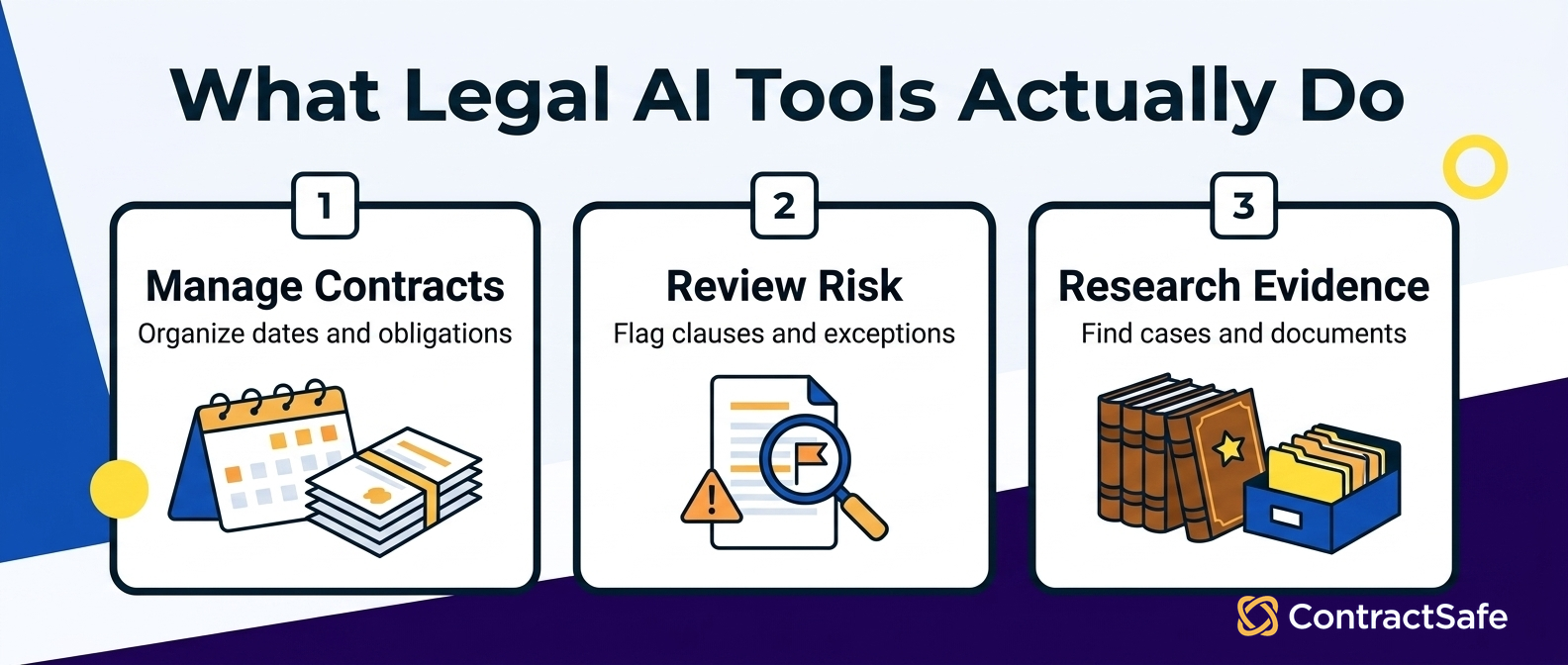
Legal AI tools are technology solutions that use artificial intelligence and machine learning to assist legal professionals in various aspects of their work.
Think of them as intelligent helpers who can automate repetitive and time-consuming tasks, analyze huge amounts of data, and spot patterns that could be overlooked by humans.
Leading platforms increasingly use retrieval-augmented generation (RAG) to ground outputs in verified sources and reduce hallucinations, which matters a lot when your work product ends up in front of a judge.
These tools are designed to address a wide range of challenges legal teams face, including contract management and review, legal research and analysis, e-discovery processes, risk management, client intake, and document drafting.
Whether you're a seasoned lawyer or an administrator for a legal team, AI tools can help tackle some of the most complex and time-consuming processes you deal with every day.
Benefits of Legal AI Tools
Legal AI tools offer real advantages for legal professionals and their clients. Here are the big ones:
-
Enhanced productivity and cost savings. AI automates repetitive tasks like data extraction, contract review, and legal research. This frees up valuable time for lawyers to focus on higher-level strategic work — client counseling, complex legal analysis, and developing winning litigation strategies.
-
Improved accuracy. Legal AI tools are trained on massive datasets of legal documents and case law. They can flag inconsistencies in contracts, predict potential legal issues, and ensure adherence to regulations. In fact, AI was able to review 153 paragraphs of contractual language with a 94% accuracy rate — in just 26 seconds.
-
Enhanced decision-making. Legal AI tools provide valuable insights and data-driven analysis that empower lawyers to make more informed decisions. These tools can analyze past cases, spot trends in your contract portfolio, or even predict how a judge might rule on a case.
-
Improved client services. AI tools allow legal professionals to deliver faster and more accurate services to their clients. From quicker contract turnaround times to more thorough legal research, AI can significantly improve client satisfaction and loyalty.
-
Scalability. Legal AI tools can adapt to handle increasing volumes of work without the need to proportionally increase staff or resources. This is crucial for law firms and legal departments looking to expand their operations efficiently.
And these are only scratching the surface of what AI is learning to do right now, in 2026.
11 Best Legal AI Tools
Now that we've explored the advantages of legal AI tools, let's dive into some of the leading solutions available on the market today.
Here's a curated list of 11 best legal AI tools:
1. ContractSafe: Contract Management
ContractSafe is an industry-leading contract management solution that uses AI to help you do what you're already doing, only faster and more efficiently.
Whether you're moving from a shared hard drive or spreadsheets to a new digital repository or trying to schedule alerts and approval workflows to stay ahead of your obligations, ContractSafe can meet you where you are.
It provides exactly what you need to take your contract management to the next level.
Key features:
-
Smart data extraction: ContractSafe uses AI to automatically extract data tailored to your needs, saving you countless hours.
-
Document categorization: Categorize your contracts by type, making it easy to find and report on your contracts quickly and accurately.
-
Automated reminders and notifications: Say goodbye to missed deadlines and forgotten renewals. ContractSafe will keep you on top of critical dates, ensuring you meet obligations seamlessly.
-
Advanced OCR search: Buried in scanned documents or screenshots of redlined contracts? No problem. ContractSafe's Google-like search functionality tackles even the toughest document formats, letting you find specific contracts with ease.
-
Integrations with other business tools: Combine ContractSafe with your existing tools and eliminate data entry drudgery. Focus on what matters most — strategic legal work, not administrative tasks.
-
AI Contract Review: Automatically analyze contracts against your predefined playbooks to flag risky clauses, missing language, and potential issues—helping legal teams review agreements faster while maintaining consistency and control.
-
AI Chat: Ask questions about your contracts in plain language and get instant answers. ContractSafe’s AI Chat can quickly surface key terms, obligations, and insights across your repository—no digging required.
With ContractSafe, AI isn't the star of the show. It's the workhorse powering some of the software's most useful and exciting features.

2. Lex Machina: Legal Analytics
Lex Machina is a legal analytics platform powered by AI. With Lex Machina, you can transform mountains of court documents into actionable insights.
Lex Machina can help you ditch the guesswork and make data-driven decisions so you understand opposing counsel's strategies and how judges typically rule in their courts.
It can also help you set realistic expectations and build stronger client relationships. (Note: Lex Machina's coverage is strongest for U.S. jurisdictions, so evaluate scope if you operate globally.)
Key features:
-
Court and judge analytics: Gain valuable insights into judge tendencies, motion success rates, and litigation trends within specific courts.
-
Opposing counsel evaluation: Analyze opposing counsel's past performance, win/loss rates, and preferred arguments to develop a winning litigation strategy.
-
Case assessment tools: Leverage AI-powered predictions to estimate case outcomes and set realistic expectations for your clients.
-
Specialized industry insights: Get in-depth analysis for various practice areas, including intellectual property, employment, and antitrust law.
With Lex Machina, you can leverage an AI tool that will give your legal team a competitive edge based on data.
3. Everlaw: E-Discovery Platform
Everlaw is a litigation platform designed with intuitive AI to streamline the discovery process.
Everlaw empowers legal professionals of all technical backgrounds by automatically summarizing findings, suggesting citations, and even answering open-ended questions buried within documents.
Key features:
-
AI-powered review and organization: Streamline your workflow and identify key evidence faster.
-
Predictive coding: Leverage AI to prioritize high-value documents for review.
-
Visual search and storytelling tools: Craft compelling narratives for presentations and court appearances.
Everlaw empowers legal teams to expedite e-discovery, ensuring a more accurate and collaborative review process.
4. Spellbook: Contract Drafting and Review
Spellbook plugs into Microsoft Word to supercharge contract drafting and redlining with GPT-4. It suggests clauses, flags risks, and autocompletes language based on your playbooks and prior matters — ideal for fast, consistent drafting without leaving Word.
Key features:
-
Word-native suggestions and auto-complete for clauses and definitions.
-
Risk flagging and playbook alignment during review.
-
Team workflows for approvals and consistency across templates.
Spellbook has broad consensus as a top contracting copilot and reflects the shift to embedded, context-aware AI rather than standalone drafting portals.
5. Smith.ai: Virtual Receptionists
Smith.ai is an AI-powered virtual receptionist service designed to streamline your business's operations.
Smith.ai's virtual receptionists handle it all, 24/7, freeing your legal staff from administrative burdens and allowing them to focus on billable hours and core legal work.
This translates to a more positive client experience from the first contact, increased efficiency within your firm, and the potential to grow your client base and revenue.
Key features:
-
24/7 virtual receptionist services: Provide exceptional client service around the clock.
-
Client intake and qualification: Capture qualified leads and streamline your intake process.
-
Appointment scheduling and call forwarding: Ensure a smooth client experience from initial contact to appointment scheduling.
Smith.ai empowers law firms to focus on what matters most — client relationships and legal expertise — by managing essential yet time-consuming tasks often handled by a law firm answering service, such as intake, call routing, and appointment scheduling.
6. Relativity: E-Discovery Platform
Relativity is another e-discovery platform designed to streamline complex legal matters. Leveraging advanced AI, Relativity automates tedious tasks and empowers legal teams to focus on strategic decisions.
Key features:
-
AI-driven data collection and organization: Effortlessly collect and organize massive data sets, saving valuable time and resources.
-
Advanced analytics for insight into data sets: Gain valuable insights from your data with AI-powered analytics, uncovering hidden patterns and key evidence.
-
Automated redaction and document translation: Ensure data privacy and streamline international discovery with automated redaction and translation tools.
Relativity empowers legal teams to manage large, complex e-discovery projects with greater efficiency and uncover critical information faster.
7. PatentPal: Niche Patent Tool
PatentPal is a niche legal tech tool designed to streamline the patent application process for attorneys and inventors. Leveraging AI, PatentPal empowers users to create and format patent applications efficiently.
Key features:
-
Automated drafting: With AI assistance, generate patent application components — claims, descriptions, and specifications — saving valuable time and resources.
-
Patent office compliance: Ensure your applications meet all formatting requirements with PatentPal's built-in formatting tools.
-
AI-powered claim and description guidance: Receive AI-driven suggestions to strengthen your claims and descriptions, improving the clarity and defensibility of your patent application.
By automating repetitive tasks and offering AI-powered guidance, PatentPal empowers users to focus on the strategic aspects of patent drafting.
8. Lexis+ AI: Legal Research
Lexis+ AI delivers conversational, citation-backed research with Brief Analysis and Judicial Analytics, built on the Lexis ecosystem. It's designed to surface on-point authority fast and reduce the risk of hallucinations in memos and motions.
Key features:
-
Conversational search with grounded citations to primary law.
-
Brief Analysis to find missing precedents and better citations.
-
Judicial Analytics to inform strategy by judge and jurisdiction.
-
Enterprise-grade privacy with auditability and usage controls.
Legal teams prefer tools that combine speed with verifiability and content depth — Lexis+ AI checks all three boxes.
9. Thomson Reuters CoCounsel: AI Assistant
Thomson Reuters CoCounsel builds on the original Casetext CoCounsel with deeper Westlaw integration to analyze large document sets, draft faster, and deliver source-linked outputs.
Key features:
-
AI-powered legal research: Leverage advanced AI to conduct efficient and thorough legal research.
-
Drafting assistance: Generate high-quality drafts for various legal documents, saving valuable time and resources.
-
Secure document processing: Enjoy peace of mind knowing your confidential information remains protected with CoCounsel's secure processing.
-
Customizable: Adapt CoCounsel to your specific legal practice needs and jurisdictions for a more personalized experience.
Tight Westlaw integration, strong enterprise controls, and reported high accuracy in complex document reviews have driven wider adoption this year.
By providing a secure and efficient legal AI solution, Thomson Reuters CoCounsel becomes an indispensable partner for legal professionals looking to streamline their workflows.
RELATED READ: How AI Is Transforming Contract Review: Faster, Smarter, and More Accurate
10. Luminance: Contract Review
Luminance is a contract review software powered by next-generation AI, designed to expedite and enhance due diligence processes, particularly for M&A transactions and real estate deals.
Beyond high-volume document analysis (over 3,600 documents per hour), Luminance can also flag inconsistencies, enhance collaboration, and streamline negotiations. Luminance's "Panel of Judges" approach ensembles multiple AI models to improve drafting and review accuracy across the contract lifecycle.
Key features:
-
Deep contract insights: AI uncovers critical terms, clauses, and potential risks across multilingual and multi-jurisdictional contracts, providing a holistic understanding.
-
Prioritization and anomaly detection: Focus on the most important aspects first. Luminance flags unusual clauses and inconsistencies, allowing legal professionals to prioritize review and identify potential issues.
-
Automated redlining and comparison: Streamline the review process with automated identification of deviations from standard clauses and redlining of key areas.
-
Collaboration and accessibility: Securely share documents and collaborate with colleagues regardless of location.
Luminance empowers legal teams to conduct faster, more efficient, and insightful contract reviews during due diligence.
11. Harvey: Contract Analysis
Harvey is a legal AI tool designed specifically for elite law firms. It utilizes generative pre-trained transformer (GPT) technology with the financial backing of OpenAI.
Harvey goes beyond basic legal AI by incorporating legal-specific data like case law and reference materials. This foundation is further enhanced by the ability to train on a specific firm's work products and templates, making it a truly bespoke solution.
Harvey is increasingly used for contract due diligence and regulatory analysis across multi-jurisdictional portfolios.
Key features:
-
Contract analysis and due diligence assistance: Identify hidden clauses, predict potential risks in contracts, and improve contract language, streamlining the review process.
-
Litigation support: Develop persuasive legal reasoning and strategies by analyzing opposing counsel's arguments and identifying relevant case law.
-
Regulatory compliance guidance: Navigate the complexities of regulatory compliance by providing up-to-date guidance tailored to the firm's specific practice areas.
-
Personalized training on a firm's work and templates: Harvey can become an extension of a firm's expertise, potentially leading to significant efficiency gains by automating repetitive tasks and surfacing relevant precedents.
Harvey offers a powerful AI solution specifically designed to enhance a law firm's capabilities across contracts, litigation, and regulatory compliance.
RELATED READ: Let's Be Real About Legal AI
What To Look for in Legal AI Tools
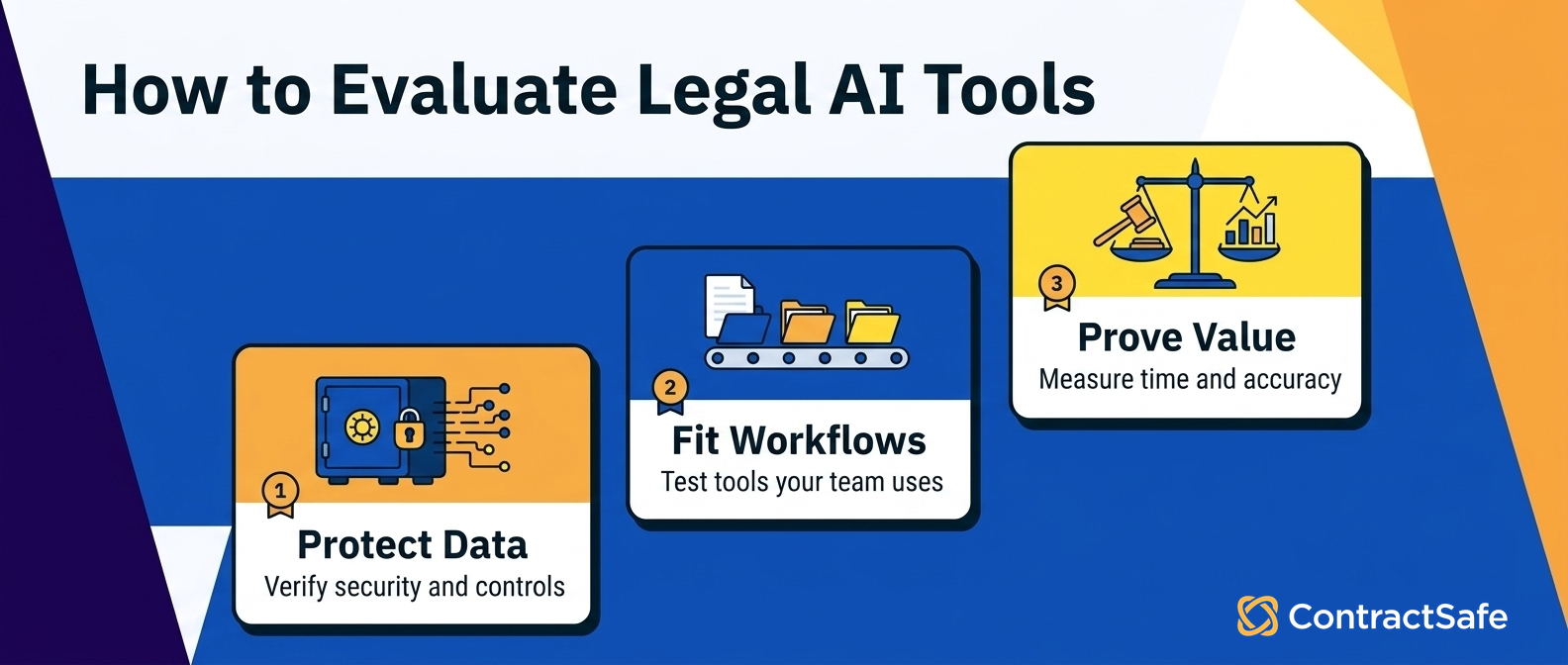
Whether you are comparing a contract repository, a research engine, or an AI legal assistant for everyday drafting and review, it's important to choose software that not only meets your current needs but also aligns with your long-term goals. Here's what matters most.
Data Security
Given the sensitive nature of legal work, the security of client data is paramount. Legal AI tools must offer robust security features to protect against data breaches and ensure compliance with regulations like GDPR or HIPAA, where applicable.
Look for end-to-end encryption that makes your data unreadable to unauthorized users, regular security audits that verify the tool's security measures are up-to-date, and compliance certifications like SOC 2 or ISO 27001.
Clear data handling policies are essential too — you need to understand how the tool stores, uses, and deletes your data.
If the tool utilizes a large language model like GPT-4, make sure your data is not used to train or improve the model without your explicit consent.
Enterprise buyers should also confirm availability of private-cloud or on-prem options, audit logs, and legal holds before rollout.
Ease of Use
Your team will adopt tools that are intuitive and easy to navigate, minimizing training time and maximizing productivity gains. Look for tools with user-friendly interfaces, comprehensive support, and training resources.
A good sign is if the provider offers demos or trial periods for you to assess the tool's usability.
Ultimately, you want something you can implement seamlessly into your current workflows, not something that will upend every process you've worked so hard putting together.
Integration With Existing Tools
A legal AI tool that integrates with your existing software ecosystem can streamline workflows and improve overall efficiency.
In 2026, look for deep integrations with Microsoft 365 (Word, Outlook, Teams) for drafting and reviews, and with research backbones like Westlaw or Lexis for grounded outputs.
Make sure the tool you're considering integrates with whichever other legal software you may be using.
While it may not be reasonable to expect every software to work with every other software out there, an API or Zapier integration will help you bridge the gap.
What matters most is that if you can't integrate right out of the box, there's a way to do it behind the scenes. That's exactly what API and Zapier integrations bring to the table.
Value and Necessity
The best legal AI tools solve specific problems, enhance your capabilities, and offer a clear return on investment.
Ask yourself: What problem does the tool solve? Does the problem actually need this tool to be solved? Is the tool worth its cost — are you reducing costly errors, saving time, or generating more billable hours?
It's also important to consider your current workflow. If you're looking to use an AI tool to scale your operations, you first need to make sure your operations are ready to scale.
Consider auditing your current processes before going all in on a shiny new tool.

Scalability
If your processes are on point and your tech stack is the only thing holding you back, an AI tool should be able to help. But it has to be flexible enough to scale with your business.
This means accommodating more users, larger data sets, and increasingly complex tasks without significant performance issues or surprise costs. Look for tools that offer flexible pricing plans, robust infrastructure, and the ability to add users or features as needed.
Support and Training
Effective support and training are crucial for maximizing the value of your chosen legal AI tool.
Look for responsive and readily available support options, comprehensive training resources like user manuals and video tutorials, and personalized training sessions.
A customer service team that actually knows the product makes a big difference. While good software should be fairly intuitive, quality support can help you get the most out of your investment.
Customization and Flexibility
Every legal practice has unique needs based on its size, specialty, and client base.
Assess the extent to which a tool can be tailored to fit your specific workflows, document types, and analysis needs. The ability to customize dashboards, reports, and alerts can be particularly valuable.
Compliance and Ethical Considerations
Legal AI tools must comply with legal and ethical standards relevant to your practice area and jurisdiction. Consider how the tool addresses potential biases in AI algorithms and whether it aligns with current regulations and your own ethical guidelines.
AI has already shown a number of problems, from biased data sets to creating its own legal precedents out of thin air.
More than anything else, you want to make sure a human has the final say in your AI tool's output. Establish internal AI use policies covering review, approval, and citation verification — and require tools to provide source links or document grounding.
RELATED READ: The Essential Guide to AI Contract Tools & Features (8 You Actually Need)
Learn How Your Legal Team Can Use ContractSafe To Transform Your Contract Management
ContractSafe’s approach to AI emphasizes utility rather than buzz. Instead of jumping the gun, so to speak, ContractSafe has found a perfect balance, emphasizing AI features that actually help you do your job better. Our [AI]ssistant is a powerful feature that will let your team get back to big-picture tasks like strategy while saving time and money by automating mundane tasks.Want to see it in action? Schedule a demo today and check it out for yourself.









.svg)







.svg)