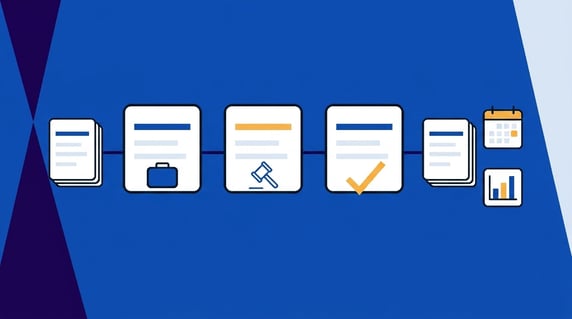
Higher education contract management is the practice of running college and university agreements through a full lifecycle: intake from academic and administrative units, review and approval routing, signature, storage, obligation tracking, renewal decisions, and audit reporting.
A signed contract is the middle of the story, not the end of it. Obligations, renewals, performance checks, and compliance work all keep going long after somebody clicks “sign.”
Quick answer: ContractSafe supports this full contract management lifecycle in one governed system, so campus teams can route work before signature and manage search, obligations, renewals, and reporting afterward.
Key Takeaways
- Higher education contract management spans intake through renewal, not just storing PDFs after signature.
- Campus contracting often spans central offices and semi-autonomous academic and administrative units.
- Standardized intake and routed approvals reduce email handoffs before signature. ContractSafe supplies both with contract request forms and automated approval routing.
- Post-signature owners, alerts, reports, and audit history turn signed agreements into managed obligations.
- Unlimited-user pricing lets every participating department use the same governed system.
Choose your next step:
Map the handoffs: see where campus contract work breaks.
Compare systems: use the software requirements.
Plan the rollout: follow the implementation stages.
Buyer Snapshot for Higher Education Contract Management
Why does campus contract management matter? Decentralized teams still need one reliable record. This comparison gives buyers a definition of a good setup and the red flags to test.
| Compare | Good setup | Red flag |
|---|---|---|
| Intake and approvals | Different routes feed one governed record | Requests disappear into separate inboxes |
| Search and data | OCR, semantic search, and reviewed extraction | Scans and metadata stay disconnected |
| Post-signature work | Owners, alerts, reports, and audit history | A shared drive is treated as the finish line |
Decision Check
Ask every vendor to run one real campus agreement through intake, approval, signature handoff, search, renewal tracking, and reporting.
What Higher Education Contract Management Covers Across the Lifecycle
Higher education contract management covers every stage an agreement passes through, from the moment a department decides it needs something through the day the institution renews or walks away. It’s the same contract management discipline any organization runs, shaped by campus governance.
That’s intake, templates, review, approvals, signature handoff, storage, obligation tracking, renewal alerts, reporting, and audit evidence. Software that only handles one of those stages hasn’t solved your problem. It’s just moved the rest of the lifecycle back onto somebody’s desk, where it was already sitting.
Columbia’s contract policy defines contract management as beginning after finalization and continuing through the contract’s life, including deliverable tracking, invoice review, performance monitoring, dispute handling, and amendments. That’s the post-signature half, and it’s a real job.
The pre-signature half, intake through execution, is a separate discipline with its own separate ways of going wrong. A university needs both running in the same system, or the handoff between them just becomes another mailroom slot where things sit. Here’s what the lifecycle looks like by stage and who typically owns each one on a campus:
| Lifecycle stage | Typical campus owner | What breaks without a system |
|---|---|---|
| Intake and request | Department admin, PI, coach, facilities manager | Requests arrive by email with no required fields |
| Template selection | Legal, procurement | Units draft from a five-year-old Word file |
| Review and approval | Legal, risk, IT security, finance | Serial email chains with no record of who approved what |
| Signature | Authorized signatory | Signed copy lives in one person’s inbox |
| Storage and search | Everyone, in theory | Nobody can find the executed version |
| Obligations and performance | The requesting unit | Deliverables go untracked until something fails |
| Renewal decisions | Procurement, finance | Auto-renewal fires before anyone reviews it |
| Reporting and audit | Legal, internal audit, compliance | Evidence gets reconstructed by hand |
Every row where the owner changes is a place the contract can slip through the floorboards, and honestly, that’s the whole reason full-lifecycle contract management exists as a category. It keeps those handoffs from being email.
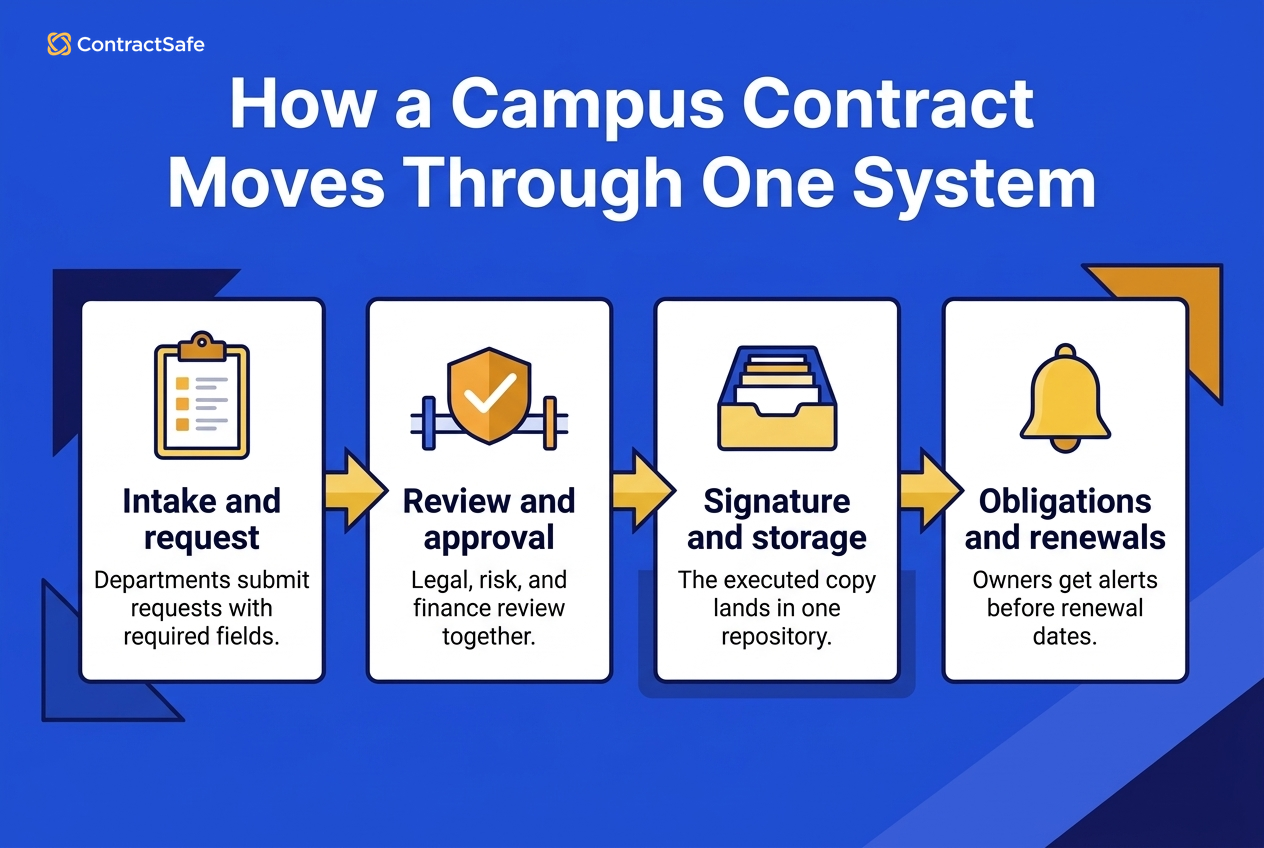
You can’t fix decentralization with a memo. A university needs one governed system that supports semi-autonomous units while keeping their handoffs visible.
Where University Contract Work Breaks Between Departments
Contract work often breaks between units, not inside them. Procurement, research administration, athletics, facilities, IT, and academic offices may each run a defensible process, yet nobody can answer a campus-wide question about who agreed to what.
It is like a campus where every building has excellent signs but the quad has no map.
Campus policy and real-world workflow tend to overlap only partially, and communication widens the gap. The people who actually need to route a contract are often not the people who sat through the session explaining how the routing works. So they do what’s reasonable: they email someone they trust and hope it lands.
The practical fix isn’t forcing every unit into one approval path. A study-abroad affiliation agreement and a copier lease shouldn’t travel the same route, and pretending otherwise just teaches people to route around the system. The fix is one system of record with many intake doors. Departments keep their own front porch. The contracts all land in the same house.
How Intake, Approvals, and Signature Handoffs Should Work
Intake gives the university its best chance to require good information before review begins. A standardized form, routed approvals, and a clean signature handoff reduce avoidable back-and-forth without changing who has signing authority.
The EDUCAUSE campus decision survey reported that 59% described third-party-service decisions as somewhat centralized, 21% as not centralized, and 4% as fully centralized. It also found that 55% involved multiple units in approval, while 66% communicated the process only to those most affected.
Read those last two figures together: many people can participate even when the process isn’t communicated broadly. A documented workflow gives the requester a status view and makes the route visible. A workable sequence looks like this:
Standardize the request form. Contract type, counterparty, dollar value, term, data involved, funding source, requesting unit. Required fields, not suggestions.
Route by attributes, not by memory. A $4,000 speaker agreement and a $400,000 SaaS contract with student data shouldn’t follow the same path.
Run approvals in parallel where you can. Legal, IT security, and risk reviewing at once beats three sequential email threads.
Give every approver the same packet. Same document, same metadata, same version. No forwarded attachments.
Hand off to e-signature, then come straight back. The executed copy lands in the repository with its data attached.
Confirm back to the requester. The submitting department should see status without emailing anyone.
Texas State University reported a 35% reduction in IT-contract execution time after a full workflow review in its 2025 Texas State workflow review session description. Notice what produced that number, though. Not more staff. Not tighter policy.
They reviewed the workflow, mapped how contracts actually moved, and took out the dead time between the steps. That’s it, and that’s usually where the time is hiding.
Demo Test
In a vendor demo, ask them to do these four things live with your own sample contract, not their polished canned one:
Submit a request as a non-legal user from an academic department and show the route it picks.
Send it to two approvers at once and show what each of them sees.
Push it to e-signature and bring the executed copy back with its fields populated.
Show the requester’s view of status the whole way through, without an admin logging in for them.
While you’re there, ask what can be configured during implementation and what quietly becomes a paid services engagement six months in. ContractSafe includes implementation and migration support, so compare that scope against systems that price configuration separately.
What Post-Signature Reporting, Renewals, and Compliance Require
Post-signature work needs three things a shared drive simply can’t give you: an accurate inventory of active agreements, alerts before renewal and termination dates, and evidence your team can produce on the day an auditor asks for it.
The EDUCAUSE 2024 poll on third-party risk reported that 63% of respondents had an informal or ad hoc third-party-risk process, or none at all, while 87% shared those responsibilities across more than one unit, with five units responsible on average.
Shared responsibility without a defined process creates coordination risk. The same EDUCAUSE poll found that just 41% maintained an accurate inventory of current third-party products and services, and only 22% regularly monitored third-party performance and compliance.
An inventory gap is really a search gap wearing a different hat. If you can’t find the contract, you can’t inventory it, you can’t monitor it, and you certainly can’t report on it.
That’s why a searchable contract repository with extracted dates and dollar values is the foundation for everything that happens after signature, and why contract compliance tracking built on a folder structure never quite gets there. Here’s what post-signature actually requires:
Key dates extracted and alerting. Renewal, termination, notice period, and auto-renewal deadlines, with reminders that reach the person who owns the relationship.
Obligations assigned to humans. Deliverables, insurance certificates, reporting requirements, and data-handling commitments, each with a named owner.
Permissions by unit. Athletics sees athletics, research sees research, legal sees everything.
Reporting that runs on real fields. Spend by vendor, contracts expiring soon, agreements involving student data.
Audit evidence on demand. Approval history, version trail, and executed copy, available without reconstructing the record by hand.
Solid contract renewal best practices put the decision on a calendar your team controls, with enough runway to actually negotiate before the term rolls over on its own.
How OCR, Semantic Search, and Data Extraction Improve Higher Education Contract Search
OCR, semantic search, and AI data extraction are what turn a pile of university PDFs into something you can ask questions of.
OCR makes scanned agreements readable, semantic search lets you ask in plain English, and extraction pulls dates, parties, values, renewal terms, and clauses into structured fields a person can look at and verify.
Picture a paper affiliation agreement someone scanned and saved years ago as `scan0043.pdf`. No text layer, no useful metadata, no chance of finding it by party or clause. It’s a picture of a contract sitting in a folder. OCR for scanned contracts converts that page image into machine-readable text, and suddenly the agreement rejoins the searchable world.
Semantic search is the next layer up, and it’s the one that changes how non-lawyers use the system. Keyword search quietly demands that you already know the vocabulary. If the clause says “indemnify and hold harmless” but you searched “liability,” you get zero results and walk away believing the contract doesn’t have one.
Plain-English search lets a facilities director ask which vendor agreements renew before the fiscal year closes without first taking a night class in contract drafting, which is what makes portfolio search practical for occasional users.
Extraction handles the tedious middle. AI reads the agreement and proposes the contract metadata you’d otherwise key in by hand late on a Friday: effective date, term, counterparty, auto-renewal window, notice period, total value, insurance requirements. Then a human reviews and confirms it. That review step isn’t a limitation we apologize for, it’s the point. AI is a co-pilot for the reading, not a substitute for the judgment.
One caution worth saying plainly, since it undercuts everything above if you skip it. Search quality depends entirely on what’s in the repository.
If half the campus is still signing contracts that never get uploaded, plain-English search will hand you a confident, well-formatted, incomplete answer, which is genuinely worse than no answer at all. Intake and search are the same project.
Higher Education Contract Management Software Requirements
Higher education contract management software should cover intake, approvals, signature handoff, storage, search, obligations, renewals, reporting, and permissions in one system, and it has to be usable by staff who touch contracts maybe four times a year.
Anything that only a trained administrator can operate will get quietly routed around, and you’ll find out two years later.
Use this as your evaluation checklist. It maps closely to a general CLM software feature checklist, with a few things that matter more on a campus than they do elsewhere.
Intake that departments will actually use. Request forms and templates can prompt a research coordinator for the agreement type and required details before review begins. If your intake is an email address, you don’t have intake.
Approval routing that varies by contract type and dollar threshold. Public institutions often have signature-authority rules written into board policy, and private institutions use their own delegation schemes.
Your software has to reflect the policy you already have, not the one it wishes you had.
E-signature integration, not e-signature as the whole system. Signature software executes an agreement. It doesn’t track what renews in March or who owns the next action.
A searchable contract repository with OCR. Executed agreements, amendments, exhibits, and the metadata that describes them, all in one governed place.
Permissions that match campus reality. Folder- and tag-based access, so athletics sees athletics and HR-adjacent agreements stay restricted. Ask vendors exactly what level their permissions operate at instead of nodding along at the word “granular.”
Alerts you can trust. Renewal and milestone reminders that reach a named person with enough lead time to do something, which puts the decision on your team’s calendar before the notice window closes on its own.
Reporting without spreadsheet archaeology. Dashboards for spend by unit, expirations by quarter, and contracts by counterparty, so audit prep becomes a query instead of a project.
Version control and audit trails. Who changed what, when, and which version got signed.
Security posture you can hand to your CISO. SOC 2, GDPR support, permissions, and audit trails. Ask about this early, because campus security review can stretch procurement out considerably.
Pricing that doesn’t punish adoption. Per-seat pricing is the natural enemy of campus-wide contract management. If adding the twentieth department costs real money, the twentieth department stays on a shared drive, and you can hardly blame them.
A Higher Education Contract Management Implementation Plan
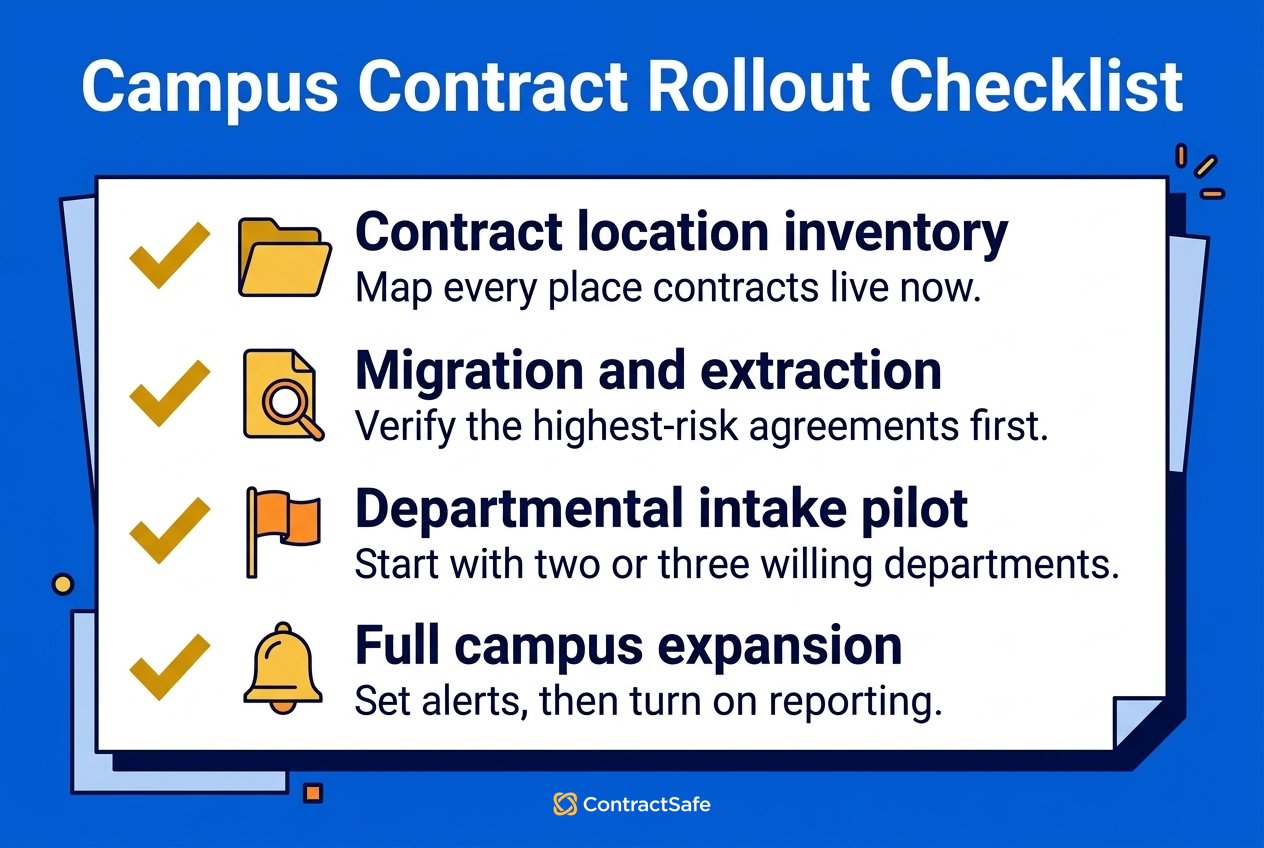
A practical rollout moves in stages: inventory what exists, migrate and extract, launch intake with two or three willing departments, then expand with reporting turned on. Nobody has to convert the entire campus in one semester, which is good, because nobody ever has.
Take inventory. Find where contracts live now. Shared drives, filing cabinets, a departmental Dropbox somebody set up in 2016, an Outlook folder named “contracts (old).” Don’t judge it, just map it. Write down any unexpected active agreements you turn up, because those are findings the rollout team will want.
Migrate and extract. Bulk upload, OCR the scans, run extraction across the portfolio, then have a person verify fields on the highest-value and highest-risk agreements first. You don’t need perfect metadata on a 2011 catering contract. You need it on your learning-management-system agreement.
Pilot intake with the willing. Pick two or three departments that already feel the pain and want the help. Build their request forms and approval routes, run live for a full term, and fix whatever breaks. Something will.
Expand and formalize. Roll out to the remaining units, publish the process broadly instead of only to those most affected, and set alerts so notice windows get caught months ahead rather than the week of.
Turn on dashboards for the CFO and general counsel at this stage, not earlier. Reporting only earns trust once the data underneath it is real.
Related Reading
How ContractSafe Helps With Decentralized Campus Contract Management
ContractSafe fits higher education because it handles the whole lifecycle without asking the campus to reorganize itself first. Departments submit through intake forms and templates built for their agreement types.
Approvals route by contract type and threshold, matching the signature authority your institution already has written down somewhere. On Finalize and Maximize, execution can run through ContractSafe’s native e-signature or the DocuSign integration, and the executed agreement and its metadata land in one governed system that legal, procurement, finance, and the units can all reach.
After signature is where the day-to-day value shows up, in search, ownership, alerts, and reporting. OCR makes decades of scanned affiliation agreements searchable again.
AI extraction proposes dates, parties, values, renewal terms, and clauses for a person to confirm, so your inventory stays current without dedicating a summer to manual data entry. Alerts surface renewals and milestones early enough that you can still renegotiate or walk. Custom dashboards answer spend and expiration questions without another spreadsheet, and version control and audit trails hold the history auditors ask for, backed by SOC 2 and GDPR support and folder- and tag-based permissions.
ContractSafe pricing helps determine whether a university can extend the system campus-wide, so it’s worth looking at closely. ContractSafe includes unlimited users on every plan, starting at $450 per month billed annually or $540 month-to-month.
No per-seat math means you can add the registrar’s office, facilities, and academic units without watching a seat count climb. Implementation, migration support, and customer success are included too, so the rollout stages above don’t land entirely on one overworked contracts administrator.
If you’re weighing options, bring a real campus problem to a working session. Load an old scanned affiliation agreement, ask a plain-English question about its renewal terms, and see what comes back. That tells you more than an hour of slides.








.svg)







.svg)