Contract repository requirements are the practical buying criteria that prove whether a system can store signed agreements, make them searchable, protect access, track dates, support reports, and help people act on contract data after signature.
That sounds tidy on paper. The real test is messier.
Imagine opening a storage closet before a board meeting. The boxes are labeled, mostly. Someone remembers that the vendor agreement is “probably in the blue folder.” The renewal date is in a spreadsheet. The signed amendment is in somebody’s email.
A repository is supposed to end that hunt.
But a weak repository only moves the hunt into software. The files are uploaded, the demo looked good, and somehow finance still asks legal where the renewal date lives.
That's why requirements matter. They keep the buying conversation focused on proof, not feature theater.
Key Takeaways
- Test a contract repository with your own messy contracts, not the clean files a vendor brings to the demo.
- Two questions matter most. Can the system do the daily work (find contracts, track dates, control who sees what, send alerts, report)? And, can your team actually afford it and use it (setup, price, support)?
- For every requirement, decide what you want the vendor to show you on the demo, not just tell you.
- Only trust an AI answer if it can point back to the exact wording in the contract.
- ContractSafe is built for teams that need signature, renewal alerts, and one searchable, secure, reportable home for every agreement.
Choose Your Next Step
Pick the spot that matches where you are right now.
- Still building your shortlist? Start with the vendor scorecard before you sit through a demo.
- Already have a few vendors in mind? Jump to the requirements and score what each one actually shows you.
- Want a lighter path? Check the requirements against your real needs for setup, access, support, and reporting.
The goal isn't a longer list of features. It's knowing whether the system will answer your real contract questions once the sales call is over.
What Contract Repository Requirements Should Prove
Contract repository requirements should prove that the platform can support real contract work after signature.
That means the requirement has to describe the job, not just the feature.
“Full-text search” is a feature.
“A finance user can search a scanned vendor agreement by clause text, find the current contract, and see the renewal date without knowing the file name” is a requirement. ContractSafe's contract search feature is built to pass exactly that test.
That difference matters because contract repositories fail quietly.
Everyone thinks the upload solved the problem. Then the first renewal report has blank dates. A customer amendment is detached from the master agreement.
A restricted HR document appears in a search result. An AI answer looks confident, but nobody can find the clause behind it.
The buying team should write requirements that make those failures visible before the contract is signed.
Thomson Reuters contract management criteria give buyers a useful pressure test: can the system help people control contract work and act on the right information?
Repository requirements turn that pressure test into demo evidence.
Start With the Repository Job, Not the Vendor Demo
A contract repository buying process should start with the contract questions your team already struggles to answer.
Those questions usually sound ordinary. Which vendor agreements renew next quarter? Which contracts have no owner? Which agreements include auto-renewal language? Which customer terms are restricted? Which files have amendments? And which AI-extracted dates has a person actually reviewed?
Those aren't abstract software requirements. They’re the work the repository has to support on a Tuesday afternoon when somebody needs an answer.
Before you look at vendors, write down the weekly jobs the contract repository must handle.
- Find the signed agreement quickly.
- Show the current version, including amendments.
- Protect sensitive records without hiding ordinary business information.
- Track renewal dates, notice periods, owners, and status.
- Build reports people can act from.
- Trace important answers back to the source agreement.
If a vendor demo doesn't prove those jobs, the demo is incomplete.
Contract Repository Evaluation Scorecard
A repository requirements checklist should compare the work the system must support: clean records, trusted answers, clear ownership, and next actions the team can actually take.
| Criterion | What to test | Pass condition |
|---|---|---|
| Search | Look for a contract a few different ways: by company name, a phrase from a clause, the contract type, and a date. | The right contract comes up without anyone needing to know the file name or which folder it's in. |
| Reading scanned documents (OCR) | Upload a scanned contract (not a clean digital file), then search for words that only appear inside that scan. | The scanned document's text becomes searchable like any other contract. |
| Metadata | Review counterparty, execution status, effective date, expiration date, notice period, value, governing law. | The fields support reports, alerts, and decisions without spreadsheet cleanup. |
| Permissions | Repeat the same search as legal, finance, procurement, sales, and read-only users. | Users see what they’re allowed to use and nothing sensitive outside their role. |
| Security | Ask where your contracts are stored, how they're protected, and what proof the vendor can show. Ask for their SOC 2 report, whether data is encrypted, how long they keep it. | The vendor can show current, independent proof, not just say "we take security seriously." Their answers fit your company's security and privacy rules. |
| Alerts and reports | Build renewal, missing-owner, obligation, and restricted-access reports during the demo. | The report names the contract, date, owner, source, and next action. |
| AI traceability | Ask AI for dates, clauses, parties, obligations, and summaries from real documents. | Important answers link back to the source contract language and review status. |
| Implementation | Ask what must be cleaned before launch and what support is included. | The vendor gives a realistic rollout path, not a magic upload story. |
Decision Check:
- Can the contract repository vendor prove the workflow with messy real contracts, not demo-perfect files?
- Can a user trace an AI answer, extracted date, or report field back to the source agreement?
- Can legal, finance, and business owners act from the same record without opening access too broadly?
- Can the scorecard narrow a shortlist before the demo gets theatrical?
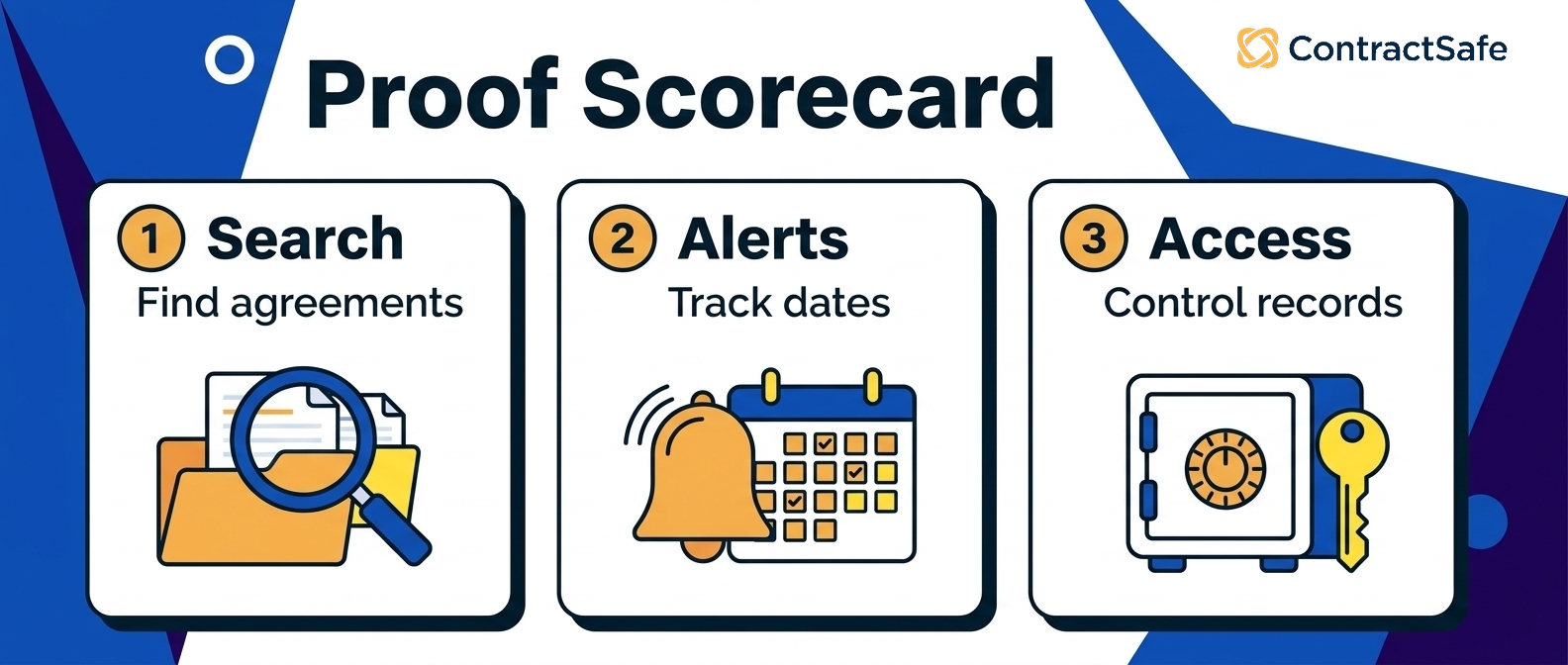
1. Can Users Find the Right Contract?
Search and OCR requirements should prove that users can find current agreements even when file names, scans, and folder history are messy.
Ask the vendor to upload a scanned agreement and search by counterparty, clause text, agreement type, owner, and dates.
The pass condition isn't that a document opens. The pass condition is that the right contract appears in the search results.
Bring a vendor agreement with an amendment and a scanned signature page.
The system should find the agreement, show the related amendment, and make the searchable text useful without a manual renaming project.
Also test what happens when the search is imperfect.
Search for an old vendor name. Search for a clause phrase with a typo. Search for a date format that appears differently across contracts.
That’s where weak repositories start to show their seams.
If users still need to know which folder a contract lives in before they can find it, the repository hasn't solved the problem.
2. Does the Repository Capture the Right Fields?
Every contract holds key facts: who it's with, when it renews, what it's worth, which state law governs. Those facts are metadata, and the system stores each one in its own field you can filter and report on. In a modern repository, you're not typing them in by hand, AI reads the contracts, pulls the facts, and fills the fields for you to review.
Metadata requirements should define the fields that make contracts useful after upload.
They shouldn't include every field someone might someday want.
Start with a practical field set: counterparty, agreement type, business owner, effective date, expiration date, renewal notice date, value, and status.
Then ask which fields must be required before launch.
A common use case is renewal reporting.
If the system can’t connect the renewal date, notice period, owner, and source clause, the report will still need spreadsheet cleanup before anyone trusts it.
| Field | Why it belongs in the first release | Demo proof |
|---|---|---|
| Counterparty | Supports search, reporting, and duplicate detection. | Find all agreements tied to the same vendor. |
| Agreement type | Separates vendor, customer, employment, lease, and policy records. | Filter reports by type without folder cleanup. |
| Business owner | Gives every reminder and question a recipient. | Show owner gaps and owner-based renewal reports. |
| Notice period | Turns the repository into an early-warning system. | Trace the alert date to the contract language. |
| Contract value | Lets teams see and prioritize where the money sits | Total the value of active vendor agreements, or sort to find the high-value contracts |
This is where teams often overbuild. They create a giant field list because the old spreadsheet had one, then half the fields stay blank, nobody trusts the reports, and everyone quietly goes back to manual work.
Start with the fields that drive decisions. Add the rest when a real report needs them.
3. Can You Control Who Sees What?
Permission requirements should test whether people can use the repository without seeing contracts outside their role.
The demo should include legal, finance, procurement, sales, HR, and read-only users.
Ask the vendor to repeat the same search from each role and show what changes.
A restricted contract should stay restricted. Useful non-sensitive metadata can still support work when policy allows it.
Scenario testing matters here.
A finance user may need renewal timing or contract value without needing privileged notes, HR agreements, settlement terms, or sensitive amendments.
A sales user may need the current customer agreement without seeing every customer agreement.
An auditor may need temporary read-only access without becoming a permanent paid seat problem.
Ask whether permissions apply to contract records, reports, exports, alerts, and AI answers.
If AI can summarize a contract the user can't open, the permission model has a hole.
ContractSafe supports role-based access so teams can share contract records with the people who own the work while keeping sensitive agreements controlled.
4. Does the Repository Turn Data into Action?
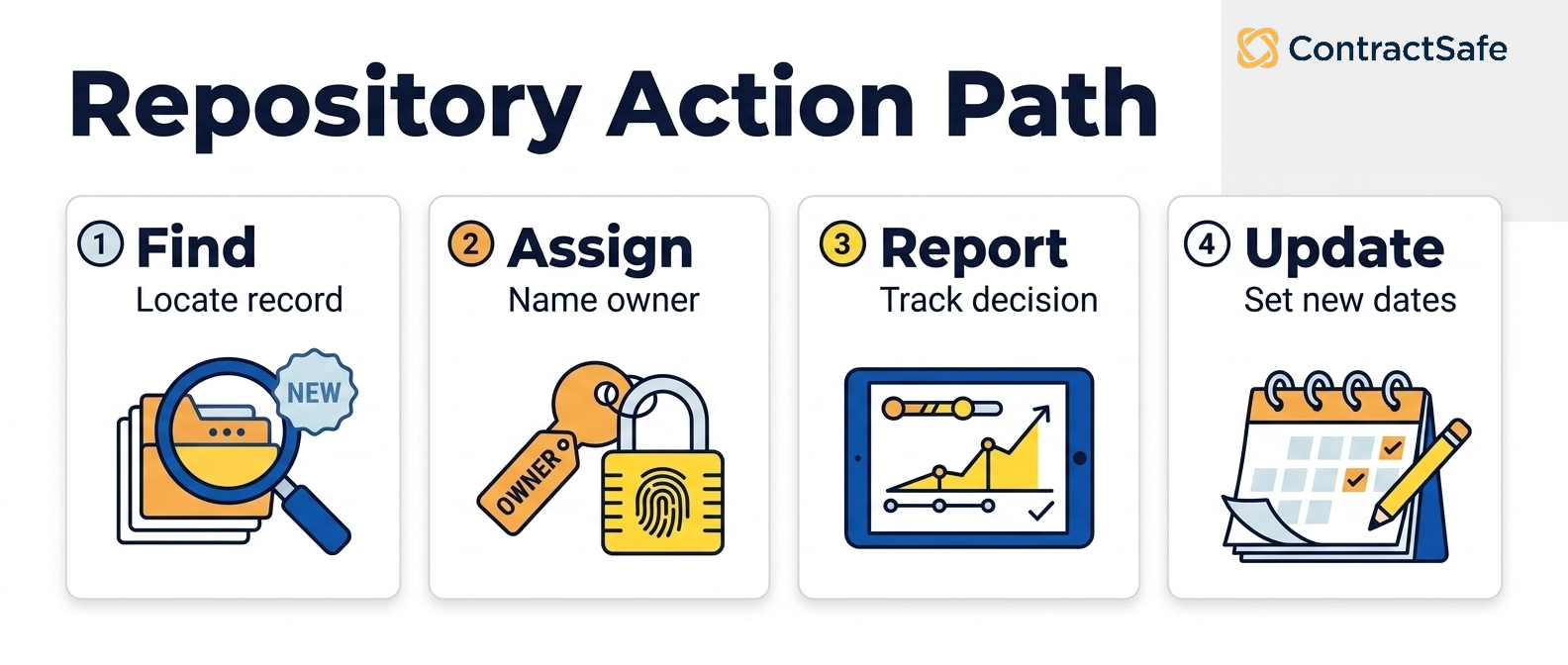
Alert and reporting requirements should prove that contract data turns into owned action after the file is uploaded.
Test renewal alerts, obligation reports, missing-field reports, owner reports, and restricted-access reports on the sample agreements you bring to the demo.
If the report needs spreadsheet cleanup before anyone trusts it, the contract repository is still storage with a nicer front door.
For example, ask the vendor to build a renewal report from extracted fields, assign the business owner, add a backup recipient, and show the source agreement behind the date.
A good report should answer four questions.
- Which contract needs attention?
- What changed or what deadline is coming?
- Who owns the next step?
- Where is the contract language that supports the report?
That last question matters because reports become business decisions.
If the report says a vendor renews soon, someone may start a negotiation.
If the source clause says the notice window already passed, the report created a false sense of control.
The Washington State procurement manual's Reporting Agency Contracts guidance is a useful reminder that reporting isn't decoration. It's how teams track obligations, status, and accountability.
ContractSafe tracks renewal dates and alerts, which helps legal, finance, procurement, and business owners act before deadlines turn into surprises.
5. Can You Trust What the AI Pulls?
AI requirements should test whether extracted values and answers are reviewable, access-aware, and tied to the source agreement.
Ask the system to extract the effective date, termination date, renewal language, governing law, parties, value, and a key obligation.
Then ask where each answer came from.
If the system can’t show the source text, the output should stay untrusted.
The useful AI workflow is narrow and practical: extract fields, mark them for review, let a human confirm or reject them, and keep a record of the decision.
That may sound less exciting than an AI demo where everything looks instant. Good.
Contracts aren't a place where "seems right" should become the operating standard.
Use this AI proof list during the demo.
- Ask the AI for a renewal date and make it show the clause.
- Ask for a contract summary from a restricted user account.
- Correct an extracted field and confirm the correction is logged.
- Build a report using reviewed fields, not unreviewed guesses.
- Ask what data is retained, deleted, or used for model training.
ContractSafe’s AI contract management features are built around practical contract work: finding useful details, improving search, and helping teams act on contract data inside the repository.
6. How Hard Is the Setup and Migration?
Repository implementation requirements should prove the vendor understands what must be cleaned before the repository becomes useful.
File movement alone isn’t enough.
Ask which records should be reviewed first, which fields must be required, who owns duplicate cleanup, how amendments are related to parent agreements, and what support is included during launch.
Use a two-lane cleanup model.
Lane one contains records that block business action: upcoming renewals, high-value vendor agreements, active customer contracts, and restricted records.
Lane two contains historical cleanup that can improve over time without delaying launch.
Ask the vendor to show the launch path in plain steps.
- Import the important contracts first.
- Review high-risk fields before alerts depend on them.
- Assign owners and backup owners.
- Connect amendments to parent agreements.
- Set permissions before broad rollout.
- Build the first reports the team will actually use.
For example, ContractSafe implementation support can help teams turn launch risk into assigned work: import the important contracts, review high-risk fields, assign owners, and keep cleanup visible.
7. Who Can Use It and What Will It Cost?
Adoption requirements should test whether the people who own contract work can actually use the repository after launch.
Ask how many users are included, what training is available, who receives support, and what happens when finance, procurement, auditors, and business owners need access.
A contract repository that only legal can use will struggle to become the operating record.
Use ContractSafe pricing to check whether the access model fits the way your teams need to work.
ContractSafe includes unlimited users on every plan, which changes the evaluation when more departments need controlled self-service access.
The practical test is simple.
Can a non-legal user find the agreement they're allowed to see, understand the date or owner attached to it, and know what action comes next?
If the answer is no, the repository may technically hold contracts while the business still works around it.
That’s the old storage closet in a nicer outfit.
8. Will the Repository Work with Your Other Systems?
Integration requirements should define where contract data goes after the repository becomes the source of truth.
Sales may still work in a CRM. Finance may still work in accounting systems. Procurement may still use vendor systems. E-signature tools may still handle execution.
The repository should keep the signed agreement and the key post-signature data dependable.
Ask which fields can move into other systems and which permissions follow the data.
This isn't only a technical question. It's an ownership question.
If finance exports a renewal report, who owns the cleaned data next month?
If procurement updates a vendor owner, does the repository update too?
If a CRM says a contract renewed but the repository says it expired, which system wins?
A good repository requirement names the system of record before integrations multiply the confusion.
9. What Happens to Data Once It Leaves the Repository?
Export requirements should prove that contract data can leave the repository without turning into a second unmanaged source of truth.
Exports are useful. Audits, board reports, finance reviews, and procurement analysis often need spreadsheet-friendly data.
The problem starts when exported data becomes the place where cleanup actually happens.
Think of it like copying a library catalog into a notebook.
The notebook may help during a meeting, but the library catalog still has to be corrected when the meeting ends.
Ask whether exports include owner, date, status, value, access level, source record, and review status.
Then ask who can export restricted fields and whether the export is logged.
A good requirement says exported reports can support audits and analysis without becoming the system of record.
10. Does It Track Who Changed What, and When?
Audit history requirements should prove that the repository can show who changed important contract records and when.
This matters because contract metadata becomes evidence.
If a renewal date changes, legal should know who changed it, when it changed, and whether the change came from source contract language.
If a user gets access to a restricted agreement, the system should show that too.
Test the ordinary changes first.
- Edit a renewal date and check the history.
- Change an owner and check the history.
- Update a permission group and check the history.
- Correct an AI-extracted field and check the history.
If the audit log can't show who changed a renewal date, legal may struggle to explain why the team acted on that date later.
11. Confirm Amendment and Version Control Requirements
Amendment and version requirements should prove that users can find the current contract record without separating it from its history.
This is one of the easiest contract repository problems to underestimate.
The original agreement is uploaded. Then an amendment changes pricing. Then a renewal letter changes the term. Then someone uploads a signed order form.
Now the question is not “do we have the files?”
The question is which record controls the decision in front of you.
Ask the vendor to connect an original agreement, amendment, and renewal document during the demo.
Then search from the old name, the new name, a clause phrase, and the counterparty.
The contract management system should make the relationship obvious enough that a business user doesn't act on the wrong document.
12. Is Your Data Safe with This Vendor?
A contract repository holds some of your most sensitive records: pricing, terms, employee agreements, settlement language. Before you hand all of that to an outside company, you need to know they can keep it safe, and that you can see who touches it once it's in there.
Don't simply accept "we take security seriously." Ask for proof:
- Do they have current, independent security certifications they can share, like SOC 2 and ISO 27001?
- Is your data encrypted, both while it's stored and while it's moving?
- Where is the data hosted, and does that fit your company's rules about where information can live?
- How long do they keep your data, and how is it deleted if you leave?
- Have they had a security breach, and if so, how did they handle it?
The pass condition is simple: the vendor can show current, independent proof, not just describe good intentions, and their answers fit whatever security and privacy rules your own company has to follow. A healthcare or finance team will have a higher bar than a small business, so measure their answers against your requirements, not a generic checklist.
Proof to Ask For During the Demo
The contract management demo should show the vendor handling real documents, real roles, real dates, real reports, and real source-language checks.
The best repository demo isn't the prettiest demo.
It’s the demo where the vendor has to work with your kind of mess.
Bring a small packet of sample agreements if your process allows it.
Include one scanned PDF, one amendment, one vendor agreement with auto-renewal language, one restricted agreement, one contract with a missing owner, and one agreement with an awkward notice period.
Then ask the vendor to show the work.
| Vendor claim | Evidence to request |
|---|---|
| AI can answer contract questions. | Show the source clause, permissions behavior, review status, and correction path. |
| Setup is simple. | Show migration steps, required fields, owner model, and first useful report. |
| Reporting is included. | Build a renewal or obligation report from extracted fields during the demo. |
| Permissions are flexible. | Run the same search from legal, finance, and restricted user accounts. |
| Users will adopt it. | Show the exact workflow a business owner uses after receiving an alert. |
Record whether each item was shown, partially shown, or only claimed.
“Only claimed” shouldn't receive full credit because the slide was convincing.
That keeps the scorecard honest when the demo starts looking cleaner than your actual contract folders.
Related Reading
- Digital contract repository, for the baseline definition and operating model.
- Contract repository software, for platform-selection criteria before demos.
- Centralized contract repository, for cleanup that starts with scattered folders.
- Contract repository management, for keeping the repository useful after upload.
- Contract management checklist, for the broader buying process.
How ContractSafe Helps With Contract Repository Requirements
ContractSafe helps when the main problem is scattered signed agreements, hard-to-trust dates, and contract questions that keep landing back in legal’s inbox.
With the ContractSafe repository, teams can store executed agreements, search contract text, review key fields, set permissions, track renewal dates, and build reports from the same governed record.
That matters because the requirement isn’t just storage.
It’s whether legal, finance, procurement, and business owners can trust the answer they find.
ContractSafe also keeps access practical.
Unlimited users on every plan means the buying team can include the people who own contract work, not just the legal team that uploaded the files.
ContractSafe supports contract alerts, AI extraction, role-based permissions, reporting, OCR, and guided implementation support.
Bring the same sample agreements, source-traceability checks, reports, permissions, and alert tests from this article into the demo conversation.
If the team needs pre-signature routing alongside repository control, note in the scorecard that ContractSafe covers both.
If the urgent need is a searchable, permissioned, reportable source of truth for signed agreements, ContractSafe is built for that work.







.svg)







.svg)