How to write a contract starts with understanding what a contract does: it turns a business relationship into a set of enforceable obligations and protections that both parties can rely on when things don’t go as planned.
Most people think of contracts as paperwork that formalizes a deal. That’s true, but it undersells the point. A contract is a list of answers to questions that haven’t been asked yet.
What happens if the vendor misses the deadline? What happens if the client changes the scope? What happens if one party goes out of business?
Every section in a contract exists because, at some point, someone left it out and paid for it.
TL;DR
- Writing a contract means answering “what could go wrong?” section by section, before anything goes wrong.
- Norton Rose Fulbright’s 2026 Litigation Trends Survey found that companies with over $1 billion in revenue spent an average of $4.1 million on litigation in 2025. Many of those disputes trace back to contracts that didn’t address a scenario both parties later disagreed about.
- The six elements that make a contract legally valid are offer, acceptance, consideration, capacity, legality, and mutual assent. Missing any one of them can make the entire agreement unenforceable.
- Each section of a business contract (scope, payment, termination, liability, confidentiality, dispute resolution) prevents a specific category of argument.
- ContractSafe stores executed contracts in a searchable repository, extracts key dates and terms with AI, and sends alerts before deadlines pass.
What Makes a Contract Legally Enforceable
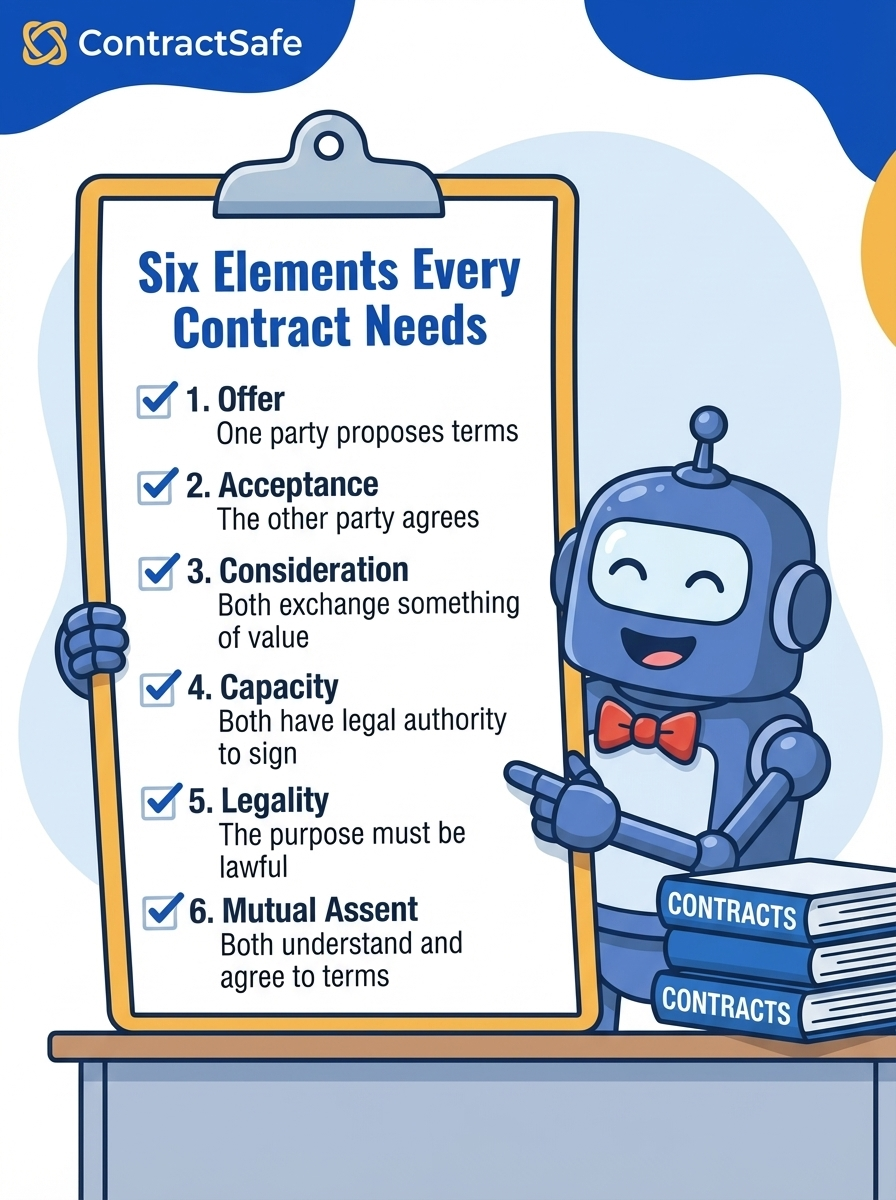
Before getting into specific sections, a contract needs six elements to be valid. Skip one and the entire document may be unenforceable, regardless of how well the rest is written.
- Offer. One party proposes terms. “We’ll redesign your website for $85,000” is an offer. “We should work together sometime” is not.
- Acceptance. The other party agrees to those terms without modification. A counteroffer (“We’ll do it for $70,000”) restarts the process.
- Consideration. Both exchange something of value. Money for services. Access for licensing fees. A contract where only one party gives something is a gift, not an agreement.
- Capacity. Both parties have the legal authority to enter the agreement. A minor can’t sign a binding commercial contract. Neither can an employee who lacks signing authority for their company.
- Legality. The purpose must be lawful. An agreement to do something illegal is void from the start.
- Mutual assent. Both understand and agree to terms. If one party believed the contract covered ten deliverables and the other believed it covered five, there’s no mutual assent.
These six elements are the foundation. Everything that follows builds on them. A contract can have fifty pages of detailed terms, but if one of these six is missing, a court may treat the entire document as unenforceable.
How to Write a Contract Section by Section
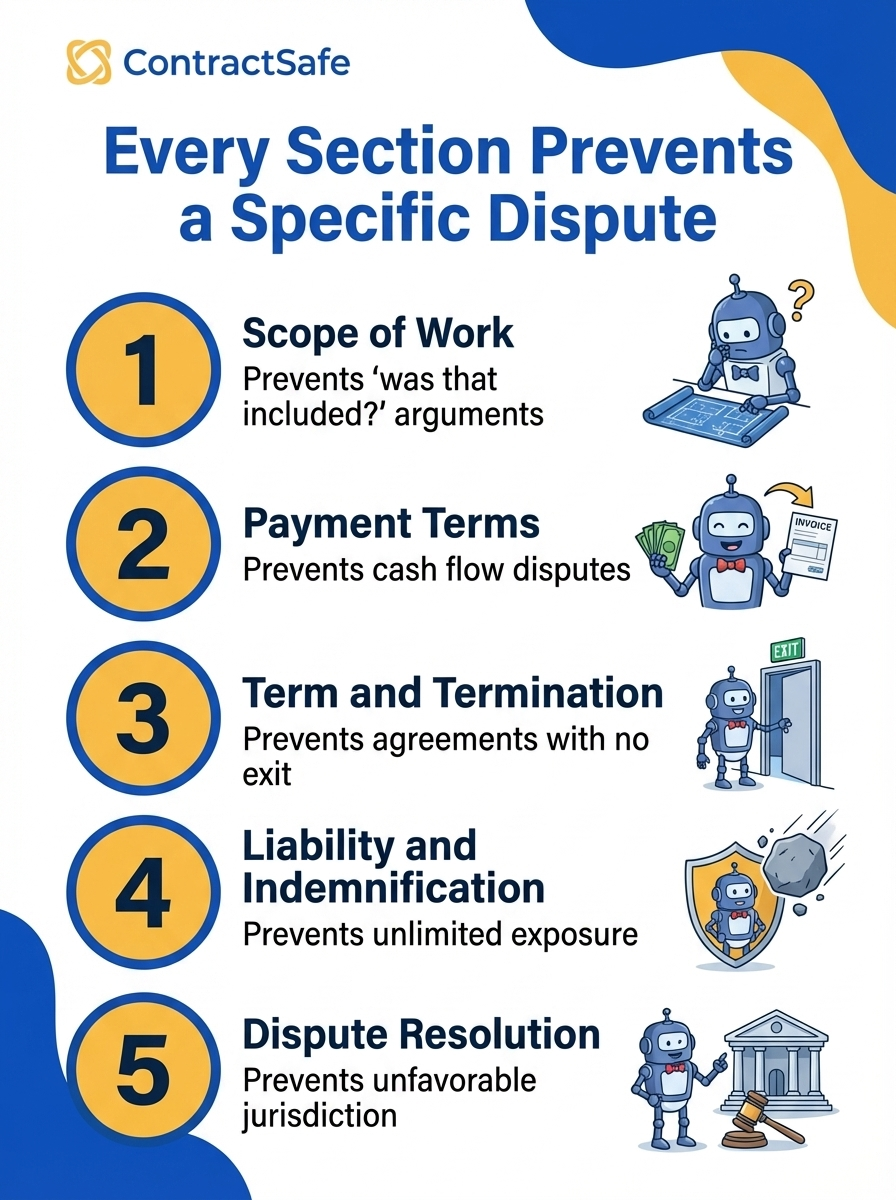
Each section of a business contract exists to prevent a specific kind of dispute. The best way to understand what belongs in a contract is to understand what happens when each section is missing.
Scope of Work: What Are You Actually Agreeing To?
The scope defines what each party will do. In a services contract, it lists the deliverables. In a sales contract, it describes the goods. In a licensing agreement, it defines what’s being licensed and how it can be used.
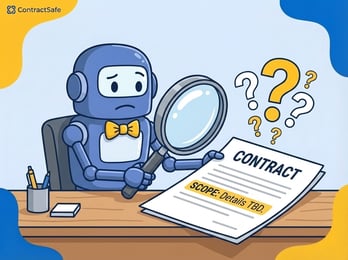
When the scope is vague, both parties fill in the blanks with their own expectations.
The Arcadis Global Construction Disputes Report ranked poorly drafted or incomplete contract documents as the number one cause of construction disputes, with errors and omissions ranked second.
Write the scope so specifically that a stranger reading it could determine whether a given task was included or excluded. If the answer is “it depends on what we meant,” the scope needs another sentence.
Payment Terms: When Does Money Change Hands?
Payment terms define how much is owed, when it’s due, and what happens when it’s late. Milestone-based, monthly, on completion, net 30, net 60.
Missing payment terms are the second most common source of contract disputes. A vendor who delivered the work but can’t collect because the contract doesn’t specify when payment is due has a problem that no amount of good faith can solve.
Include the amount, the schedule, the method, late payment penalties, and what happens to payment if either party terminates early.
Term and Termination: How Does This End?
The term is how long the contract lasts. The termination clause is how either party can end it early. Without both, you have an agreement with no exit.
Termination clauses typically cover termination for cause (one party breached the agreement), termination for convenience (either party can walk away with notice), and what happens to in-progress work, unpaid fees, and confidential information after termination.
The University of Chicago Law Review analyzed half a million contracts and found that whether a contract includes a dispute settlement provision is almost exclusively driven by the template used for the first draft.
If your template doesn’t include a termination clause, your contract probably won’t either.
Liability and Indemnification: Who Pays When Something Goes Wrong?
Liability clauses cap how much one party owes if they cause harm. Indemnification clauses determine who covers losses caused by third-party claims. Together, they answer the question every business relationship eventually asks: who pays?
Without a liability cap, one party’s exposure is theoretically unlimited. Without indemnification, a company that gets sued because of a vendor’s mistake may have no contractual right to recover those costs.
Standard provisions include a mutual cap on direct damages (often set at the total contract value), exclusions for indirect or consequential damages, and indemnification for intellectual property infringement or data breaches.
Confidentiality: What Can’t Be Shared?
A confidentiality clause defines what information is protected, how it can be used, and how long the obligation lasts. In many contracts, the confidentiality section does the same job as a standalone NDA, built directly into the agreement.
Without one, information shared during the engagement has no contractual protection. A vendor who learns your pricing model during a consulting engagement and shares it with your competitor hasn’t breached anything if the contract didn’t restrict them.
Define what counts as confidential, what’s excluded (publicly available information, independently developed work), how long the obligation survives after the contract ends, and what happens if a breach occurs.
Dispute Resolution: What Happens When You Disagree?
A dispute resolution clause tells both parties what to do when they can’t resolve a disagreement on their own. Mediation first? Arbitration? Litigation? Which state’s laws govern?
Without this clause, both parties default to their local courts, which may be in different states with different rules.
Norton Rose Fulbright’s 2026 survey found that companies with over $1 billion in revenue spent $4.1 million on average on litigation. A dispute resolution clause won’t eliminate that cost, but it determines where and how those disputes play out.
Include the governing law, the forum (which court or arbitration body), whether mediation is required before litigation, and who bears the cost of dispute resolution.
The Contract Clauses People Forget Until They Need Them
Beyond the core sections, several clauses are routinely omitted from contracts and routinely wished for later.
- Force majeure. What happens when events outside either party’s control (natural disasters, pandemics, government actions) prevent performance? Without this clause, the party that can’t perform is in breach. With it, both parties have a defined process for handling the unforeseeable.
- Assignment. Can either party transfer the contract to a third party? If your vendor gets acquired, does the contract follow? Without an assignment clause, the default answer varies by jurisdiction.
- Amendment process. How are changes to the contract documented? Verbal agreements to modify terms are notoriously difficult to enforce. A clause requiring all amendments in writing prevents “I thought we agreed to change that” disputes.
- Notices. How do the parties formally communicate under the contract? An email to the wrong address doesn’t constitute valid notice unless the contract says it does.
How ContractSafe Helps After the Contract Is Signed
Writing the contract is the first half. Managing it is the second half, and it’s where most organizations lose track. A well-written contract sitting in someone’s email doesn’t protect anyone if nobody can find it when they need it.
ContractSafe stores every executed contract in a single, searchable repository. AI extraction pulls key dates, parties, renewal terms, and termination provisions automatically. Automated alerts notify the right person when a deadline is approaching.
Every contract is fully searchable by keyword, including scanned documents and legacy PDFs that were never digitized. Need to find every contract with a specific liability cap or governing law? One search.
Need to review all contracts expiring in the next quarter? One query.
Unlimited users on every plan means the team writing the contracts and the team managing them are working from the same system.






.svg)







.svg)