Quick answer: OCR contract search is search that runs optical character recognition on your contracts, so the words in scanned and image-based files become text you can search word by word, alongside your PDFs and Word files. A search then returns every contract that contains your term, whatever the file is called or wherever it's saved. ContractSafe runs OCR on every file you upload, so any contract, even a scan, is fully keyword searchable.
If you’ve ever searched your hard drive for something, you know just how long it can take to find what you actually need. Searching and Finding are definitely not the same thing! Searching can involve a serious chunk of time. First, you pull back results that may (or may not) have anything to do with your query. Then, you have to go through the results and open random documents to find what you need. Hopefully.
Buyers feel the difference: 87% of the teams that went on to buy ContractSafe named search in seconds, scans included, as one of the features that mattered most.
Choose your next step:
For teams who want to see it on their own contracts: see how contract search works, then book a ContractSafe demo.
For anyone comparing plans: check what each plan includes on our pricing page.
For anyone who'd rather test it first: start a free trial. It runs 7 days and includes every feature except single sign-on (SSO).
Key Takeaways
- Contract OCR adds a text layer to scanned and image-based contracts, so search can see the words inside them.
- Search can only find text that OCR was able to read, so a clean, legible scan matters.
- AI extraction now fills key fields and dates from that same text, so you don't have to tag every file by hand.
- Pick a contract system that OCRs every upload automatically and builds its fields and filters from the text.
How the Right Contract Management System Changes the Search Game
So, what’s the difference between searching and finding? It’s the same basic activity. Just minus the frustration and wasted time. How you store and organize things make all the difference. If you have a system where everything needs to be perfectly labeled, renamed and placed 7 folders deep in nested folders…or you’ll never find it...you’re in trouble.
When you're choosing between basic search and full-text search for contracts, weigh where each one looks and how well your files are labeled. Basic search checks file names, folders and tags, so it finds a contract only if someone labeled it well. Full-text search checks every word inside the contract, and OCR is what gives a scanned contract words to check. If a word appears anywhere in the contract, a full-text search for it brings the contract back.
Finding the contracts and information you need is much easier with the right Contract Management System (CMS). The right CMS gives you the ability to quickly and easily tag your contracts with key information. When businesses take the time to develop and use specific tags, it makes finding information much faster. It’s also more accurate than just searching through hundreds or thousands of files. A good CMS will also give you the ability to organize and search by custom drop down fields, check boxes or other fields. Setting all this up in advance will make finding easier. However, something called OCR makes finding easy without having to do the upfront work!
OCR (optical character recognition) takes finding to a whole new level. ContractSafe's contract search is built on it. OCR enables your CMS to essentially read and index the documents that are placed within it…even if they are scans or images! It’s another means of allowing users to find what they need if it can’t use tags to locate it. If you know the business name or the name of at least one of the parties involved in the contract (or even just something referenced in the contract), you could search with OCR and find any contract uploaded that had that name in it. It’s like having Google for all of your contracts!
OCR could also be used to help you find a specific clause within a contract. Whether you just want to review that clause or you want to use it in a new contract, OCR gives you the ability to find it in less time. OCR provides more precision than searching on tags alone.
You could also search for all contracts that contain a specific phrase. As an example, if your new in-house lawyer decides certain language in a contract needs to be changed going forward…you could quickly pull up all the contracts that have that particular clause or language.
Using OCR, Tags and Custom Fields Together for Incredibly Fast Finding
Here's how the three work together. Say you need the vendor agreement that names a particular product and comes up for renewal this quarter. Filter by your vendor tag, narrow the list to contracts whose renewal date in your custom field falls this quarter, then search the product name. OCR finds the name inside the contract even when the file is a scan, so the tag, the date field and the search each cut the list until the right contract is what's left.
Any one of these three features will make your life a lot easier. Using them together turns you into a Super Finder. You’ll be able to instantly put your hands on the right document, report or information. Stop wasting time searching. Go find things! If you want to make it really easy to put all this into practice, you might want to give ContractSafe a try!
How OCR Contract Search Works, From Upload to Result
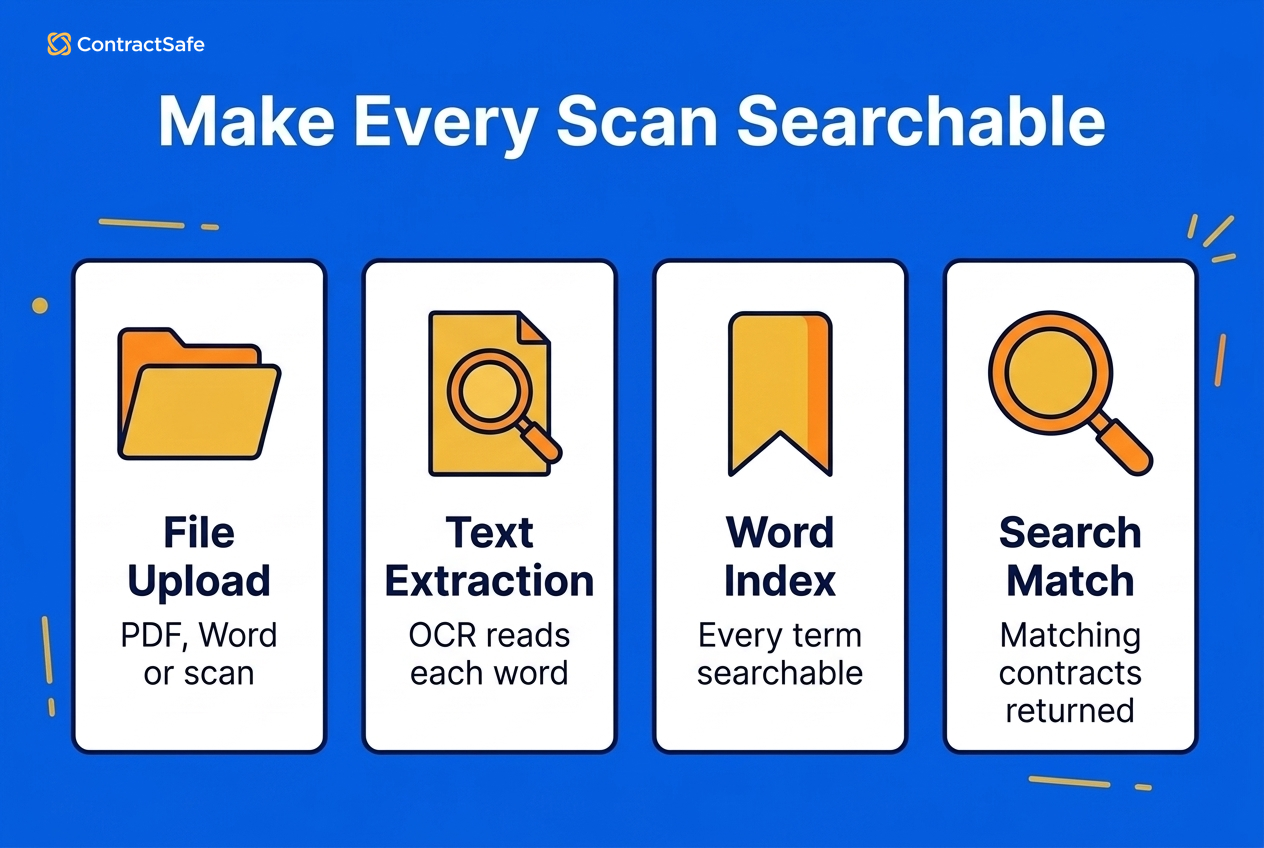
OCR contract search works in four steps: you upload a contract, OCR reads the page image into a text layer, the system indexes every word, and your search is matched against that index. Search can only find what made it into the index.
Upload. You add a contract: a PDF, a Word file or a scan of a signed paper copy.
Read. OCR turns the picture of each page into text. Today's engines use machine learning to do it. One widely used example, described in Microsoft's Read model documentation, converts a scanned-image PDF into a PDF with the text embedded.
Index. Each word in the text layer is stored so it can be looked up later.
Match. Your search term is compared against the index, and every contract that contains it comes back.
In ContractSafe, all four steps happen without anyone asking. When you search for the wording your new in-house lawyer wants changed, the scanned signed copies come back in the same list as the Word files.
Which Files and Languages OCR Search Covers
OCR contract search covers PDFs, Word files and scanned contracts, and current OCR engines also read common image formats and several non-Latin scripts. Language support for the AI features layered on top of search can be narrower than for OCR itself.
The engines keep widening. Microsoft's release notes show searchable-PDF output extended to image files (JPEG, PNG, BMP, TIFF and HEIF) and to Chinese, Japanese and Korean. That's what an OCR engine can do, not what every contract system accepts, so when you evaluate one, upload a few of your own scans and search for a phrase you know is in them.
In ContractSafe, AI data extraction is optimized for English-language contracts. On contracts in other languages, such as Spanish, French or German, extraction may work, and the values stay in the contract's language.
What Affects OCR Search Accuracy
OCR search accuracy depends on scan quality. A faint, tiny or crooked scan gives the engine less to read, and any word it misses won't come back in a search, however good the search itself is.
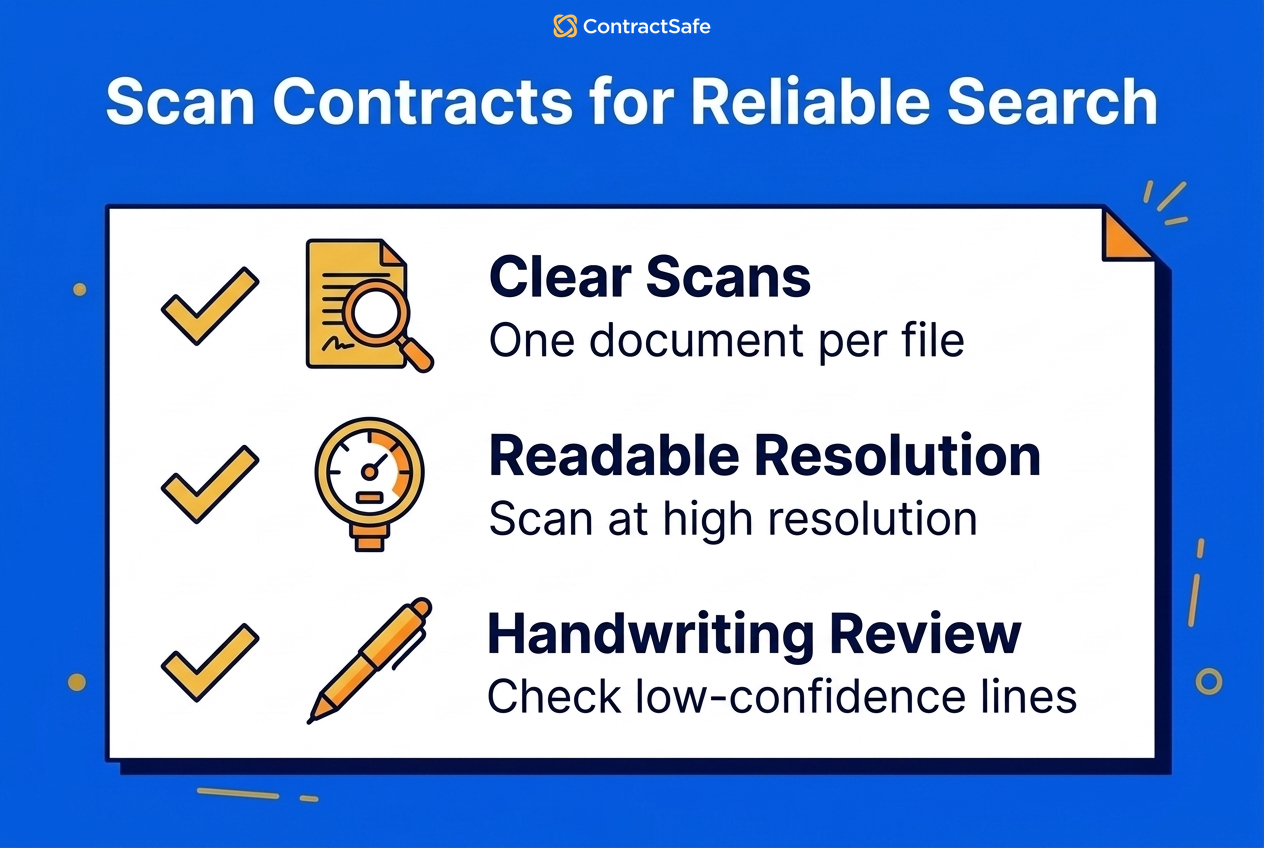
The work that pays off happens before upload. Before you bulk-upload a box of old paper contracts, run each batch past these checks:
One contract per file, not a stack of agreements scanned into a single PDF.
A clean, high-resolution scan, straight on the page, with no shadows, so footnotes and schedules stay legible at their printed size.
A manual look at handwritten amendments and initialed changes, since those are the lines OCR is least sure about.
How OCR, AI Extraction and Filters Work Together
The OCR text is the layer underneath everything else, not the whole search. AI extraction fills fields and dates from that text, and filters sort contracts by those fields, so tagging every file by hand is no longer the price of finding things.
Once OCR has produced the text, ContractSafe's AI reads it. It can extract up to 29 fields from each new upload. It reads each contract for key dates such as renewals, terminations, notice periods and expirations. It also detects whether a contract is fixed-term, evergreen, terminable at will or auto-renewing.
You stay in charge of what goes in. You can accept, correct or skip each suggested value, including reviewing suggestions across many contracts at once, and a person confirms or edits every extracted date.
Your own fields sit alongside the AI's. In ContractSafe you can filter by tags, folders or contract type, sort by the fields your team cares about, and keep custom dashboards and saved views.
Related Reading
Metro MLS case study: how Metro MLS moved more than 600 data feed contracts into ContractSafe so its executives could search them directly.
Vitality Living case study: how Vitality Living manages more than 600 vendor contracts across 35 communities in ContractSafe.
City of Dahlonega case study: how the City of Dahlonega replaced spreadsheet tracking with ContractSafe to centralize its official records.
How Contract Data Extraction With AI Works and How to Check It: what happens to the OCR text once AI starts filling fields from it.
Contract AI software: how to compare tools when the search is for a clause, not a keyword.
How ContractSafe Helps You Find Any Contract
ContractSafe is a full-lifecycle contract platform where teams request, approve, sign and track contracts, and the complete feature set is on the Maximize plan. OCR search is one capability within it. It's the capability that makes the rest work, because approvals, reminders and reports all depend on finding the right contract first.
The Organize plan includes OCR search, AI data extraction, AI contract chat, reminders for any date you track, and custom dashboards and saved views. The Finalize plan adds approval sequences, unlimited built-in e-signature, and editing in Word with tracked changes that sync back. The Maximize plan adds intake forms, templates, lifecycle tracking and AI contract review.
ContractSafe pricing starts at $450/month (Organize plan, billed annually; $540 month-to-month), with unlimited users on every plan. It's built for companies of about 50 to 1,000 people where one person owns hundreds to a few thousand contracts and needs everyone else to request, approve, sign and track them without buying seats. The median new customer has its first contract in the system within a week of buying.