Utility contract management software is software for managing vendor, franchise, easement, construction, service, and regulatory agreements. The general-purpose platforms compared in our buyer’s guide cover most of that ground.
Think of it like a control room for contract records. The operator needs to know which switch controls which obligation.
A regulator's question becomes harder when the answer depends on an old folder name.
Key Takeaways
- Every dollar a utility spends ends up in a rate case filing. PUC staff (lawyers, accountants, engineers, economists) audit the spending against the underlying contracts.
- Electric companies plan to invest nearly $208 billion in 2025 to strengthen the grid, according to EEI. Every contract behind that spending will be reviewed.
- Capital investment in distribution infrastructure rose 160% from 2003 to 2023, reaching $50.9 billion, according to EIA data. More contracts, more audit exposure.
- Municipalities across 30 states hold utility franchise agreements they can renegotiate, and the National Laboratory of the Rockies estimates those renewals could drive 164 to 911 terawatt-hours of renewable energy by 2030.
- ContractSafe offers unlimited users, full audit trails, and AI extraction across the entire portfolio.

Choose Your Next Step
Utility contract management decisions go faster when you start from the nearest regulatory deadline: the rate case, the franchise renewal, or the audit you know is coming. Jump to the section that matches your contract calendar.
- Rate case on the calendar? Start with what happens when the PUC opens your books and run the discovery drill this week.
- Franchise renewals approaching? Go to the franchise expiration pressure.
- Evaluating tools? Work through the five capabilities utility teams need.
- Whichever it is, check your franchise agreements first: confirm each agreement has an owner, an expiration alert with a long runway, and the full amendment history linked on the record.
- Looking sector-wide? Our guide to energy contract management covers the broader energy picture, from generation agreements to trading.
What Happens When the PUC Opens Your Books
A rate case is an open-book exam. Every two to five years, a utility files with the Public Utility Commission to adjust customer rates, and the PUC audits the filing against the contracts behind the numbers.
The PUC assigns a team to audit the filing. That team includes lawyers, accountants, engineers, economists, and financial analysts.
They don’t just review the numbers. They review the contracts behind the numbers.
The vegetation management contract with the tree trimming vendor. The pole replacement agreement with the infrastructure contractor. The transformer supply contract. The IT service agreement for the new outage management system. The franchise agreement with the county that specifies right-of-way access terms.
Discovery requests have deadlines. In many rate cases, the process runs long enough that contract records need to stay organized from the start.
If the utility can’t produce a contract behind a line item, it can’t justify the cost. If it can’t justify the cost, the PUC can deny recovery. That’s revenue the utility spent but can’t collect.
A searchable repository with audit trails turns a 30-day discovery response from a scramble into a search query.
Check your readiness with one drill: pick a line item from the last filing and time how long the supporting agreement takes to produce, with its amendments.
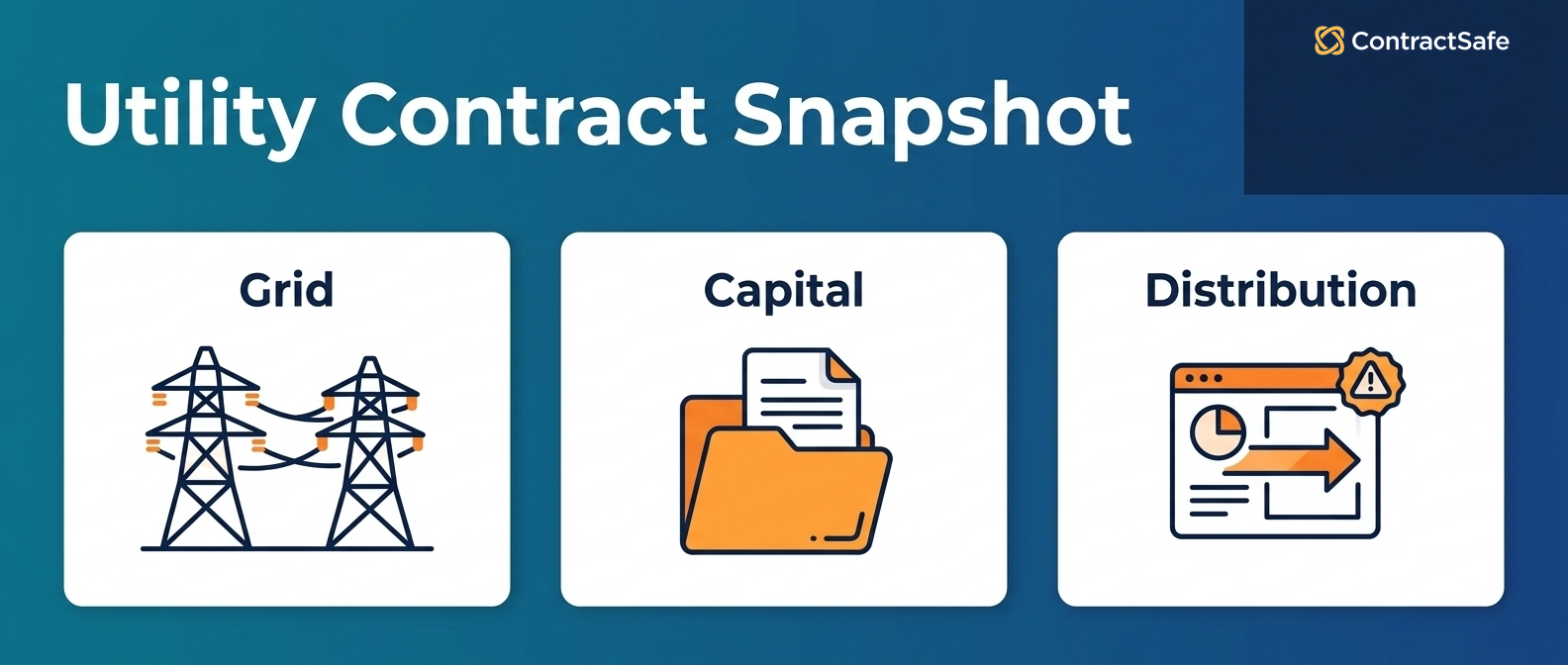
$208 Billion in Grid Upgrades, and Every Contract Will Be Audited
The spending environment makes the audit problem worse. Utilities are in the middle of what analysts call a capital expenditure super-cycle.
Electric companies plan to invest nearly $208 billion in grid investment for 2025, according to EEI. Capital spending on distribution infrastructure has risen 160% from 2003 to 2023, reaching $50.9 billion, according to EIA.
That spending includes replacing aging poles with steel and concrete. Burying overhead lines in wildfire-risk areas. Installing smart meters, sensors, and automated controls. Upgrading substations to handle renewable intermittency. Replacing decades-old cast-iron gas pipes with modern materials.
Every one of those projects generates contracts. Vendor agreements, engineering service contracts, material supply deals, construction subcontracts. And every one of those contracts will eventually appear in a rate case filing when the utility asks to recover the cost.
The volume is the problem. Say your utility spent $200 million on grid upgrades in 2020 and spends $400 million by 2027. The contract portfolio doubles, and the audit exposure doubles with it.
Check the trajectory at your own utility: compare this year’s capital plan against the contract team’s headcount, and decide which one the software has to scale.
1,200 Franchise Agreements Expire by 2030
Franchise expirations are the second regulatory clock. A franchise agreement is the contract between a city and a utility, giving the utility the exclusive right to serve customers in that area.
The agreement covers access to public rights-of-way, franchise fee payments, service standards, and sometimes clean energy commitments.
Local governments across 30 states can negotiate utility franchise agreements, according to the National Laboratory of the Rockies, which tracks agreements from more than 3,500 municipalities and estimates the renewals could unlock 164 to 911 terawatt-hours of renewable energy by 2030.
When a franchise expires, the city has negotiating power. For example, Portland’s electric franchise expires in 2027, St. Paul’s expired in 2026, and Las Vegas’s in 2025.
Both sides need to understand the current agreement completely before negotiating the next one. What commitments were made? What amendments were added? What fee structure is in place? If the utility can’t produce the full agreement history, it’s negotiating blind.
Date tracking for franchise expirations isn’t a nice-to-have. Missing a renewal window can mean losing the right to serve a territory.
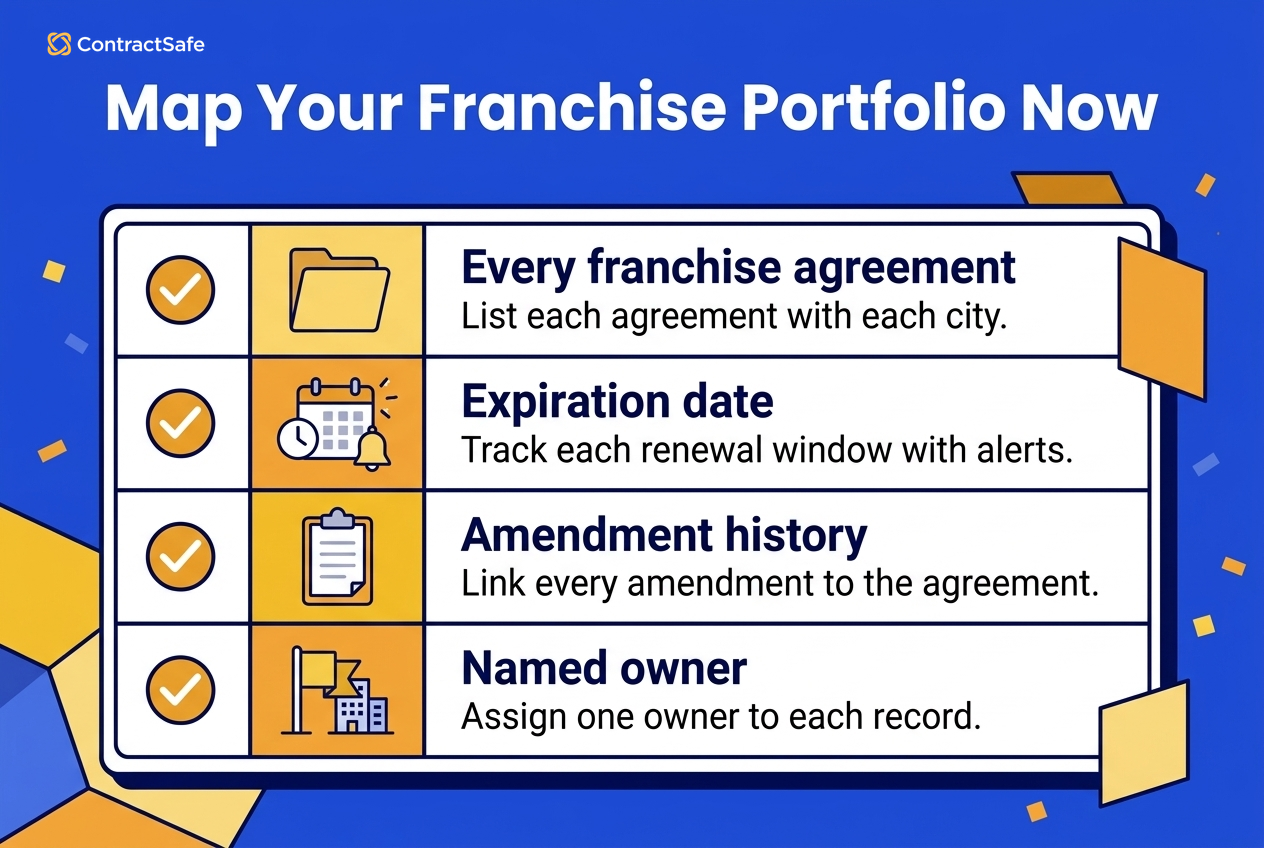
Map your franchise portfolio now: every agreement, its expiration, its amendments, and a named owner. The negotiation calendar for the next five years falls out of that one list, and so does the staffing plan for the renewals.
What a Discovery Failure Costs
A failed discovery response costs a utility in three currencies: denied cost recovery, regulator trust, and staff time burned on archaeology.
The denial is the visible cost, and the remedies are blunt. For example, a capital line item with no producible agreement invites the PUC to disallow recovery, a penalty absorbed as spending customers were meant to fund.
Repeated gaps bring deeper consequences: extended proceedings, conditions on the filing, and damage to the utility’s standing in the next case.
The trust cost compounds quietly. Examiners who catch one unproducible contract sample deeper in the next case, and settlement conversations start from a weaker position.
There are defensible exceptions, and commissions recognize them: a documented record gap with a remediation plan reads very differently from a shrug.
Prevention is operational: contracts filed at execution with owners and amendments linked, so the discovery clock starts with the answer already in the system.
What Utility Contract Management Means in Practice
In practice, utility contract management means keeping every agreement audit-ready by default: findable by clause text, carrying owners and renewal dates, with amendments linked to their parent contracts and the access history recorded.
The definition is regulatory before it is operational. The rate case and the franchise renewal both assume the records exist; the only question is how long producing each agreement takes when the request lands.
Check your portfolio against the definition quarterly, sampling the way an examiner would: oldest easement, newest construction contract, the franchise agreement with the most amendments.
Log the drill results on the contract records, so the readiness history is evidence too, and assign the next drill before closing the current one. Check the misses at the record level, not the process level.
The CLM vs the Asset Systems: The Difference
The difference between the CLM and the utility’s asset systems is the difference between managing agreements and managing infrastructure.
The asset management system tracks the poles, the transformers, and the maintenance schedule. Compared with that, the CLM tracks the contracts that bought, built, and service those assets, with the dates and owners regulators ask about.
Keep both, connected by reference. The work order cites the agreement; the agreement record carries the terms, the amendments, and the audit trail.
| The question | Asset system | Contract management software |
|---|---|---|
| Where is the pole? | Yes, with maintenance history | Not the system’s job |
| Who installed the pole, on what terms? | A reference at best | The agreement, amendments, and pricing |
| Which version was in force in 2024? | Unknown | Version history with the audit trail |
| When does the franchise expire? | Not tracked | Date field with an owner and an alert |
Why the Contract Layer Pays at Rate Case Time
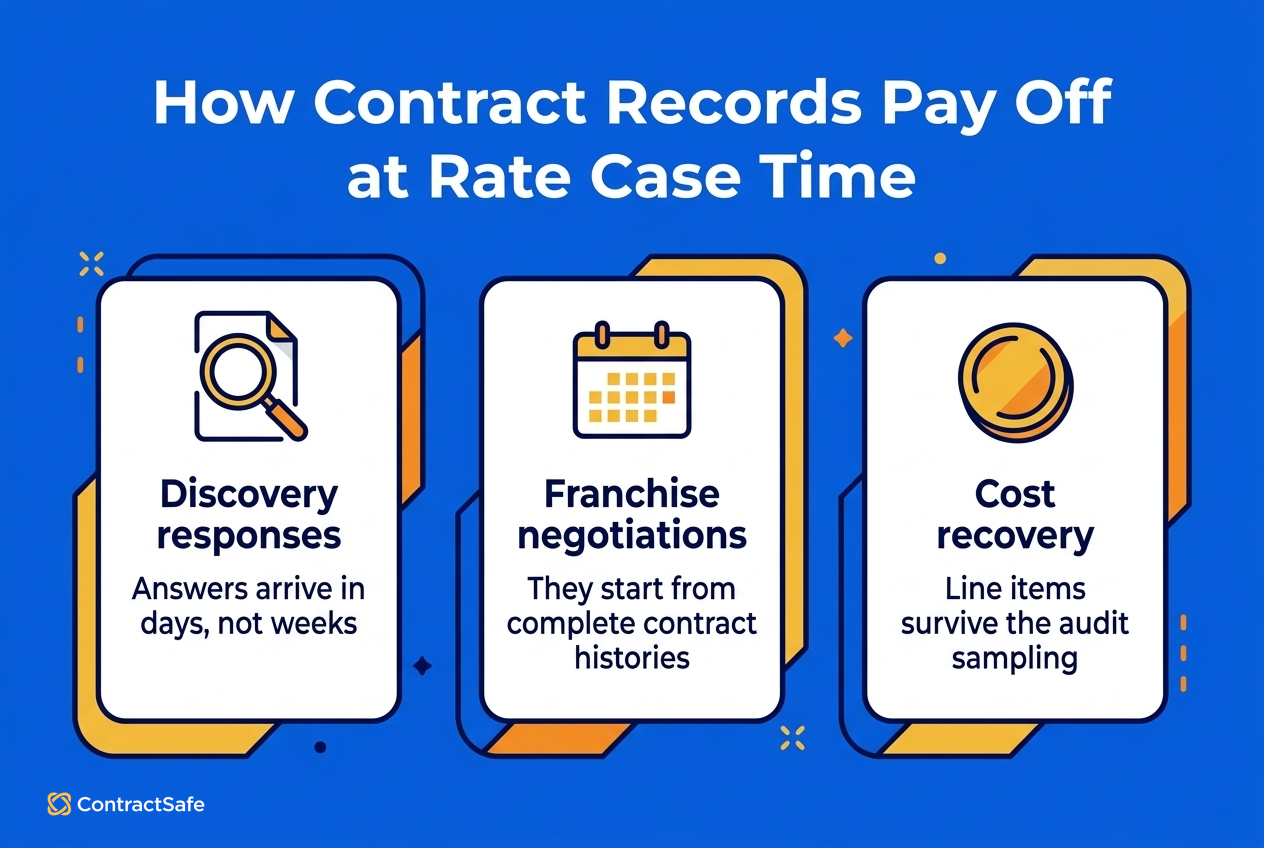
The benefits concentrate where utilities feel the most pressure: discovery responses in days instead of weeks, franchise negotiations that start from complete contract histories, and cost recovery that survives the audit sampling.
The quieter benefits accrue between filings. Field supervisors find vendor terms without calling the main office. The regulatory attorney reads amendment history instead of requesting a document hunt. The executive sees the franchise exposure on one report, with owners named.
Count the benefit in avoided disallowances and staff weeks returned. One recovered line item typically carries the software cost for years.
The discovery drill above turns the claim into your own number. Check the math after the next rate case filing closes, with the contract team in the room.
What Utility Teams Need From Contract Management Software
Utility contract management software earns its place by answering regulators quickly, and five capabilities carry that job: discovery production, audit trails, franchise date tracking, one full portfolio, and access for every region.
Check each capability against your own contract records, not the vendor’s demo data.
Score every candidate against all five with your own records: the scanned easement, the amended franchise agreement, and the vendor contract from the last filing.
Require the answers live in the demo, on your agreements, and keep the score sheet on the evaluation record. The vendor who handles all five has answered the rate case question; the vendor who schedules a follow-up has answered a different one.
1. Produce Contracts for Rate Case Discovery
Discovery production means the agreement behind any line item surfaces as a search, not an excavation through district-office folders and retired employees’ archives.
You'll want full-text search across every document, even your scanned originals, because decades-old easements and joint-use pole agreements live as scans in most utility archives.
Check the worst case in any demo: a scanned, amended construction agreement, found by clause text, with the version history attached and the in-force dates visible.
- Watch for: search that reads filenames but not the scanned contract text inside them.
Time the production drill end to end, agreement plus amendments plus the version in force on a chosen date. The clock is the capability, and the franchise agreement with the most amendments is the honest test document.
2. Track Every Step of Every Contract
Audit trails answer the PUC’s process questions: who accessed the document, when the agreement was amended, and which version was in effect on a given date.
The trail has to be system-kept, not reconstructed after the request arrives. Examiners treat recorded history as evidence and remembered history as testimony.
Ask for the trail format in the demo and read one entry yourself.
- Watch for: bulk imports that wipe or muddy the history the audit depends on.
Check the trail on a contract record your team actually edited last month, and confirm the story reads cleanly from upload through the latest amendment and owner change, with timestamps intact.
3. Track Franchise Expirations Across Jurisdictions
A multi-state utility might have dozens of franchise agreements, each with different expiration dates and renewal terms, and every one is a territory-level risk.
Check the calendar across all jurisdictions on one report, owned by one person, with the fee terms beside each date.
You'll want automated alerts months in advance, pointed at named owners with escalation behind them. Franchise renewals are negotiations that take quarters, not weeks, and territories ride on the dates.
For example, the franchise agreement expiring in 2027 needs the negotiation team reading the amendment history in 2026, not discovering the records that spring.
- Watch for: franchise fee terms that changed by side letter and never reached the contract record.
4. Handle the Entire Portfolio in One Place
One searchable contract system needs to hold the full utility portfolio: vendor service contracts, franchise agreements, right-of-way easements, material supply deals, compliance documents, IT service agreements, and joint-use pole agreements, with the same fields on every record.
Split portfolios fail at discovery time, because the auditor’s question doesn’t respect which system holds which agreement type.
Check for strays quarterly: contracts in email, in the e-signature tool, or in a district share. Every stray is a discovery risk wearing a convenience costume.
- Watch for: easements and franchise records living in a separate “legacy” archive nobody searches.
Decide the boundary explicitly: which agreement types live in the CLM, which references live in the asset system, and who owns routing the new ones.
5. Unlimited Users Across Operating Regions
The contracts manager in the main office, the field supervisor in the district office, the regulatory attorney, and the executive reviewing the franchise renewal all need access to the agreements.
Charging per user creates roadblocks in organizations where contracts touch every department and every region.
Check the real roster: count everyone who asked a contract question last quarter, across all districts, and price that number honestly against any per-seat quote.
- Watch for: per-seat plans where the field offices end up sharing one login.
- Watch for: view-only seats that still bill but can’t run the franchise expiration report.
Quick gut check before you evaluate anything. Time one drill: produce your oldest active franchise agreement, with amendments and the current fee structure, in under ten minutes. The result names your gap better than any requirements document.
Building the Rate Case Binder All Year
The rate case binder works best as a standing posture, not a filing-season project: every cost-bearing agreement stays production-ready between cases.
- Tag every contract that backs a recoverable cost the day the agreement is executed.
- Require the fields discovery always asks for: counterparty, term, value, amendments, and the cost category the agreement supports.
- Run the production drill quarterly on a sample, timed, with the misses fixed at the record level.
- Check the orphan report monthly, because departed owners are how production trails go cold.
- Keep the drill log on the records. A documented readiness habit reads as a control, and examiners price controls into their sampling.
The binder posture also pays at franchise time, since the negotiation team inherits records that are already complete.
And the posture compounds across cases: the utility that answered cleanly last cycle gets lighter sampling this cycle, while the utility that scrambled gets the deeper look.
Examiners remember which kind of respondent they’re dealing with, and the state of the contract records decides which kind your utility gets to be next time the books open.
The First Month for a Utility Contract Team
A utility contract layer becomes useful within the first month when the rollout follows the regulatory risk, starting with the agreements regulators actually sample.
- Week one: upload the franchise agreements and the top cost-recovery contracts, scans included.
- Week two: verify extracted dates and parties on those records by hand, and assign owners.
- Week three: set the franchise expiration alerts with long runways, and the vendor renewal alerts behind them.
- Week four: run the first discovery drill and the first franchise exposure report for leadership.
Check the result honestly at the month’s end: if the drill produces agreements in minutes and the franchise calendar has owners, expand to the rest of the portfolio on a schedule, easements and joint-use agreements next.
How ContractSafe Helps Utilities Manage Contracts That Regulators Will Audit
ContractSafe is the CLM built for teams who want power without the pain. You get everything you need to manage contracts from intake to renewal, with no steep learning curve.
Most teams can start quickly. Our AI automatically pulls out key terms and tells you the execution status. You'll get custom dashboards and reports right out of the box. And the best part? Every plan comes with unlimited users.
SOC 2 certified. Enterprise-grade encryption. Support from real humans on every plan.
Run the five capabilities against ContractSafe with your own portfolio: the scanned easement, the amended franchise agreement, the discovery drill.
Connecting the Utility Contract Stack
The audit-ready posture comes from connected pieces: storage, fields, and obligations working as one record per agreement.
Make sure your contracts connect to your central storage, their key details, and how you track your obligations.
If contract dates are a risk for your utility, review your renewal checklist and your effective date rules before you consider any file complete.
For outside context, WorldCC’s research ties contract discipline like this to commercial results, and Cornell’s contract law overview covers the legal foundations underneath every agreement here.
Related Reading
- Energy contract management, for the sector-wide view beyond regulated utilities.
- Contract obligation management, for turning franchise commitments and vendor duties into tracked work.
- Contract management metrics, for the owner-coverage and date-coverage numbers worth reporting between rate cases.
How ContractSafe Helps With Utility Contract Management
ContractSafe gives a utility contract team the audit-ready layer the regulators assume: every agreement searchable, scans included, with system audit trails, franchise expiration alerts pointed at owners, and unlimited users across every operating region.
The discovery drill is the honest test. When the PUC asks for the contract behind a line item, the answer is a search query and a record, produced in minutes with its amendment history attached.
Bring your own hardest records to a free demo: the scanned easement, the multi-amendment franchise agreement, and the vendor contract from the last rate case.







.svg)







.svg)