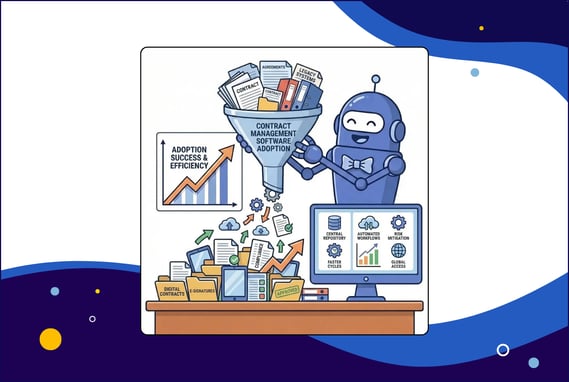
Contracts don’t fall apart because the language was sloppy. They fall apart because nobody can find the latest version, nobody knows who owns the next step, and “we’ll deal with it later” turns into a missed renewal at the worst possible time.
Then you try to fix it with a new system—and hit the real wall: adoption. If the tool feels confusing, slow, or “not my job,” people quietly go back to email threads and shared drives.
So if you’re rolling out a contract management system (CMS) / contract lifecycle management (CLM) platform and want it to actually stick, here are five practical ways to get your team on board—without turning your implementation into a multi-month morale event.
TL;DR
To improve contract management software adoption, focus less on “training everyone” and more on removing friction: address resistance early, avoid overbuying features, communicate like a human, build feedback into rollout, and prove day-one value with simple, repeatable workflows people can’t mess up.
Why is contract management software adoption so hard?
Adoption usually fails for boring reasons—not dramatic ones. Hands-on implementation support from the vendor removes a few of them before day one. The system feels like extra work. The value feels abstract. The rollout feels like it’s happening to people, not for them.
And contract work is inherently cross-functional (legal, finance, procurement, ops). If even one group opts out, you end up with split reality: some contracts in the system, some in inboxes, and everyone losing trust.
The fix isn’t “more reminders.” It’s designing adoption so the easiest path is the right path.
RELATED READ: What is Contract Management Software?
Tip 1: How do you address resistance to change during a contract management rollout?
You address resistance to change by naming concerns early, explaining what will change (and what won’t), and showing how the system reduces—not adds—work.
Resistance usually isn’t about the software itself. It’s about fear of disruption, loss of control, or extra responsibility landing on already-busy teams.
When those concerns go unaddressed, people quietly opt out. They keep contracts in email or shared drives because that feels safer and familiar.
Adoption improves when rollout messaging focuses on real outcomes—fewer fire drills, fewer “where is this contract?” moments, and clearer ownership across teams—rather than abstract efficiency gains.
Tip 2: How do you avoid buying a system no one uses?
You avoid overbuying contract management software by starting with the core workflows teams use every day and delaying advanced features until adoption is established.
One of the fastest ways to kill adoption is to roll out a system that feels bigger than the problem teams are trying to solve.
When contract management software is packed with advanced features before users understand the basics, everyday tasks start to feel harder—not easier. People hesitate, make mistakes, or quietly go back to email and shared drives because they feel faster and more familiar.
Adoption improves when teams start with the workflows they actually repeat every week, then expand over time.
Focus first on features that support daily contract work, such as:
-
finding contracts quickly
-
understanding key terms and dates
-
knowing who owns the next step
-
getting reminders before deadlines are missed
Once those actions become routine, additional capabilities can be layered in without overwhelming users.
The goal isn’t to limit functionality forever—it’s to match complexity to readiness so the system feels helpful instead of heavy.
RELATED READ: Four Strategies for Accelerating the Adoption of Contract Management Processes
Tip 3: What communication actually improves contract management software adoption?
Communication improves adoption when it clearly explains personal impact, repeats key messages consistently, and uses real examples teams recognize.
A single announcement or one-time training session isn’t enough. People forget, get busy, and fall back on old habits unless the message is reinforced.
What works better is practical, human communication—short updates, simple explanations, and stories that show how the system prevents real problems like missed renewals or lost contracts.
When people understand how the system makes their job easier, adoption becomes a choice they’re willing to make.
Tip 4: How do you collect user feedback without slowing contract software adoption?
You collect feedback effectively by tying it to real workflows and looking for patterns instead of reacting to individual preferences.
Open-ended feedback without structure can stall adoption by creating constant changes and uncertainty.
Instead, ask for feedback after users complete specific tasks—uploading a contract, searching for an agreement, or setting a reminder. This keeps feedback focused on usability, not personal taste.
When teams see their input reflected in small, visible improvements, trust increases without derailing momentum.
Tip 5: How do you prove value quickly so teams keep using the system?
You prove value by delivering fast, obvious wins that remove daily friction—especially around search, access, and key dates.
Adoption sticks when people experience benefits immediately, not months later. If finding a contract is faster, ownership is clearer, and reminders prevent surprises, the system earns trust quickly.
Simple wins—like reliable search, controlled access, and automated reminders—do more to drive usage than advanced features people aren’t ready for yet.
When early value is clear, continued adoption follows naturally.
RELATED READ: 5 Legal Tech Adoption Challenges (And How To Overcome Them)
How does ContractSafe make contract management software adoption easier?
Some contract management systems are powerful but complex — requiring long training, consultant support, and weeks of “what button do I press?” frustration. ContractSafe was built to avoid exactly that.
ContractSafe is designed so teams can get up and running fast, see value immediately, and bring the whole organization along without heavy training or IT overhead. Customers report that they can begin uploading, organizing, and managing contracts “in minutes, not months,” because the platform doesn’t overcomplicate everyday tasks.
Key aspects that support easy adoption include:
-
Seamless setup and onboarding — users can upload contracts as they are, without messy pre-organization.
-
AI-assisted data extraction — key contract details like dates and parties are pulled automatically, so teams don’t wrestle with manual tagging.
-
Intuitive search and organization — powerful search and OCR let users find documents quickly, even in scanned PDFs, reducing frustration and boosting trust in the system.
-
Straightforward team onboarding — unlimited users and simple permission controls help bring legal, procurement, finance, and operations into the same system without complex role mapping.
This real-world example of easy adoption shows how aligning tooling with human workflows — not forcing teams to “fit software” — leads to better usage and long-term success.
RELATED READ: ContractSafe: Contract Management Software Implementation Made Easy
Common mistakes teams make with contract management software adoption
-
Trying to migrate everything perfectly before anyone can use it
Start with priority contracts + a repeatable intake process. Momentum beats perfection.
-
Training everyone on everything
Train people on what they need to do—then add more later.
-
No clear ownership
If nobody owns taxonomy, permissions, and “what goes in the system,” adoption becomes optional.
-
Measuring activity instead of outcomes
Logins don’t matter. Fewer missed dates, faster retrieval, cleaner audits do.
Key Takeaways
-
Adoption succeeds when the system matches real workflows—not idealized ones.
-
Reduce friction first: minimal features, clear ownership, fast wins.
-
Communicate early and often, using real examples people recognize.
-
Treat feedback as data: patterns > opinions.
-
Prove value with the boring stuff that matters: search, access, dates, and reporting.
Conclusion
Contract management software adoption doesn’t fail because teams lack discipline. It fails when systems are rolled out without regard for how people actually work.
The most successful rollouts focus on reducing friction first—clear ownership, simple workflows, and early wins that make daily contract work easier. When the system earns trust quickly, adoption follows naturally.
If your contract process is growing more complex, the goal isn’t to force change faster. It’s to introduce structure in a way people are willing to use—and keep using.
Ready to make contract management software adoption easier?
If your biggest concern isn’t choosing contract management software—but getting people to actually use it—you don’t need a more complex system. You need one designed for fast onboarding, low friction, and everyday contract work. Adoption speed is one of the columns in our contract management platform comparison.
ContractSafe is built to support easy adoption from day one, with simple setup, intuitive workflows, and fast time to value, so teams can stop fighting the system and start using it. Check out our Implementation Made Easy Quick Guide, or get a quick demo to see ContractSafe in action!
See how easy contract management adoption can be!







.svg)







.svg)