
Quick answer: The six hidden costs of scattered contracts are duplicated vendor spend, missed renewals, slow search and review, audit gaps, lost context when people leave and weak spend reporting, and they appear when signed agreements live in inboxes, shared drives, procurement tools and personal folders instead of one contract repository.
Scattered contracts are like receipts stuffed into jacket pockets, glove compartments, desk drawers and that one tote bag nobody wants to unpack. You technically own the records, but when you need one, you’re digging through every pocket in the house while the return window quietly closes.
So the cost never arrives as one obvious invoice; it’s spread across every pocket. Contract repository software gets the receipts into one place, and storing them turns out to be the smallest part of what it does.
Key Takeaways
- Scattered contracts cost money because nobody has a clean view of what the company has signed, what it owes, and what renews next.
- The biggest risks are duplicated vendor spend, missed renewal windows, audit gaps, lost institutional knowledge, slow review cycles, and weak spend reporting.
- A contract repository fixes the problem by making agreements searchable, dates trackable, access controlled, and records easier to prove.
- The best contract repository software should include bulk import, OCR, AI search, renewal alerts, role-based permissions, reporting, and clean pricing.
- ContractSafe is built for teams that need repository strength without a heavy enterprise rollout.
Choose Your Next Step
Jump to the part that matches where you are:
-
If you’re still trying to prove the problem, start with the hidden-cost table.
-
If you already know the storage mess is real, jump to the comparison of shared drives, spreadsheets, and repository software.
-
If you’re evaluating platforms now, use the buyer checklist before your next demo.
What Is Contract Repository Software?
Contract repository software is a central system that stores agreements, extracts contract data, tracks key dates, controls access, and makes signed records searchable.
What matters is that a repository turns contracts from files people happen to remember into records the whole business can actually use.
What Fragmented Contract Storage Actually Costs You
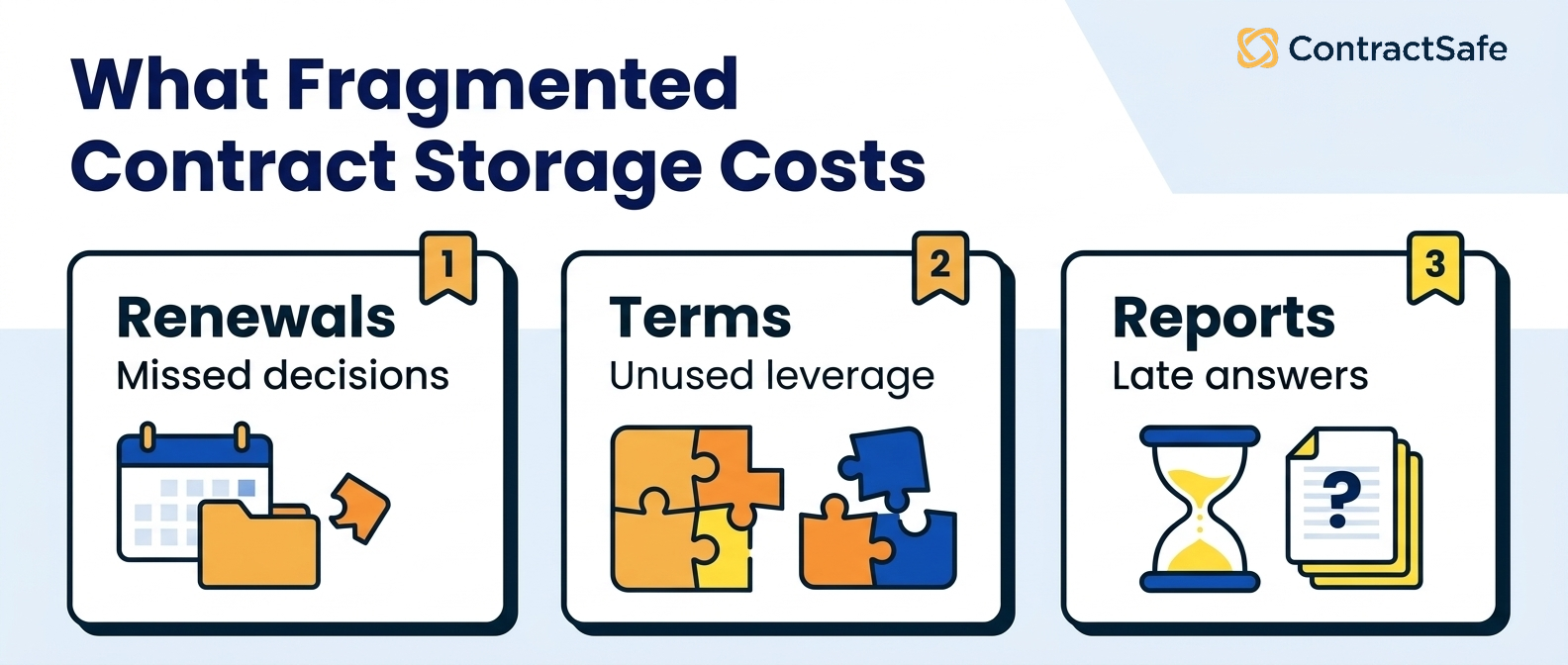
Fragmented contract storage costs money because it separates the agreement from the people, dates, records, and decisions that depend on it.
That’s why storage location matters. Contracts aren’t passive files once they’re signed.
The annoying part is that the cost usually wears a disguise.
A missed renewal looks like vendor spend. A bad audit looks like a compliance scramble. A lost amendment looks like a negotiation problem.
The contract storage problem is still underneath all of it, waving politely from the basement.
| Hidden cost | How it happens | What it does to the business |
|---|---|---|
| Duplicated vendor spend | Departments sign or renew agreements without seeing what other teams already bought | The company pays twice for similar tools or services |
| Missed renewals | Notice dates sit inside inboxes, PDFs, or spreadsheets nobody trusts | Unwanted contracts roll into another term |
| Slow review cycles | Legal and operations teams hunt for the right version before work can start | Review time goes into searching instead of deciding |
| Audit and records gaps | Amendments, approvals, and signed versions sit in different places | The company struggles to prove what happened |
| Lost context | Contract knowledge stays with one employee or department | Renewal history and negotiation context disappear |
| Weak spend reporting | Payment terms and renewal dates are not searchable across vendors | Finance can’t easily see commitments before they hit the budget |
Buyer checklist: before you trust any repository with contracts that currently live in multiple places, run this quick test on a real sample of agreements. It targets the six ways scattered storage quietly bills you, and it turns a vague "we should centralize" feeling into evidence you can show finance and legal without a long meeting.
- Time lost: Pick one signed agreement and clock how long it takes to find the final, current version. If the hunt runs past a few minutes, or turns into a "let me check" email, scattered storage is billing you in staff hours on every review, and nobody is putting those hours on an invoice.
- Renewal risk: Ask who owns the next renewal date and where that date actually lives. If the answer is a buried PDF, an inbox reminder, or one person's memory, you have a term that can renew before anyone gets the chance to decide, and canceling after the window closes is the expensive version.
- Duplicate records: Search a single vendor name across every place contracts live and count what comes back. Two similar deals from different teams, or three copies of one agreement, means duplicate spend and a standing argument over which version is actually current when it matters most.
- Access problems: Try to open a contract you did not sign yourself. If you hit a locked drive, or an "ask whoever set that up" answer, access depends on people instead of roles. Every review stalls when that person is on vacation, and urgent work waits on someone's inbox.
- Reporting rebuilds: Ask finance to list which vendors renew next quarter and what each one costs. If that needs a spreadsheet export and a day of stitching files together, you are rebuilding the same report by hand every budget cycle, and the numbers are stale by the time anyone reads them.
- Owner confusion: Point at a random agreement and ask who owns it right now. If nobody claims it, or three people half claim it, the next renewal starts from guesswork, and the reason behind those special terms leaves the building with whoever managed the vendor last.
Run all six on the same small stack of contracts, then write down exactly where each one broke instead of just noting that it felt slow. If four or more fail, the storage mess is already costing you, and the answer is a searchable repository, not another folder. Bring your scattered contract files and folders to each vendor demo and make the platform reproduce the exact step where locating a renewal date fell apart.
The 6 Hidden Costs Hiding in Scattered Contracts
The six hidden costs are the repeatable failure points that show up when contracts live outside a shared repository.
1. Duplicated Vendor Spend
Duplicated vendor spend happens when teams buy what the company already owns.
For example, procurement may store one vendor agreement in a purchasing tool while marketing keeps an agency agreement in a shared drive.
IT may approve a small software renewal because nobody can see that another department already bought a similar tool.
The fix isn’t another spreadsheet. It’s a searchable digital contract repository where vendor names, renewal dates, payment terms, and owners are easy to find.
2. Missed Renewals and Auto-Renewals
Missed renewals happen when the contract knows the date, but nobody else does.
Say you signed a vendor agreement, meant to cancel before renewal, and then forgot because the notice date was buried in a PDF.
That’s not a character flaw. It’s a system flaw.
The system should surface the date before the decision window closes. ContractSafe Alerts are built for exactly that kind of deadline rescue mission.
3. Slow Contract Search and Review
Slow contract review often begins before anyone reads a clause.
Someone has to find the right file first. Then they need to confirm whether it’s the final version, whether an amendment exists, and who approved the last change.
For example, legal may spend the first half of a vendor review figuring out whether the signed agreement is in an inbox, a drive, or an old ticket.
That’s expensive work because it doesn’t move the decision forward.
Require two things before calling a repository searchable:
-
It can search the full contract text.
-
It can surface the connected dates, owners, and amendments.
4. Audit and Records Gaps
Audit gaps happen when the signed contract exists, but the complete story doesn’t.
During an audit, the question isn’t “Do we probably have the document somewhere?” It’s “Can we show the signed agreement, amendment, approval trail, and owner without rebuilding the story by hand?”
That’s why The National Archives records management policy is a useful outside reference here. Records need ownership, retention, access rules, and a way to prove what happened.
That same logic applies to contract records. If the executed agreement, amendment, approval note, and access history live in separate places, the audit becomes a scavenger hunt.
Contract repositories reduce that risk by keeping the agreement and its related records together.
Ask whether the system keeps the original agreement, later amendments, activity history, and approval context attached to the same record.
5. Lost Context When Employees Leave
Contracts stored in personal inboxes aren’t really company assets yet.
They’re more like house keys in one person’s coat pocket. Everything is fine until the person wearing the coat leaves the building.
For example, the person who managed a vendor may be the only one who remembers why that vendor got special payment terms.
When that context disappears, the next renewal starts from fog instead of facts.
A repository should give the next owner enough history to act without calling the person who used to manage the vendor.
6. Weak Spend Reporting
Weak spend reporting happens when finance can see invoices but can’t easily read the contracts behind them.
A vendor bill tells you what got paid. The contract tells you why, when it renews, what changed, and whether the company still needs it.
When every agreement sits in a different place, reporting becomes a manual reconstruction project.
A repository with searchable terms and reporting turns the contract collection into a working business record, not just a folder full of PDFs.
Use reporting to spot duplicate vendors, upcoming renewals, and agreement owners before the next budget review.
For example, a finance team should be able to answer:
-
Which vendors renew soon?
-
Which agreements belong to the same department?
-
Which contracts need an owner before budget planning?
How to Prove the Hidden Cost Before You Buy Software
You don’t need a giant consulting study to prove fragmented contract storage is costing money.
You need a small audit that follows real contract questions.
Pick a sample of active vendor agreements, customer agreements, NDAs, and high-value service contracts. Then ask the questions people ask when the pressure is on.
-
Can we find the current signed agreement in less than a few minutes?
-
Can we tell whether an amendment changed the answer?
-
Can finance see the renewal date, notice period, and contract owner?
-
Can legal see who approved the latest version?
-
Can the business owner explain whether the vendor still matters?
If those answers take a meeting, a spreadsheet export, and three “let me check” emails, the cost is already there.
That audit also makes the software conversation cleaner.
You’re not buying a repository because “centralization” sounds mature. You’re buying it because your current system can’t answer the questions the business already asks.
For a more formal buying checklist, use the contract repository requirements guide before you compare vendors.
Contract Repository Software Compared With Shared Drives and Spreadsheets
Contract repository software beats shared drives and spreadsheets because it connects files to dates, metadata, permissions, search, and reporting.
Shared drives are better than chaos. Spreadsheets are better than memory.
But both usually depend on one person keeping the system clean, which is where the wheels start wobbling.
| Storage method | What it does well | Where it breaks |
|---|---|---|
| Shared drive | Stores files in one folder structure | Search depends on file names, version control is weak, and dates are easy to miss |
| Spreadsheet tracker | Lists renewal dates and owners | Goes stale fast and rarely links to the complete contract record |
| Procurement tool | Tracks vendor intake or purchasing steps | May not serve legal, finance, or audit needs after signature |
| Contract repository software | Stores agreements, extracts data, tracks dates, and controls access | Needs clean import and adoption planning to work well |
The NIST Cybersecurity Framework isn’t a contract guide, but its basic idea still helps here: identify what matters, protect it, detect problems, respond, and improve.
Contract storage should follow the same rhythm. Know what you have, control who can reach it, notice risk early, and keep improving the record.
What to Look for in Contract Repository Software
The best contract repository software should make contracts easy to import, search, track, protect, report on, and use across the company.
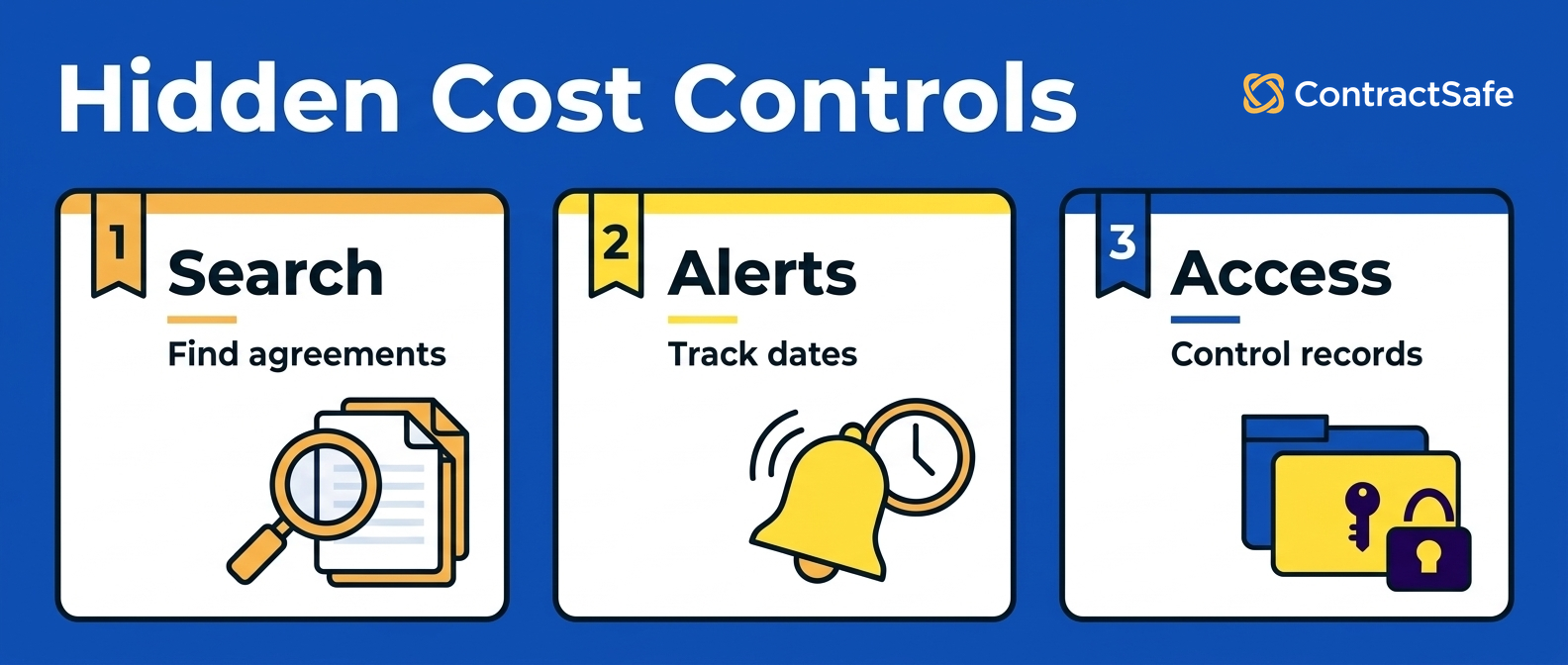
Repository Fix 1. Bulk Import That Doesn’t Punish You
Bulk import matters because every repository project starts with a mess.
You shouldn’t need to rename every file, rebuild every folder, or hand-enter every key term before the system becomes useful.
Look for batch upload, OCR, and AI extraction that can turn old PDFs into searchable records.
ContractSafe is strongest here when teams need to move quickly instead of turning migration into a second job.
For example, ask the vendor to show a bulk upload, not just describe it.
Then ask how much work remains after the upload finishes.
Repository Fix 2. Search That Finds Terms, Not Just File Names
Good search should find what the contract says, not only what someone named the file.
For example, a user should be able to search for renewal language, vendor names, payment terms, or confidentiality clauses without remembering the document title.
AI contract repository software only works when the underlying records are clean enough to trust.
That means search, OCR, and metadata need to work together.
Repository Fix 3. Renewal Alerts Tied to the Contract Record
Renewal alerts should connect back to the actual agreement.
A calendar reminder that says “vendor renewal” is only half useful if nobody can open the contract, read the notice clause, or see the owner.
Ask whether alerts can be routed to the right people, repeated before the deadline, and tied to extracted dates.
This is where a repository starts doing work instead of simply storing files.
For example, ContractSafe Alerts can point teams back to the agreement behind the date.
That keeps the renewal decision tied to the contract, not a lonely calendar note.
Repository Fix 4. Role-Based Permissions
Role-based permissions keep contracts available without turning every agreement into a free-for-all.
Finance may need vendor payment terms. Sales may need customer agreement status. HR may need employment contracts. Legal may need access to everything.
The repository should make those access lines easy to set and easy to audit.
The FTC’s business guidance on protecting personal information is a useful reminder that access control isn’t just an IT preference.
Repository Fix 5. Reporting That Helps Finance and Legal Talk
Reporting matters because contracts aren’t only legal documents. They’re also commitments, costs, deadlines, and promises.
Finance needs to know what’s coming. Legal needs to know what’s binding. Operations needs to know what can be done next.
A repository should let those teams work from the same record instead of emailing screenshots back and forth.
For example, finance should be able to check:
-
Which vendors renew this quarter?
-
Which contracts have payment changes?
-
Which owners need to review a renewal before it rolls forward?
Repository Fix 6. Pricing You Can Explain Internally
Repository pricing should be easy to explain to finance before the buying process turns weird.
For example, if your team needs broad access, ask whether the vendor charges by user, contract volume, feature tier, or services package.
Use the pricing conversation as a practical test.
If the quote changes every time you add a business user, an AI feature, a migration batch, or a support tier, finance should see that before the contract is signed.
ContractSafe keeps pricing public so buyers can check the budget risk before the demo turns into a guessing game.
What the First Cleanup Sprint Should Prove
The first repository cleanup sprint should prove that the system can turn scattered files into usable contract records.
Don’t start with every contract in the company.
Start with a set that matters: active vendor agreements, contracts renewing soon, high-value customer agreements, and documents legal gets asked about over and over.
Then test whether the repository can turn those files into decisions.
-
Owner cleanup: every active agreement has a business owner and a backup owner.
-
Date cleanup: renewal dates, expiration dates, and notice periods are reviewed before alerts depend on them.
-
Amendment cleanup: the master agreement and later amendments are connected to the same record.
-
Access cleanup: sensitive records are restricted before business users are invited into the repository.
-
Report cleanup: finance and legal can run one report that shows upcoming renewals, missing owners, and high-value contracts with incomplete fields.
That sprint gives you a real read on the platform.
If the repository can handle that first batch cleanly, the rest of the rollout has a path. If it can’t, you’ve found the problem early, before the whole company is depending on the new system.
For example, a first sprint might end with legal handing finance a renewal report that finance can trust before budget review, instead of another spreadsheet with three blank owners and a note that says “checking.”
That first report gives legal and finance a practical win they can feel immediately, because the next renewal conversation starts with facts.
This is also where ContractSafe’s full-lifecycle approach matters.
The first useful milestone is not a complicated workflow diagram. It’s a searchable, permissioned, alert-ready set of contracts your team can actually use next week.
Quick Gut Check Before You Choose a Repository
A repository buying checklist helps you test whether the platform can handle real contracts before the demo glow wears off.
-
Can the vendor import messy files without weeks of cleanup?
-
Can search find text inside scanned PDFs?
-
Can alerts point back to the contract language that created the deadline?
-
Can finance report on vendor commitments without asking legal for a manual export?
-
Can permissions match how your teams actually work?
-
Can business users answer simple contract questions without waiting on one admin?
-
Can you understand the pricing before the buying process turns into a maze?
On a ContractSafe demo, test the boring stuff.
Upload a real sample agreement. Search for a clause. Set a renewal reminder. Ask the AI a plain-language question. Check whether the answer points back to the contract.
That’s how you separate a good repository from a prettier shared drive.
One more useful test: ask the vendor what happens after import.
That’s where weak systems get quiet.
A good answer should explain who owns cleanup, how AI-extracted fields get reviewed, how alerts are confirmed, how permissions are tested, and how finance or legal can run the first useful report.
If the answer is mostly “our implementation team will help,” keep asking. Help is good. A clear operating path is better.
Related Reading
How ContractSafe Helps Stop the Hidden Costs of Fragmented Contract Storage
ContractSafe helps by giving every agreement a searchable home, then adding the alerts, permissions, AI, and reporting teams need after signature.
That matters because contract chaos usually starts small.
One vendor agreement sits in procurement. One NDA sits in an inbox. One renewal date sits in a spreadsheet. Nobody panics because each piece seems manageable.
Then the company grows, people change roles, vendors multiply, and the old system starts charging interest.
ContractSafe is built for that moment.
You can bulk import agreements, search across scanned PDFs, track renewals with automated alerts, ask questions with AI-powered contract management, and give each team the access it needs.
You also get a full-lifecycle CLM, signature, storage, alerts, and reporting in one system, without turning the rollout into a long enterprise project.
If scattered contracts are already costing time, money, and patience, request a ContractSafe demo and bring the whole contract mess into one place.








.svg)







.svg)