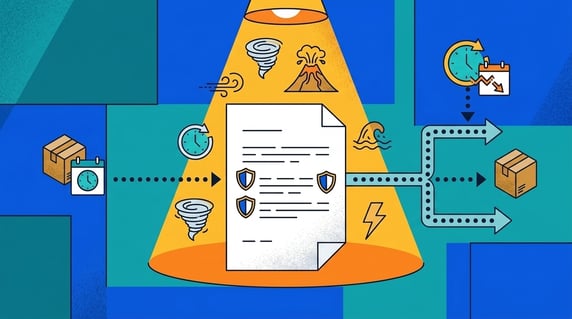
A force majeure clause is contract language that may excuse or delay performance when an extraordinary event outside a party’s control prevents the contract from being performed.
That sounds tidy until you need to use it. Then the question is not just whether the contract has a force majeure heading. The question is whether the clause actually works when the business is under pressure.
Quick answer: A force majeure clause should name the covered events, connect the event to the blocked obligation, explain notice and mitigation duties, say what happens to payment and timing, and tell the team when termination becomes available.
Think of force majeure like an emergency exit. The sign over the door is useful, but only if the door opens, the hallway is clear, and everyone knows where to go.
A clause that says “acts of God and other events beyond our control” may look comforting. It may also leave the team arguing about scope, notice, proof, and timing after the disruption has already started.
This article is not legal advice. It is a practical way for legal, finance, procurement, and operations teams to read the clause, find it later, and manage the follow-up work.
-
A force majeure clause is only as useful as its exact wording, notice rules, and evidence requirements.
-
The clause should say which events count, which obligations are affected, what notice is required, and how long the disruption can continue before termination rights appear.
-
Force majeure is contractual. Frustration of purpose and impossibility are legal doctrines, so teams should not treat them as interchangeable shortcuts.
-
The post-signature work matters. If you cannot find the clause, owner, notice address, and evidence record quickly, the language is harder to use.
-
ContractSafe helps teams keep force majeure clauses searchable, tied to owners, and connected to alerts, reports, and post-signature follow-up.
Choose your next step:
-
If you need the basic definition, start with what the clause does.
-
If you are reviewing language, jump to the seven clause elements.
-
If you are comparing legal concepts, go to force majeure vs. frustration of purpose.
-
If you already have signed agreements, use the post-signature tracking checklist.
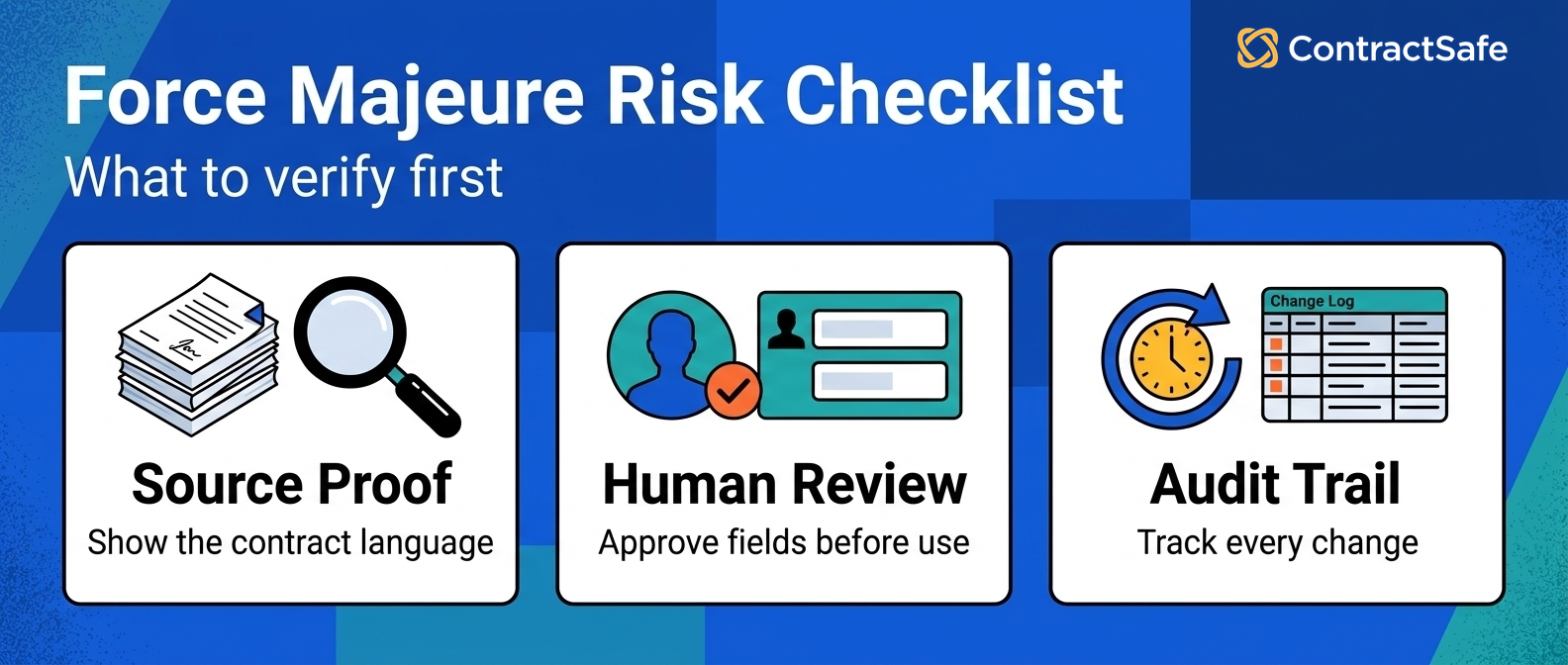
What Does a Force Majeure Clause Do?
A force majeure clause in a contract does three jobs: it defines the triggering event, explains which obligations are excused or delayed, and sets the process for notice, mitigation, evidence, and follow-up rights.
The clause is usually about risk allocation. The parties are deciding, before anything goes wrong, who carries the risk when a disruption makes the promised work impossible, impracticable, or late.
Cornell’s Legal Information Institute describes force majeure as a contract provision that can free parties from obligations when an extraordinary event directly prevents performance. That “directly prevents” part is doing a lot of work.
A supplier may have a weather disruption. A buyer may have a facility shutdown. A vendor may lose access to a required system. The clause decides whether those facts actually affect the specific obligation in the contract.
That is why the clause should not be treated as decorative boilerplate. The wrong language can leave the business with no clear notice process, no proof trail, and no answer for what happens next.
For a broader lifecycle view, force majeure belongs inside contract lifecycle management, not just drafting. The clause has to be negotiated, stored, searched, tracked, and acted on after signature.
Force Majeure Clause Buyer Snapshot
Use this snapshot when you are reviewing a clause in a vendor agreement, customer agreement, services agreement, or supply contract.
| Clause question | Weak answer | Useful answer |
|---|---|---|
| What events are covered? | A vague catch-all phrase. | Named events plus a clear standard for similar events. |
| What obligation is affected? | The whole contract pauses. | Only the obligations actually blocked by the event are excused or delayed. |
| What notice is required? | Tell the other party soon. | Specific deadline, recipient, delivery method, and required facts. |
| What proof is needed? | Whatever seems reasonable later. | Documents, timeline, mitigation steps, and affected obligations. |
| What happens after delay? | The parties will work it out. | Suspension, extension, continued payment duties, and termination rights are defined. |
The table is simple on purpose. If the clause cannot answer those questions, the team will have to negotiate the answers during the disruption. That is not when anyone does their clearest thinking.
The 7 Parts of a Force Majeure Clause to Check
A force majeure clause can be short, but the useful version has several moving parts. You don’t need a giant wall of language. You need language that answers the right operational questions.
1. Covered Events
The covered-events language tells you what kinds of disruption can trigger the clause. Natural disasters, war, terrorism, labor disruption, epidemics, government action, cyber incidents, and supply failures may appear here.
The list should match the contract. A software subscription may care about outages, security incidents, data-center failures, and government restrictions. A manufacturing contract may care more about ports, parts, labor, transport, and supplier interruptions.
Don’t assume a broad phrase covers the event you care about. Courts often look closely at the words the parties chose, so the list and catch-all language need to work together.
For example, if cyber incidents matter to the business, check whether the contract actually names cyberattack, ransomware, service outage, or third-party infrastructure failure.
2. Causation
Causation is the bridge between the event and the missed obligation. The event happened, but did it actually prevent performance under this contract?
That question matters because force majeure is not a general “things got harder” button. The clause usually works best when the party can show a direct connection between the event and the obligation it could not perform.
For example, a port closure may affect delivery obligations. It may not excuse unrelated reporting duties, payment duties, or work that could still happen through another route.
3. Notice Duties
Notice is where many teams lose the protection they thought they had. The clause may require notice within a specific number of days, to a specific address, through a specific method.
Troutman Pepper Locke explains that force majeure notices are driven by the contract’s own notice language. The form, content, and delivery method come from the agreement, not from vibes.
The practical question is boring but vital: does anyone know who has to send notice, where it goes, and what it has to say?
For example, review the notice clause before relying on force majeure, then store the sent notice and delivery receipt with the contract record.
4. Mitigation
Mitigation language tells the affected party what it must do to reduce the impact of the event. The contract may require reasonable efforts, alternative suppliers, workaround plans, or continued performance of unaffected obligations.
This is where the clause moves from legal theory to business operations. If the vendor can reroute delivery, use a backup provider, or keep part of the service running, the clause may not excuse everything.
When you review the clause, ask what evidence would prove mitigation. Emails, supplier notices, outage records, shipping records, and internal decision notes may all matter later.
For example, track each workaround the business considered, which owner approved it, and why a rejected workaround was not practical under the contract.
5. Suspension, Payment, and Partial Performance
A force majeure event may suspend some duties without ending the contract. That creates a practical question: what keeps running while the disrupted obligation is paused?
Payment is the usual flashpoint. Does the buyer still pay for unaffected services? Does a minimum commitment continue? Are service credits paused, preserved, or handled separately?
Partial performance deserves its own check. If the vendor can deliver half the service, the contract should say whether that partial performance is accepted, discounted, rejected, or treated as temporary.
For example, review whether service credits, minimum commitments, support duties, and payment obligations continue while only part of the work is paused.
6. Termination Rights
Some force majeure clauses allow termination if the event continues beyond a set period. The exact window comes from the contract. The number itself matters less than whether the team can see it in time.
Termination rights should say who can terminate, when the right begins, what notice is required, and what happens to unpaid amounts, returned property, data, transition services, and open obligations.
Without that language, the team may know the contract is stuck but still have no clean way to move on.
For example, review transition duties, data return, unpaid amounts, and customer notices before using termination. Track the termination window as an alert so the right does not pass unnoticed.
7. Evidence Record
The evidence record is not usually one sentence in the clause. It is the operational trail that proves what happened.
Keep the contract language, event timeline, notice copies, delivery receipts, mitigation steps, business-owner notes, and affected obligations together. If the documents live in five systems, the legal analysis becomes slower than it needs to be.
This is where a searchable contract repository matters. The clause itself is only the starting point. The team also needs the surrounding facts, owners, dates, and follow-up work.
For example, use ContractSafe to attach notices, outage records, owner notes, and mitigation evidence to the contract record so the proof does not live in someone’s inbox.
8. Remedies and Consequences
The remedies language tells the team what happens if the clause works, and what may happen if it does not. That can include delay relief, suspension, service credits, termination rights, breach of contract claims, damages, or reserved rights.
For example, a customer agreement may excuse a service delay but still preserve confidentiality duties, data-security duties, payment obligations for unaffected services, and transition help after termination.
This is the part of the clause that keeps legal and finance in the same room. Legal needs the rights. Finance needs the commercial exposure. The business owner needs the practical next move.
How ContractSafe supports clause review
ContractSafe helps teams keep this review connected to the actual agreement. Search can find force majeure language across scanned PDFs, and metadata fields can keep owner, notice, renewal, and evidence details close to the contract.
For example, a team can use ContractSafe reports to pull contracts with force majeure language, then use alerts to track notice windows or follow-up dates tied to the same record.
Force Majeure vs. Frustration of Purpose Comparison
The comparison is straightforward: force majeure starts with the contract clause, while frustration of purpose starts with a legal doctrine that may apply when the deal’s main purpose has been destroyed.
Force majeure starts with the contract. The team asks what the clause says, whether the event fits, whether performance was prevented, and whether notice was given correctly.
Frustration of purpose is a legal doctrine. Cornell describes frustration of purpose as an excuse for nonperformance when an unforeseeable event destroys the agreement’s principal purpose.
Crowell explains that impossibility and frustration analysis depends heavily on the facts, the governing law, and whether the changed circumstances truly alter the bargain.
| Question | Force majeure | Frustration of purpose |
|---|---|---|
| Where does it come from? | The contract clause. | A legal doctrine under governing law. |
| What is the first question? | Does the event fit the clause? | Was the contract’s main purpose destroyed? |
| Does notice matter? | Usually yes, because the clause may require it. | Maybe, depending on the contract and dispute posture. |
| What evidence matters? | Event, causation, notice, mitigation, affected obligations. | Purpose of the deal, changed facts, foreseeability, legal standard. |
| What should the team do first? | Find the clause and follow the process. | Ask counsel to evaluate the doctrine under governing law. |
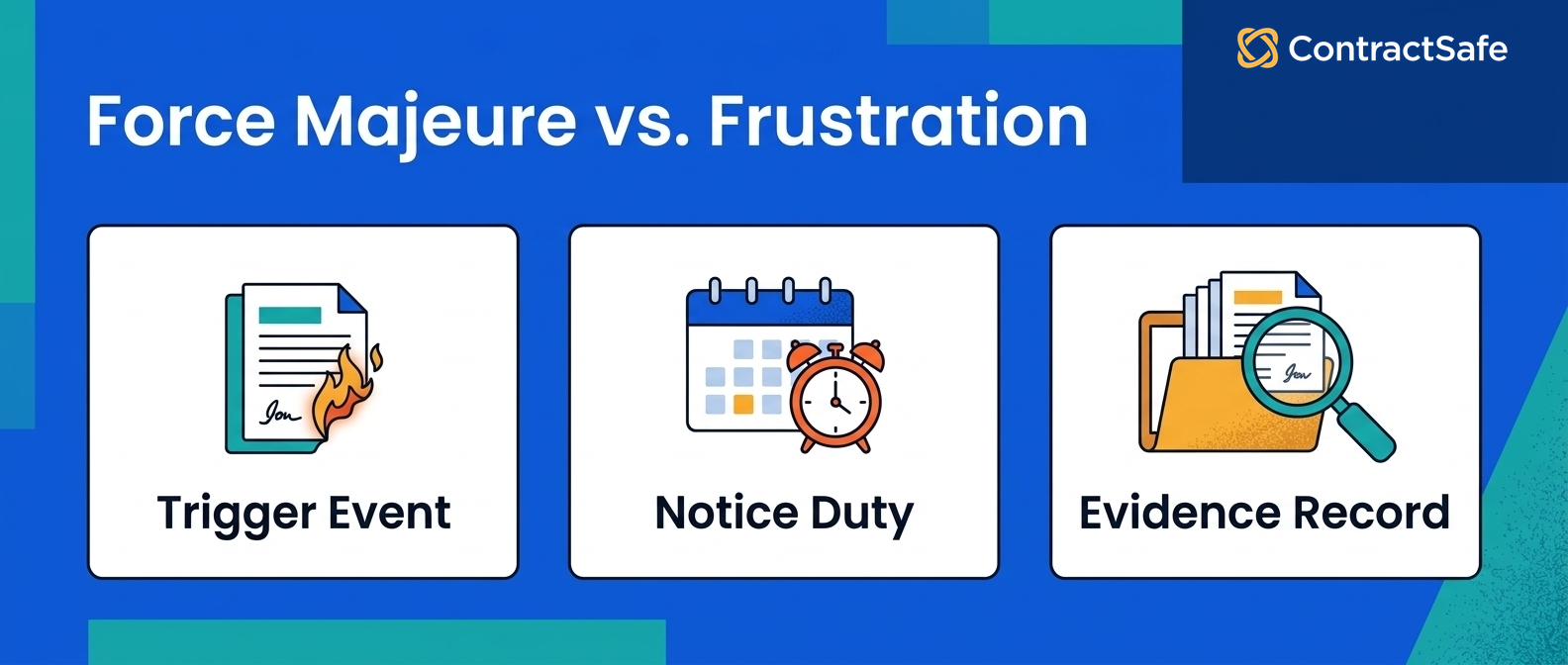
The practical takeaway is not to skip the contract. Even if a doctrine might apply, the first working document is still the signed agreement. Find the clause, read the notice section, and preserve the evidence trail.
Force Majeure Clause Gut Check
Use this contract checklist for force majeure clauses to confirm that the language, notice process, owner, and evidence trail are ready before anyone tries to rely on the contract.
-
Can you find every force majeure clause across active vendor and customer agreements?
-
Can you filter affected contracts by business owner, department, counterparty, and contract type?
-
Does the clause name the covered event, or does it rely on broad catch-all language?
-
Does the clause require notice within a specific number of days?
-
Do you know the notice recipient and delivery method?
-
Does the clause say what obligations are suspended and which ones continue?
-
Can you see termination rights if the event continues too long?
-
Can you attach the evidence record to the contract itself?
This is the point where legal and operations usually discover the real work. The clause may be fine, but the contract record might be missing the owner, notice address, amendment history, or alert dates.
Example: The Vendor Outage That Tests the Clause
This example shows how a force majeure clause moves from contract language into live business work. A key software vendor has a regional outage after a severe storm, and one contracted service is down for two days.
The force majeure question is not “Was there a storm?” Everyone agrees there was a storm. The question is what the contract says should happen next.
Start with the covered-events language. Does the clause name weather events, natural disasters, utility failures, or third-party infrastructure failures? Does it require the event to be unforeseeable, unavoidable, or beyond reasonable control?
Then connect the event to the blocked obligation. If the outage affects one service level, it may not excuse every promise in the agreement. Support, data protection, confidentiality, and payment language may keep running.
Next, check notice. The clause may require written notice within five business days. It may also require the notice to describe the event, affected obligations, mitigation steps, and expected timeline.
Now collect evidence. Save the vendor’s incident notice, internal timeline, customer communications, service logs, mitigation decisions, and any follow-up notice sent under the contract.
Finally, assign an owner. Someone has to decide whether to reserve rights, request a workaround, extend a deadline, issue notice, or escalate to counsel.
That whole sequence sounds obvious when nothing is happening. It is much harder when the business is asking for an answer by noon.
Who Should Own Force Majeure Follow-Up?
Legal should own interpretation and notice language, but force majeure follow-up needs business owners too. The clause touches facts that live in procurement, finance, operations, sales, and customer success.
Procurement may know which vendor is affected. Operations may know whether the workaround is real. Finance may know whether payment duties continue. Sales or customer success may know which customer commitments are at risk.
The contract record should make that ownership obvious. If the agreement has no business owner, the team has to rebuild the map while the issue is already live.
A simple ownership model works better than a complicated one:
-
Legal owns interpretation, notice language, and counsel escalation.
-
The business owner owns facts, operational impact, and vendor communication.
-
Finance owns payment exposure, credits, and commercial tradeoffs.
-
Operations owns workarounds, timelines, and service continuity.
-
Contract administration owns the repository record, alerts, attachments, and reports.
If those roles are not assigned before the disruption, the first meeting becomes a scavenger hunt. Everyone agrees the clause matters, but nobody knows where the file, notice address, owner, or latest amendment lives.
How to Triage a Force Majeure Event
Force majeure triage starts with eight artifacts: the signed contract, amendments, clause, notice rules, affected obligation, event timeline, mitigation record, and next owner.
Use this order:
-
Find the signed contract and every amendment.
-
Locate the force majeure clause and notice section.
-
Identify the obligation that is delayed, blocked, or at risk.
-
Check the notice deadline, recipient, and delivery method.
-
Collect the event timeline and evidence.
-
Record mitigation steps already taken.
-
Ask counsel whether the clause, governing law, or legal doctrines change the analysis.
-
Decide who updates the business and who owns the next deadline.
That order keeps the team from jumping straight to the dramatic question. Most mistakes happen earlier: the wrong contract, stale amendment, missed notice address, missing owner, or no evidence file.
How to Manage Force Majeure Clauses After Signature
After signature, force majeure management means keeping the clause searchable, tied to an owner, connected to notice requirements, and backed by an evidence record.
The contract might sit quietly for three years. Then a storm, strike, outage, regulation, or cyber incident turns one paragraph into the most-read part of the agreement.
The safer approach is to treat force majeure as searchable contract data. You don’t need to read every agreement every week. You do need a way to find the affected clauses fast.
| What to track | Why it matters | ContractSafe place to keep it |
|---|---|---|
| Clause location | Legal needs the exact language before giving guidance. | OCR search, clause notes, and searchable PDFs. |
| Notice deadline | Late notice can weaken the position. | Alerts tied to the contract record. |
| Notice recipient | Sending notice to the wrong place wastes time. | Metadata fields and owner notes. |
| Affected obligation | Not every duty is excused by the event. | Contract notes, tags, and reports. |
| Business owner | Someone has to coordinate facts and decisions. | Owner fields and permissions. |
| Evidence record | The team needs proof, not memory. | Attachments, audit trail, and saved reports. |
That table is also a good cleanup list. If you cannot report on those fields today, start with the highest-risk contracts: key vendors, customer commitments, supply agreements, service agreements, and contracts with strict notice language.
If your team is also tracking post-signature duties, connect this work to contract obligation management. Force majeure, renewals, insurance, reporting, and service levels all have the same basic problem: someone has to know what the contract requires after it is signed.
Common Force Majeure Mistakes
Most force majeure mistakes come from ordinary contract-management gaps: missing owners, missed notice rules, stale amendments, weak evidence, and clauses nobody can find quickly.
-
Treating the heading as protection without reading the actual clause.
-
Assuming every disruption excuses every obligation.
-
Missing notice deadlines because nobody turned the clause into an alert.
-
Forgetting that payment, confidentiality, data, and transition duties may continue.
-
Failing to collect evidence while the facts are still fresh.
-
Leaving force majeure language buried in PDFs that only legal can search.
-
Tracking the clause but not the business owner responsible for follow-up.
The fix isn’t to make every clause longer. The fix is to make the clause usable. Good language plus poor tracking still leaves the team scrambling.
Related Reading
How ContractSafe Helps With Force Majeure Clause Management
ContractSafe helps teams find force majeure clauses before the disruption becomes a scavenger hunt. Contracts live in a central repository, and OCR makes scanned PDFs searchable.
ContractSafe’s repository keeps signed agreements, amendments, and attachments together, so the team can start with the actual contract instead of a folder guess.
ContractSafe alerts help teams track notice windows, termination rights, renewal dates, and other deadlines tied to the contract record.
ContractSafe search and reporting help legal, finance, procurement, and operations answer practical questions fast: which contracts mention force majeure, who owns them, and what needs follow-up?
ContractSafe is not a substitute for legal judgment. It is the place where the contract language, owner, notice dates, and evidence trail can stay together so legal judgment has something solid to work from.








.svg)







.svg)