

The importance of the nonprofit sector in America cannot be overstated. Every day, nonprofits and their dedicated employees perform important service roles throughout society, affecting health, religion, education, environment, and community development. Many underserved populations would undoubtedly suffer without these efforts. But while most of us are aware of and appreciate the social and cultural importance of nonprofits, many people do not realize their overall economic importance.
According to Independent Sector’s December 2025 Health of the U.S. Nonprofit Sector report, roughly 1.9 million nonprofit and philanthropic organizations are registered nationwide. These nonprofits contributed over $1.5 trillion to the U.S. economy in 2024 and employ about 9 percent of the U.S. workforce.
While there are many differences between nonprofit and for-profit organizations, they certainly have one thing in common: both are looking to improve the bottom line. In this article, we’ll discuss some of the ways in which effective contract management tools can boost margins for nonprofit organizations.

Is There Really Room for Improvement?
In a word – absolutely! According to Aberdeen Group research, as reported by the International Association for Contract and Commercial Management (IACCM), companies suffered yearly revenue losses between five and nine percent due to poor contract management. While this research was not specifically aimed at nonprofit organizations, the study has relevance. Non-profits are often under-resourced, especially when compared to the for-profit world, meaning the losses are probably higher.
After all, just like for-profit enterprises, nonprofits exist in a world full of contracts. Nonprofits enter into agreements with employees, vendors, utility companies, landlords, and contractors, just as for-profit companies do. In fact, according to the educational publication Nonprofit Hub, some of the most common hidden costs faced by nonprofits are embedded in contracts. The largest culprits include provisions that place too much risk on the nonprofit while relieving the supplier of risk, as well as suppliers who sneak in exclusivity and arbitration provisions benefiting themselves. Finally, grants--a key resource for many non-profits--are contracts with terms and conditions and deliverables.
How Does Nonprofit Contract Management Software Increase the Bottom Line?
Efficient Storage and Access
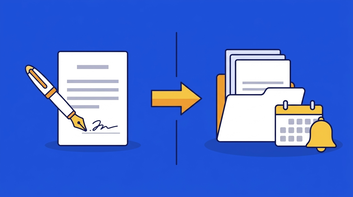
ContractSafe contract management tools are designed to immediately increase the organization’s efficiency. Using OCR technology, all of the company’s contracts are quickly and easily scanned and digitally stored in a single repository. Thereafter, any contract can be quickly accessed from any computer with an internet connection – no more dedication of employee-hours to searches through filing cabinets, desks, boxes, or piles of paper (or shared drives!).
Improved Security and Recovery
Of course, good nonprofit contract management software must emphasize data security: Rest assured the safety of your data is our highest priority. We use state-of-the-art Amazon servers, encryption technology and a number of other top-notch security features to protect data.

Streamlined Searching
Let’s revisit the issue we mentioned earlier: vendor (or other third-party) contracts including liability-shifting provisions that harm the nonprofit. With all contracts now centralized, ContractSafe's contract management tools let you search every contract within seconds with Google-type word searches.
With a few keywords, you can instantly pull up any contracts that have riskier clauses like indemnification or liability. You can also search for specific language in contracts that could be problematic.
So, if you’re ready to boost your nonprofit's bottom line with user-friendly contract management software, start your free ContractSafe trial today.




.svg)







.svg)