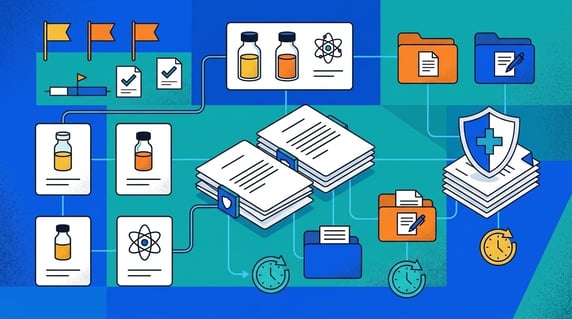
Pharmaceutical contract management software is software for managing clinical, vendor, research, quality, licensing, and commercial agreements.
Think of it like a lab notebook for contracts. Each date, owner, amendment, and record has to be traceable.
A trial delay can start with one agreement nobody can find fast enough.
Key Takeaways
- Pharma’s most important work happens through other companies’ contracts. CROs, CMOs, distributors, and licensing partners do the work. The agreements are the control layer.
- Negotiating clinical trial contracts can take over 100 days on average, according to a study funded by the NIH. And each day of those delays can cost sponsors anywhere from $600,000 to $8 million.
- Applied Clinical Trials reports that almost half of all study delays happen because of contract holdups.
- Even though new biopharma companies start 63% of trials, they often don’t have their own contract teams, according to Contract Pharma.
- ContractSafe gives you unlimited users and uses AI to pull key details from all your contracts. It’s the CLM for the company, not a replacement for clinical trial management systems.
Choose Your Next Step
Pharmaceutical contract management decisions go faster when you start from the agreement chain that worries you most. Jump to the section that matches.
- Trial timelines slipping? Start with what contract delays cost and the contracts that get a drug to market.
- Small team, big portfolio? Read why small biotechs feel this most.
- Evaluating tools? Work through the six capabilities pharma teams need.
- Whichever it is, check your CRO and CMO agreements first: confirm each has an owner, its key dates tracked, and its amendments linked.
- Building the foundation? Our contract repository software guide covers the buying tests underneath.
The $8 Million Day and What Contract Delays Cost Pharma
Contract delays cost pharma more than almost any other industry, because the physical supply chain stops whenever the contractual one stalls.
A drug’s journey to market runs through a supply chain of agreements. Each physical step only happens because a contract authorized it.
Synthesize the compound, run the trial, manufacture at scale, distribute to pharmacies. When a contract in the chain stalls, the physical supply chain stops too.
The numbers are severe. A study funded by the NIH found that negotiating clinical trial agreements takes over 100 days, with each day of delay costing sponsors between $600,000 and $8 million.
That’s the cost of a slow contract, not a failed one.
Applied Clinical Trials reported that nearly half of all study delays are tied to contracting bottlenecks. The agreements that authorize the trial to begin are the single largest source of startup delay.
Check your own portfolio against that math: count the agreements currently in negotiation that gate a trial milestone, and ask who is watching each one’s timeline.
The Contracts That Get a Drug to Market
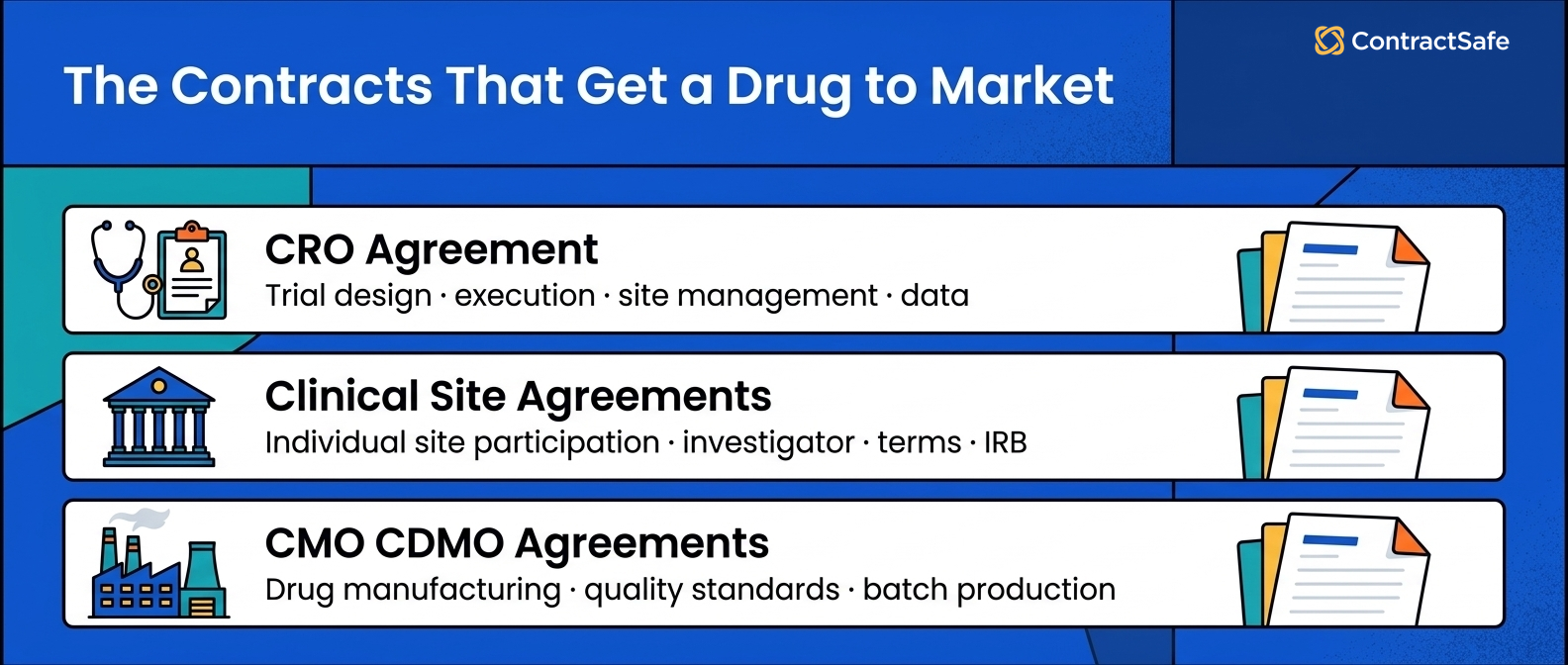
Pharma runs two parallel supply chains. The physical one moves molecules through labs and manufacturing plants. The contractual one moves authorization through legal departments and counterparties.
Every link in the physical chain depends on a corresponding link in the contractual chain.
| Contract Type | What It Governs | What Stalls If It’s Delayed |
|---|---|---|
| CRO Agreement | Trial design, execution, site management, data collection | Enrollment can’t begin. No trial data. |
| Clinical Site Agreements | Individual site participation, investigator terms, IRB coordination | Sites can’t activate. This can lead to enrollment gaps across geographies. |
| CMO/CDMO Agreements | Drug manufacturing, quality standards, batch production | Your manufacturing timeline might decouple from your trial timeline. |
| Licensing/IP Agreements | Patent rights, royalty terms, exclusivity windows | Your commercial launch date could become undefined. Investor confidence erodes. |
| Distribution Agreements | Market access, pricing, territory rights | Post-approval commercialization stalls. |
| Regulatory Submissions | FDA/EMA filings, compliance documentation | Approval timeline extends. Competitors gain ground. |
A centralized repository that connects these agreements lets the VP of Legal see the full chain. When the CRO agreement shifts by extra time, the downstream impact on the CMO timeline and the distribution launch date becomes visible immediately.
Map your own chain once: list the agreements between your molecule and its market, in order, with owners. The unowned links are where the delays will start.
Update the map at every program milestone, because the chain changes shape as the drug advances: new sites, new suppliers, new territories, new agreements.
Why Small Biotechs Feel This the Most
Small biotechs carry enterprise-grade contract complexity with a fraction of the staff, which makes the contract chain their most fragile system.
The global CRO market keeps growing because so much of pharma’s work is outsourced. But it’s not just the big companies doing the outsourcing.
IQVIA reports that emerging biopharma companies now account for 63% of clinical trial starts, up from 56% in 2019. These are mostly pre-commercial organizations. Many have fewer than 50 employees.
A 40-person biotech with one drug in Phase III faces the same contracting complexity as a company 50 times its size. They deal with CRO agreements across multiple countries. And CMO contracts often come with milestone-based payments.
Plus, there are licensing deals with royalty terms tied to the commercial launch date. And, of course, NDAs with every potential partner.
The person managing all of this is often a single VP of Legal who also handles employment agreements, board governance documents, and vendor contracts for the office lease.
That person doesn’t need a six-month CLM implementation. They don’t need per-seat pricing that punishes them for giving the CFO read access. They need everything in one place, searchable, with date tracking that connects related agreements.
What Pharmaceutical Contract Management Means in Practice
In practice, pharmaceutical contract management means treating the agreement chain as an operating system: every contract findable, every key date owned and alerted, every amendment linked, and every obligation tracked as work the team can see.
The definition is a test. If the CRO agreement’s current amendment, the CMO’s next milestone payment, and the licensing deal’s royalty trigger can’t be produced in minutes, the chain is being stored, not managed.
Check the gap now, before a partner’s diligence team checks for you, and put the worst findings on this quarter’s contract cleanup list.
Run that test on your three most trial-critical agreements before evaluating any software, and check who on the team can pass the test besides you. The results are your requirements list and your access list.
The CLM vs the Trial Systems: The Difference
The difference between the CLM and the trial systems is the difference between managing the company’s contract portfolio and running the regulated trial itself. Confused buyers purchase the wrong layer, then build workarounds.
The CTMS runs trial operations; the eTMF holds the regulated trial documents. Compared with those, the CLM carries the business layer: the CRO contract’s terms, the CMO’s payment schedule, the licensing deal’s exclusivity windows, and the renewal dates each agreement carries.
Keep the boundary clean and connected. The trial systems reference the agreements; the CLM holds them, with the dates and owners that drive the company’s decisions.
Check the boundary with your quality team once, in writing, so the validation question never blocks the contract layer’s rollout.
Why the Contract Layer Pays for Itself
The benefits of managed pharma contracts compound along the chain: faster trial starts, fewer milestone surprises, calmer partner diligence, and a legal lead who answers questions instead of hunting agreement files.
The delay math above is the headline benefit, but the quieter ones matter weekly. The CFO reads renewal exposure from a report. The regulatory head finds every agreement touching a standard in one search. The board diligence packet assembles in an afternoon.
Count the benefit in your own units: hours of legal time per contract question, days of trial slippage per contracting bottleneck, and the one renewal nobody missed this year.
Check the math quarterly against the delay-cost numbers above. A contract layer that prevents one gating delay has paid for years of itself.
What Compliance Asks of Pharma Contract Records
Pharma contract records face a second audience besides the business: regulators and auditors who expect traceable, controlled documentation.
The FDA’s Part 11 guidance on electronic records and signatures frames the expectations for electronic documentation in regulated contexts: controlled access, audit trails, and reliable records.
For the contract layer, the practical reading is simple. Know where every agreement is, who touched the record, which version governs, and when the duties fire.
Check three things on your own system: role-based access that matches your quality policies, an audit trail on every contract record, and search that can produce any agreement during an inspection without a hunt.
Confirm the boundaries with your quality team: the CLM manages company agreements, while validated trial systems carry the regulated trial data. The two should connect by reference, not by copy.
What Pharma Teams Need From Contract Management Software
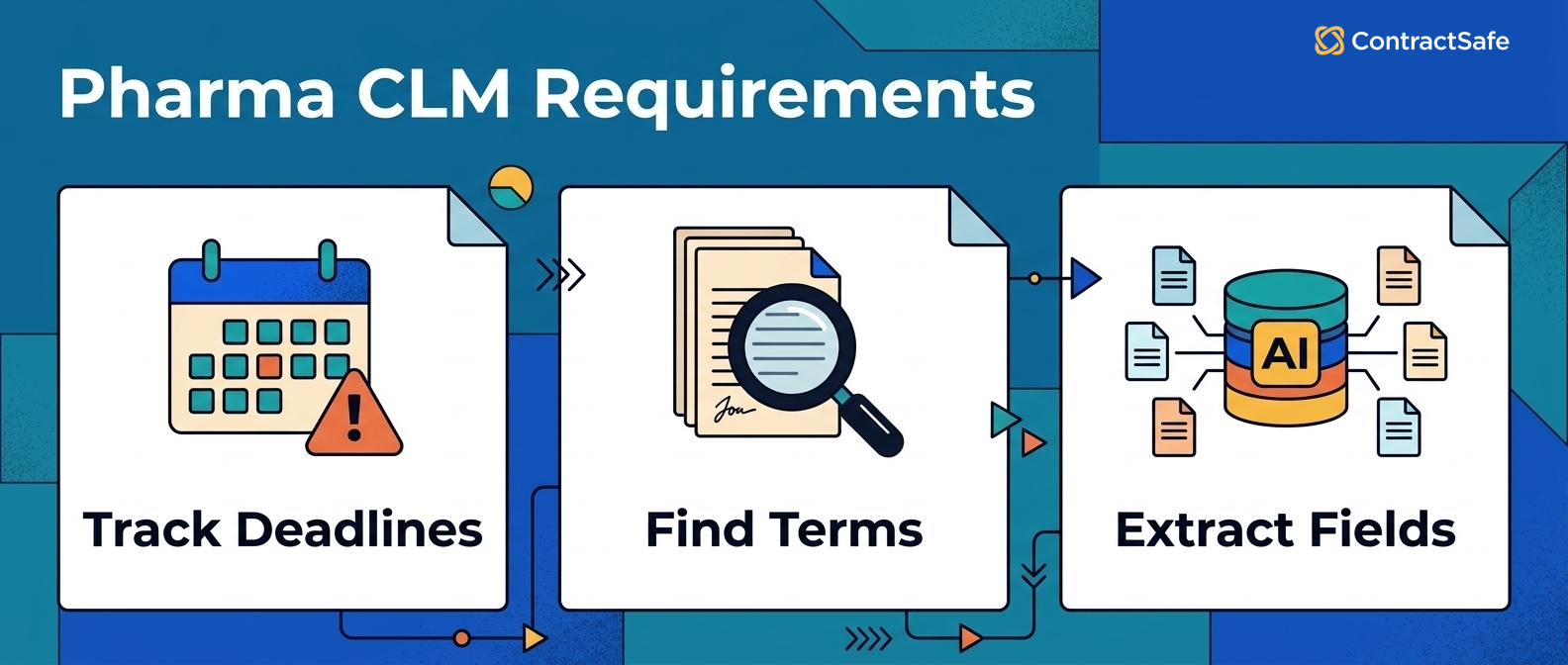
Pharma contract management software needs six capabilities the trial systems never provide, because the CTMS and eTMF are scoped to the study, not the company’s agreements.
A clinical trial management system handles the trial. The electronic trial master file manages the regulated trial documents. The company’s vendor agreements and licensing deals never touch either one.
The CLM handles the company. Six capabilities cover what pharma teams actually need from the contract layer, and each one below ends with the check that proves a vendor delivers the capability on your agreements, not the demo’s.
Score every candidate against all six with your own CRO, CMO, and licensing documents, and require the answers live, in the meeting, on your contract files rather than vendor samples.
1. Date Tracking Across Connected Agreements
Date tracking in pharma means connected dates: the CRO agreement’s enrollment deadline affects the CMO’s manufacturing start, which affects the distribution agreement’s launch window.
Each connection needs an owner watching the contract, and the renewal calendar needs all three layers on it.
Automated alerts need to span these connections, with owners and escalation, so one shifted milestone surfaces its downstream impact.
- Watch for: milestone payments in CMO agreements whose trigger dates nobody re-checks after amendments.
Check the connection in the demo: shift one CRO date and ask where the change shows up across the related agreements. A flat list of independent reminders fails the pharma test.
2. Search Across the Full Portfolio
Cross-portfolio search means finding every agreement that references a specific compliance standard when a regulation changes, in minutes, across CRO contracts, site agreements, and supplier paper alike.
That’s a full-text search across every contract type and counterparty, not a folder-by-folder hunt through CRO, CMO, and licensing archives.
Test the search on your own worst documents: a scanned site agreement, an amended licensing deal, a quality agreement with an exhibit stack. Score each search pass or fail, and keep the failures for the next vendor conversation.
For example, when a data-protection standard changes, the team that searches “every agreement referencing the standard” in one query starts remediation the same day. The folder team starts an inventory project.
Check the scanned-document case too, because site agreements and older supplier contracts usually live as scans.
3. AI Extraction That Handles Variety
AI extraction for pharma has to handle variety: a CRO agreement looks nothing like a licensing deal, and both look nothing like a distribution contract or a clinical site agreement.
The CLM’s AI needs to pull key terms from each without manual configuration per contract type, and show the results for human review before anyone relies on the data.
- Watch for: extraction that only works on clean templates, when your portfolio is counterparty paper.
Check extraction with three different agreement types in the demo, and confirm the review queue shows the human what the AI found before any field on the contract record becomes truth.
4. Implementation Measured in Days
A biotech in the middle of Phase III enrollment doesn’t have six months to implement a CLM for its agreements. The contract tool needs to be useful in the first week, on the real portfolio.
Check the realistic path: contracts uploaded, AI extraction first pass, key dates verified on the top agreements, and alerts live, all before the next board meeting.
For example, the team that uploads its CRO and CMO agreements in week one has its delay-risk map by week two. The team in a services implementation is still in workshops.
- Watch for: implementation plans that need IT resources your biotech doesn’t have.
5. Access for Everyone Who Needs Answers
When your VP of Legal, CFO, regulatory head, clinical ops lead, and board advisor all need contract access, per-seat pricing creates artificial barriers.
Unlimited users at a flat price means the renewal question gets answered by the system instead of by interrupting the one lawyer.
Check the roles too: the board advisor gets read access to diligence materials, while the employment agreements stay restricted to the people who should see them.
- Watch for: per-seat plans that quietly decide who gets to see the company’s obligations.
6. Security That Survives Diligence
Pharma contracts carry partner IP, trial data references, and commercial terms, so the contract system itself gets audited during diligence and partnering conversations, sometimes before the term sheet.
Check the basics before they’re asked: SOC 2 certification, encryption, role-based permissions, and an audit trail on every record.
For example, a licensing partner’s diligence team asking “who can see our royalty terms?” should get a roles answer, not a shrug.
- Watch for: security questionnaires that stall deals because the contract system can’t answer them.
Quick gut check before you evaluate anything. Time one question on your current system: which agreements gate the next trial milestone, and which of those lack owners? Under five minutes means you’re managing; longer names the gap.
How ContractSafe Helps Life Sciences Teams Move Faster
ContractSafe is for teams who want powerful contract management, but without the usual headaches. You'll find everything you need to manage contracts from intake to renewal, and you won't get stuck on a steep learning curve.
Most teams can start quickly. AI extracts key terms and identifies execution status automatically. Custom dashboards and reports come standard. Every plan includes unlimited users.
SOC 2 certified. Enterprise-grade encryption. You'll get support from real humans on every plan.
The six capabilities above are the honest checklist: run them against ContractSafe with your own CRO, CMO, and licensing agreements in a free demo.
Connecting the Pharma Contract Stack
The contract layer works best when each piece connects: the repository holds the agreements, the metadata keeps the fields trustworthy, and the obligations become tracked work.
Tie your pharma contract work into your contract repository, its metadata, and your system for managing obligations.
Since dates carry so much pharmaceutical contract risk, review your contract renewal checklist and effective date rules before considering any contract file complete.
For outside context, WorldCC’s research ties contract discipline like this to commercial results across industries, pharma included.
Getting Started Without a Project Plan
The pharma contract layer starts with one afternoon and the agreements that gate the trial.
- List the contracts between your molecule and its next milestone: CRO, sites, CMO, licensing.
- Upload them, scans included, and let AI extraction make the first pass on dates and parties.
- Verify the extracted fields on those gating agreements by hand, and assign each an owner.
- Turn on the alerts: enrollment deadlines, milestone payments, notice windows, royalty triggers.
- Run the first chain report for the leadership meeting: every gating agreement, its stage, its owner, its next date.
Check the result after week one: if the team can answer “what gates the trial and who owns it” from a report, the layer works. Expand to the rest of the portfolio on a cleanup schedule.
Keep the cleanup honest with a monthly orphan check: agreements without owners, dates without alerts, and amendments without parents. Three small reports keep the chain trustworthy between milestones, audits, and partnering conversations.
Related Reading
- Choosing contract repository software, for the buying tests under any pharma CLM decision.
- Contract obligation management, for turning milestone duties and reporting obligations into tracked work.
- Contract management metrics, for the owner-coverage and date-coverage numbers a lean legal team should watch.
How ContractSafe Helps With Pharmaceutical Contract Management
ContractSafe gives a lean pharma legal team the contract layer the trial depends on: every agreement searchable, scans included, with AI extraction reviewed by humans.
Connected date alerts carry owners. Role-based permissions survive diligence. And unlimited users mean the whole team sees the same record.
The delay math is the argument: when a single day of trial slippage costs six to seven figures, the contract that nobody can find fast enough is the most expensive document in the company.
Bring your own agreement chain to a free demo: the CRO agreement, a CMO contract, and a licensing deal, and watch the dates, owners, and connections surface on records your whole team can read.






.svg)







.svg)