Quick answer: Procurement risk is anything that stops you getting what you contracted for, on time, at the agreed price and quality, and within the rules. It falls into five types: supplier, contract, financial, operational and external risk. ContractSafe's AI reads each vendor contract on upload and pulls out its renewal, termination and notice dates for a person to confirm, then sends email reminders before each one comes due.
Picture a software contract that renews itself every year. Buried in it is a clause that lets the vendor raise the price at renewal by whatever it likes, and nobody flagged it at signing. The notice window closes, the contract rolls over, and the first anyone hears of it is an invoice well above budget, with another year locked in.
Nothing dramatic happened. No supplier went under and no shipment went missing. The money went out through one term and one date sitting in a file nobody was watching, and in our experience, that's how the costliest procurement risks usually arrive: quietly, inside contracts you already hold.
Below, each of the 11 risks gets its type and a fix you can apply this quarter.
Choose your next step:
For anyone building a risk process: Start with our guide to contract risk management.
For procurement and contracts managers: See ContractSafe's procurement contract management software.
For teams that want to see renewals tracked: See how ContractSafe tracks renewal dates and sends reminders before notice windows close.
Key Takeaways
- Procurement risk falls into five types: supplier, contract, financial, operational and external. The ones most worth your time are the supplier and contract risks you can see coming.
- Score each risk for likelihood × impact, then choose one response: avoid, mitigate, transfer or accept.
- A risk register becomes a control only when each high-score risk has a named owner and gets re-scored at every renewal.
- Write transfer levers such as insurance certificates, indemnity and SLAs into the contract, then track their expiry dates the way you track renewals.
The Five Types of Procurement Risk
The five types of procurement risk are supplier, contract, financial, operational and external risk. Each one threatens a different part of the deal, and each of the 11 risks below falls under at least one of them.
- Supplier risk: the vendor can't or won't deliver, because it's unreliable, poorly managed, insecure or in financial trouble.
- Contract risk: the terms work against you, or nobody tracks them, so obligations, renewals and notice windows slip by.
- Financial risk: costs rise beyond what you planned, through price escalators or forecasts built on old numbers.
- Operational risk: your own process breaks down, through data entry mistakes, poor planning or buying the wrong thing.
- External risk: events outside anyone's control, such as political instability, natural disasters and blocked trade routes.
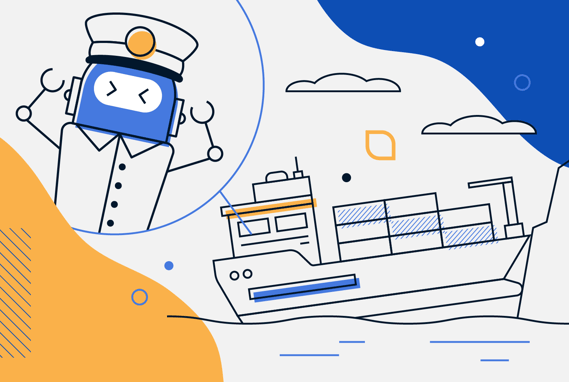
External risk is the kind that makes headlines. The 2021 Suez Canal blockage began when the Ever Given ran aground that March. It closed the canal for six days and held up about $9 billion in global trade each day.
Few companies can do much about a stuck container ship. For most mid-size companies, the procurement risks worth your time are contract and supplier risks, because you can see those coming and act on them with the time and tools you already have.
How to Assess and Manage Procurement Risk in Four Steps
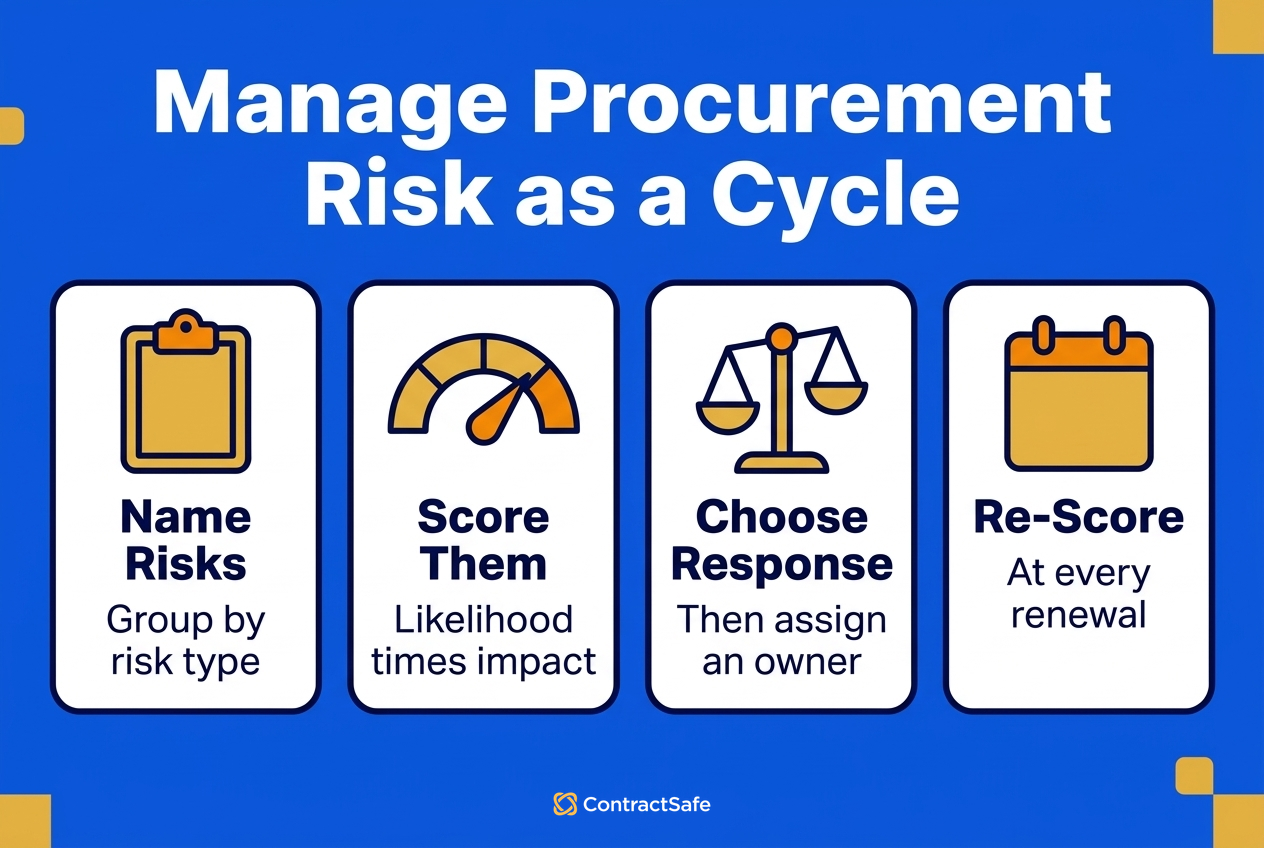
To manage procurement risk, list your risks by supplier and contract, score each one for likelihood and impact, choose a response, and re-score it at every renewal. A named owner and a review date keep the list from going stale.
Run each top-spend or single-source vendor through these four checks:
List the risks. For each supplier and each contract, write down what could go wrong, using the five types as prompts. One vendor might carry a supplier risk (late deliveries), a contract risk (an auto-renewal with no price cap) and an external risk (one factory in one region).
Score them. Rate likelihood from 1 to 5 and impact from 1 to 5, then multiply. Anything that scores 15 or higher gets a named owner this quarter.
Choose a response. Pick one of four:
- Avoid: change the supplier, or change the terms before you sign.
- Mitigate: add a backup source, set alerts on key dates or schedule audits.
- Transfer: shift the cost to someone else through insurance certificates, indemnity, liquidated damages, service level agreements (SLAs) and termination rights.
- Accept and monitor: when mitigation would cost more than the impact, write that decision down and keep watching.
Review. Re-score every risk at each renewal and after any supplier incident, such as a missed delivery or a security breach.
If you're unsure which mitigation to reach for first, procurement leaders favor backup sources. In Deloitte's 2025 Global Chief Procurement Officer Survey, 74% named maintaining active alternative sources as a way to mitigate risk, ahead of seeing further into the supply chain (64%) and sharing more information with suppliers (61%).
Who Owns Each Risk, and How Often to Review It
A risk register only works as a control when every high-score risk has one named person behind it. Make that the person closest to the vendor, often the budget holder, and give them the contract, the score and the next review date. The risk's owner sets the review calendar: at each renewal, and sooner when something goes wrong.
Transfer levers only work if someone can find them later. An insurance certificate that expired last spring or an SLA nobody measures protects no one, so track expiry dates and service levels with the same care as the renewal date.
1. Human Error
Human error is an operational risk: someone types the wrong figure, files a contract in the wrong place or gives access to the wrong person. The more of your procurement process runs by hand, the more of these you'll see:
- Typing in incorrect product codes
- Misfiling a contract
- Misplacing or scattering contracts
- Giving the wrong people access to contracts
The solution: Have a second person check product codes, amounts and dates against the paperwork before anything goes into your systems.
Even better, keep contracts in a digital system with search features like optical character recognition (OCR), so a contract filed in the wrong place still turns up when you search for it.
2. Poor Vendor Management
Poor vendor management is a supplier risk: as your vendor list grows, nobody keeps a full view of how each one performs, what it bills and when its contract renews.
A couple of reliable vendors are easy to watch. Dozens aren't, especially when the team managing a vendor day to day isn't the team that negotiated and signed the contract, and doesn't know what to look for when auditing purchases, approvals and payments.
The gaps show up as:
- Unforeseen expenses
- Missed opportunities
- Contract renewals you'd rather have let lapse
The solution: Instead of poring over every piece of paperwork that lands on your desk, use software to set up an audit process for vendors. Generate performance reports and review them often, so issues surface before the renewal does.
3. Unreliable or Failing Suppliers
An unreliable or failing supplier is a supplier risk: a vendor that can't deliver on its contract, or one heading for financial trouble. Either way, your costs rise and your schedule slips.
Watch for these warning signs:
- Late deliveries two quarters running
- Sudden changes in pricing
- Inconsistent quality
- Demands for new payment terms, such as larger deposits or faster payment
Many companies don't plan for a supplier failing: in EY's 2023 Global Third-Party Risk Management Survey, only 48% of organizations had an exit strategy or contingency plan for their high-risk third parties.
The solution: Vet each supplier before you sign, and use more than one where you can. Write the exit plan, including who you'd switch to and how fast, before you lock in the vendor contract.
4. Contract Noncompliance
Contract noncompliance is a contract risk: your business fails to meet terms it signed, often because circumstances changed or someone misread what the contract requires. It isn't always deliberate, and unfavorable terms don't get you out of it.
Noncompliance carries serious consequences, like:
- Financial fallouts
- Legal disputes
- Run-ins with regulators
The solution: Make sure both parties understand the terms before signing, and document any change in writing. Then follow the contract closely with contract management software, which:
- Sets up automated notifications for key events
- Gives the right people access to the right contracts
- Simplifies regular audits
- Minimizes mistakes caused by manual data entry
If a breach does occur, act fast to limit the damage.
5. Ineffective Contract Management
Ineffective contract management is a contract risk: the deal gets signed and then forgotten, so obligations and dates slip by unnoticed while value quietly drains out of the agreement.
The losses add up. WorldCC's Closing the procurement value gap report found 11% value erosion in procurement contracts.
It gets harder as the contract count grows. The usual failure points are:
- Lost contracts
- Missed obligation dates
- Working from the wrong version
The solution: Track every procurement contract in one place, with its key dates, owner and obligations recorded when it's signed. Good tracking sends reminders before deadlines and makes the signed version the one everyone finds. It should also be quick to set up, because procurement managers don't have months to spend on an implementation project.
6. Vendor Price Creep
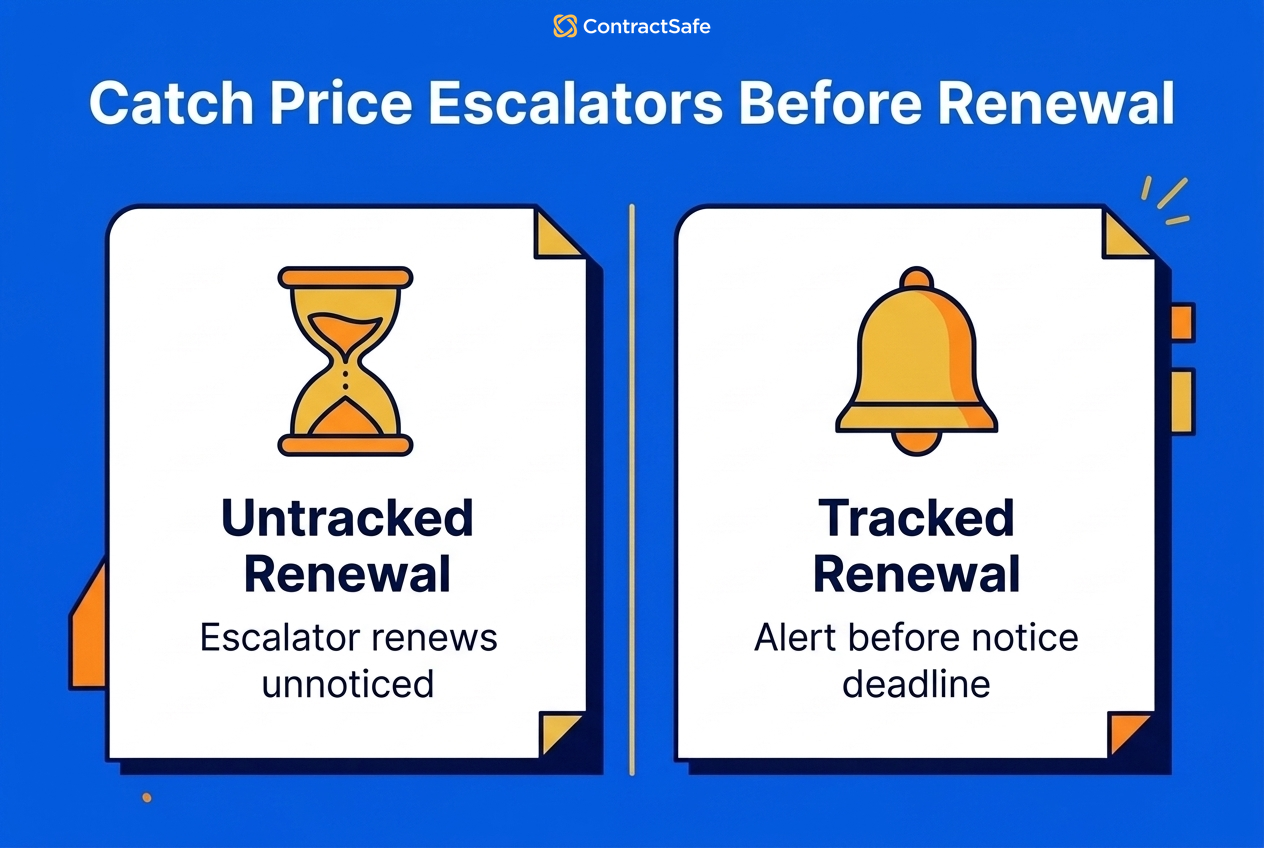
Vendor price creep is a financial risk: costs climb at renewal or mid-term, often through terms nobody reread. It's easy to miss when your team can't see the contract or is missing key information when the renewal comes up.
Price increases can come from many directions, and not all of them are spelled out in last year's contract. Common causes include:
- Inflation
- Rising shipping costs
- Increasing producer prices
- General expense increases
The solution: Use the contract itself to control the increase:
- Cap escalators. Negotiate a fixed percentage or an index-linked ceiling on annual increases instead of leaving price changes open.
- Track notice windows and renewal dates. Know when the window to give notice closes, well before the contract renews on its own.
- Decide at each renewal. Compare the quote with current market pricing, then either renegotiate or accept the increase on purpose.
Before each renewal, make sure everyone involved has the same data, so finance, procurement and the budget holder aren't working from different numbers.
7. Supply Chain Disruptions
A supply chain disruption is an external risk: something outside your company's and your supplier's control stops goods or services from arriving. You can't prevent a blocked port or a storm, but you can plan so one doesn't stop your business.
Disruptions can come from:
- Political instability
- Natural disasters
- Factory closures
- Cyberattacks
- Blocked trade routes
- Pandemics
Only about a quarter of firms say they can reliably identify and predict supply disruptions in time, per Deloitte's 2023 Global CPO Survey.
Before a disruption hits, check which supplier contracts carry a force majeure clause and what it covers, so you know whether a late supplier owes you anything.
The solution: Plan for disruption before it happens. Three steps reduce the impact:
- Diversify your suppliers: Having multiple suppliers means you're never left without a part you need to finish your product.
- Build up extra inventory: If you're able to, a stockpile of materials can carry you through a crisis.
- Create a contingency plan: A backup plan helps you respond when something goes wrong, and it settles in advance which suppliers take priority and where resources go.
8. Unethical Sourcing
Unethical sourcing is a supplier and external risk: buying from suppliers, countries or entities with human rights abuses, poor environmental track records or unsavory political practices. The risk falls under ESG (environmental, social and governance), which has become a top priority for investors and so for businesses and their suppliers.
Falling short on ESG can do real damage to a company's reputation. Buyers are watching it too: in Amazon Business's 2022 State of Business Procurement Report, 63% of business buyers said improving sustainability in their purchasing practices is a top goal.
The solution: Find a supplier's ESG risks before you sign, then hold them to standards in writing:
- Run due diligence on each potential supplier's practices.
- Write a supplier code of conduct and make every supplier sign it.
- Add ESG compliance clauses to the contract, so a breach gives you grounds to act.
- Back it up with detailed supplier management policies.
9. Poor Planning and Inaccurate Forecasting
Poor planning and inaccurate forecasting are operational and financial risks: plans and cost forecasts built on stale data. The result is missed deadlines and budgets that don't hold, plus no reliable way to check whether you're being quoted a fair price.
A forecast that misses a seasonal spike leaves you short of stock just when demand peaks, and customers who can't buy from you may not come back.
Forecasts usually go wrong for a handful of reasons:
- Not taking into account changes in customer behavior
- Not considering new product launches or discontinuations
- Not factoring in changes in seasonality
- Outdated data or methodology
- Not being able to get reports when needed
The solution: Build plans you can realistically deliver, with a backup if things don't work out. Then track them against deadlines and budget, and re-forecast when the numbers move.
That only works if your data is current and you can pull reports when you need them, instead of rebuilding figures from spreadsheets each quarter. Performance and status reports show which factors move your costs most, so you can adjust your procurement plans to match.
10. Supplier Cybersecurity and Data Breaches
Supplier cybersecurity is a supplier and external risk: any vendor that holds your data or connects to your systems is a path an attacker can use to reach you. A breach at the vendor can quickly become your breach.
In EY's 2023 Global Third-Party Risk Management Survey, respondents ranked cybersecurity and digital risk as the top third-party risk domains.
The solution: Write security requirements and breach-notification deadlines into every contract with a vendor that touches your data. Ask for the vendor's cyber insurance certificate and track it to expiry, since a lapsed certificate covers nothing. Inside your own team, limit who can open sensitive contracts to the people who need them.
11. Incorrect Needs Analysis
Incorrect needs analysis is an operational risk: you buy something that doesn't fit what the team actually needs. The mistake often happens when the person buying a tool or service isn't the person who'll use the tool every day.
In cases like these, buyers often pick whatever has the most features. After all, the more features something has, the better it has to be, right? Not always. Plenty of products come loaded with features that justify a high price but don't help with the work in front of you.
Red flags include:
- Jargon, and lots of it
- Big numbers you aspire to but may never reach
- A demo that never shows the product handling your team's own work
The cost shows up later: staff time spent learning features nobody needs, and budget that could have gone somewhere better.
The solution: Ask the people who'll use it what they need, and bring them into the buying process.
Related Reading
- How procurement contract management works
- Contract management software adoption statistics
- How to manage procurement risk with contract management
How ContractSafe Helps You Manage Procurement Risk
ContractSafe is a full-lifecycle CLM, so procurement can run requests, approvals, signature and the dates and obligations that follow in one place. Approval sequences and unlimited native e-signatures come with the Finalize and Maximize plans, and custom intake forms with Maximize.
Access is set by folder, tag, user and group, so a budget holder sees their own vendors' contracts and nothing else. Saved reports can be emailed on a schedule, which puts the upcoming renewals in front of finance and procurement before the quarter starts. Reminders can also go out on any custom date, such as the day a vendor's insurance certificate expires.
Every plan includes unlimited users, so requesters and approvers don't need seats. Pricing starts at $450/month on the Organize plan, billed annually, and onboarding, migration of your existing contracts and a dedicated customer success manager come with every plan, with no implementation fee.
To see it with your own vendor contracts, book a demo.